Norway
Pledges And Targets
Summary table
Paris Agreement target
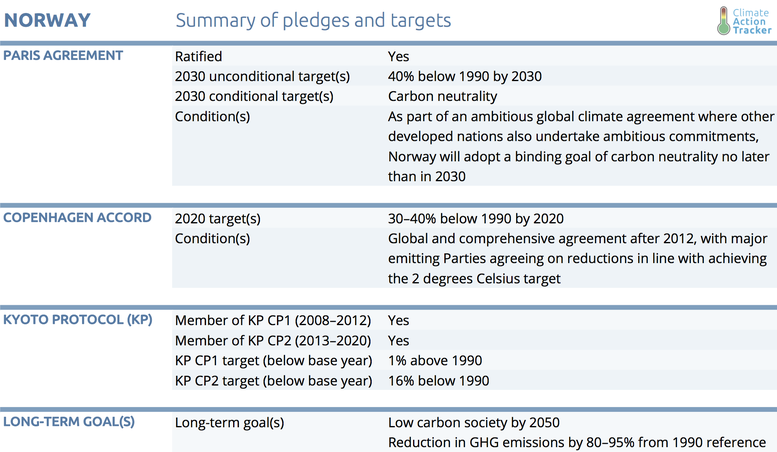
Norway signed and ratified the Paris Agreement on 20 June 2016. Since Norway made no new submissions, its INDC (submitted in March 2015) automatically became its NDC. The NDC states the goal of reducing emissions by at least 40% below 1990 by 2030 (UNFCCC, 2015).4This stated goal is in the third biennial report submitted by Norway, and has been legally mandated by the Norwegian parliament (Norwegian Ministry of Climate Change and Environment, 2018).
Norway’s current intention is to fulfil its commitment collectively with the EU. The European Commission has proposed a preliminary target for Norway for emissions reductions in sectors outside the EU Emissions Trading System of 40% by 2030 below 2005 levels. Final targets remain subject to further calculations by the Commission (Ministry of Climate and Environment, 2016). The target is based on Norway’s high GDP relative to other European countries (both Luxembourg and Sweden have also been given reduction targets of 40%).
Although the base year for Norway’s NDC is set with respect to GHG emissions excluding LULUCF in 1990, Norway intends to use the land-use, land-use change and forestry sector to achieve its emissions reduction. Its NDC submission states that the 40% reduction commitment includes additional measures in the land sector, but the ‘final choice of land sector accounting shall not affect the ambition level for 2030.’ The exact meaning of this statement, however, is unclear, and open to quite different interpretations.
In this assessment, based on the information in the NDC, we interpret the meaning of the LULUCF approach as the following: the 40% reduction commitment is compared to 1990 GHG emissions excluding LULUCF, and this metric is to be achieved irrespective of the additional measures taken in the land sector. This approach is justified by Norway’s statement that the final choice of land sector accounting will not affect the ambition level compared with the case where this sector is not included.
According to Norway’s NDC, the LULUCF sink will grow from 10.1 MtCO2e in 1990 to 21.2 MtCO2e in 2030. The NDC submission text (footnote 2 of the text) suggests that only reductions in addition to those in the base year and those already projected can be counted as credits toward meeting the 2030 target. However, the supporting text is not completely clear as to how Norway will incorporate the LULUCF sector into the final target, and the conditions described in the NDC submission make it difficult to evaluate the assumed contribution of this sector. The submission states that if the projected increase in the sink between 1990 and 2030 (11.1 MtCO2e) were credited, the 2030 target would be recalculated so that the ambition level does not change. We estimate that this would mean that Norway would need a target of about a 60% emissions reduction below 1990 levels (including. LULUCF) to produce the same outcome of a 40% emissions reduction without LULUCF.
Norway’s NDC also includes a conditional element with regard to its target of carbon neutrality; “as part of an ambitious global climate agreement where other developed nations also undertake ambitious commitments, Norway will adopt a binding goal of carbon neutrality no later than in 2030.” The NDC specifies “that Norway will commit to achieving emission reductions abroad equivalent to Norwegian emissions in 2030.” In June 2016 the Norwegian government approved the goal of achieving climate neutrality by 2030 through “the EU emissions trading market, international cooperation on emissions reductions, emissions trading and project-based cooperation” (“Komiteens tilråding,” 2016). Given that Norway includes its LULUCF sink in this target definition, we assess this target as being equivalent to emissions of ~21.2 MtCO2e in 2030 excluding LULUCF.
2020 pledge and Kyoto target
Kyoto Protocol second commitment period (2013–2020)
Norway's target under the Kyoto Protocol’s second commitment period (2013–2020) is to reduce average GHG emissions (excluding LULUCF) by 16% (QELRO1 of 84) below 1990 levels, equivalent to about a 41% reduction in the year 2020, taking into account the emissions from 2013 and 2014, and assuming a linear pathway reduction from current levels2. Under the Kyoto Protocol’s Land Use Change and Forestry accounting provisions, CAT estimates that Norway is likely to get an annual credit equivalent to about 1.7–3.4% of 1990 GHG emissions excluding LULUCF over the period 2013–2020. This would result in a 26–39% reduction of GHG emissions excluding LULUCF in the year 20203. The actual level of domestic emissions reductions would also depend upon emissions trading and the level of Joint Implementation (JI) and CDM (CER) units acquired or held.
With currently implemented policies and measures, Norway’s emissions are expected to increase by around 10% above 1990 levels in 2020 in GHG emissions excluding LULUCF, reaching emissions of roughly 52 MtCO2e by 2020. According to these projections, Norway will not be able to meet its Kyoto target (see figure) without acquiring emission units internationally or introducing new policies. National policy is to reduce two thirds of its GHG emissions domestically and to purchase emissions units for the rest, to the tune of up to 30 million credits during the Kyoto Protocol second commitment period.
Copenhagen Pledge
Prior to adoption of the Kyoto Protocol second commitment period target, in 2010 Norway pledged to reduce emissions by 30–40% below 1990 levels by 2020 with the 40% reduction target conditional on global action.
Long-term goal
Norway’s long-term goal is to become a low emissions society by 2050, a goal that Norway has agreed to try to fulfil by 2030. Norway also aims to achieve this through the EU emissions trading market, international cooperation on emissions reductions, emissions trading and project-based cooperation. The goal to achieve carbon neutrality by 2050 has now been quantified as a 80–95 % reduction in GHG emissions from 1990 levels (Norwegian Ministry of Climate Change and Environment, 2018).
Footnotes
1 | The QELRO, expressed as a percentage of Kyoto Protocol Annex I GHG emissions and sources in relation to the base year, denotes the average level of emissions that an Annex B Party could emit annually during a given commitment period.
2 | Starting with reported Kyoto Annex A emissions in 2012 and assuming a linear decline in these emissions until 2020 so that cumulative emissions in 2013–2020 are equal to the total Kyoto assigned amount based on the QELRO.
3 | Assuming that the LULUCF credits are effectively added to the QELRO and starting with reported Kyoto Annex A emissions in 2012, with a linear decline in these emissions until 2020 so that cumulative emissions in 2013-2020 are equal to the total Kyoto assigned amount based on the QELRO plus the LULUCF credits.
4 | The base year emissions specified in the NDC are all greenhouse gases not controlled by the Montreal Protocol and in effect Kyoto Annex A sources - Energy; industrial processes and product use; waste.
5 | In the NDC it is stated that “If it can contribute to a global and ambitious climate agreement in Paris, Norway will consider taking a commitment beyond an emission reduction of 40% compared to 1990 levels, through the use of flexible mechanisms under the UN framework convention beyond a collective delivery with the EU.”
Further analysis





Latest publications







Stay informed
Subscribe to our newsletter