Rescuing shipping's Net Zero Framework
Impact of adopting the Net Zero Framework
by Michael Petroni & Finn Hossfeld
In October 2025, the International Maritime Organization (IMO) failed to adopt the Net Zero Framework (NZF) measures agreed earlier that year, instead postponing the decision to April 2026 following pressure from the US and Saudi Arabia.
The NZF would have marked a major milestone in decarbonising international shipping, introducing a global fuel emissions standard alongside a market-based mechanism to reduce the sector’s emissions.
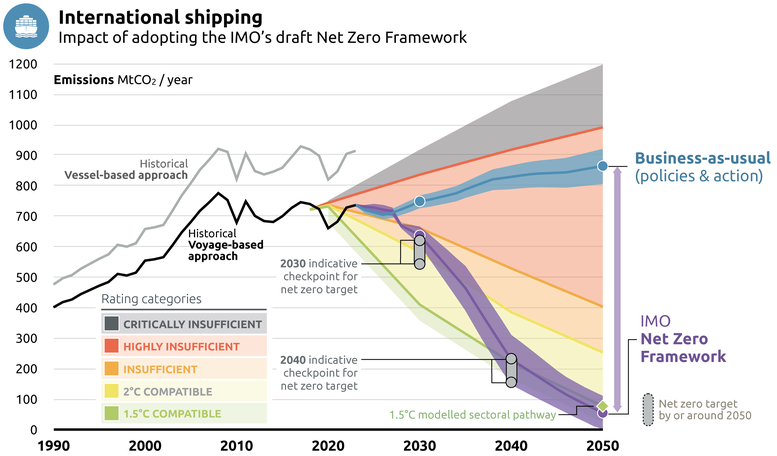
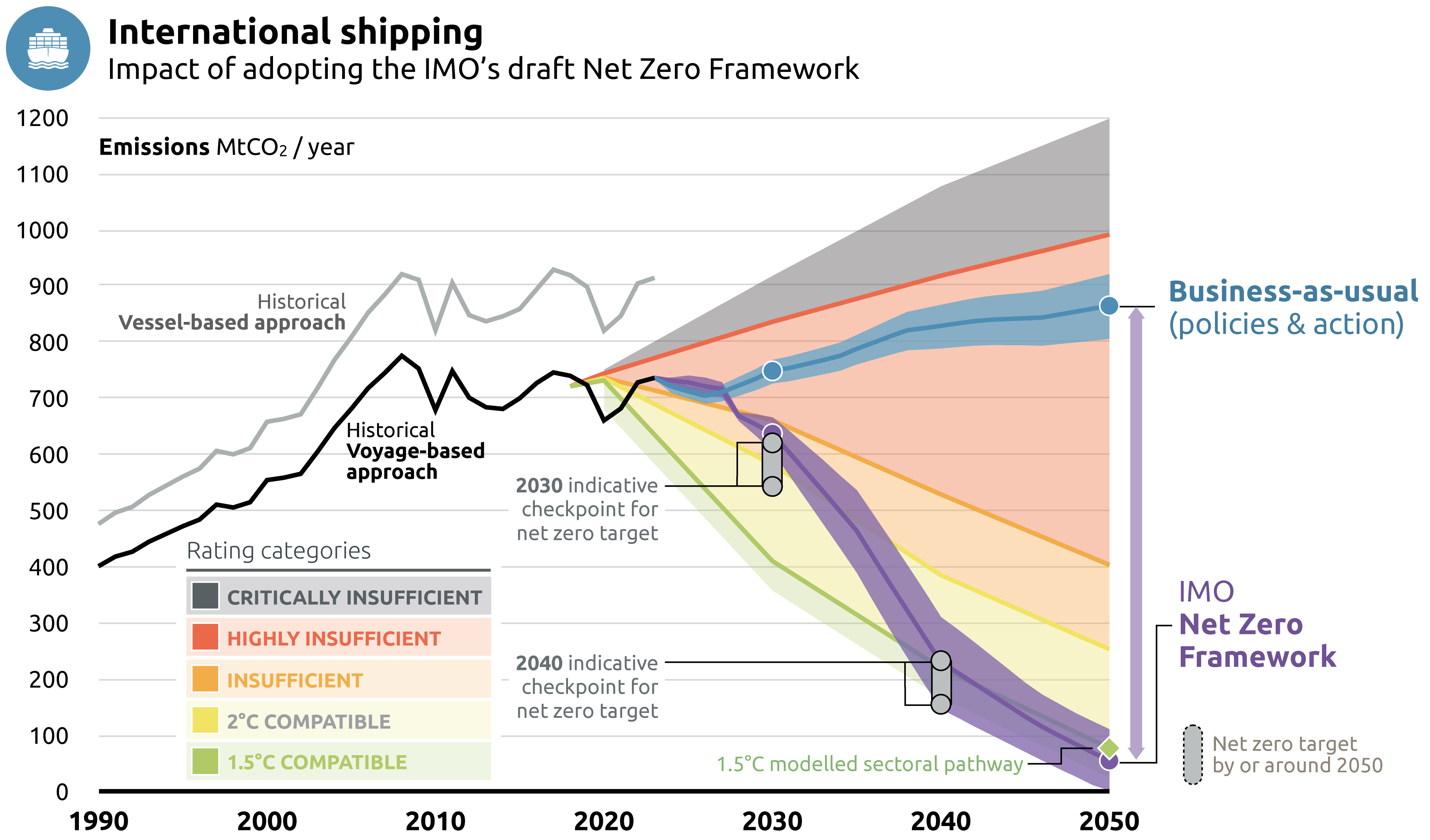
The Climate Action Tracker (CAT) finds that the IMO's adoption of the NZF could decide whether the shipping sector's emissions would be consistent with global temperature rise being held near 2°C by 2050—or allowed to drift toward 4°C under a business-as-usual trajectory. Ahead of MEPC 84 in April 2026, positions are divided, with submission of proposals from member states showing that many countries support adopting and, in some cases, strengthening the NZF, particularly Small Island Developing States (SIDS) and Least Developed Countries (LDCs). Others seek to further weaken the NZF, which would derail the transition to zero emission fuels, while the US remains totally opposed to the framework.
The world is likely to overshoot a 1.5°C global average temperature increase by 2030 or in the early 2030s, as global emissions have not been falling fast enough. Urgent action is required now to reduce emissions to minimise the magnitude and duration of any overshoot. Recent research shows that the highest possible ambition, if implemented immediately, can limit peak warming close to 1.7°C and reduce warming to well below 1.5° by 2100. The world needs to intensify its efforts to bring temperatures back below 1.5°C and achieve net zero emissions as soon as possible in the second half of the century, in line with the objectives of the Paris Agreement.
While not aligned with 1.5°C, the NZF in its current form is the IMO’s most ambitious emissions reductions mechanism to date. The NZF would be a crucial tool for driving zero-emissions fuel uptake and reaching net zero emissions by 2050. Without the NZF, shipping emissions are expected to continue increasing through to 2050. Governments pushing to further weaken the NZF—through lower carbon pricing, broader flexibilities, or the removal of the IMO Fund that supports accelerating zero emission fuel uptake and enabling a just and equitable transition—risk significantly delaying progress towards net zero emissions.
In its current form, the NZF would improve the sector’s CAT rating from “Highly Insufficient” to “Insufficient” in 2030, consistent with warming between 3°C and 4°C by the end of the century, if all sectors followed the same level of ambition. Achieving 1.5°C would require emission reductions of at least 47% by 2030 below 2008 levels. If adopted, the NZF is projected to reduce emissions by 14–22% by 2030 below 2008 levels, bringing the sector closer to the IMO’s minimum emissions reductions target of “at least 20%” for 2030 but still far short of the highest-ambition 30% emissions reductions target.
By 2050, the current NZF would contribute to even deeper emission reductions, improving the prospects of limiting global temperature rise to 2°C. Any residual emissions from international shipping would need to be counterbalanced by durable carbon dioxide removals (CDR). If stronger fuel standard targets are set beyond 2035, the NZF could be 1.5°C compatible by 2050.
Although an important step in the right direction, the NZF’s design risks locking in LNG, increasing reliance on biofuels, and delaying the transition to zero-emission fuels. The ambiguity in the target’s formulation of reaching net zero “by or around” 2050 creates significant uncertainty about the sector’s residual emissions.
Recommendations
To begin to bring the shipping sector into alignment with the Paris Agreement, members of the IMO would have to:
- Vote to pass the full NZF in November 2026, the draft of which was already agreed to in April 2025. At the very least, member states should maintain the draft NZF’s carbon pricing and IMO Fund components.
- Increase carbon pricing and penalties to help move closer to raising the estimated USD 95bn needed annually to transition global shipping fleet to zero emission fuels.
- Increasing the stringency of GFI emission intensity base targets and develop stronger life cycle assessment (LCA) standards for zero and near-zero-emission (ZNZ) fuels to prevent the uptake of LNG and limit the role of biofuels, ensuring that biofuels are sourced from sustainable feedstocks and do not contribute to deforestation and food insecurity.
- Develop equitable transition financing scenarios that allocate the NZF’s revenues not only fairly, but strategically also support zero emission fuel uptake.
Further information
Stay informed
Subscribe to our newsletter