Historical Progress
Progress since Paris
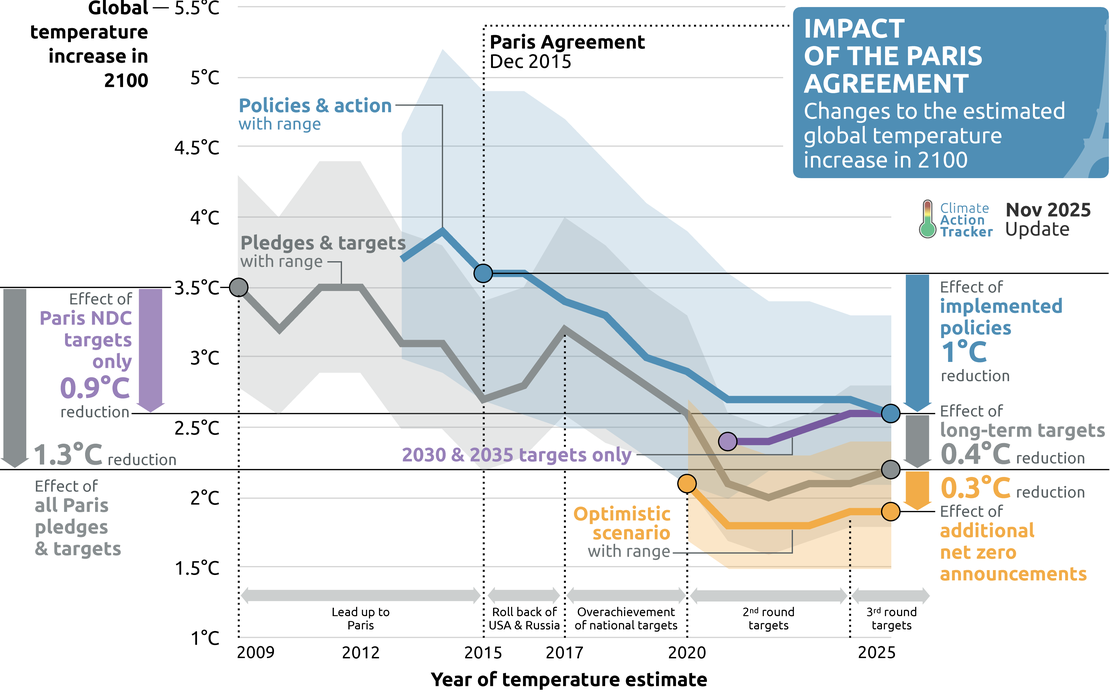
The 2015 Paris Agreement was negotiated six years after the failed climate talks in Copenhagen in 2009. High-level diplomatic efforts helped bridge deep political divides – especially among major economies with contrasting histories, emissions profiles, and levels of development – and sought to address the unique vulnerabilities of small island states, least developed countries and other affected nations.
The Paris Agreement aims to limit global warming to 1.5°C and reach net zero greenhouse gas emissions worldwide in the second half of this century. The 2025 International Court of Justice Advisory Opinion on climate change anchors the 1.5°C temperature limit as the central target of the Paris Agreement for all countries, noting they are obligated to work towards the highest possible ambition for their national determined contributions (NDCs).
With overshoot of 1.5°C likely by 2030 given the lack of action to date, it’s important to recognise that the 1.5°C limit remains the scientifically grounded and legally significant temperature goal. The 1.5°C limit emerged from post-Copenhagen negotiations, which found that the former 2°C goal was unsafe. Since 2015, the IPCC and a growing body of scientific research have reinforced the benefits and urgency of the 1.5°C threshold. It is now seen as a key planetary boundary beyond which extreme events and tipping points will become very dangerous.
Alongside the Paris Agreement’s net zero goal, the 1.5°C limit provides the scientific and technical basis to designing policies that will limit the magnitude and duration of any temporary overshoot of 1.5°C, while driving global emissions down to net zero as fast as possible.
The CAT has been tracking the impact of government targets and policy action against end-of-century global warming since Copenhagen in 2009. In line with the objectives of the Paris Agreement, countries submitted Nationally Determined Contributions (NDCs) and Long-Term Strategies (LTS) that should embody their “highest possible ambition” to align with the 1.5°C temperature limit.
Our analysis shows that the Paris Agreement works
Since the Paris Agreement’s adoption in 2015, our global warming estimates for 2100 have decreased for both targets and policies. However, progress has stalled in recent years and, collectively, these efforts are still insufficient.
Ten years on, in 2025, the world is not on track to meet the long-term temperature goal of the Paris Agreement.
The figure above captures the entire history of our CAT thermometer for end-of-century warming estimates for our different scenarios:
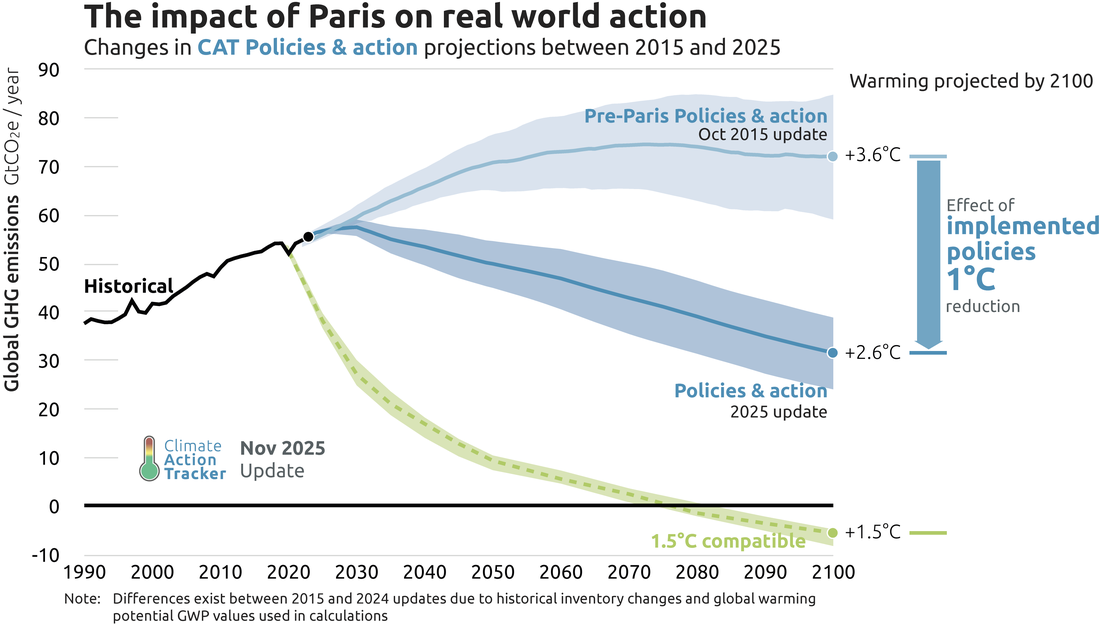
- The Policies & action scenario best reflects the warming we're heading to, as it includes the impact of policies that governments are currently implementing. It’s considered the most realistic scenario. Since the Paris Agreement, warming projections for this scenario have gone down from 3.6°C to 2.6°C.
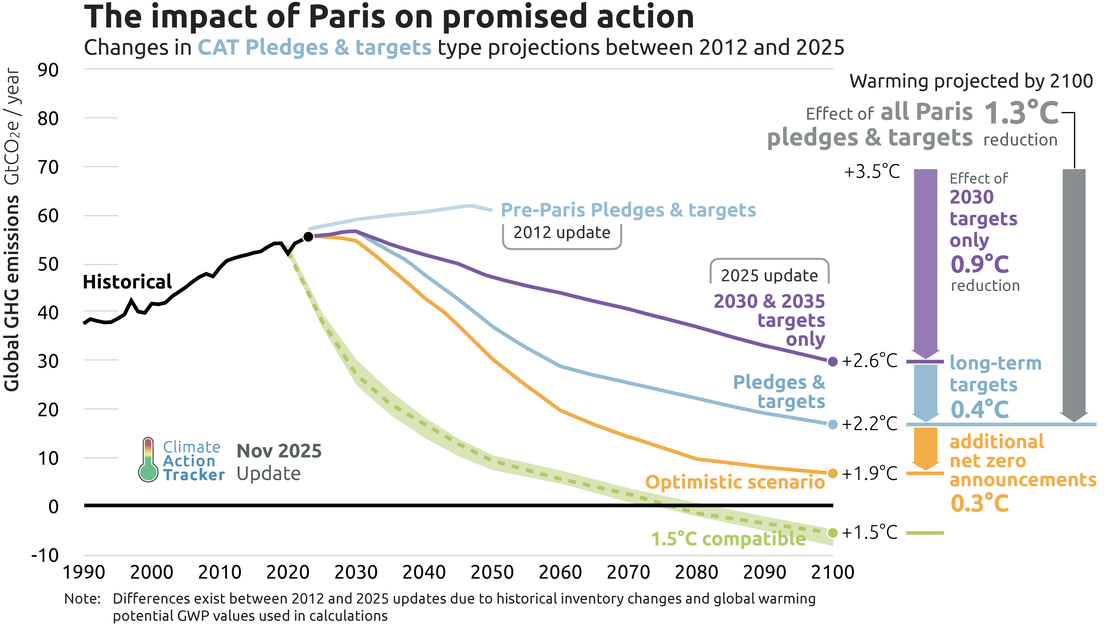
- The short-term NDC targets contained in 2030 targets only scenario have driven projected warming down from the 2012 estimate of 3.5°C to 2.6°C.
- The impact of announced long-term targets such as net zero targets is included in our Pledges & targets scenario, which drives this down a further 0.4°C to 2.2°C.
- While factoring in all announced but not submitted targets contained in our Optimistic scenario brings projected warming down an additional 0.3°C to 1.9°C.
CAT policies & action scenario
Significant advances in real world action, but more effort needed
In 2015 ahead of COP21 in Paris, the CAT estimated that current policies would lead to 3.6°C of warming at the end of the century. Six years later, by 2021, progress had brought these numbers down: warming under current policies was projected at 2.7°C, which reflects significant progress even if much more is still needed to achieve the emissions cuts required for 1.5°C.
From then onward to 2025, the projected warming under government Policies & action is virtually unchanged at 2.6°C: we have reached a standstill.
The impact of NDC and net zero targets
Net zero targets appear to put Paris within reach, but achieving this is highly questionable
The years leading up to the 2015 Paris Agreement saw momentum building through the announcement of numerous targets from various governments, later to be collectively known as intended NDCs (iNDCs). Our 2012 update, where we projected 2100 warming of 3.5°C under our Pledges & targets scenario, best captures the pre-Paris baseline in terms of government targets.
Overall, the effect of all pledges and targets such as NDCs and long-term targets, if achieved, has driven down projected warming estimates by 1.3°C. This even reaches 1.6°C if all net zero announcements were to be included (see our Optimistic scenario). This represents the vision, but so far, governments have not implemented enough policies to achieve all of their pledges and targets.
Further information
For more results linked to our most recent Global temperature update see:
- Our full global temperature update briefing
- CAT thermometer
- Emissions pathways to 2100
- Emissions gaps for 2030
For the latest on NDC updates, please refer to our Climate Target Update Tracker as well as our briefing detailing our 2030 and 2035 NDC target recommendations for major emitters to align to 1.5°C. For the latest in country developments, see our country assessments.
For more information on the global emissions and temperature pathways and how they are calculated, please refer to our methodology section.
If you use the provided data or any of the graphs provided on this website, please use the suggested citation below:
- Climate Action Tracker (2025). Historical progress: Improvements to the CAT global temperature estimates over time. November 2025. Available at: https://climateactiontracker.org/global/historical-progress/
Copyright ©2025 by Climate Analytics and NewClimate Institute. All rights reserved.
Last update: 30 November 2025
Stay informed
Subscribe to our newsletter