
South Korea
Net zero targets
Summary
We evaluate the net zero target as: Average.
After former President Moon Jae-in announced South Korea’s goal of becoming carbon neutral by 2050, the government also included this commitment in its updated 2030 NDC and its Long-Term Strategy (Republic of Korea, 2020, 2021c). The carbon neutrality target was enshrined in law through the Carbon Neutrality Act, passed in August 2021 (Ministry of Climate, Energy and Environment, 2021) and enforced in March 2022 (Ministry of Climate, Energy and Environment, 2022).
In October 2021, South Korea published the 2050 carbon neutrality scenarios, outlining potential pathways to reach net zero emissions (Republic of Korea, 2021b). Improving on the LTS, the 2050 pathways explicitly state the net zero target does not include overseas reductions. However, South Korea is still not explicit in its coverage of GHGs, and the target review process lacks detail.
Both scenarios phase out coal before 2050, although the exact phase-out year remains unclear. One of the scenarios also phases out fossil gas. The other one allows for some fossil gas, and has a higher amount of CCUS to compensate for emissions. Both scenarios assume a sink of about 25 MtCO2e from forestry in 2050.
The South Korean government faces criticism over its lack of comprehensive planning for achieving carbon neutrality. Part of the Carbon Neutrality Act was deemed unconstitutional by the South Korean constitutional court in August 2024. The government is required to “enact revised legislation” by March 2026 and set yearly emission reduction targets for the 2031–2049 period.
The government has faced criticism in the past for its slow pace in advancing climate legislation. In August 2023, out of 291 proposed climate-change-related bills, only 33 had been passed (Kyunghyang Shinmun, 2023). Legislative momentum has increased more recently following the establishment of the Ministry of Climate, Energy and Environment, which consolidates climate and energy policymaking under a single ministry, is expected to support more coordinated decision-making and could help drive further legislative and policy action on climate (Kang, 2025).
CAT now evaluates the comprehensive of the net zero target as “Average”. The government has yet to make the emissions coverage explicit, a prerequisite for an overall evaluation of “Acceptable”.
CAT analysis of net zero target
Scope
- Target year – South Korea aims to reach net zero emissions by 2050.
- Emissions coverage – South Korea provides no explicit information on the target’s emissions coverage. South Korea aims to achieve ‘carbon neutrality’ by 2050 – a term which typically means net zero CO2 emissions (IPCC, 2018). However, in its LTS and 2050 carbon neutrality scenarios, the government lists methane reduction measures and presents targets in units of CO2 equivalents (MtCO2e). The Korean Government would need to be explicit about the emissions coverage for the rating of this element to change. For the quantification of the 2050 target value CAT assumes a coverage of all gases (see assumptions section).
- International aviation and shipping – South Korea provide no information on its intention to cover international aviation and shipping.
- Reductions or removals outside of own borders – South Korea’s 2050 carbon neutrality scenarios, published in October 2021, state that its net zero target does not include overseas emissions reductions (Republic of Korea, 2021c).
Target architecture
- Legal status – The carbon neutrality target is included in South Korea’s LTS (Republic of Korea, 2020) and has been enshrined in law through the Carbon Neutrality Act (Ministry of Climate, Energy and Environment, 2021) and enforced in March 2022.
- Separate reduction & removal targets – South Korea’s draft 2050 net zero pathways plan for a LULUCF sink of 25.3 MtCO2e in 2050. The document lists strengthening forest circulation management and expanding afforestation and reforestation but does not reference any specific plans. Earlier in 2021, the Korea Forest Service announced a reforestation plan that could lead to a removal of 34 million tonnes CO2 (Republic of Korea, 2021d). The plan, which aims to log and replant over 70% of South Korea’s mature forests, received a lot of criticism as it is based on a new definition of “old trees” and contested research on the lifetime carbon absorption of trees (Bang-Hyun & Kim, 2021; KFEM, 2021; Macdonald, 2021). Activists also comment that the estimate of 34 million tonnes CO2 removal is highly inflated (KFEM, 2021).
- Review process – In its LTS, South Korea states it will regularly review and update its carbon neutral strategy (Republic of Korea, 2020). The Carbon Neutrality Act states that the government will set a medium and long-term greenhouse gas emission reduction target of reducing national GHG emissions by at least 35% by 2030, below 2018 levels [ref, Art 8(1)]. In addition, the government will set sectoral reduction targets until 2030 and annual emission reduction targets [ref Art 8(2) and 8(3)]. The Carbon Neutrality Act provides that these targets will be reviewed every five years [ref 8(4)] but does not include an obligation to review the net zero target itself.
Transparency
- Carbon dioxide removal – South Korea’s 2050 carbon neutrality scenarios illustrates two different scenarios to reach carbon neutrality, in which it shows the contribution from different sectors, incl. carbon dioxide removals separately. Both scenarios include sinks from LULUCF, one scenario an additional removal through Direct Air Capture (DAC). The plan outlines South Korea’s strategy for achieving these removal and states that forthcoming carbon pricing policy will be a key policy instrument to facilitate reductions across all sectors.
- Comprehensive planning – The Framework Act on Carbon Neutrality and Green Growth, effective since March 2022, imposes legal procedures and policy measures to achieve carbon neutrality by 2050 (Ministry of Climate, Energy and Environment, 2022). The implementation mechanism will be based on a national carbon neutrality master plan (i.e. 1st National Basic Plan for Carbon Neutrality and Green Growth), which has a planning period of 20 years (revised every five years), and, aligned with that regions will prepare climate plans every ten years. In August 2024, South Korea’s constitutional court ruled that the lack of legally binding emission reduction targets for the period 2031-2049 places an excessive burden on future generations (Shin & Kim, 2024). The constitutional court ordered the Korean government to amend the Framework Act on Carbon Neutrality and include long-term, yearly carbon reduction targets for the 2031-2049 period by March 2026.
- Clarity on fairness of target – The Korean government has not explained why its net zero target is a fair contribution to the global goal of limiting warming to 1.5°C. The 2050 carbon neutrality scenarios explicitly mention the need for a fair and just transition to a carbon-neutral society, but provides no further details. The document also states that revenues from the forthcoming carbon tax will be used to support vulnerable communities in this transition.
Good practice
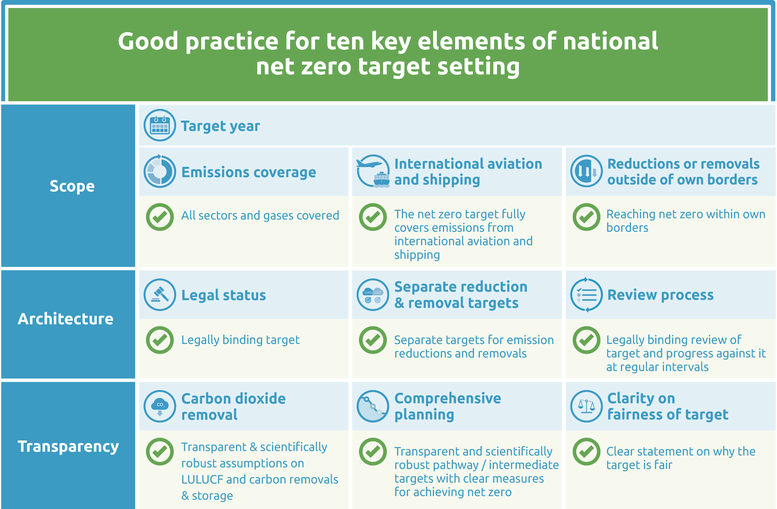
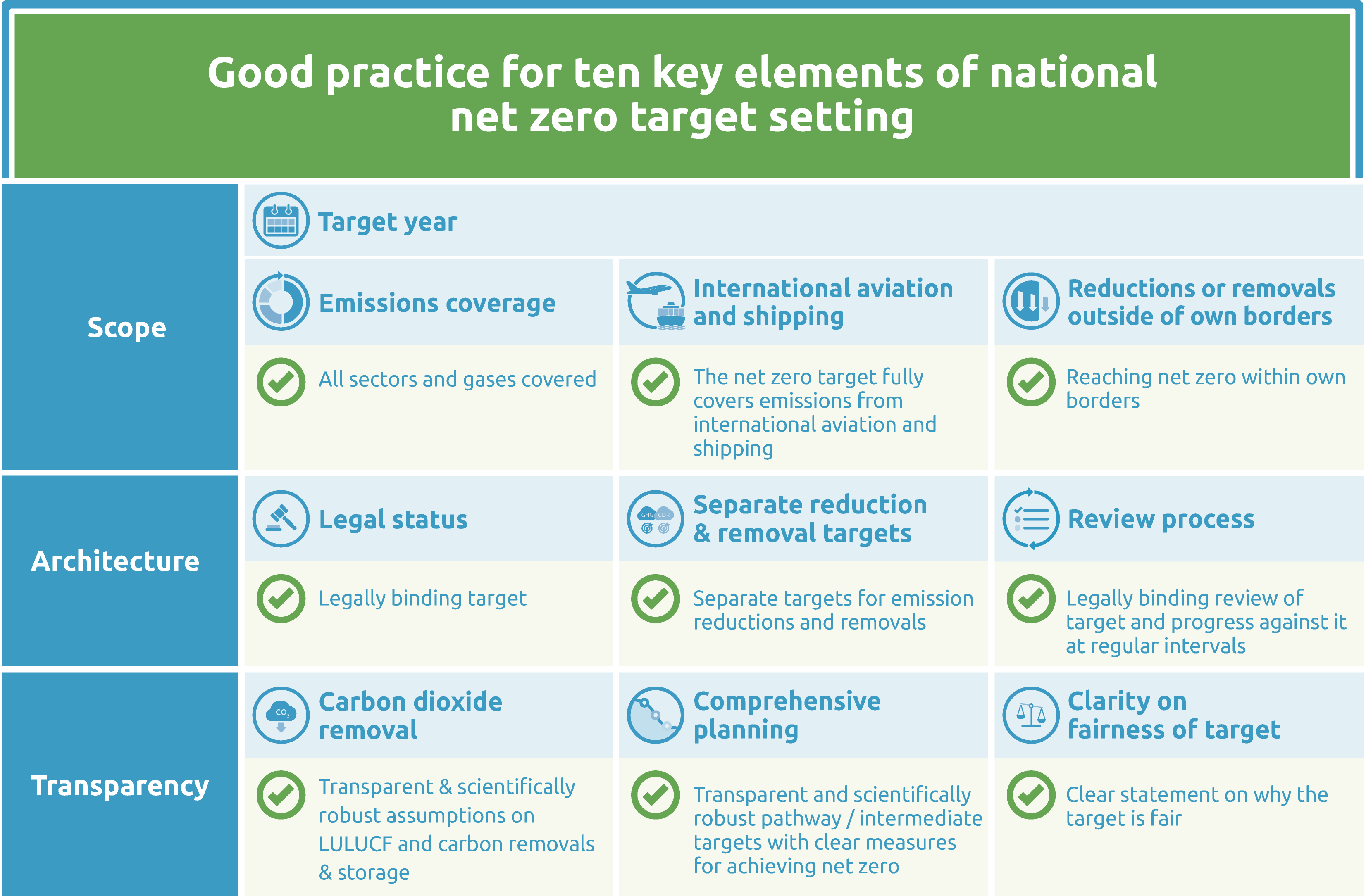
The Climate Action Tracker has defined the following good practice for all ten key elements of net zero targets. Countries can refer to this good practice to design or enhance their net zero targets.
Further analysis





Latest publications




Stay informed
Subscribe to our newsletter