Emissions Gaps
How Far Are We from Meeting Our Climate Goals?
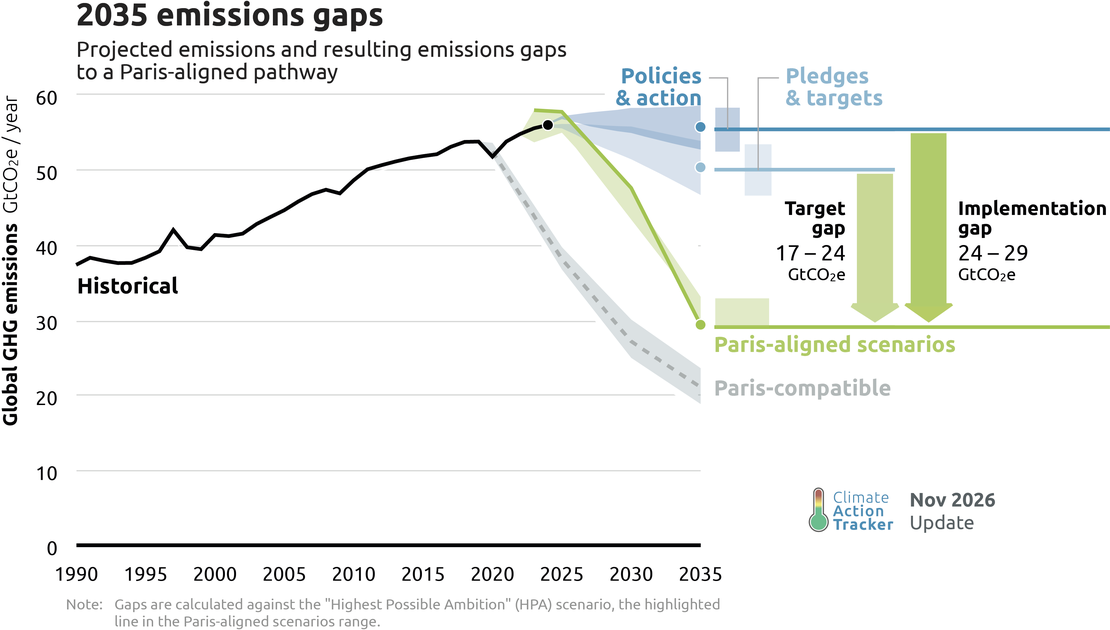
To reflect the current reality that global emissions still have not peaked, and long-term warming is expected to cross the Paris Agreement’s 1.5°C limit around 2030, there is a new generation of emissions pathways which assess how to limit overshoot of 1.5°C. We consider them Paris-aligned, not Paris-compatible.
The CAT assesses the expected absolute emissions in 2035 and compares these with emissions consistent with Paris-aligned pathways. The AR6 Paris-compatible pathways, against which we previously measured this gap, are now out of date: because of the lack of action since 2020, the emissions cuts they assumed can no longer be delivered.
Compared to the Paris-compatible pathway, the Paris-aligned pathway has a higher level of emissions as a starting point, followed by much steeper reductions in the short and medium term towards 2050, and see the need for negative emissions. The longer we wait, the worse the outcomes in terms of climate and the narrower and steeper the path to net zero needs to be.
2035 Emissions Gap
As of November 2026, substantial gaps remain:
- The Target gap: even if all countries met their official 2030 and 2035 climate promises1 and long-term commitments, the world would still fall short of what's needed, by 17–24 GtCO2e in 2035.
- The Implementation gap: current government policies & actions put us even further behind, with a gap of 24–29 GtCO2e in 2035 compared to what would be a Paris-aligned pathway.
Under current policies, we will reach 53-59 GtCO₂e in 2035. This is a far cry from the emissions levels consistent with the Paris-aligned 2025 “Highest Possible Ambition” scenario (HPA-2025)2, which would see emissions halve from today’s levels to around 29 GtCO₂e by 2035 (Climate Analytics and PIK, 2025). This means we need both stronger climate pledges, and much more aggressive climate action.
For further details, please see our latest global temperature update briefing.
Footnotes
1 | For weak targets, we take a country’s estimated 2030 or 2035 level under current policies, if that level is lower than the target.
2 | We compare the ‘Target’ and ‘Implementation’ gaps to the HPA-2025 pathway developed by Climate Analytics and the Potsdam Institute for Climate Impact Research (PIK) (Climate Analytics and PIK, 2025). This scenario shows the highest possible ambition in a wider set of these new Paris-aligned scenarios.
Further information
For more results linked to our most recent Global temperature update see:
For the latest on NDC updates, please refer to our Climate Target Update Tracker as well as our briefing detailing our 2030 and 2035 NDC target recommendations for major emitters to align to 1.5°C. For the latest in country developments, see our country assessments.
For more information on the global emissions and temperature pathways and how they are calculated, please refer to our methodology section.
If you use the provided data or any of the graphs provided on this website, please make sure to reference the Climate Action Tracker and the Climate Analytics / NewClimate Institute team!
Last update: 12 November 2026
Suggested citation
Climate Action Tracker (2026). 2035 Emissions Gap: CAT projections and resulting emissions gap to a Paris-aligned pathway. November 2026. Available at: https://climateactiontracker.org/global/emissions-gaps/.
Copyright ©2026 by Climate Analytics and NewClimate Institute. All rights reserved.
Stay informed
Subscribe to our newsletter