Fossil fuel phase-out: how are governments doing?
Ahead of TAFF: how are participants progressing in their transition away from fossil fuels
by Sarah Heck, Sofia Gonzales-Zuniga, Ana Missirliu & Janna Hoppe
The world has been repeatedly shaken by fossil fuel price spikes, supply disruptions, and geopolitical crises that show how dangerous fossil fuel dependence has become for both the climate and energy security. This current moment - linked to the closure of the Strait of Hormuz - should be seen as a point of strategic clarity. The repeated exposure to fossil fuel shocks is not incidental – it is a direct consequence of structural dependence.
At COP28, governments agreed through the first Global Stocktake (GST1) decision to transition away from fossil fuels and to pursue tripling global renewable energy capacity and doubling the rate of energy efficiency improvements by 2030. These measures, together with cutting methane emissions from the energy sector, would put the world on a path to phase out fossil fuels and substantially reduce projected warming. The Climate Action Tracker analysis shows these key near-term actions could bring 21st‑century warming below 2°C. Yet implementation is lagging: renewables deployment is still too slow, energy efficiency gains are too modest, and fossil fuel production and infrastructure expansion continue largely unabated.
The task now is to translate these GST1 goals into real policies, investment decisions and implementation on the ground. The first International Conference on Transitioning Away From Fossil Fuels (TAFF) in Santa Marta, Colombia, will test whether governments can move from high‑level commitments to concrete national roadmaps.
This blog looks at how a selection of TAFF participants are progressing in their transition away from fossil fuels, and what action they need to take to align with 1.5°C compatible power sector pathways.
A credible roadmap for the transition away from fossil fuels starts with a commitment to large-scale electrification of transport, buildings, and industry, powered by rapidly expanding wind and solar. This directly builds on the GST1 energy goals and must be backed by:
- ramping up investment in electrification and renewable energy deployment
- early retirement of fossil fuel powered plants
- ending fossil fuel subsides and
- ending investment in new fossil fuel production, exploration, and infrastructure.
It also means avoiding new fossil fuel infrastructure lock-in, so short-term energy security responses do not undermine long-term climate and development objectives.
Delivering such a roadmap requires reshaping the electricity system itself. Governments need to plan and finance major upgrades in transmission and distribution grids, strengthen system flexibility through storage, demand-side management and flexible renewables, and reform power market design so that renewable investments are low-risk and affordable. A just transition for workers and communities tied to the fossil fuel economy must be embedded from the outset, with clear strategies for social protection, economic diversification, and participation of affected groups.
Decarbonising the power sector in conjunction with large‑scale electrification of end‑use sectors is the backbone of this shift. The Climate Action Tracker has developed national wind and solar benchmarks that show what a 1.5°C aligned pathway looks like for individual countries. These benchmarks reveal both positive momentum and large remaining gaps, including among key fossil fuel exporters.
Addressing the barriers
Countries transitioning away from fossil fuels, especially developing countries, face serious hurdles such as competing demands for energy access, growing electricity demand, high capital costs, and difficulties accessing finance for adequate power infrastructure, including grids and storage. It is therefore critical that governments clearly set out the investment needs required to bring their transmission and distribution networks up to the level needed for high shares of renewables – and that developed countries provide financial support to help close this gap.
Another challenge for many developing countries that produce and export fossil fuels is the structural dependence of their economies on these revenues for government budgets, foreign exchange earnings and employment.
Global financial institutions can also undermine phase‑out efforts, as Colombia’s experience shows: its decision to halt new oil and gas exploration exposed its reliance on fossil fuel revenues, leading financial markets to view the move as a fiscal risk, weakening its credit outlook, increasing borrowing costs, and contributing to a more volatile currency (see our comment in our recently published Colombia analysis).
Country snapshots
The countries featured in this section play very different roles in the global fossil fuel landscape - from major exporters to fast-moving renewable leaders - but all will be critical to the success of a transition away from fossil fuels. Their recent fossil CO₂ emissions trends offer an important backdrop to understanding how far they have come since the Paris Agreement in 2015 and how much further and faster they need to go.
The table below shows that, for most of these countries, the share of global fossil CO₂ emissions has started to decline signalling that the transition has started. But the pace of change is still far too slow, and absolute emissions from many of these economies remain high.
| Country / Region | 2015 fossil CO2 (MtCO2) | 2024 fossil CO2 (MtCO2) | 2015 share of global fossil CO2 (%) | 2024 share of global fossil CO2 (%) | Change 2015 to 2024 |
|---|---|---|---|---|---|
| Australia | 401 | 387 | 1% | 1.00% | -3.58% |
| Brazil | 528 | 483 | 1% | 1.25% | -9.35% |
| Canada | 563 | 533 | 2% | 1.38% | -5.56% |
| Chile | 82 | 79 | 0% | 0.20% | -3.88% |
| EU27 | 3095 | 2426 | 9% | 6.29% | -27.56% |
| Norway | 46 | 37 | 0% | 0.10% | -22.43% |
| Philippines | 111 | 175 | 0% | 0.45% | 36.50% |
| Türkiye | 388 | 513 | 1% | 1.33% | 24.43% |
| UK | 422 | 313 | 1% | 0.81% | -35.01% |
| Total (listed countries) | 5635 | 4946 | 16% | 12.81% | -13.93% |
| Global total | 35404 | 38599 | 100% | 100.00% | 0.00% |
Below, we take a closer look at how a selection of TAFF participants are doing in terms of their transition away from fossil fuels and what more is needed to align with 1.5°C compatible power sector pathways – from positive stand-outs like Chile, with one of the fastest rates of renewable energy growth globally, to countries like Australia, Canada, and Norway that continue to heavily exporting fossil fuels.

COP31 host, Türkiye
- Türkiye has no plans to phase out of fossil fuels. Instead, it plans to increase its reliance on fossil fuels, casting doubt on the government’s climate ambition. Its efforts to boost fossil gas production, position Türkiye as a supply hub for Europe, and its continued coal use jeopardise its net zero goal and risk locking the country into a high-emissions pathway.
- In 2022 alone, Türkiye’s net energy trade deficit was USD 81bn, placing a burden not only on its economy but also leaving it vulnerable to volatile commodity markets and geopolitical shifts.
- While Türkiye is ramping up the rollout of solar and wind power, its targets need updating. To be 1.5°C compatible, Türkiye would need to increase wind and solar capacity to 150 GW by 2035, 30 GW more than its current 120 GW target by 2035.

Australia
- Australia, co-host of COP31, was the world's third-largest exporter of liquefied natural gas (LNG) in 2023, after being the largest exporter in 2021. The government has a continued commitment to fossil gas expansion, and it is expected that LNG production and exports will be sustained at close to current levels until at least 2035.
- 2035 is also the date, according to our wind and solar analysis, by which Australia should have phased out fossil fuels in its electricity system, but recent government current policy projections indicate fossil fuels would still account for 17% of generation.
- To align with 1.5°C, Australia’s wind and solar generation needs to grow between four and five times relative to 2022, reaching 45 GW of wind and 120 GW of solar, by 2030 or a total of around 165 GW capacity. If the acceleration in installation assumed to occur in the next several years in the government policy projections, wind and solar capacity would come within the range of the wind and solar benchmarks.

Brazil
- Despite having one of the cleanest power systems in the world, Brazil remains a major fossil fuel producer. Ranking as the world's ninth-biggest oil producer in 2022, and exporting about half of its production, Brazil aims to become the world’s fourth-largest oil producer by the end of this decade. According to government plans, it intends to expand oil production until at least 2029 while fossil gas production is expected to maintain its high levels well into the next ten years.
- Brazil generated 88% of its electricity from renewables in 2024 with 55% of its total power generation coming from hydropower. Due to this larger share of hydropower, its continuous expansion of solar and wind power would still need to increase to reduce its vulnerability to droughts. Our analysis shows that compared with 2022 levels, Brazil would need to triple solar capacity and double wind capacity by 2030 to meet growing demand and align with a 1.5°C pathway.

Canada
- At nearly a third of total emissions, oil and fossil gas production represents Canada’s largest source of emissions. Canada’s exported emissions from oil and fossil gas are continuing to rise, surpassing its total domestic GHG emissions.
- When it comes to fossil gas in the power mix, Canada is headed in the wrong direction. Electricity generated from fossil gas has increased over the last five years, with its share of the overall power mix also rising steadily. Canada is expected to use fossil gas for power generation beyond 2030, betting on carbon capture and storage (CCS) technologies to deliver on its promise of a net zero emissions grid by 2050.
- Emissions from Canada’s electricity system have fallen rapidly, dropping 58% since 2005, largely due to the phase-out of coal and the expansion of renewables. Canada’s electricity grid is predominantly clean, 65% of generation coming from renewables in 2024, but only 9% of total power generation came from wind and solar.
- To align with a 1.5°C pathway, Canada would need to reach 70 GW of wind and solar capacity by 2030 (43 GW solar, 27 GW wind). This would require average annual capacity additions of 4.3 GW/yr of solar and 1.5 GW/yr of wind from 2023-2030.

Chile
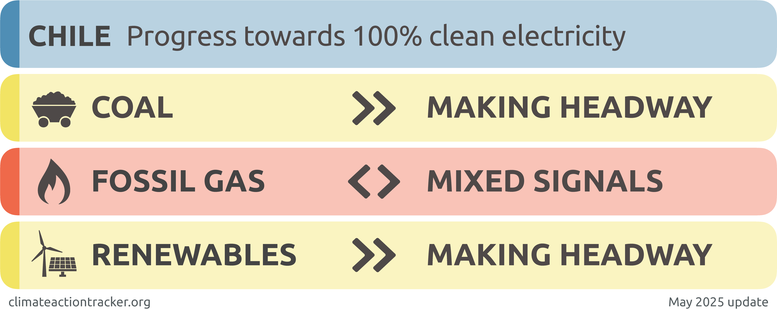
- Chile is leading Latin America with its decarbonisation programme, one of the fastest rates of renewable energy growth globally, and a planned phase-out of coal-fired power by 2040. Chile rapidly expanded renewable sources, increasing its share of electricity generation from around 35% in 2013 to roughly 70% by 2024.
- Chile has repeatedly raised its renewable energy targets to reflect faster-than-expected deployment. The country’s updated Energy Strategy targets 80% renewable electricity by 2030 and a 100% renewable system by 2050. Its Energy Sector Mitigation Plan suggests a shift away from continued fossil gas production and imports.
- In 2022, Chile produced more electricity from wind and solar than from coal for the first time. Coal generation has declined more quickly than initially planned, with several units retiring or converting ahead of schedule.

Norway
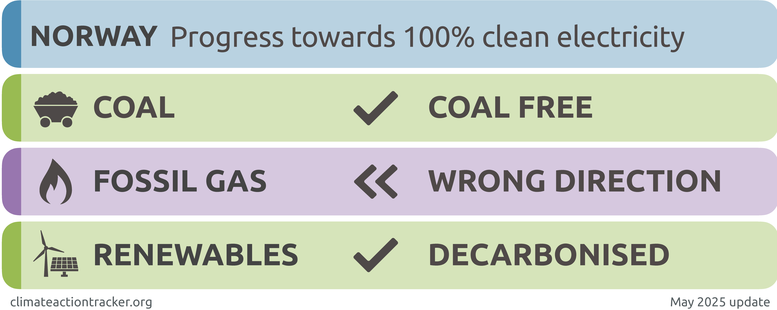
- While electricity generation in Norway is almost exclusively renewable (90% of its power generated by hydroelectric plants in 2024), its claim to ambitious climate action is undermined by the fact it was the third largest exporter of fossil gas in 2021, with over 94% of its annual production exported for consumption abroad.
- In January 2025, Norway awarded 53 licenses for oil and gas exploration to 20 companies. The country has no plans to phase out fossil fuel production.

Philippines
- The Philippines’ power system is dominated by fossil fuels, with coal, gas, and oil accounting for almost 80% of its electricity generation in 2023. As a net importer of fossil fuels, the Philippines is highly exposed to energy security risks. High dependence on imported fossil fuels contributes to frequent power supply disruptions and high electricity prices. The Philippines’ power sector is also the single largest contributor to its overall greenhouse gas emissions, contributing to both global warming and local air quality issues.
- While the Philippine Energy Plan (PEP) 2023–2050 reduces reliance on coal and gas compared to previous versions, both fuels are still projected to expand, with gas growing rapidly through new liquefied fossil gas infrastructure that risks creating a new fossil dependency.
- Renewable energy has seen significant growth in recent years, driven by government policies, with most new power capacity additions being wind and solar. The Philippines also has the largest pipeline of renewable projects in Southeast Asia. However, wind and solar generation would still need to grow between 23 to 30 times by 2030 compared to 2023 to align with 1.5°C benchmarks.
- Achieving these benchmarks in lower-income countries is a global responsibility, rather than a domestic responsibility. Therefore, ambitious climate finance commitments and delivery are essential to support high ambition at the national level.

European Union
- While the EU has not signed the Beyond Oil and Gas (BOGA) declaration, eight of its member states have. Six member states — Denmark, France, Ireland, Portugal, Spain, and Sweden — are core members of the Alliance and have committed to ending oil and fossil gas exploration and development.
- Fossil gas remains a sticking point, with no phase-out date, and the EU continues to invest in the buildout of LNG terminals and gas pipelines, leading to an overcapacity of LNG infrastructure.
- The EU has experienced a consistent upward trend of wind and solar power for the last decade, accelerating in the past five years, as the share of fossil fuels in the electricity mix has decreased. In 2025, wind and solar generated more power in the EU than fossil fuels for the first time. The EU has set a target to reach a 42.5% share of renewables in the region's gross final energy consumption across all sectors by 2030 with the aspirational aim of reaching a higher 45%.

UK
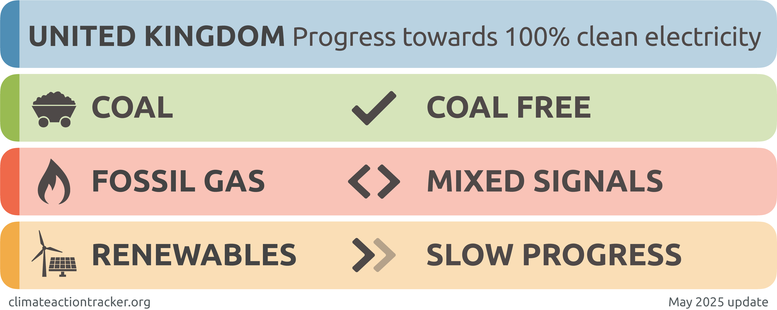
- The UK phased out coal from its power mix in October 2024.
- The government’s Clean Power 2030 Action Plan will mostly phase out fossil fuels from the electricity mix while increasing the share of low carbon technologies from 65% in 2024 to over 95% by 2030.
- The government has committed to end licensing for new oil and fossil gas fields, but there is a substantial pipeline of projects which have already received exploration licenses and are either waiting for development consent or are already in production.
Stay informed
Subscribe to our newsletter