
Chile
2035 NDC
2035 NDC Target
This analysis was published in December 2025.
Chile submitted its 2035 NDC to the UNFCCC on September 23, 2025.
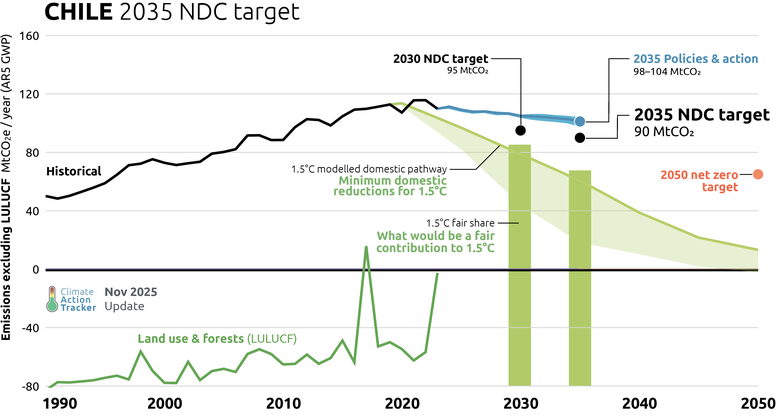
Chile's new 2035 climate target is not 1.5˚C aligned according to its fair share, and the gap between its target and 1.5˚C pathways has grown compared to 2030. Chile commits to an absolute emissions level of 90 MtCO2e by 2035, which would fall below emissions projected under current policies, indicating that additional action is required. However, its new climate pledge does contain some positive elements: Chile maintains its commitment to peak emissions by 2025, re-commits to a coal phase-out by 2040 and it sets out an absolute national emissions budget (Gobierno de Chile, 2025b). Enshrined in national law, this emissions budget for 2031–2035 will be translated into seven sectoral mitigation plans, operationalising the goals outlined in the NDC as already done for the 2030 NDC and demonstrating continued efforts to translate the NDC target into action required at a sectoral level (Gobierno de Chile, 2022).
| Chile | 2035 NDC | |
|---|---|---|
| 2030 target | ||
|---|---|---|
| Formulation of target in NDC | The Chilean government has not updated but did reaffirm its unconditional 2030 target, while the conditional target has not been reaffirmed. See the full 2030 NDC assessment here. | |
| Absolute emissions level in 2030 excl. LULUCF |
Level of emissions to be achieved at home (domestic target component) 95 MtCO2e [13% below 2023] |
|
| Status | Submitted on 23 September 2025 | |
| 2035 target | ||
|---|---|---|
| Formulation of target in NDC | Chile commits to a GHG emission budget not exceeding 480 MtCO2e between 2031 and 2035, and a GHG emissions level of 90 MtCO2e by 2035. | |
| Absolute emissions level in 2035 excl. LULUCF |
Level of emissions to be achieved at home (domestic target component) 90 MtCO2e [18% below 2023] |
|
| Status | Submitted on 23 September 2025 | |
Ambition
For the world to have a significant chance of limiting warming to 1.5˚C, governments must switch to emergency mode and strengthen both their 2030 targets and current policies to include substantial emissions cuts and significantly contribute to closing the 2030 emissions gap. Chile’s submitted 2035 did not increase the ambition of its 2030 target.
Further information on Chile’s 2030 target can be found here link.
2030 NDC target
| 2030 NDC target | ||
|---|---|---|
| Is the target 1.5°C compatible compared to fair share? |
|
|
| Is the target 1.5°C compatible compared to modelled domestic pathways? |
|
|
| Is this a stronger target than previously submitted? |
|
|
2035 NDC target
| 2035 NDC target | ||
|---|---|---|
| Is the target 1.5°C compatible compared to fair share? |
|
|
| Is the target 1.5°C compatible compared to modelled domestic pathways? |
|
|
| Does the NDC include sectoral targets? |
|
|
| Does the NDC include a renewable energy target? |
|
|
| Does the target align with the country’s net-zero pathway? |
|
|
Chile submitted its 2035 NDC mitigation target on 23 September 2025, setting a 2035 target of 90 MtCO2e and a GHG emissions budget not exceeding 480 MtCO2e between 2031 and 2035. This target covers all sectors and gases. Chile’s target is built on an absolute net emissions reduction target excluding land, land use change, and forestry (LULUCF), resulting in 18% below 2023 levels (Gobierno de Chile, 2025b).
When compared to its fair share contribution to climate change mitigation, Chile's target of 18% below 2023 in 2035 is not 1.5°C compatible because it is above the 1.5°C compatible threshold of 68 MtCO2e, excluding LULUCF. To make its fair contribution to climate action Chile would need to further reduce its emissions to 38% below 2023 in 2035 (excl. LULUCF). While Chile has submitted a stronger target for 2035 compared to 2030 (Gobierno de Chile, 2020), the gap between those targets and a 1.5°C aligned pathway compared to its fair share grows from 10 MtCO2e in 2030 to 22 MtCO2e in 2035 – signalling a weakening, not strengthening, of ambition.
On the other hand, the NDC target in 2035 is not compatible when compared to 1.5°C modelled domestic pathways as it is above the 1.5°C compatible threshold of 61 MtCO2e, excluding LULUCF. To reach that level, Chile would need to reduce emissions to at least 45% below 2022 in 2035 (excl. LULUCF). Again, the gap between the 2030 and 2035 targets compared to a 1.5°C aligned modelled domestic pathways increases, from 16 MtCO2e in 2030 to 29 MtCO2e in 2035. Chile could communicate its finance needs to bring the target into line with a 1.5°C least-cost pathways.
Enshrined in national law, Chile’s GHG emissions budget for 2031–2035 will be translated into seven sectoral mitigation plans, operationalising the goals outlined in the NDC (Gobierno de Chile, 2022). The 2035 NDC target includes sectoral measures and objectives for the transport sector, establishing a peak emissions target by 2030. This milestone is particularly significant as transport has been the country’s largest source of emissions since 2022, surpassing electricity generation (Gobierno de Chile, 2025a).
Chile’s power sector is addressed in the 2035 NDC through specific targets for coal phase-out and renewable electricity generation. Chile reiterates its goal to phase out coal in 2040, which would need to happen in 2030 to align the country with a 1.5°C global pathway (Climate Action Tracker, 2023). Progress has been considerably faster than expected, and the government is now considering advancing the coal phase-out date to 2035 (Ministerio de Energía, 2022). This would represent a positive step forward that would bring the country closer to 1.5°C alignment.
The NDC reiterates Chile’s target at least 80% renewable electricity generation by 2030, with the country experiencing a rapid growth in renewables, achieving its 2025 target ahead of schedule (OECD, 2024). According to CAT’s power sector benchmarks, Chile should achieve a more ambitious renewables share of 98% in 2030 to be aligned with a global 1.5 °C pathway. Chile has strong potential to generate electricity from renewable sources, but further attention and investment are needed in transmission and storage infrastructure (OECD, 2024).
Further information on Chile’s targets can be found here.
| Chile | Target summary (excluding LULUCF) | |
|---|---|---|
| 2030 target: Emissions reductions from 2023 levels (CAT estimates) | ||
|---|---|---|
| Current policies in 2030 | 4–5% | |
| 2030 NDC target | 14% | |
| 1.5ºC fair share | 28% | |
| 1.5ºC modelled domestic pathway | 23% | |
| 2035 target: Emissions reductions from 2023 levels (CAT estimates) | ||
|---|---|---|
| Current policies in 2035 | 5–11% | |
| 2035 NDC target | 18% | |
| 1.5ºC fair share | 38% | |
| 1.5ºC modelled domestic pathway | 45% | |
Fairness & Finance
Chile’s 2035 NDC does not include a conditional target and sets only an unconditional target, demonstrating its commitment to clear and ambitious climate action. The 2035 NDC reaffirms the unconditional target set in the 2030 NDC but makes no mention of the conditional target included in that document – a 45% reduction in net emissions by 2030. Since this conditional target has not been reiterated in the 2035 NDC, we assume the government is no longer considering it.
Whether Chile should receive climate finance from abroad to reduce its emissions is a matter of debate. Our methods do not provide a clear answer to this question. On balance, CAT methodology indicates that provision of a small amount of international support is consistent with the wide range of literature on fair share contributions to meeting the Paris Agreement’s goals. However, this contribution would likely be small under most equity perspectives.
It is also important to emphasise that our current analysis indicates a widening gap between Chile’s targets and the 1.5ºC modelled domestic pathway. Chile could enhance its capacity to further reduce emissions and align with a 1.5ºC-compatible least-cost trajectory by clearly identifying and communicating the finance needs that it would need to close this gap.
Credibility
Credible NDCs should build on robust national planning processes that translate the economy-wide emissions reduction target into action in all sectors. Governments need to ramp up the implementation of their existing targets and further develop policies to close the – still significant – emissions gap between current policies and the 1.5°C pathway. Contradictory policies must be addressed and reversed: fossil fuel production needs to be phased out, while fossil fuel exploration and fossil fuel subsidies need to stop.
| 2035 NDC target | ||
|---|---|---|
|
Is the target driving more ambitious action? |
|
|
|
Is there a policy framework in place to increase ambition to meet the target? |
|
|
|
Does the NDC reference national planning processes for its development? |
|
|
|
Does the NDC reference an institutional framework/plan in place for its implementation? |
|
|
|
Does the target commit to phase out fossil fuel production? |
|
|
|
Does the target commit to stop fossil fuel exploration & subsidies? |
|
|
Chile’s 2035 NDC was developed through a rigorous national planning process that included broad public participation (Gobierno de Chile, 2024b). The NDC serves as a key instrument for reducing national GHG emissions. As defined by the Climate Change Framework Law (Ley Marco de Cambio Climático, LMCC) (Gobierno de Chile, 2022) and the Long-Term Climate Strategy (Estrategia Climática de Largo Plazo, ECLP) (Gobierno de Chile, 2021), each NDC establishes absolute emissions budget for its implementation period. For example, the 2030 NDC covers the 2020–2030 period, while the 2035 NDC sets the budget for 2031–2035.
These budgets are distributed across seven ministries, each responsible for developing its own sectoral mitigation plan. This process enables the operationalisation of the targets set in the NDC into the national text. As of 2025, the sectoral mitigation plans have been published and approved for the first period (Gobierno de Chile, 2025a).
Chile’s sectoral plans translate its 2030 climate target and sectoral emissions budgets into concrete short and medium term mitigation measures, although recent analyses suggest that these measures alone may not be enough to fully achieve the target. The next challenge lies in ensuring effective coordination and stakeholder participation in implementing these sectoral mitigation plans. The Chilean government has designed a comprehensive process to translate the plans into regional action and to establish mechanisms for monitoring and evaluating progress (Gobierno de Chile, 2024a).
Transparency
Governments should set absolute, economy-wide, emissions reduction pathways including all GHG gases, specifying the emissions levels for each year as an absolute level of gross emissions (excluding LULUCF). This level of transparency will ensure that their reduction targets are immune to creative accounting. NDC targets should primarily focus on their domestic reductions by decarbonising all sectors of the economy rather than relying on forestry sinks, other carbon dioxide removal (CDR) or international carbon markets.
Chile has set a notable example of transparency in its communications to the UNFCCC, and its 2035 NDC is no exception. It establishes absolute net emission reduction targets along with emissions budgets for the period, clearly outlining both the end goal and the pathway to achieve it. However, in certain areas, such as the potential use of Article 6 mechanisms, Chile could have provided clearer messaging on its approach and the scale of their planned use.
| 2035 NDC target | ||
|---|---|---|
|
Is the target based on fixed, absolute values? |
|
|
| Does the target cover all sectors? |
|
|
| Does the target cover all greenhouse gases? |
|
|
| Does the target specify an emissions pathway? |
|
|
| Does the target separate out land use and forestry? |
|
|
| Does the target separate out other CO2 removal by type? |
️ |
|
|
Does the target separate out the use of carbon credits under Article 6? |
️ |
|
Chile intends to utilise market mechanisms under Articles 6.4 of the Paris Agreement to help achieve its climate goals and access international climate finance. The 2035 NDC communicates that the country plans to establish a list of eligible activities under Article 6 to prevent overselling of mitigation outcomes (Internationally Transferred Mitigation Outcomes, or ITMOs) and to prioritise the use of these mechanisms for technologies with higher entry barriers or lower cost-effectiveness. Chile also aims to create mechanisms to ensure that international financing through Article 6 adheres to the principles of additionality and traceability, while safeguarding the achievement of its national emissions reduction targets.
Chile has developed a national regulation (Gobierno de Chile, 2024c) that sets the guidelines to define the list of activities to be eligible under Article 6. Although this is a good first positive step, as these safeguards are not yet fully established, their eventual implementation and effectiveness remain uncertain. Article 6 risk selling emission reductions that are relatively inexpensive, as ITMOs are designed to help the buying country meet its targets while requiring Chile to make corresponding adjustments, effectively making its own targets harder to achieve. Especially for Chile, where current policies are still not sufficient to meet its NDC, selling reductions internationally now may be at odds with the article 6 principles, which is to ensure that the use of carbon credits drive real and additional emissions reductions. For more information on the promise and pitfalls of Article 6 mechanisms, see the recent CAT briefing on Article 6.
For more information, on Chile’s climate targets and policies, please click here.
For the CAT’s full recommendations for setting NDC targets that form the basis of the analysis above, please click here.
Further analysis





Latest publications





Stay informed
Subscribe to our newsletter