
South Korea
2035 NDC
2035 NDC Target Overview
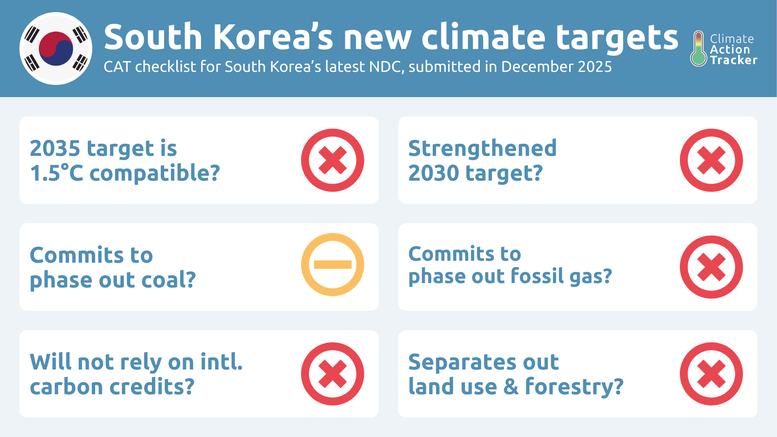
South Korea submitted its 2035 NDC to the UNFCCC on December 26, 2025. We will update this target analysis once further information on the planned use of Article 6 and international carbon credits becomes available.
South Korea's new 2035 climate target is not 1.5˚C-aligned according to its modelled domestic pathway*, and the gap between its target and 1.5˚C-compatible pathway has only marginally narrowed compared to its 2030 commitment. The lack of transparency on its intended use of international carbon credits to achieve the target leaves the level of domestic mitigation implied by the target unclear. Any reliance on international credits would set South Korea further off track from 1.5°C-compatibility.
The South Korean government has committed to an emissions reduction target of 53–61% below 2018 levels by 2035 (incl. LULUCF). This corresponds to an emissions level of 304–364 MtCO2e in 2035, or a 51–59% reduction below 2018 levels when excluding LULUCF. For its 2030 target, South Korea clearly distinguished between emission reductions to be achieved domestically and those to be met through action abroad. While the submitted NDC indicates South Korea’s intention to use market mechanisms under Article 6, it provides no information on the extent international carbon credits would contribute to achieving the 2035 target.
The CAT’s latest briefing on Article 6 cautions against buying international carbon credits to delay or avoid investing in domestic mitigation efforts. South Korea should avoid purchasing so-called “low-hanging fruit” credits from developing countries, burdening them with a more difficult and expensive decarbonisation in the future, and should instead enhance its domestic ambition.
South Korea has not strengthened its 2030 NDC. Compared to its domestic 2030 target, the upper end of the full 2035 target only marginally narrows the gap with 1.5°C-compatible modelled domestic pathways emissions levels, declining from 45 MtCO2e in 2030 to 40 MtCO2e in 2035. Therefore, the 2035 target does not represent a meaningful improvement in South Korea’s climate ambition.
South Korea’s 2040 coal phase-out commitment, announced at COP30, is a concrete step towards power sector decarbonisation. In its submitted NDC, this is framed as ‘a view to achieving a coal phase-out by 2040’ rather than a firm commitment. South Korea should aim to phase out coal earlier than 2040 - in line with international benchmarks. The CAT estimates that developed countries should fully phase out coal by 2030 to align with a 1.5°C pathway (CAT, 2023). Accelerating the coal phase-out would be supported by South Korea’s significant renewable energy potential and help reduce fossil fuel dependency and enhance energy security.
To fully realise these benefits, South Korea will need to ensure that the coal phase-out is not offset by a growing reliance on fossil gas. Even short-term expansion of LNG risks undermining the effectiveness of a coal phase-out. South Korea’s public export finance, which continues to prioritise fossil fuel projects with no commitment to phasing them out, compounds the risks of carbon lock-in and stranded assets (SFOC & GESI, 2025).
The government’s inclusion of sector-specific emission reduction targets in its announcement and related communications, and reiterated in its submission to the UNFCCC, provide a clearer link between the NDC and actionable policies.
However, ambitious implementation must follow. Under current policies, South Korea is still far from meeting its 2030 NDC target, largely due to rising energy demand and increasing industrial emissions. The gap between South Korea’s current policies and its 2035 target is even larger, underscoring the need for more ambitious long-term action. To align with a 1.5°C compatible pathway, South Korea needs to strengthen its climate commitments for both 2030 and 2035 and accelerate domestic action.
For further guidance on how South Korea could strengthen its 2035 target, see our guide for new NDCs.
*The CAT rates the domestic component of the NDC against modelled domestic pathways, representing the emissions reductions required within South Korea, while assessing the full NDC target, including any reductions achieved abroad, against South Korea’s fair share contribution. In the absence of information regarding the use of international carbon credits for the 2035 target, we assess the upper end of South Korea’s target range, corresponding to the minimum effort required to achieve the NDC, against modelled domestic pathways. South Korea should provide clear information on its planned use of Article 6 to allow for a complete assessment of the domestic and international components of its 2035 target.
Further analysis





Latest publications



Stay informed
Subscribe to our newsletter