CAT Article 6 evaluations
What is Article 6?
Last updated: 16.06.2026
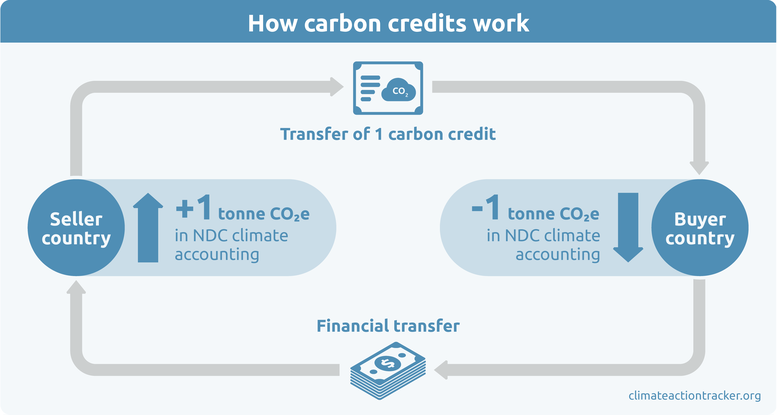
Under Article 6 of the Paris Agreement, countries can cooperate with each other to achieve their climate targets: they can buy emission reductions in the form of carbon credits from other countries, and count these towards their own emission reduction target.
Carbon credits transferred from one country to another under Article 6 are called Internationally Transferred Mitigation Outcomes (ITMOs), with one ITMO equalling one tonne of CO2e.
Article 6 creates the framework that allows governments to support emission‑reducing activities abroad and apply those reductions to their own targets, or Nationally Determined Contributions (NDCs), through internationally coordinated accounting. Article 6.1 of the Paris Agreement provides the basis for countries to cooperate to allow for higher ambition in mitigation and adaptation actions. In practice, this is not always the case.
When transferring ITMOs between two countries, both governments must apply Corresponding Adjustments (CA) to their NDC emissions accounting. The buyer country can subtract the purchased amount of ITMOs from its reported national inventory, and the host country (seller) must add the same amount to its reported national inventory. Once a mitigation activity is authorized by the host country, it can be converted into ITMOs and transferred between countries. The corresponding adjustment applies only during one NDC period, so even if the emission reduction is permanent, its effect on accounting is temporary.
How does the CAT deal with Article 6?
From June 2026 onwards, the CAT will systematically assess countries' engagement with Article 6. This will include a quantitative assessment, i.e. an evaluation of a country's domestic ambition, taking into account the number of purchased credits. The CAT will also conduct a qualitative assessment, track the number of signed bilateral agreements and ongoing projects and provide a high-level evaluation of each country's Article 6 strategy. In doing so, it will consider the well-known risks and principles of responsible engagement, as outlined in our CAT Art. 6 briefing paper of 2025.
Risks
Climate action
Cooperation based on Article 6 should result in higher overall emission reductions. However, when emissions are transferred between countries whose climate targets are not aligned with the 1.5°C warming limit, this does not increase emission reductions globally – it merely shifts responsibility from one country to another. In other words, such cooperation is, at best, a zero-sum game and most likely a net negative one in relation to emissions. In addition there are a few if any constraints in relation to avoiding social or environmental effects.
For Article 6 to work as intended, governments must first demonstrate their highest possible domestic ambition before relying on the use of ITMOs. However, this principle is not being enforced by international rules.
Equity
When a rich country purchases carbon credits from a poorer country, this will most likely imply the selling of low-hanging fruit reductions: the purchaser participates in reducing costs, while the transaction is likely to make NDC achievement more expensive for the host. This therefore raises equity issues from the transfer of responsibility and 1.5°C alignment from the Global North to the Global South.
Quality
To ensure environmental integrity, emission reductions must contribute to sustainable development, be truly additional, permanent, not double counted and adhere to the highest standards of transparency, measurement and verification.
Twenty years of experience with the Clean Development Mechanism (CDM) have shown that developing high quality offset projects is extremely difficult. For example, a major issue lies in the use of weak or inflated baselines, particularly for countries whose targets are set as reductions below business-as-usual (BAU) rather than as absolute emission targets.
Many countries still have BAU-based NDC targets, and as seen during the CDM era, this can lead to significant over-crediting, which, under Article 6, is now on a much larger and more difficult to manage scale. On the other hand, transactions between countries with absolute targets may be subject to accounting problems and uncertainties emerging from the lack of clear trajectories towards their target.
These risks are now magnified by the new rules that allow the transition of certain CDM activities to Article 6.4. This transition risks undermining global ambition, as credits may simply be used to meet, not exceed, NDCs. In the worst case, this could allow about one billion carbon credits to enter NDC accounting by 2030.
Responsible engagement
In order to use Article 6 responsibly, countries should first seek to close the ambition gap. This means that buyer and host countries must first set domestic targets compatible with the Paris Agreement, and implement domestic policies to achieve them. Developed countries are responsible for helping other countries set and achieve 1.5°C-compatible targets, primarily by providing climate finance.
Article 6 projects should meet a number of quality criteria, including the following:
- additionality to existing efforts;
- avoidance of carbon lock-in effects;
- robust quantification;
- appropriate consultation with stakeholders.
Countries should also implement rigorous accounting systems to ensure that all transfers under Article 6 are recorded in a transparent and reliable manner.
Importantly, Article 6 transactions should not be counted as climate finance, which is not just a form of cooperation. Climate finance is a legal obligation grounded in the principles of responsibility and equity, where the donor gets nothing in return for its climate finance contributions.
In contrast, buying credits under Article 6 is transactional and conditional. It is also expected that a significant share of revenues will go to project developers and intermediaries in high-income countries, so that the financial benefits for developing countries will be more limited.
For more information on the risks associated with the use of Article 6, read the CAT’s 2025 Bonn briefing on the topic.
In-depth Article 6 evaluation by country
The in-depth evaluation of countries' engagement with Article 6 are available when clicking on the flags below.
 Brazil - Article 6 evaluation
 Japan - Article 6 evaluation
 Kenya - Article 6 evaluation
 Switzerland - Article 6 evaluation
Overview of Article 6 components
Article 6 comprises three main components:
- Article 6.2 (cooperative approaches),
- Article 6.4 (project-based mechanism), and
- Article 6.8 (non-market based cooperation).
Each has its own distinct rules, safeguards, and shortcomings. None of them requires a minimum level of domestic ambition prior to engaging in the transfer of carbon credits.
- Article 6.2, also known as “cooperative approaches”, mostly sets the accounting framework for the transfer of emission reductions based on bilateral agreements between countries.[1] For example, it prevents double counting, meaning that two different entities cannot account for the same ITMOs. Art. 6.2 currently
- Operates with very limited international oversight
- Operates without internationally agreed quality standards and methods.
- Article 6.4, also known as the Paris Agreement Crediting Mechanism (PACM), is a project-based mechanism under the supervision of the UN Climate Secretariat (UNFCCC). It allows for the participation of private actors. Art. 6.4 currently
- Operates using uniform standards and methodologies.
- Allows the transfer of old CDM (Clean Development Mechanism) credits into the Article 6.4 market, which will likely undermine the credibility of the mechanism.
- Creates the possibility of generating so-called ‘Mitigation Contribution Units’ (MCUs). These mitigation outcomes do not lead to any ITMO transfers, i.e. they stay in the host country and can serve as a contribution to climate finance.
- Includes a mandatory contribution to the UN Adaptation Fund (5% of the proceeds) and a mandatory provision to avoid a ‘zero-sum game’: 2% of the allowances are automatically cancelled.
- Article 6.8: This approach allows countries to collaborate on climate protection and adaptation measures outside of carbon markets through non-market-based cooperation. This mechanism has not yet received much attention.
[1] Airlines under CORSIA (the aviation industry’s offset programme under the supervision of the International Civil Aviation Organisation) can also purchase these credits.


Stay informed
Subscribe to our newsletter