RELEASE: Without rapid climate action, the world is heading to "irrecoverable overshoot"
Press release
The world is now heading towards "irrecoverable overshoot" unless governments start rapidly cutting emissions and abandon their support for the fossil fuel industry - as collective climate action stalls now for the fifth consecutive year, the Climate Action Tracker reports today in its global update, released at COP31.
The new reality of overshoot of 1.5°C means that the task is now to limit its magnitude and duration. The guiding principle of climate action must be to bring warming back below (and ideally well below) 1.5˚C by 2100, with warming continuing to decline thereafter.
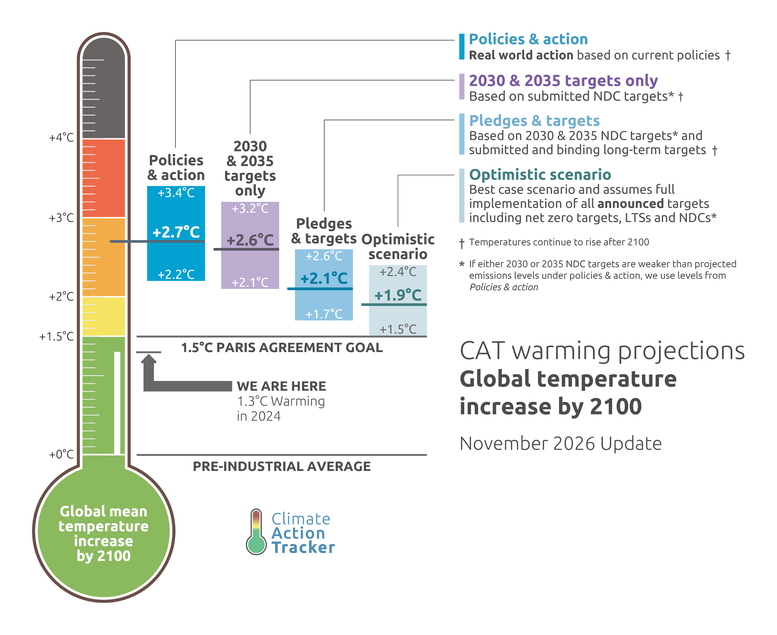
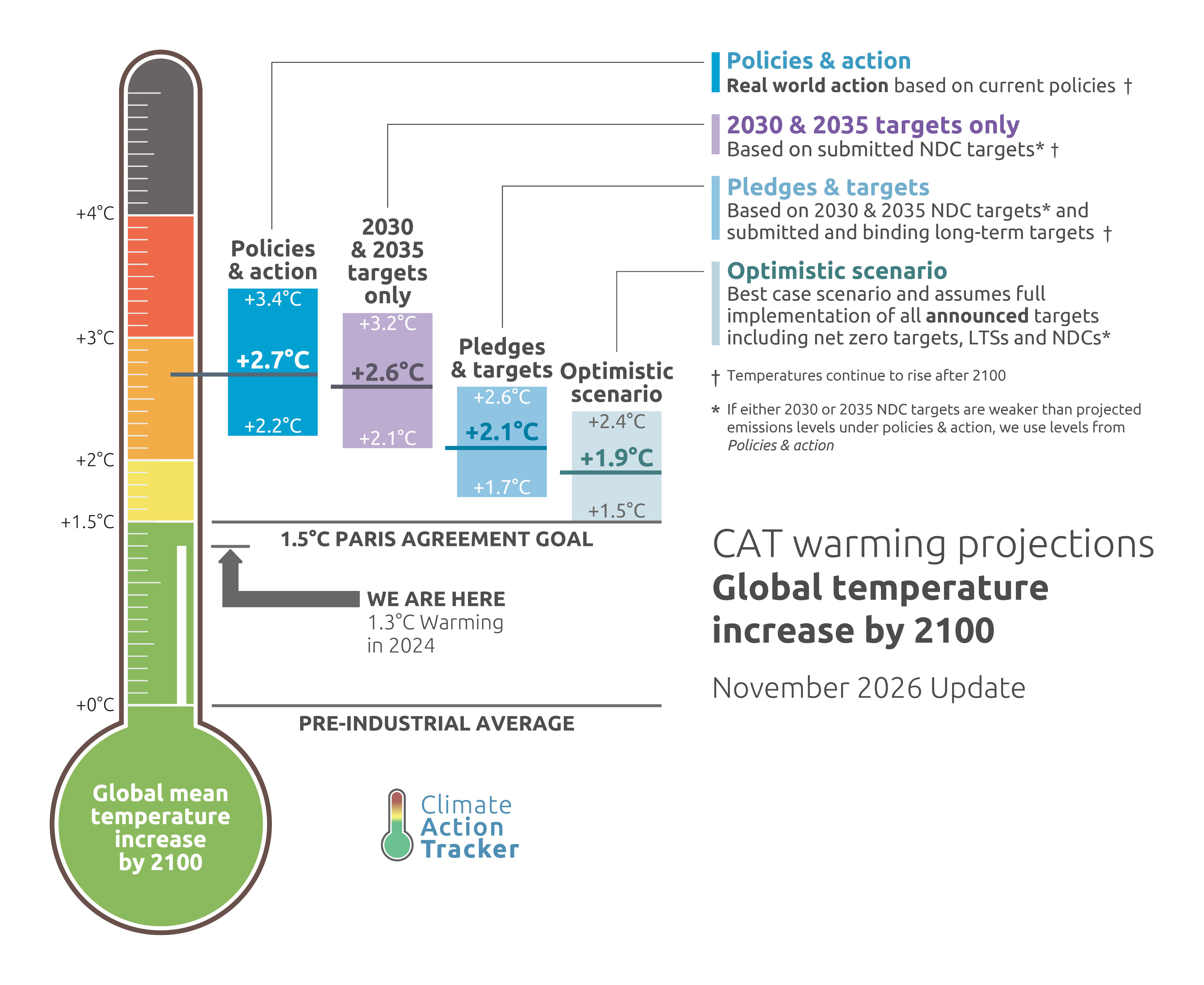
- With the policies they have in place today, collective government action will result in 2.7˚C of warming by 2100 (slightly up from last year’s 2.6˚C) as it stood from 2021-24.
- If governments meet their 2030 and 2035 targets, warming would still be 2.6˚C by 2100, no change from last year.
- Combined pledges and targets including long term targets would result in warming of 2.1°C in 2100, slightly down from 2.2°C last year.
- The CAT's Optimistic scenario, with all pledges, targets, long term and net zero targets would result in 1.9˚C in 2100.
"The stark choice for governments is to either continue to support the fossil fuel industry, which would consign humanity to insurmountable economic damages, rising mortality from heat and climate-driven diseases and disasters that they are unable to adapt to - or pivot to the solutions which are available and cheaper than ever," says Bill Hare, CEO of CAT partner organisation Climate Analytics.
"The imminence of breaching 1.5°C cannot be an excuse to open the door to defeatism – the focus has to be on accelerating action to limit the magnitude and duration of overshoot. Every increment of warming above 1.5°C means even more significant consequences across climate, nature and human systems," adds Hare.
The CAT notes there are definite signs of progress: clean electricity met all additional global demand in 2025, India and China are deploying renewables at record pace, EV adoption rates hit new highs, and Brazil's Amazon deforestation has fallen sharply, with some regions at their lowest levels since records began.
"With the closure of the Strait of Hormuz exposing our vulnerability to geopolitical shocks, the case for renewables and electrification has never been stronger - and it does appear that global emissions could be on the verge of a peak and a much faster decline than we had previously thought," says Dr. Niklas Höhne, of CAT partner organisation NewClimate Institute.
But the CAT report points out that the "brutal truth" is that the positive developments do not yet add up to bending the curve of emissions fast enough. Increasing energy demand and build-out of new fossil fuel infrastructure have led to still rising emissions.
"Governments collectively are simply not moving fast enough to adopt the policies that would enable us to escape from the emerging overshoot trap. Worse, several are taking their foot off the accelerator and slowing their climate action - or in cases such as the USA, Canada and New Zealand - rolling it back at a "staggering level," adds report lead author, Climate Analytics policy analyst Sarah Heck.
This lack of decisive action means that long-term warming is expected to cross the 1.5°C limit around 2030. To hold overshoot to the lowest level still achievable, the CAT has calculated that the pace of action has to accelerate over time: from around 4% emission reductions year to 2030 (range of 3-5%), to 7% a year in the first half of the 2030s (range of 6-9%), and 9% a year over 2035–2050 (range of 6-15%). Every year of delay steepens the curve.
Relevant links
Stay informed
Subscribe to our newsletter