New Zealand: three years of systematic climate policy rollbacks
Attachments
2026 general election
As New Zealand approaches its 2026 general election, it is important to reflect on the recent adverse changes in climate policies.
In this briefing, we set out the problems with the country's climate policies, and some recommendations for whichever government is elected on November 7.
Climate policy rollbacks and reversals
Climate action and policy is central to the country's economic resilience, energy security and ability to adapt to a warmer and more volatile world, especially a country so reliant on agriculture as one of its main exports.
Yet over the past three years, the conservative, National party-led government, elected in late 2023, has systematically rolled back key parts of New Zealand’s climate policy framework.
By any international comparison, the list of climate policy rollbacks and reversals is staggering. The only two comparable examples the Climate Action Tracker is aware of are the United States and Canada.
The government has weakened the country’s 2050 methane target despite agriculture being the country’s largest source of emissions. It has removed legal requirements for emissions trading settings to support meeting international climate commitments, reopened the door to offshore oil and gas exploration, stepped back from planned agricultural emissions pricing, dropped support for EV's, and weakened the country's first-ever emissions standards for cars. This is by no means a definitive list.
Latest climate targets
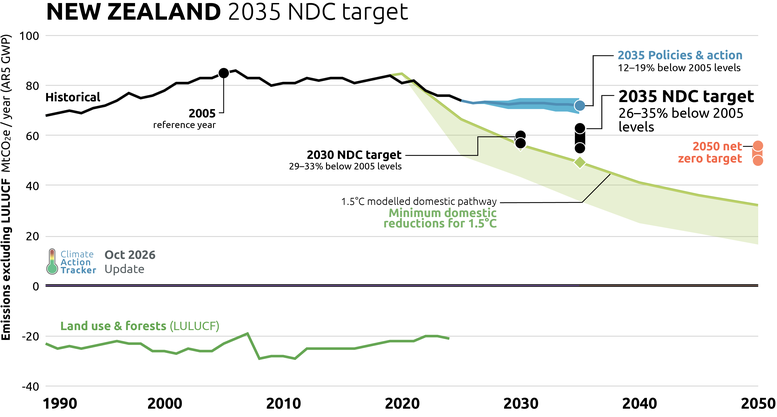
The government's latest climate targets, submitted last year, reflect this broader weakening of climate ambition. New Zealand’s 2035 NDC is not aligned with a 1.5°C pathway. The gap between the target and a 1.5°C compatible modelled domestic pathway is wider than it was for 2030, and the new target would allow emissions to rise after 2030. The next government will inherit this gap, along with the fiscal, economic and climate risks that come with it.
Climate impacts hitting hard
Meanwhile, the impacts of climate change are hitting the country hard. Cyclones Gabrielle and Hale, along with more frequent extreme rainfall and flooding, have shown how climate impacts can damage infrastructure, strain public finances, reduce property values and disrupt communities.
Between March 2025 and February 2026, the insurance industry reported that an extreme weather event hit the country every eight days, as it urged the government to build resilience.
The choice facing New Zealand
For New Zealand, accelerating the renewable energy transition would improve energy security, reduce exposure to global price shocks and support increasingly cost-competitive energy.
The choice facing New Zealand is not between climate action and economic prosperity. It is between managing the transition deliberately now, or paying more later through higher climate damages, greater fiscal pressure and missed investment opportunities.
Stay informed
Subscribe to our newsletter