
International Shipping
IMO policies & action
Current policy emissions projections
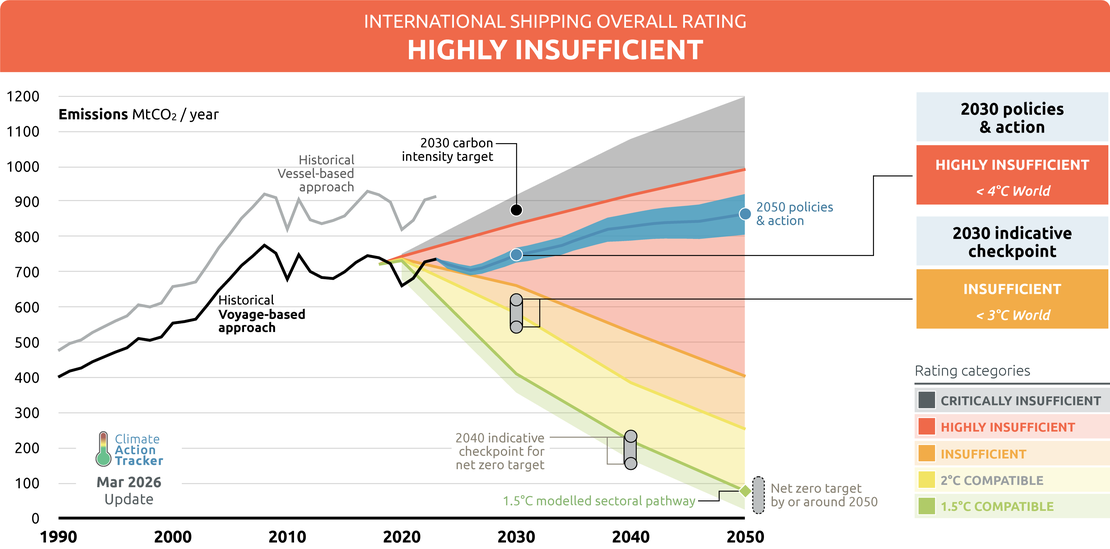
International shipping accounts for about 2.3% of global CO2 emissions in 2023 (ICCT, 2025). With the current level of policy action, CO2 emissions are projected to be between 729-768 MtCO2 in 2030 (based on a voyage-based approach), only representing a 1-6% decrease below the reference emissions level in 2008. The CAT rates 2030 emissions under current policies as “Highly Insufficient.” The rating remains unchanged from the previous assessment since no new policy measures have been adopted that would reduce emissions projections. There remains an ambition gap of 78-87% between current policy projections and 1.5°C compatible pathways for 2030.
The IMO failed to adopt the Net Zero Framework (NZF), a global fuel standard and carbon pricing mechanism, at the Marine Environment Protection Committee’s (MEPC) extraordinary session in October 2025. Despite reaching agreement on the draft NZF in April 2025, last minute pressure from the United States and Saudi Arabia sabotaged the agreement when IMO member states met to formally vote on the NZF’s adoption in October 2025. Instead of abandoning the NZF, governments decided to postpone the vote to October 2026. It is unclear how the postponement will affect the agreed technical measures.
If adopted, the NZF would have marked a significant step towards reducing emissions from the international shipping sector. The NZF was the IMO’s most robust emissions reductions mechanism to date, even though the framework was still insufficiently ambitious and lacked just transition measures. The NZF would have improved the CAT’s rating of the sector’s 2030 target and current policies from “Highly Insufficient” to “Insufficient.” This would have be compatible with aligning to reducing warning to 3°C to 4°C.
Current policies put the shipping sector far off track from achieving the IMO’s target of reducing emissions by 20% and striving for 30% by 2030, with an implementation gap of 109–186 MtCO2. The IMO’s target of reducing carbon intensity by 40% below 2008 levels will not promote emissions reductions; instead, emissions will likely increase. However, the 2030 emissions reductions target will reduce emissions beyond the 2030 carbon intensity target, rendering the latter redundant.
Mitigation measures
The tools and technologies for decarbonising the shipping sector are becoming increasingly accessible. Further policy implementation and finance mobilisation is necessary to achieve the enabling conditions to spearhead accelerated uptake in fuel production, port infrastructure and storage, and on-board technologies (GMF, 2024, 2025).
To achieve full decarbonisation, the shipping sector will need to adopt alternative fuels, otherwise known as scalable zero-emission fuels (SZEFs), to power vessels. To date, the main approach implemented to reduce GHG emissions has been around improving the energy efficiency of ships to reduce carbon intensity (ITF, 2018). However, energy efficiency gains have not resulted in any meaningful emissions reductions (Comer & Sathiamoorthy, 2022).
What is the International Maritime Organization?
The IMO is a UN special agency composed of 174 members states and is responsible for preventing shipping pollution.
The IMO consists of an Assembly, a Council, and five committees. The Marine Environment Protection Committee (MEPC) is responsible for directing the IMO’s climate actions. The MEPC deals with issues related to preventing pollution from ships, including GHG emissions and energy efficiency measures. The MEPC adopts resolutions on these issues and establishes working groups.
Technical proposals relating to emissions reductions are considered and negotiated at the Intersessional Working Group on Reduction of GHG Emissions from Ships (ISWG-GHG), which forwards proposals for the MEPC’s consideration, agreement, and adoption. Any country who is party to the IMO can submit proposals to the MEPC.
NGOs and industry observers registered with the IMO can also make submissions, but only member states have the right to vote (Hayer, 2016). Following adoption, a resolution will then need to be accepted by contracting party governments within an agreed fixed period, after which the resolution enters into force.
Relationship with the UNFCCC
While the Kyoto Protocol stipulated in 1997 that developed countries should reduce their international shipping emissions by working through the IMO, the Paris Agreement does not explicitly consider international shipping. The Agreement refers to setting or moving towards “economy-wide” reduction targets, which implies that emissions from international bunkers should be included in government climate targets under the Paris Agreement.
2018 Initial GHG Reduction Strategy
The Initial Strategy set several emissions reductions targets: to reduce the CO2 intensity of international shipping by at least 40% and 70% from 2008 levels by 2030 and 2050, respectively, and to reduce GHG emissions at least 50% below 2008 levels by 2050 (IMO, 2018).
Previous actions to achieve these targets have been ineffective. In 2021, the IMO adopted several efficiency measures—specifically, the Energy Efficiency of Existing Ship Index (EEXI) and the Carbon Intensity Indicator (CII)—but these will not curb long term emissions growth. Instead, the EEXI and CII have a counterproductive impact on near-term ambition: the measures promote a switch to LNG-powered ships, resulting in greater GHG emissions (Smith, Perico, et al., 2025).
2023 Revised GHG Reduction Strategy
The Revised Strategy, unveiled at the MEPC80 meeting in July 2023, set out additional emissions reductions objectives, introducing GHG emissions reductions checkpoints (rather than firm targets) for 2030 and 2040 and strengthened the IMO’s long-term target to net zero (see our targets section for details). At this IMO meeting, governments did not adopt new emissions reductions measures but rather only agreed to a timetable outlining potential measures, which ultimately manifested into the 2025 Net Zero Framework measures (IMO, 2023b).
Outcomes of the Revised Strategy:
- Agreed to a fuel-based target of at least 5%, striving for 10%, of the energy used in international shipping to come from zero and “near zero” emission fuels and technologies by 2030.
- Agreed to work towards developing further measures, including a fuel standard, to reduce the GHG intensity of shipping fuels over time, and an ‘economic instrument’ (i.e. a market-based measure) for adoption in 2025, with implementation expected from 2027. As of October 2025, this failed to materialise through the postponed vote of the Net Zero Framework (NZF).
- Agreed to expand coverage for targets and for any measures adopted in the future to cover the full life cycle emissions (Well-to-Wake instead of only Tank-to-Wake emissions) and GHG emissions (instead of only CO2).
- Adopted the Guidelines on Life Cycle GHG Intensity of Marine Fuels (LCA Guidelines) outlining methods for calculating Well to Wake GHG emissions.
- Agreed to account for “just and equitable transition” considerations, with text identifying a list of criteria to be considered when developing measures that may impact developing states, particularly SIDS and LDCs.
- Agreed to consider long-term measures beyond 2030 as part of the review of the Strategy in 2028.
- Agreed to develop tools to support capacity building and further studies to inform policy making decisions.
Operational and energy efficiency measures
The IMO has adopted several energy efficiency measures over the years. The most recent measures, Energy Efficiency of Existing Ship Index (EEXI) and the Carbon Intensity Indicator (CII), came into effect in January 2023, with the first ratings and reporting issued in 2024 (Infineum Insight, 2025). These are the main policy measures underpinning the CAT’s current policy projections.
The Energy Efficiency Design Index (EEDI) requires a minimum energy efficiency level per activity to be tightened up in phases every five years and is currently in phase two. Each phase defines a reduction factor for the EEDI to comply with, increasing at each phase, the last phase being phase three (IMO, 2017).
In 2019, the IMO tightened its energy efficiency design requirements regulating the amount of CO2 emissions related to installed engine power, transport capacity, and ship speed (Bureau Veritas, 2021). Additionally, the Ship Energy Efficiency Management Plan (SEEMP) was established to improve energy efficiency planning tool for shipping companies to manage their fleets’ operational energy efficiency over time. It consists of three parts: (1) establishing a ship management plan to improve energy efficiency, (2) developing ship fuel oil consumption data collection plans, and (3) introducing a ship operations carbon intensity plan (DNV, 2022; IMO, 2022).
The CII gives a rating to existing vessels based on an efficiency measure of the CO2 emitter per cargo-carrying capacity and nautical mile. The scale ranges from A (major superior) to E (inferior performance). Ships rated E, or rated as D for three consecutive years, will need to develop a plan to increase their operational efficiency (DNV, 2023). In 2024, 78% of ships were awared a rating of C or higher (Infineum Insight, 2025). Newly-built ships which comply with EEDI are also de facto compliant with the EEXI. While these measures would cover more than half of international shipping emissions from 2008, the estimated impact in reducing emissions by 2030 is marginal: less than 2% compared to if no measure were applied, mainly due to a continued low speed applied by the operators (Rutherford et al., 2020). The IMO will need to make further efforts to drive emissions reductions to meet its carbon intensity target by 2030.
The CII and EEXI are expected to cut CO2 emissions in the near term, but are ineffective in the long-term, as CO2 emissions are projected to start increasing again later in the decade and beyond. The near-term drop in CO2 is due to fuel switching from heavy fuel oil (HFO) to LNG, which means that total GHG emissions are expected to be greater because of higher methane emissions. In fact, overall GHG emissions would likely have been lower in a world without the recent energy efficiency measures, which further highlights their limitations (Smith, Perico, et al., 2025).
Methane emissions have been on the rise, even before the introduction of the IMO’s recent energy efficiency measures. Between 2012 and 2018, methane emissions rose by 150% (IMO, 2020) mostly driven by the increased use of LNG-fuelled engines.
Heavy fuel oil ban
In 2021, IMO member states adopted a ban to limit the use of heavy fuel oil (HFO) in the Arctic. However, the ban has been heavily criticised by environmental groups, which note several loopholes that reduce its effectiveness. Not only has the ban’s enactment been postponed until 2029, but it would still allow 74% of Arctic shipping activities to continue as usual (Ocean Conservancy, 2020). This is a major weakening of the policy’s effectiveness, as 68% of the fuel consumed come from just five of the Arctic Nations: Russia, the US, Canada, Norway, and Denmark (Roy & Comer, 2017).
Just transition for workers
At COP 26, the International Chamber of Shipping (ICS), the International Transport Worker’s Federation (ITF), the UN Global Compact, and the International Labour Organisation (ILO), with support from the IMO, launched the “Maritime Just Transition Task Force,” to support the coordination between governments, industry, and stakeholders to develop the skills needed by seafarers to operate with new technical challenges associated with the maritime sector’s green transition (IMO, 2023a).
At COP27, a 10-point action plan setting out recommendations on the skills needed by seafarers to support maritime decarbonisation was published by the Maritime Just Transition Task Force as an action plan on how to support the transition from upskilling seafarers to work with new zero-emission technologies and fuels (Maritime Just Transition Task Force, 2022).
Further analysis







Latest publications




Stay informed
Subscribe to our newsletter