Germany's extreme summer calls for more climate action, not less
Back from summer recess
To read the German version of this blogpost, please go here.
When Germany's Parliament, the Bundestag, resumes its session next week, it will consider whether to green light measures that would substantially undermine government support for renewable energy. Already approved by Cabinet in July, the measures are part of a broader government slowdown of climate action that comes at precisely the wrong moment. The extreme heat and drought of summer 2026 should mark a turning point in German climate policy, compelling the government to expand and accelerate its efforts to mitigate the climate crisis.
Chancellor Merz's priority is to revive the German economy. But this summer exposed a pressing reality: Germany cannot ensure economic prosperity without confronting the increasingly severe impacts of climate change.
An astounding 15,800 German citizens died prematurely during this summer’s climate change-fuelled heatwaves. Forests fires reached unprecedented scale and intensity. The Rhine is at one of its lowest ever recorded levels, disrupting barge traffic and forcing freight back onto the roads, further driving up emissions and costs. The economic losses of the heatwave are estimated to be in the tens of billions of euros. These are not abstract projections of future climate risks; these are immediate costs borne by German society and its economy.
Opportunity to align economic recovery with stronger climate policies
The German government could seize this moment to strategically align economic recovery with stronger energy transition and emission reduction policies. When the Bundestag resumes after its summer break next week, it will have to decide on a reform to the Renewable Energy Act (Erneuerbare-Energien-Gesetz) and the accompanying grid-connection package (Netzschlusspacket) that risks substantially weakening important pillars of Germany’s renewable energy framework. The proposed reform would end guaranteed long-term support for new small solar installations and reduce compensation for renewable generators that are required to curtail output because of insufficient grid capacity.
If approved by the Bundestag, these changes risk undermining the energy transition that is transforming Germany’s electricity system. Renewable energy now accounts for nearly 60% of total electricity generation, driven by sustained policy support over successive previous governments.
While Chancellor Merz declared during a visit to wildfire-affected areas that he wants to do everything possible to curb climate change, his government is actively decelerating, rather than accelerating, climate action across most sectors.
Our new assessment of Germany's climate policies from August 2026 shows that, for the second consecutive year, Germany’s emissions in 2030 are projected to be higher than our previous update. Germany is moving backwards on climate change, drifting further from the Climate Change Act's legally binding emission reduction targets for 2030 and 2045.
The Cabinet’s decision to weaken support for renewables is another item on a growing list of similar moves by the German government:
- it is expanding support for fossil gas,
- it has scaled back its approach to the transition to zero emission cars, decreased taxes on flights,
- it is repealing the previous government’s requirement to only install heating systems with at least 65% renewables, and
- it has enabled the greater use of international carbon credits to meet climate targets.
Weaker domestic action also slows EU progress
Germany’s influence on climate policy extends well beyond its borders, even if the government often claims that Germany is too small to make a meaningful dent on global emissions on its own. As Europe’s largest economy and largest emitter, Germany’s retreat on climate action is already felt at the regional level and reflected in a broader weakening of policies at the EU level that will influence markets and industries around the world.
Most consequential is the EU’s ongoing reform of its Emissions Trading System (ETS), which will likely dilute the scheme’s ambition and slow emission reductions by allowing greater pollution from power generation and heavy industry.
A weakened ETS would undermine the effectiveness of the EU’s Carbon Border Adjustment Mechanism (CBAM), which imposes an additional levy on carbon-intensive imports to the EU. As a result, CBAM extends the reach of EU climate policy into global markets, having already altered production decisions by Chinese and Indian steelmakers. Germany’s retreat therefore risks triggering a broader downward spiral: weaker domestic action slows EU progress, which in turn disincentivises decarbonisation among other major emitters.
Risk of growing fossil-fuel dependency
The Climate Action Tracker continues to rate Germany’s climate action as “Insufficient”.
Alongside the proposed weakening of renewable energy policies, Germany's power sector deserves special scrutiny. The government’s approach to coal and fossil gas risks locking in fossil-fuel dependency at a moment when Germany needs to accelerate the energy transition.
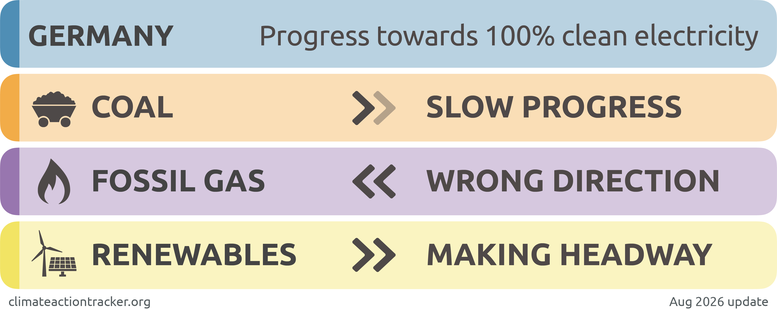
On coal, the government has - for now - maintained its predecessor's 2038 phase-out date for coal-fired power. However, that commitment is becoming increasingly uncertain. Under the guise of strengthening energy security, Chancellor Merz has questioned the phase-out date, while eastern German states have recently reaffirmed their opposition to ending coal mining and coal-fired power generation in their regions by 2038.
While Germany has been making slow progress on phasing out coal, the government’s coalition agreement makes the decommissioning of coal plants conditional on the construction of new fossil gas-fired power plants. As a result, Germany’s coal phase-out is being tied to the expansion of another fossil fuel.
This is particularly concerning because Germany does not have a fossil gas phase-out target. Germany currently operates around 32 GW of fossil gas power capacity, with plans to subsidise a further 9 GW of new long-duration peak capacity, which is expected to be met with new gas-fired power plants.
Germany’s response to Russia's invasion of Ukraine further deepened its reliance on fossil gas. To diversify away from Russian gas imports, Germany entered long-term liquified natural gas (LNG) partnerships with countries including Qatar, Senegal and the US.
While this strategy addressed the country’s short-term energy supply challenge, long-term LNG contracts and new import infrastructure risk locking Germany into fossil gas dependence for decades.
Several of these LNG supply agreements extend into the 2040s, beyond Germany's legally binding 2045 climate neutrality target. Combined with ongoing investments in LNG import infrastructure, including the conversion of temporary floating LNG terminals into longer-term import facilities, these commitments risk substantial fossil fuel lock-in and stranded assets.
In a summer marked by record temperatures and heat-related deaths, the German government is poised to weaken support for renewables and further prolong the reliance on coal and fossil gas. The government could use this moment to change course and strengthen its energy transition policy portfolio, instead of weakening it, and use its influence to drive climate ambition in the EU.
Related content
Stay informed
Subscribe to our newsletter