Germany
Targets
Target Overview
Germany has the following national climate change mitigation targets (Bundesregierung, 2021a):
- 65% national emissions reduction below 1990 levels excl. LULUCF by 2030 (up from 55%)
- An interim target of 88% below 1990 levels excl. LULUCF by 2040
- climate neutrality by 2045
Germany did not submit its own NDC but is part of the EU’s target of 55% below 1990 levels excl. LULUCF and the EU climate neutrality goal for 2050.
CAT rates the 2030 target as “Almost sufficient” compared to modelled domestic pathways, and “Insufficient” when compared to Germany’s fair share. CAT analysis finds that to be in line with the 1.5°C limit of the Paris Agreement, Germany’s 2030 emissions reduction target should aim for reductions of at least 69% below 1990 levels domestically. To fully contribute its fair share, Germany would also have to significantly increase its international climate finance.
| GERMANY — Main climate targets |
|---|
| 2030 national target | |||
|---|---|---|---|
| Formulation of target in national law |
Greenhouse gas emissions will be reduced from 1990 levels as follows: • at least 65% by 2030 |
||
|
Absolute emissions level in 2030* excl. LULUCF |
Level of emissions to be achieved at home 435 MtCO2e [65% below 1990] [53% below 2010] |
||
| Status | Updated Climate Protection Law from 18 August 2021 | ||
| Net zero & other long-term targets | |||
|---|---|---|---|
| Formulation of target |
Greenhouse gas emissions will be reduced from 1990 levels as follows: • at least 88% by 2040 By 2045, greenhouse gas emissions will be reduced to such an extent that net greenhouse gas neutrality is achieved. After the year 2050, negative greenhouse gas emissions are to be achieved. |
||
|
Absolute emissions level in 2050* excl. LULUCF |
40 MtCO2e [97% below 1990] [96% below 2010] |
||
| Status | Updated Climate Protection Law from 18 August 2021 | ||
*For details on how Climate Action Tracker calculated the target values see the Assumptions tab
National Target Updates
In June 2021, in the wake of a Constitutional Court ruling that Germany’s climate targets were not strong enough, the government adopted an amendment to its 2019 Climate Change Act. The court ruled that the previous Climate Change Act from 2019 risked delaying action and putting too much burden on future generations, and asked for more clarity on the trajectory beyond 2030.
The 2021 amendment of the climate revised the targets as follows (Bundesregierung, 2021a):
- 65% national emissions reduction below 1990 levels excl. LULUCF by 2030 – up from a 55% reduction in the 2019 Climate Change Act;
- 88% below 1990 levels excl. LULUCF by 2040 – an additional interim goal that was not part of the 2019 Climate Change Act;
- Climate neutrality by 2045 – five years earlier than the 2050 net zero date from the 2019 Climate Change Act.
Overall, the amendment significantly increased the ambition of Germany’s climate law. The 2030 target of a 65% reduction is close to the 69% domestic emissions reduction that CAT identified as the minimum level of effort consistent with Germany’s fair contribution (Climate Action Tracker, 2021).
Since the 2021 amendment, Germany has not adopted more ambitious headline emission reduction targets. While the Climate Change Act sets sector-specific targets through 2030, it does not provide a comparable breakdown for the period thereafter. It also lacks an intermediate target for 2035, creating a gap between the 2030 and 2040 milestones.
More recently, the government is considering the idea of using international carbon credits from Article 6 from outside the EU to meet this target (Bundesregierung, 2025a). Germany endorsed the EU debate that led to the EU’s decision to allow a limited use of such credits. Germany has not yet incorporated this approach into its national climate target framework. Doing so would weaken incentives for domestic emissions reductions.
| GERMANY — History of national target updates | 2019 target | 2021 target update |
|---|---|---|
| 1.5°C Paris Agreement compatible |
|
|
| Stronger target | N/A |
|
| Fixed/absolute target |
|
|
| GERMANY | 2019 target | 2021 target update |
|---|---|---|
| Formulation of target in national target | By the target year 2030, a reduction rate of at least 55% applies. |
Greenhouse gas emissions will be reduced from 1990 levels as follows: • at least 65% by 2030 |
|
Absolute emissions level excl. LULUCF |
562 MtCO2e by 2030 | 435 MtCO2e by 2030 |
|
Emissions compared to 1990 and 2010 excl. LULUCF |
55% below 1990 emissions by 2030 40% below 2010 emissions by 2030 |
65% below 1990 emissions by 2030 53% below 2010 emissions by 2030 |
| CAT rating |
Overall rating*: Highly insufficient |
National target against modelled domestic pathways: Almost Sufficient National target against fair share: Insufficient |
| Sector coverage | Economy-wide | Economy-wide |
| Separate target for LULUCF | No |
Yes, at least -25 MtCO2e by 2030 |
| Gas coverage | All greenhouse gases | All greenhouse gases |
| Target type | Relative emissions reduction below a base year | Relative emissions reduction below a base year |
* Before September 2021, all CAT ratings were based exclusively on fair share and only assessed a country’s target
CAT rating of targets
The CAT rates NDC targets against each country’s fair share contribution to global climate change mitigation, considering a range of equity principles including responsibility, capability, and equality. The CAT also rates NDC targets against indicative national emissions from global least-cost emissions pathways (called modelled domestic pathways). For assessing targets against the fair share, we consider both a country’s domestic emission reductions and any emissions it supports abroad through the use of market mechanisms or other ways of support, as relevant.
The German government intends to use Article 6 to achieve its domestic climate targets. The use of market mechanisms would shift the government’s responsibility to reduce emissions domestically and, as a result, would not contribute to increasing global emissions reductions.
We rate Germany’s 2030 reduction target of 65% below 1990 levels as “Almost sufficient” when compared to modelled emissions pathways. The “Almost sufficient” rating indicates that Germany’s national target in 2030 is not yet consistent with modelled domestic pathways limiting warming to 1.5°C but could be, with moderate improvements.
If all countries were to follow Germany’s approach, warming could be held at—but not well below—2°C. While the proposed target represents a significant improvement compared to its previous target, Germany’s new target is not stringent enough to limit warming to 1.5°C and needs further improvement.
We rate Germany’s 2030 target of 65% below 1990 levels excl. LULUCF as “Insufficient” when compared with its fair-share emissions allocation. The “Insufficient” rating indicates that Germany’s national target in 2030 needs substantial improvement to be consistent with its fair share of the global mitigation effort to limit warming to 1.5°C.
Germany should both further increase its emissions reduction target and provide significantly more and predictable finance to others to meet its fair-share contribution. Germany’s target is at the least stringent end of what would be a fair share of global effort, and is not consistent with the Paris Agreement’s 1.5°C limit, unless other countries make much deeper reductions and comparably greater effort. If all countries were to follow Germany’s approach, warming would reach over 2°C and up to 3°C.
Germany’s international climate finance is rated “Insufficient” (see below) and is not enough to improve Germany’s fair share rating.
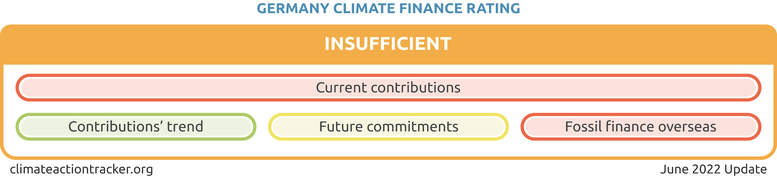
Germany’s international public climate finance contributions are better than most developed countries but still rated “Insufficient.” While Germany continues to present itself as a provider of its fair share of international climate finance, its contributions remain below the level that the CAT considers consistent with its fair-share responsibility.
To improve its rating, Germany needs to increase its international climate finance contributions by around a factor of three post-2020 and urgently stop funding fossil fuel projects abroad. At COP26, Germany signed a declaration to stop financing fossil fuels abroad, but the government’s sector guidelines for export credits still allow investments in existing and new fossil fuel infrastructure outside Germany's borders (Bundesregierung, 2023b).
Germany is the biggest European climate finance donor. According to the CAT estimates, its contributions represent more than half the EU contributions. However, due to the high fair share requirements assessed by the CAT, Germany’s current level of climate finance contributions remain “Highly insufficient.”
Most German contributions for climate finance are distributed via bilateral development cooperation. Funding is implemented by Gesellschaft für internationale Zusammenarbeit (GIZ) and KfW Development Bank. The International Climate Initiative (IKI) is a separate funding mechanism of the Climate and Economics Ministry (BMWK), the Environment Ministry (BMU), and the Federal Foreign Office (AA). A smaller share is disbursed through contributions to multilateral climate funds. A significant share of the finance takes the form of grants, but Germany also relies on other financial instruments, such as concessional loans (Deutsche Klimafinanzierung, 2026a).
Germany’s international climate finance contributions remain below the level the CAT considers a fair contribution. In 2024, Germany provided EUR 6.1bn in climate finance from federal budget resources, meeting its commitment to provide at least EUR 6bn annually in public international climate finance (Bundesministerium für wirtschaftliche Zusammenarbeit und Entwicklung, 2025).
The coalition contract of 2025 states that the German government intends to contribute its fair share to international climate finance. While this signals continued political support, it remains unclear what “fair” means for the absolute level. Recent budget decisions and projections for 2025, 2026 and beyond raise concerns about whether climate finance can be maintained at or above the 6bn level (Deutsche Klimafinanzierung, 2025, 2026b).
The Climate Action Tracker climate finance rating focuses on finance for climate change mitigation, and the data shows an increase in this area over the years, which results in a positive rating of the contribution's trend. A clear and sustained increase in international climate mitigation finance across all areas is fundamental.
Further information on how the CAT rates countries (against modelled pathways and fair share) can be found here.
Net zero and other long-term target(s)
In June 2021, Germany adopted its 2045 net zero target in its revised Climate Change Act. The net zero target generally covers all key elements but fails to meet best practice standards for some of them. Germany also falls under the European Union net zero target (Climate Action Tracker, 2024).
Germany’s target covers all sectors and gases, underpinned by an emissions pathway to 2040 and the communication of binding sectoral targets until 2030. International aviation and shipping remain outside of the target’s scope. A periodic and legally-binding review process of measures and interim targets by an Expert Council is in place. Germany provides separate reduction and removal targets with regards to LULUCF but remains unclear on any other carbon removal. The net zero target is enshrined in law in Germany’s Climate Change Act 2021.
The German government failed to provide explicit and transparent assumptions on some key elements of its net zero target, including not clarifying its key assumptions on the role of carbon storage and removal. Adding to the net zero target’s uncertainty is that the Climate Change Act explicitly reserves the right to use international carbon credits under Article 6.
For the full analysis click here.
Further analysis





Latest publications


Stay informed
Subscribe to our newsletter