
Indonesia
2035 NDC
2035 NDC Target overview

This analysis was published in November 2025.
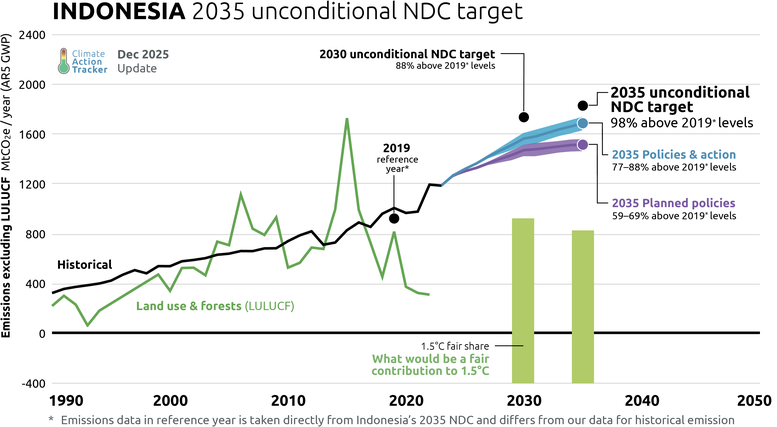
Indonesia’s 2035 unconditional target would lead to emissions higher than our estimate under current policies and remains far above the 1.5°C-compatible fair-share pathway, implying steeply rising emissions for the next 25 years, peaking in 2050 at over double the 2019 levels (excluding LULUCF). The conditional targets only offer marginally stronger emissions reductions in the medium term but then foresee steep reductions after 2035 (lower than our current policy trajectory) to reach net zero by 2060. Such a trajectory is likely infeasible without credible policies, full policy implementation, international climate finance, and other forms of international support.
Worryingly, the new NDC makes no commitment to phasing out coal exploration, production, or coal-fired power generation—an omission that is particularly concerning for one of the world’s largest coal exporters, whose power sector remains heavily dominated by coal. False solutions such as “clean coal” and biomass co-firing remain in the proposed climate mitigation policy measures.
To make its fair contribution to climate action, the country would need to stabilise its emissions at 2019 levels through 2030 and reduce emissions to 10% below 2019 levels by 2035 (excluding LULUCF). Instead, Indonesia’s ambition gap—defined as the difference between the 1.5°C-compatible fair-share level and the unconditional target—increases by 23% between 2030 and 2035.
The new NDC sets a 2035 target and updates the emission pathways for 2030 and 2035. The new 2030 unconditional and conditional scenarios result in a lower absolute emissions limit compared to the 2022 Enhanced NDC. However, the scenarios have not been formally adopted, as the 2035 NDC document specifies that the new target period covers 2031–2035 only. Therefore, we do not consider this a strengthened 2030 target and continue to treat the previously submitted NDC as the valid reference for the 2030 target.
While Indonesia’s NDC improves transparency by shifting from a 2010 BAU baseline to a historical reference year (2019) and expanding GHG coverage, its overall credibility remains undermined by heavy reliance on LULUCF sinks to offset rising emissions in the energy and industry sectors, as well as the continued absence of a coal phase-out commitment—two of the main issues already highlighted in our previous 2025 Bonn briefing and 2024 blog.
The 2035 NDC includes sectoral targets, such as the FOLU Net Sink 2030 and zero waste emissions by 2050, but its reliance on carbon market mechanisms (Article 6) raises risks of incentivising lower NDC ambition and the export of low-cost LULUCF reductions, leaving the country with higher-cost mitigation options in the future. Indonesia estimates a total investment need of around USD 472.6bn to achieve its 2035 climate targets, without distinguishing between domestic investment and international climate finance needs.
| Indonesia | 2035 NDC | |
|---|---|---|
| 2030 target | ||
|---|---|---|
|
Formulation of target in NDC |
Unconditional target: Indonesia has committed to reduce unconditionally 31.89% of its GHG emissions against the business-as-usual scenario by 2030. Conditional target: Indonesia can increase its contribution up to a 43.20% reduction of emissions in 2030, subject to availability of international support for finance, technology transfer and development and capacity building. The new 2030 unconditional and conditional scenarios result in a lower absolute emissions limit compared to the 2022 Enhanced NDC. However, the scenarios have not been formally adopted, as the 2035 NDC document specifies that the new target period covers 2031–2035 only. Therefore, we do not consider this a strengthened 2030 target and continue to treat the previously submitted NDC as the valid reference for 2030 target. |
|
|
Absolute emissions level in 2030 excl. LULUCF |
Unconditional target: 1,737 MtCO₂e (88% above 2019, or 156% above 2010) Conditional target: 1,643 MtCO₂e (78% above 2019, or 142% above 2010) |
|
| Status | Submitted on 23 September 2022 | |
| 2035 unconditional target | ||
|---|---|---|
|
Formulation of target in NDC |
CPOS: 56% increase above the emissions level in the reference year (1,145 MtCO₂e in 2019), including LULUCF | |
| Absolute emissions level in 2035 excl. LULUCF | 1,830 MtCO₂e (98% above 2019, 170% above 2010) | |
| Status | Submitted on 27 October 2025 | |
| 2035 conditional target | ||
|---|---|---|
|
Formulation of target in NDC |
- LCCP-L aims for a 9.8% increase above the emissions level in the reference year (1,145 MtCO₂e in 2019), including LULUCF - LCCP-H aims for a 30% increase above the emissions level in the reference year (1,145 MtCO₂e in 2019), including LULUCF |
|
|
Absolute emissions level in 2035 excl. LULUCF |
- LCCP-L: 1,426 MtCO₂e (54% above 2019, 110% above 2010) - LCCP-H: 1,696 MtCO₂e (84% above 2019, 150% above 2010) |
|
| Status | Submitted on 27 October 2025 | |
Ambition
For the world to have a significant chance of limiting warming to 1.5˚C, governments must switch to emergency mode and strengthen both their 2030 targets and current policies to include substantial emissions cuts and significantly contribute to closing the 2030 emissions gap.
Further information on Indonesia’s 2030 target can be found here.
2030 NDC Target
| 2030 unconditional NDC target | 2030 conditional NDC target | |
|---|---|---|
|
Is the target 1.5°C compatible compared to fair share? |
|
N/A |
| Is the target 1.5°C compatible compared to modelled domestic pathways? | N/A |
Indonesia needs international climate finance and other forms of support to align its 2030 conditional target to 1.5C modelled domestic pathways. |
| Is this a stronger target than previously submitted? |
|
|
2035 NDC Target
| 2035 unconditional NDC target | 2035 conditional NDC target | |
|---|---|---|
|
Is the target 1.5°C compatible compared to fair share? |
|
N/A |
| Is the target 1.5°C compatible compared to modelled domestic pathways? | N/A |
Indonesia needs international climate finance and other forms of support to align its 2035 conditional target to 1.5°C modelled domestic pathways. |
| Does the NDC include sectoral targets? |
The target contains sectoral targets for all of the country’s major emitting sectors. |
The target contains sectoral targets for all of the country’s major emitting sectors. |
| Does the NDC include a renewable energy capacity target? |
The NDC does not contain renewables capacity target; it only makes reference to the National Energy Policy’s primary energy supply mix target for 2030, 2040, and 2060. |
The NDC does not contain renewables capacity target; it only makes reference to the National Energy Policy’s primary energy supply mix target for 2030, 2040, and 2060. |
| Does the target align with the country’s net-zero pathway? |
The unconditional target does not align with the net zero by 2060 target. |
The 2035 NDC conditional targets are linked to the net zero by 2060 target. Caveat: the net zero pathway relies heavily on steep emissions reduction after 2035. |
Indonesia submitted its 2035 NDC mitigation target on 24 October 2025. The country’s unconditional 2035 target aims for a 56% increase above 2019 emissions levels (1,145 MtCO₂e), while the conditional targets (LCCP-L and LCCP-H) aim for 10% and 30% increases above 2019 levels, respectively (including LULUCF). These targets cover all sectors and all gases.
Excluding land use, land use change, and forestry (LULUCF) gives us a baseline of 924 MtCO₂e in 2019. The CAT estimates that the 2035 targets correspond to 1,830 MtCO₂e (CPOS, unconditional target), 1,426 MtCO₂e (LCCP-L, conditional target – low economic growth), and 1,696 MtCO₂e (LCCP-H, conditional target – high economic growth) in 2035, corresponding to emission levels that are 98%, 54%, and 84% above 2019 levels, respectively.
The unconditional 2035 target leads to emissions levels above Indonesia’s current policies trajectory. As a result, it does not drive further emission reductions, as Indonesia can meet the target without introducing additional policies.
When compared to its fair share contribution to climate change mitigation, Indonesia's unconditional target of 1,830 MtCO₂e in 2035 (98% above 2019) is not 1.5°C compatible and far above the 1.5°C threshold of 835 MtCO₂e in 2035 (excl. LULUCF). To make its 1.5°C fair contribution to climate action, Indonesia would need to stabilise its emissions at 2019 levels through 2030 and reduce its emissions to 10% below 2019 levels in 2035 (excl. LULUCF). Under the unconditional NDC pathway, which assumes economic growth of 6.7% in 2035, emissions are projected to continue rising over the next 25 years, peaking around 2050 at nearly double 2019 levels (excl. LULUCF).
The conditional NDC target, corresponding to 54–84% above 2019 levels in 2035, is not compatible with 1.5°C modelled domestic pathways. To reach that level, Indonesia would need to reduce its emissions to 720 MtCO2e (22% below 2019) in 2035 (excl. LULUCF). Under the LCCP-low scenario (assuming 6.7% economic growth in 2035), emissions are projected to peak in 2030 (excl. LULUCF). Under the LCCP-high scenario (assuming 8.3% economic growth in 2035), emissions are projected to peak in 2035 (excl. LULUCF). The conditional LCCP scenarios present only marginally stronger pathways, relying on limited action before 2030 and steep post-2035 reductions to achieve net zero, which are unlikely to occur without credible policies, full policy implementation, international climate finance, and other forms of international support.
The 2035 NDC includes sectoral plans and targets across major emissions sectors:
- The FOLU Net Sink 2030 target aims to reach net negative FOLU (Forestry and Other Land Use) emissions of 140 MtCO₂e by 2030 and net negative emissions of 340 MtCO₂e by 2050.
- The NDC also references the National Energy Policy’s targets for the primary energy supply mix: 19–23% renewable energy by 2030, 36–40% by 2040, and 70–72% by 2060.
- In the waste sector, the 2035 NDC introduces an ambitious goal of achieving “zero waste by 2040” and zero waste emissions by 2050.
These sectoral targets are not explicitly linked nor aligned with the Global Stocktake (GST) goals to triple renewable energy capacity, and end deforestation by 2030.
It is important to note that Indonesia’s 2035 NDC remains heavily reliant on LULUCF sinks to offset the continued growth of fossil fuel emissions. As highlighted in the previous 2025 Bonn briefing and 2024 blog, LULUCF removals are subject to large fluctuations, measurement uncertainties, and lack of permanence, as stored carbon can be released due to natural disturbances or changes in land-use practices. Over-reliance on LULUCF may also divert attention from the deep emissions reduction needed in the energy and industry sectors.
Further information on Indonesia’s targets can be found here.
| Indonesia | Target summary (excluding LULUCF) | |
|---|---|---|
| 2030 target: Emissions reductions from 2019 levels (CAT estimates) | ||
|---|---|---|
| Current policies in 2030 | 65–74% above 2019 | |
| 2030 NDC target | 78–88% above 2019 | |
| 1.5ºC fair share |
Close to 2019 emissions level (924 MtCO₂e) |
|
| 1.5ºC modelled domestic pathway |
7% below 2019 to be reached with international climate finance and other forms of support that facilitate substantial emission reductions domestically |
|
| 2035 target: Emissions reductions from 2019 levels (CAT estimates) | ||
|---|---|---|
| Current policies in 2030 | 77–88% above 2019 | |
| 2035 NDC target | 54–84% above 2019 | |
| 1.5ºC fair share | 10% below 2019 | |
| 1.5ºC modelled domestic pathway |
22% below 2019, to be reached with international climate finance and other forms of support that facilitate substantial emission reductions domestically |
|
Fairness & Finance
Developed countries need to significantly scale up international climate finance and other means of support. They should set 1.5°C aligned domestic mitigation targets in their NDCs and communicate the financial and other support they will provide to developing countries. Developing countries should clearly communicate the climate finance they need to set and achieve ambitious 1.5°C aligned conditional targets.
| 2035 conditional NDC target | |
|---|---|
| Does the target clearly communicate the climate finance and support needed to reach the conditional target? |
|
Most developing countries will need financial support to mitigate emissions beyond what would be their fair share according to effort-sharing frameworks. Therefore, the CAT encourages these governments to put forward an ambitious conditional target that is in line with their 1.5°C modelled domestic pathway, and to quantify climate finance needed, including an implementation plan, to meet the set target.
In its 2035 NDC, Indonesia has communicated that its climate targets would require a total investment of IDR 7,552.5tn (USD 472.6bn). Indonesia does not clearly distinguish its finance need from national budgets and international climate finance. However, the NDC refers to earlier estimates from the Third Biennial Update Report (BUR3), which communicates financing needs of USD 285bn for the conditional targets and USD 281bn for unconditional targets between 2018 and 2030, primarily focused on mitigation.
Indonesia estimates this climate finance need across four main sectors: energy, agriculture, forestry and other land use (FOLU), and does not yet include the industrial processes and product use (IPPU). The government reports constraints in estimating financial support needs due to methodological limitations, data gaps, and different stakeholder perceptions of NDC financing.
Credibility
Credible NDCs should build on robust national planning processes that translate the economy-wide emissions reduction target into action in all sectors. Governments need to ramp up the implementation of their existing targets and further develop policies to close the – still significant – emissions gap between current policies and the 1.5°C pathway. Contradictory policies must be addressed and reversed: fossil fuel production needs to be phased out, while fossil fuel exploration and fossil fuel subsidies need to stop.
| 2035 NDC target | |
|---|---|
| Is the target driving more ambitious action? |
Unconditional NDC Conditional NDC |
| Is there a policy framework in place to increase ambition to meet the target? |
|
| Does the NDC reference national planning processes for its development? |
|
| Does the NDC reference an institutional framework/plan in place for its implementation? |
|
| Does the NDC commit to phase out fossil fuel production? |
|
| Does the NDC commit to stop fossil fuel exploration & subsidies? |
|
Indonesia's 2035 NDC presents a mixed picture on credibility. While the new conditional targets are more ambitious than the previous NDC, the document’s credibility is undermined by contradictory policies that continue to support the fossil fuel industry.
The 2035 NDC is closely aligned with the country’s medium-term development vision. The LCCP-high scenario takes into account Indonesia’s ambitious target of achieving 8% economic growth as stated in the 2025–2029 National Medium-Term Development Plan (RPJMN), which prompted the revision of the first draft of the 2035 NDC earlier this year. Indonesia’s climate targets are being recalibrated to align with this growth ambition, which is also reflected in other national planning documents.
The NDC refers to an institutional framework that outlines coordination between the Directorate General of Climate Change under the Ministry of Environment, the National Development Planning Agency, the Ministry of Finance, sectoral ministries, and the Ministry of Home Affairs for more decentralised, subnational implementation. It also references a broad policy framework on energy conservation, renewable energy acceleration, and waste management.
However, the new NDC makes no commitment to phasing out coal exploration, production, or coal-fired power generation—an omission that is particularly concerning for one of the world’s largest coal exporters, whose power sector remains heavily dominated by coal. False solutions such as “clean coal” and biomass co-firing remain in the proposed climate mitigation policy measures.
While the new NDC claims that Indonesia has “succeeded in removing fossil fuel subsidies”, significant subsidies persist. The government allocated IDR 335tn (USD 21.75bn) for energy subsidies in 2024 and plans IDR 394.3tn (USD 25.8bn) in the 2025 budget for fuel, LPG, and electricity (Reuters, 2024b). Additional implicit subsidies through the coal Domestic Market Obligation (DMO) keep coal power artificially cheap, undermining fiscal space and delaying the transition away from fossil fuels.
Transparency
Governments should set absolute, economy-wide, emissions reduction pathways including all greenhouse gases, specifying the emissions levels for each year as an absolute level of gross emissions (excluding LULUCF). This level of transparency will ensure that their reduction targets are immune to creative accounting. NDC targets should primarily focus on their domestic reductions by decarbonising all sectors of the economy rather than relying on forestry sinks, other carbon dioxide removal (CDR) or international carbon markets.
| 2035 NDC target | |
|---|---|
|
Is the target based on fixed, absolute values? |
Unconditional NDC Conditional NDC |
|
Does the target cover all sectors? |
|
|
Does the target cover all greenhouse gases? |
|
|
Does the target specify an emissions pathway? |
|
|
Does the target separate out land use and forestry? |
|
|
Does the target separate out other CO2 removal by type? |
|
|
Does the target separate out the use of carbon credits under Article 6? |
|
It is a positive step that Indonesia has shifted from a Business-as-Usual (BAU) baseline to a historical reference year, with targets now expressed as emissions levels below 2019 values rather than relative to a 2010 BAU projection. The previous 2022 Enhanced NDC covers CO₂, CH₄, and N₂O, while the new 2035 NDC expands this to include HFCs.
The 2035 NDC also applies to all major sectors: energy, industrial processes and product use (IPPU), waste, agriculture, and forestry and other land use (FOLU). Its new conditional targets are linked to the scenarios outlined in the long-term low carbon and climate resilience strategy (LTS-LCCR 2050), which charts the country’s pathway to reach net zero emissions by 2060.
Indonesia continues to not separate its mitigation and removal targets and relies heavily on the LULUCF sector to meet its conditional NDC targets, diverting attention and efforts from necessary emission reductions in the critical sectors of energy and industry. The government aims to turn the FOLU sector into a net sink by 2030, but lacks credible commitments and policies to halt its ongoing commodity-driven deforestation and forest degradation.
The new 2035 NDC also introduces blue carbon as a mitigation measure. While important for climate adaptation and resilience, ocean-based sequestration should not offset fossil emissions given its uncertainty and lack of permanence.
In addition, the new NDC expresses Indonesia’s openness to international cooperation for Article 6 implementation without providing safeguards to prevent double-counting and other integrity risks.
Article 6 use for developing countries
Indonesia intends to use both market and non-market mechanisms of Article 6 of the Paris Agreement, where it exceeds its NDC targets. This presents two risks: first, that Indonesia may be incentivised to aim for a lower level of ambition in its NDC in order to meet the criteria to create “excess” reductions eligible for sale. This is opposite to the objective of Article 6, which is to allow for higher ambition in a country’s mitigation and adaptation actions and to promote sustainable development and environmental integrity. The fact that the unconditional target leads to higher emissions than Indonesia’s current policies trajectory is an indication that a decrease in ambition has already happened.
Second, Indonesia risks selling emission reductions that are relatively inexpensive or would have occurred anyway (its “low-hanging fruit” reductions, particularly from the LULUCF sector). This could leave the country with fewer and more costly abatement options to increase its own mitigation ambition in the future.
Finally, finance generated through the purchase of carbon credits (ITMOs) under Article 6 should not be counted as climate finance (an obligation for developed countries under Article 9). ITMO transactions are designed to help the buyer country achieve its targets, while the selling country must make a corresponding adjustment that effectively makes the achievement of its target more difficult.
For more information on the promise and pitfalls of Article 6 mechanisms, see the recent CAT briefing here.
For more information on Indonesia’s climate targets and policies, please click here. For the CAT’s full recommendations for setting NDC targets that form the basis of the analysis above, please click here.
Further analysis





Country-related publications

Stay informed
Subscribe to our newsletter