
Indonesia
Net zero targets
Summary
We evaluate the net zero target as: Target information incomplete
Indonesia is exploring scenarios that could lead to net zero by 2060 or sooner in its Long-Term Strategy for Low Carbon and Climate Resilience (LTS-LCCR) document submitted to the UNFCCC in July 2021. A net zero pathway is also included in the 2035 NDC, particularly under the Low Carbon Scenarios Compatible with the Paris Agreement (LCCP), which could be interpreted as the country’s conditional targets under both low and high economic growth scenarios.
As a developing economy, Indonesia’s goal of reaching net zero for all greenhouse gases by 2060 can be considered ambitious and broadly aligned with what is needed globally to limit warming to 1.5°C, as outlined in the IPCC’s Sixth Assessment Report (AR6). However, the target relies on steep emissions reductions after 2035, with minimal or no reductions before then and only a plateau around 2030. This delayed trajectory is why Indonesia’s near-term NDC targets are rated as “Highly Insufficient” or “Critically Insufficient”, even as the long-term net zero target is viewed as more ambitious.
In November 2024, the President made an announcement to achieve net zero emissions before 2050, a decade earlier than previously indicated (AP News, 2024). While these announcements signal a positive shift in the country’s energy and climate commitments, the complexity of Indonesia’s power sector and the existing policy and regulatory framework present structural barriers to implementing these pledges quickly. The President’s leadership in reforming the regulatory framework and aligning policies is a prerequisite to achieving these targets.
The CAT currently does not evaluate Indonesia’s net zero target given the lack of more detailed information. The CAT will do so once further information will be communicated by the government.
CAT analysis of net zero target
Scope
- Target year – Indonesia aims to reach net zero by 2060 or sooner.
- Emissions coverage – Indonesia provides no explicit information on the target’s emissions coverage. The LTS considers some, but not all GHGs – the energy sector analysis focuses on CO2; while the waste sector analysis considers CO2 and CH4; industry considers CO2, N2O, PFCs, omitting HFCs and SF6; and the AFOLU sector considers CO2, CH4, and N2O.
- International aviation and shipping – Indonesia provides no information on its intention to cover international aviation and shipping.
- Reductions or removals outside of own borders – Indonesia provides no information on its intention to use international offset credits to meet its net zero target.
Target architecture
- Legal status – Indonesia has not yet communicated an explicit net zero target but explores scenarios that could lead to net zero by 2060 or sooner in its long-term strategy (LTS) submitted to the UNFCCC in July 2021. A net zero pathway is also included in the 2035 NDC, particularly under the Low Carbon Scenarios Compatible with the Paris Agreement (LCCP), which could be interpreted as the country’s conditional target under both low and high economic growth scenarios.
- Separate reduction & removal targets – Indonesia provides no information on its intention to communicate separate emission reduction and removal targets.
- Review process – Indonesia provides no information on its intention to establish a formal review cycle for its net zero and intermediate targets. However, the LTS-LCCR notes that it will be monitored, reviewed, and updated as necessary, taking into account national circumstances, capacity, and the provisions of the Paris Agreement.
Transparency
- Carbon dioxide removal – Indonesia provides no information on its intention to communicate transparent assumptions on carbon dioxide removals. The country primarily relies on its FOLU sector to achieve a net sink, with quantitative targets specified for actions such as peatland restoration and afforestation/reforestation. Indonesia aims to peak national GHG emissions by 2030, anchored by a FOLU Net Sink target of –140 MtCO₂e. By 2050, the FOLU sector is expected to reach –304 MtCO₂e.
- Comprehensive planning – The LTS-LCCR 2021 and the LCCP scenarios in the 2035 NDC explore pathways that could lead to net zero by 2060 or sooner, although Indonesia does not yet formally commit to a pathway. In addition to relying heavily on its FOLU Net Sink target, key mitigation measures include decarbonising the energy sector through large-scale renewable deployment, reducing coal consumption, and adopting Carbon Capture, Utilisation and Storage (CCUS) technologies. As mentioned, CCUS remains neither commercially viable nor proven at scale and should be limited to industrial applications with few abatement alternatives, not used to prolong fossil fuel use in the power sector, where cost-effective renewable alternatives exist.
- Clarity on fairness of target – Indonesia provides some information that its target has taken into account the country’s economic development needs and climate justice, citing the Common but Differentiated Responsibilities and Respective Capabilities (CBDR-RC) principle. However, it lacks detail on how the government defines the target as the country’s fair share.
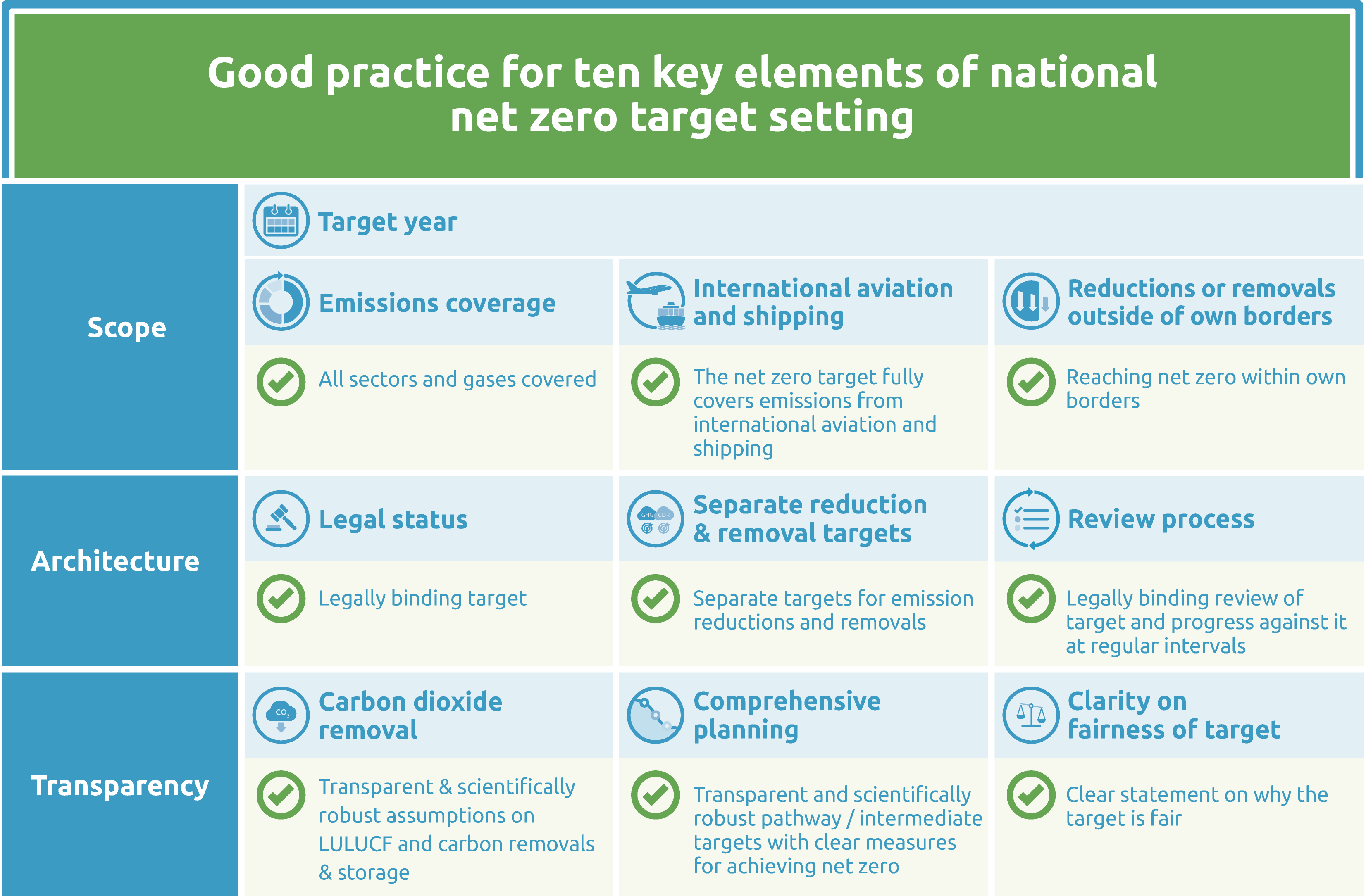
Good practice
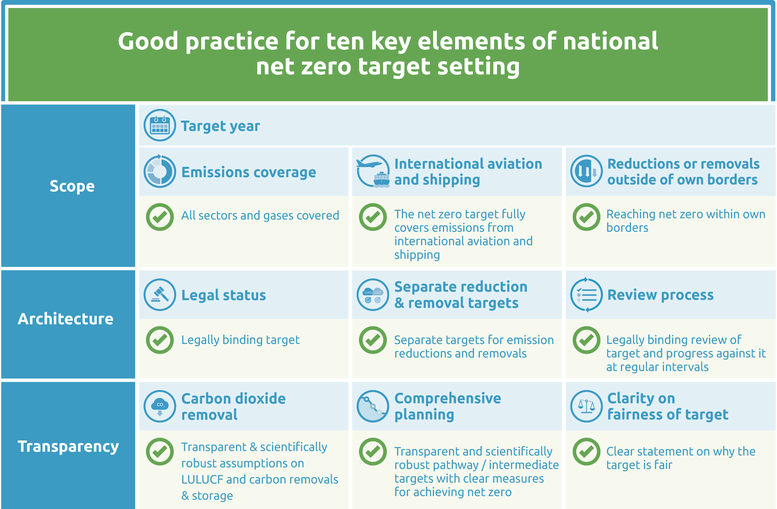
The Climate Action Tracker has defined the following good practice for all ten key elements of net zero targets. Countries can refer to this good practice to design or enhance their net zero targets.
Further analysis





Country-related publications

Stay informed
Subscribe to our newsletter