
Norway
Net zero targets
Summary
NOTE: Norway’s 2050 target is not a net zero target, rather it targets a 90–95% reduction below 1990 levels. In the absence of a net zero target, the CAT assesses Norway’s 2050 emissions reductions target.
We evaluate Norway’s 2050 target as: Average.
Norway has committed to a 90–95% GHG emissions reduction below 1990 levels by 2050 and included this target in its long-term strategy (LTS) submitted to the UNFCCC (Government of Norway, 2020b). While the target generally covers the key elements, it should be noted that Norway has not yet committed to reaching net zero.
Norway’s continued oil and gas exploration and production poses a potential risk to global efforts to achieve net zero emissions by 2050 given the large-scale exporting of downstream emissions. Meanwhile, Norway’s 2050 target does not include a commitment to ramp down the oil and gas industry that constitutes a large proportion of Norway’s export economy.
Norway’s target covers all sectors and gases, although international aviation and shipping remain outside its scope. It also commits to including emission reductions achieved by Norwegian companies in the EU through the EU ETS. A periodic review of measures and interim targets is in place.
The Norwegian government currently fails to provide explicit and transparent assumptions on several key elements of the target. While the government reserves the right to meet its reduction goals through international credits, the Climate Change Act does not specify the portion of the 2050 target that will be met through domestic action. Offsets have played a major role in previous Norwegian climate action. Norway also fails to communicate transparent assumptions on carbon storage and removal and does not provide separate reduction or removal targets.
CAT analysis of 2050 target
* Norway’s 2050 target is not a net zero target, rather it targets a 90–95% reduction below 1990 levels. In the absence of a net zero target, the CAT assesses Norway’s 2050 target.
Ten key elements
Scope
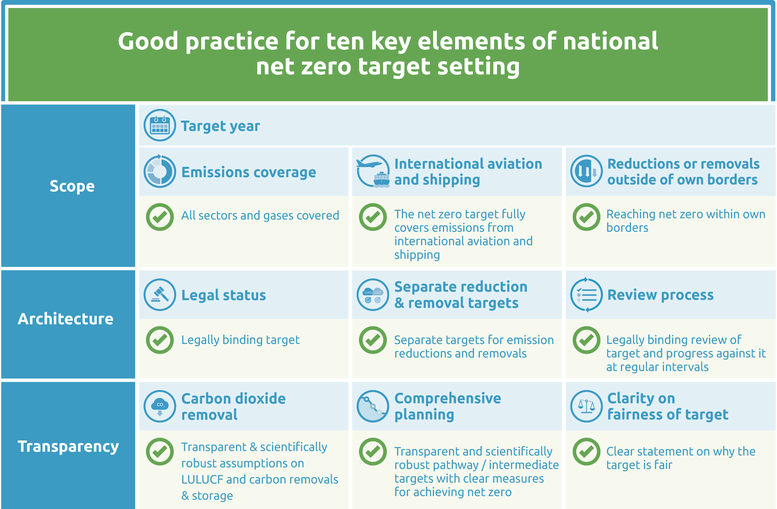
- Target year – Norway aims to reach a GHG emissions reduction of 90–95% by 2050 but has so far not set a year to reach net zero emissions.
- Emissions coverage – The target covers all GHG emissions (i.e., the 7 Kyoto gases: CO2, CH4, N2O, HFCs, PFCs, SF6, NF3) and all sectors of the economy (excluding international bunkers). At the same time, the target only concerns an emissions reduction of 90–95% from 1990 levels.
- International aviation and shipping – Norway provides no information on its intention to cover international aviation. From 1 January 2024 the EU Emissions Trading System has been extended to emissions from shipping, a change that applies to both Norway and Iceland (European Commission, 2025b).
- Reductions or removals outside of own borders – Norway states that emissions reductions achieved in the EU by Norwegian companies via Norway’s participation in the EU emissions trading system are to be included in an assessment of progress towards achieving Norway’s 2050 target.
Target architecture
- Legal status – the Norwegian parliament passed the Norwegian Climate Act on June 16, 2017, enshrining a GHG emissions reduction target of 80–95% by 2050 (from 1990 levels) (Government of Norway, 2017). A government declaration on January 17, 2019, raised this ambition to 90–95% by 2050 (Government of Norway, 2019). This target is included in Norway’s LTS and was formally adopted with an amendment to Norway’s Climate Change Act in 2021 (Government of Norway, 2020b; Morel, 2022).
- Separate reduction & removal targets – Norway provides no information on its intention to communicate separate emissions reductions and removal targets.
- Review process – Norway’s amended Climate Change Act includes a commitment to submit updated climate targets every fifth year that shall:
- Be based on the best available scientific knowledge; and
- As far as possible, be quantitative and measurable.
The Act states that these targets should represent a progression from the preceding targets and promote a gradual transformation in the period up to 2050 (Government of Norway, 2017).
Transparency
- Carbon dioxide removal – As part of its LTS, Norway outlines its intention to use carbon dioxide removals from the forestry sector to balance residual emissions, but does not specify to what extent these will be used to meet its emissions reduction targets.
- Comprehensive planning – The Norwegian Climate Act established an interim target of a 40% emissions reduction by 2030 (from 1990 levels), which was subsequently raised to at least a 55% reduction by the government in 2021. To achieve its 2050 target, Norway presented a white paper outlining comprehensive climate action (Government of Norway, 2021b). Measures include, but are not restricted to, a gradual carbon tax rate increase, biofuel obligations from 2022, vehicle taxes, requirements for zero-emission solutions for passenger cars in 2022 and buses from 2025, as well as increased financial support for innovation and development.
- Clarity on fairness of target – Norway makes no reference to fairness or equity in the context of its 2050 target, nor does it explain how to close the gap between the current target and a more equitable target.
Good practice
The Climate Action Tracker has defined the following good practice for all ten key elements of net zero targets. Countries can refer to this good practice to design or enhance their net zero targets.
Further analysis





Latest publications





Stay informed
Subscribe to our newsletter