Norway
Targets
Target Overview
In June 2025, Norway submitted its 2035 NDC to the UNFCCC, committing to reduce its emissions by 70-75% below 1990 levels by 2035. While we consider Norway’s 2035 target 1.5°C compatible compared to modelled domestic pathways, a lack of detail on the expected contribution from the land use and forestry sector (LULUCF) and plans to rely on carbon credits raise concerns about the target’s true ambition. For our full analysis, please see the 2035 NDC tab here.
Following the recently-elected Støre government’s pledge to strengthen Norway’s 2030 emissions reduction target, Norway formally submitted a renewed 2030 NDC in November 2022. In the revised NDC, the government increased its 2030 emissions reductions target from 50–55% to at least 55% below 1990 levels. The revised target is aligned with the EU’s NDC target and represents progress beyond Norway’s previous submission in 2020.
Norway intends to achieve this target in collaboration with the EU through the European Economic Area (EEA) Agreement, first agreed to in 1994 and revised in 2019 (EEA Joint Committee, 2019). Norway will regulate emissions from all economic sectors through three pieces of legislation: the EU Emissions Trading Scheme, the EU Effort Sharing Regulation (ESR), and the Land Use, Land-Use Change and Forestry (LULUCF) Regulation.
Under the Effort Sharing Regulation (ESR), which covers sectors not included in the EU ETS, Norway is only required to reduce non-ETS emissions by 40% by 2030, although it increased this to 45% in its Climate Action Plan 2021-2030. This is not compatible with its overall 55% target, since most of Norway’s emissions reductions must come from sectors not covered by the EU ETS.
Under the LULUCF Regulation, Norway commits to no net emissions from the LULUCF sector between 2021 and 2030 (Government of Norway, 2020c). Norway is permitted to use up to 1.6 MtCO2e in net removals from the land sector towards meeting its 2030 NDC although this amount may be revised in subsequent agreements between Norway and the EU.
Norway does not have a net zero target but has committed to reduce emissions by 90–95% below 1990 levels by 2050. This target is included in Norway’s long-term strategy submitted to the UNFCCC in 2021 and restated in Norway’s latest 2030 NDC submission.
| NORWAY - Main climate targets |
|---|
| 2030 NDC target | |
|---|---|
| Formulation of target in NDC | To reduce emissions by at least 55% below 1990 levels by 2030. |
| Absolute emissions level in 2030 excl. LULUCF |
24.5 MtCO2e [52% below 1990] [55% below 2010] |
| Status | Submitted on 3 November 2022 |
| Net zero & other long-term targets | |
|---|---|
| Formulation of target | Achieve emission reductions of 90–95% below 1990 levels by 2050 |
| Absolute emissions level in 2050 excl. LULUCF |
13.7–15.7 MtCO2e [69–72% below 1990] [71–75% below 2010] |
| Status | Submitted on 25 November 2020 |
NDC Updates
In November 2022, Norway submitted a stronger target compared to its previous 2030 NDC submission, increasing its 2030 emissions target from a 50–55% reduction to at least 55% below 1990 levels. This updated target represents progress beyond Norway’s previous submission and a significant step up from its 2030 NDC target submitted in 2016 of reducing emissions by 40% below 1990 levels by 2030.
In 2023, both the ESR and LULUCF Regulations were amended to align with the EU’s updated NDC target of reducing the EU’s emissions by at least 55% by 2030 below 1990 levels (Regulation (EU) 2023/839 of the European Parliament and of the Council, 2023; Regulation (EU) 2023/857 of the European Parliament and of the Council, 2023). However, neither the amendments to the ESR nor the LULUCF Regulation have yet been incorporated into the EEA Agreement (European Commission, 2025a). This means that Norway’s commitments under the initial ESR and LULUCF Regulation from 2018 are not compatible with the updated 55% target.
In June 2025, Norway submitted its 2035 NDC with an emissions reductions target of at least 70-75% below 1990 levels. The full analysis of Norway’s 2035 target can be found here.
| NORWAY — History of NDC updates | First NDC (2016) | Updated NDC (2020) | Updated NDC (2022) |
|---|---|---|---|
| 1.5°C Paris Agreement compatible |
|
|
|
| Stronger target | N/A |
|
|
| Fixed/absolute target |
|
|
|
Comparison of 2030 NDC Targets
| First NDC (2016) | Updated NDC (2020) | Updated NDC (2022) | |
|---|---|---|---|
| Formulation of target in NDC |
Unconditional target: At least 40% reduction in 2030 below 1990 levels. To be developed into an emissions budget for the period 2021 to 2030. |
Unconditional target: At least 50% and towards 55% reduction of GHG by 2030 compared to 1990 levels. |
Unconditional target: At least 55% reduction in greenhouse gas emissions by 2030 compared to 1990 levels. |
| Absolute emissions level in 2030 (excl. LULUCF) |
Unconditional target: 32.1 MtCO2e |
Unconditional target: 24.5–27.0 MtCO2e |
Unconditional target: 24.7 MtCO2e |
| Emissions compared to 1990 and 2010 (excl. LULUCF) |
Unconditional target: 37% below 1990 emissions by 2030 41% below 2010 emissions by 2030 |
Unconditional target: 47–52% below 1990 levels 51–55% below 2010 levels |
Unconditional target: At least 52% below 1990 emissions by 2030 At least 55% below 2010 emissions by 2030 |
| CAT rating |
Overall rating*: Insufficient |
Overall rating*: Insufficient |
NDC target compared to modelled domestic pathways: 1.5°C compatible NDC target compared to fair share: Insufficient |
| Sector coverage | Economy-wide | Unchanged | Unchanged |
| Separate target for LULUCF | No, but under EU Regulation, Norway has committed to reaching net zero emissions from LULUCF in 2030 | Unchanged | Unchanged |
| Gas coverage | All greenhouse gases | Unchanged | Unchanged |
| Target type | Absolute emissions reduction from a base year | Absolute emissions reduction from a base year (single year target) | Unchanged |
* Before September 2021, all CAT ratings were based exclusively on fair share and only assessed a country’s target.
Timeline of 2030 NDC developments & previous CAT analysis
- 7.2.2020: Norway updated its NDC in 2020
- 3.11.2022: Norway updates its NDC again in 2022
CAT Rating
The CAT rating compares NDC targets to country fair share contributions to global climate change mitigation, considering a range of equity principles including responsibility, capability, and equality. The CAT also compares NDC targets to indicative national emissions from global least-cost emissions pathways (called modelled domestic pathways). For assessing targets with fair share, we consider both a country’s domestic emissions reductions and any emissions it supports abroad through the use of market mechanisms or other ways of support, as relevant. Further information on how the CAT rates countries (against modelled domestic pathways and fair share) can be found here.
In its 2030 NDC update submitted in 2020, Norway had indicated that it may use voluntary cooperation under Article 6 of the Paris Agreement for part of its NDC target if the EU did not also update its target to the same level (Government of Norway, 2020c). In December 2020 the EU submitted its updated NDC, targeting at least a 55% reduction in emissions below 1990 levels. As the EU's NDC now matches Norway’s latest unconditional target of at least 55%, we interpret Norway’s 2030 target as being domestic, for the time being (i.e. with no emissions reductions achieved through international credits), although this may change in the future. In its next 2030 NDC update from 2022, Norway states it could use Article 6 mechanisms to meet emissions reductions going “beyond what is achieved through the climate cooperation with the European Union” (Government of Norway, 2022b).
The CAT rates Norway's 2030 NDC target as aligned with least cost modelled domestic pathways which limit warming to 1.5°C and "Insufficient" when rated against its fair share contribution. Since Norway does not have a specific target for emission reductions abroad, as is the case with Switzerland, for example, we rate its NDC target against both frameworks.
We rate Norway’s updated 2030 NDC as "1.5C compatible" when compared to modelled domestic pathways. The "1.5°C compatible" rating indicates that Norway’s NDC target in 2030 is consistent with its share of a global least-cost pathway limiting warming to 1.5°C. Our 1.5°C modelled domestic pathway is based on global least-cost mitigation and defines the minimum level of domestic emissions reductions needed to be 1.5°C compatible and should be taken as the floor and not ceiling for domestic ambition. Norway has strengthened its 2030 target to at least a 55% reduction below 1990 levels, which was formally communicated to the UNFCCC in 2022.
We rate Norway’s updated 2030 NDC target as "Insufficient" when compared with its fair share contribution to climate action. The "Insufficient" rating indicates that Norway’s NDC target in 2030 needs substantial improvements to be consistent with its fair share of the global mitigation effort to limit warming to 1.5°C. Norway’s target is at the least stringent end of what would be a fair share of global effort, and is not consistent with the 1.5°C limit, unless other countries make much deeper reductions and comparably greater effort. If all countries were to follow Norway’s approach, warming would reach over 2°C and up to 3°C.
Where further domestic emissions reductions are not possible, Norway will need to develop clear and ambitious plans to support climate action in other countries, particularly through capacity building, technology transfer, and climate finance. Without such support, Norway cannot be properly aligned with the Paris Agreement’s commitment to reflect equity and the principle of “common but differentiated responsibilities” in climate action. Norway’s international climate finance contributions are rated “Insufficient” (see below) and are not enough to improve its fair share rating.
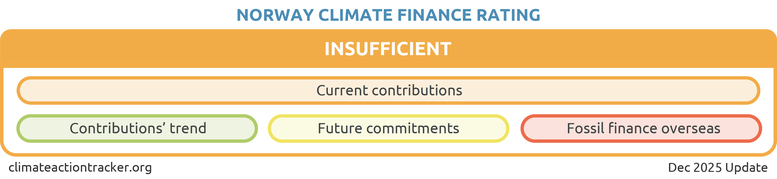
Norway is the only country to meet our benchmark for current climate finance contributions based on the USD 100 bn commitment (which we still consider insufficient) and is committed to doubling its climate finance from NOK 7 bn (USD 770 m) in 2020 to NOK 14 bn (USD 1.54 bn by 2026 at the latest (Government of Norway, 2021a). Norway met and exceeded this pledge in 2022 and by 2023 had reached NOK 16.5 bn in commitments (Government of Norway, 2024a).
However, despite this increase Norway has not committed to a new financing target and continues to use its financial resources to support fossil fuels. The Norwegian Oil Fund is the largest fossil fuel investor in Europe with NOK 700 bn (USD 70 bn) invested in 214 companies worldwide as of 2024 (Nordic Center for Sustainable Finance, 2024). 94% of the Fund’s investments are in fossil fuel companies with expansion plans – a strategy that is both environmentally and economically unsustainable.
We rate Norway’s contributions to international climate finance as “Insufficient.”
Norway’s international contributions are the highest among countries assessed by the CAT, considering its mitigation obligations. Norway also ranks first in finance provided as a portion of gross national income (GNI) and is committed to spending 1% of GNI as international support for achieving the Sustainable Development Goals (SDGs), making it one of the most generous providers of official development assistance (ODA) (OECD, 2025). Some of the country’s main initiatives are the Norwegian International Climate and Forest Initiative (NICFI) and contributions to multilateral institutions and funds, such as the World Bank and the Global Environment Facility (GEF). A large portion of Norway’s contributions have climate as a main objective and take the form of grants.
Overall annual contributions slightly decreased between the signing of the Paris Agreement and 2019, but 2020 saw a sizeable increase year-on-year, when Norway doubled its contributions to the Green Climate Fund (GCF) from the initial round of funding to the first replenishment (Government of Norway, 2021c). In 2024 the NICFI, the country’s largest climate finance program, was extended to 2035 (Government of Norway, 2024b).
Norway has not committed to stop funding fossil fuels overseas and continues to allow new domestic oil and gas exploration. Norway’s parliament voted in 2019 for its sovereign wealth—the Government Pension Fund of Norway—to divest from some investments in oil and natural gas exploration and production. The decision affected nearly USD 6 bn of investments. However, investment in major oil companies remains and the parliament’s move was much weaker than a central bank proposal in 2017 which sought to divest from all petroleum firms (valued at USD 37bn) (Solsvik, 2019). In 2021, Norway announced it would offer oil and gas firms financial support in measuring and assessing climate risks in their investment portfolios Click or tap here to enter text. (Schwartzkopff, 2021).
Norway could act boldly and strengthen its climate finance by:
- Moving to further divest the Government Pension Fund of Norway from oil and gas firms until all stakes in petroleum investments have been sold.
- Ending investments from the Norwegian Oil Fund in fossil fuel companies with expansion plans and instead requiring renewable transition plans as a condition of investment.
- Funding more programmes to promote decarbonisation abroad, like a recent USD 200 m investment with the UN Development Programme (UNDP) to deploy high-capacity cogeneration units and solar power across Ukraine, greening and stabilising its war-torn energy sector (UNDP, 2025).
- Committing to an ambitious climate finance goal for post-2026 in line with real needs, which are much larger than the old USD 100 bn goal.
Further information on the CAT climate finance ratings can be found here.
Net zero and other long-term targets
Norway has committed to a 90–95% GHG emissions reduction below 1990 levels by 2050 and included this target in its long-term strategy submitted to the UNFCCC (Government of Norway, 2020b). While the target generally covers the key elements, Norway has not yet committed to a formal net zero target. Nevertheless, we rate Norway’s 2050 target as “Average,” using our standard methodology for evaluating net zero targets.
Our full analysis can be found here.
Further analysis





Latest publications




Stay informed
Subscribe to our newsletter