
South Africa
2035 NDC
2035 NDC Target
This analysis was published in December 2025.
South Africa's 2035 NDC targets continue the historical trend of declining emissions and are lower than the previous 2030 target range. But the level of ambition has not substantially increased from the 2030 NDC, with the new targets being less compatible with a 1.5˚C aligned pathway than the 2030 targets. The country has seen declining emissions in recent years and the government is in the process of implementing improvements to climate policies and governance. Yet implementation gaps are apparent: the phase-out of coal in the country’s power sector has faced major delays from previously communicated timelines and the implementation of decarbonisation measures in buildings, transport and industry is slow.
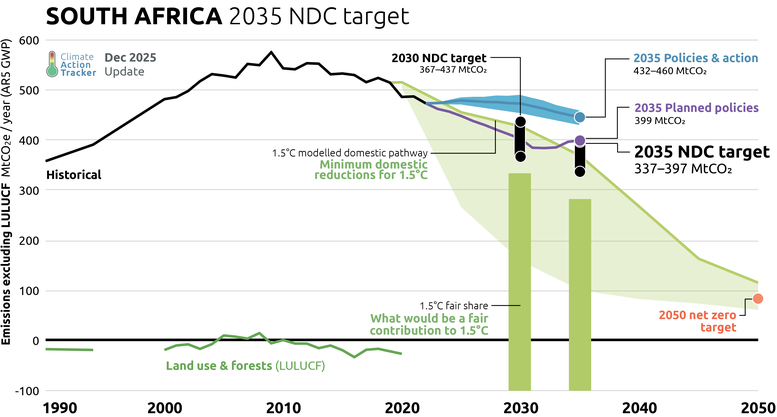
The 2035 NDC aims for a continuation of the current trend of gradually declining emissions. Historical data shows that South Africa’s emissions peaked around 2009 and have undergone a slow decline since. The newly announced 2035 NDC targets follow this trend, aiming for emissions to reach 337–397 MtCO2e in 2035 (excl. LULUCF).
The CAT estimates that the new targets place South Africa close to, but not fully aligned with, a 1.5˚C compatible trajectory. The 2035 NDC targets do not represent an increase in ambition levels from the previously-submitted 2030 targets. The CAT estimates that the gap between the target range of emissions to a fully aligned 1.5 pathway has widened with the new 2035 targets, compared to the 2030 targets which fall almost entirely within the 1.5˚C aligned pathway. The gap between the higher level of the 2030 target range to the 1.5˚C trajectory was around 11 MtCO2e. For the 2035 targets, this gap has widened to 28 MtCO2e.
The NDC commits to an absolute level of emissions for 2035, expressed as a range, with the more ambitious half roughly falling within the CAT’s 1.5˚C compatible modelled domestic pathway (MDP) for South Africa, while the less ambitious half is above the 1.5˚C compatible pathway. The target range of emissions falls entirely above the CAT’s estimate of South Africa’s fair share contribution to global climate mitigation efforts to limit warming to 1.5˚C.
South Africa’s 2035 NDC incorporates many criteria which the CAT considers to be good practice, such as setting economy-wide targets and in absolute emission levels. The NDC could be further strengthened by clearly separating out LULUCF emissions from overall targets and creating a separate target for LULUCF.
South Africa’s 2030 and 2035 targets would also benefit from narrowing the range to reduce uncertainty about the true level of ambition. A clearer description of the policies or financing the government believe necessary to achieve the upper versus lower bound of the range would also improve transparency.
| South Africa | 2035 NDC | |
|---|---|---|
| 2030 target | ||
|---|---|---|
| Formulation of target in NDC | South Africa has not updated the ambition of its 2030 target, please see full 2030 NDC assessment here. | |
| Status | Submitted on 27 September 2021 | |
| 2035 unconditional target | ||
|---|---|---|
| Formulation of target in NDC | South Africa’s annual GHG emissions will be between 320-380 Mt CO2e in 2035 [incl. LULUCF] | |
| Absolute emissions level in 2035 excl. LULUCF |
337–397 MtCO2e [18% below 2023] |
|
| Status | Submitted on 24 October 2025 | |
Note: South Africa does not set alternative conditional and unconditional targets. References are made to the expectation that international support will be provided, and South Africa has already received financial support under the JET-P programme. However, the NDC also commits to implementing domestic measures to achieve the targets. The CAT therefore considers the target range to be an unconditional commitment.
Ambition
For the world to have a significant chance of limiting warming to 1.5˚C, governments must switch to emergency mode and strengthen both their 2030 targets and current policies to include substantial emissions cuts and significantly contribute to closing the 2030 emissions gap. South Africa’s submitted 2035 NDC target did not increase the ambition of its 2030 target.
Further information on South Africa’s 2030 target can be found here.
2030 NDC target
| 2030 NDC target | ||
|---|---|---|
| Is the target 1.5°C compatible compared to fair share? |
|
|
| Is the target 1.5°C compatible compared to modelled domestic pathways? |
|
|
| Is this a stronger target than previously submitted? |
|
|
2035 NDC target
| 2035 NDC target | ||
|---|---|---|
| Is the target 1.5°C compatible compared to fair share? |
|
|
| Is the target 1.5°C compatible compared to modelled domestic pathways? |
|
|
| Does the NDC include sectoral targets? |
|
|
| Does the NDC include a renewable energy target? |
|
|
| Does the target align with the country’s net-zero pathway? |
|
|
The CAT rates the targeted 2030 range of emissions to be achieved by 2030 in South Africa’s first NDC as almost sufficient. Most of the 2030 target range falls within South Africa’s 1.5°C-aligned least cost pathway.
The 2035 NDC signals a reluctance on the part of the South African government to commit to increasing its climate action. Compared to the 2030 target, the 2035 target range is less compatible with the 1.5°C-aligned least-cost trajectory. If South Africa fails to meet the lower half of its target range for 2035, it will not be 1.5°C aligned according to the least-cost trajectory.
When compared to its fair share contribution to climate change mitigation, South Africa's unconditional target, of a 16–29% reduction below 2022 levels in 2035, is not 1.5°C compatible because it lies above the 1.5°C-compatible fair share threshold of 284 MtCO2e, excluding LULUCF. To make its fair contribution to climate action South Africa would need to further reduce its emissions to 40% below 2022 levels in 2035, excluding LULUCF.
| South Africa | Target summary (excluding LULUCF) | |
|---|---|---|
| 2030 target: Emissions reductions from 2022 levels (CAT estimates) | ||
|---|---|---|
| Current policies in 2030 | -4 to 4% (i.e., between a 4% decrease and 4% increase) | |
| 2030 NDC target | 8–23% | |
| 1.5ºC fair share | 30% | |
| 1.5ºC modelled domestic pathway | 10% | |
| 2030 target: Emissions reductions from 2022 levels (CAT estimates) | ||
|---|---|---|
| Current policies in 2035 | 3–9% | |
| 2035 NDC target | 16–29% | |
| 1.5ºC fair share | 40% | |
| 1.5ºC modelled domestic pathway | 22% | |
Fairness & Finance
Developed countries need to significantly scale up international climate finance and other means of support. They should set 1.5°C aligned domestic mitigation targets in their NDCs and communicate the financial and other support they will provide to developing countries. Developing countries should clearly communicate the climate finance they need to set and achieve ambitious 1.5°C aligned conditional targets.
| 2035 NDC | ||
|---|---|---|
| Does the NDC clearly communicate the climate finance and support needed to reach the conditional target? |
|
|
Most developing countries will need financial support to mitigate emissions beyond what would be their fair share according to effort-sharing frameworks. Therefore, the CAT encourages these governments to put forward an ambitious conditional target that is in line with their 1.5°C modelled domestic pathway, and to quantify climate finance needed, including an implementation plan, to meet the set target.
South Africa has communicated that it would need climate finance and other support mechanisms to achieve its 2035 targets. The NDC outlines an estimated total investment of ZAR 3.47tn, (approximately USD 201.6bn), for mitigation projects to achieve its 2035 NDC target range. But it does not state how much of this total investment figure should be met by international support. The NDC also does not clarify what share of the target range of emissions reductions is reliant on financial support.
Credibility
Credible NDCs should build on robust national planning processes that translate the economy-wide emissions reduction target into action in all sectors. Governments need to ramp up the implementation of their existing targets and further develop policies to close the – still significant – emissions gap between current policies and the 1.5°C pathway. Contradictory policies must be addressed and reversed: fossil fuel production needs to be phased out, while fossil fuel exploration and fossil fuel subsidies need to stop.
| 2035 NDC target | ||
|---|---|---|
|
Is the target driving more ambitious action? |
|
|
|
Is there a policy framework in place to increase ambition to meet the target? |
|
|
|
Does the NDC reference national planning processes for its development? |
|
|
|
Does the NDC reference an institutional framework/plan in place for its implementation? |
|
|
|
Does the target commit to phase out fossil fuel production? |
|
|
|
Does the target commit to stop fossil fuel exploration & subsidies? |
|
|
South Africa’s second NDC does not outline in sufficient detail how it will achieve its targets.
The South African government is in the process of strengthening climate action and governance with several commendable achievements in recent years, including the passing of the Climate Change Act in 2024. However, past targets have faced implementation gaps. The phase-out of coal in the country’s power sector has faced major delays from previously communicated timelines and the implementation of decarbonisation measures in buildings, transport and industry is too slow.
While the targets outlined in the first and second NDCs are technically achievable and feasible, the credibility of the targets relies on further evidence of detailed sectoral planning, more evidence of policy implementation, an accelerated coal phase-out, as well as securing sustainable financial support from a variety of international stakeholders.
Transparency
Governments should set absolute, economy-wide, emissions reduction pathways including all GHG gases, specifying the emissions levels for each year as an absolute level of gross emissions (excluding LULUCF). This level of transparency will ensure that their reduction targets are immune to creative accounting. NDC targets should primarily focus on their domestic reductions by decarbonising all sectors of the economy rather than relying on forestry sinks, other carbon dioxide removal (CDR) or international carbon markets.
| 2035 NDC target | ||
|---|---|---|
|
Is the target based on fixed, absolute values? |
|
|
| Does the target cover all sectors? |
|
|
| Does the target cover all greenhouse gases? |
|
|
| Does the target specify an emissions pathway? |
|
|
| Does the target separate out land use and forestry? |
|
|
| Does the target separate out other CO2 removal by type? |
|
|
|
Does the target separate out the use of carbon credits under Article 6? |
|
|
South Africa sets an economy-wide target including the land-use sector. The NDC further notes that emissions from natural disturbances in the land sector will be excluded from total net greenhouse gas emissions. Elsewhere, the NDC notes that the term disturbances primarily refers to wildfires, indicating the intention to exclude any emissions arising from wildfires during the period of implementation.
The CAT considers the separation of land use and forestry sinks from remaining emission targets to be a good practice for transparent NDC target setting. By avoiding this separation, the South African government injects greater uncertainty into their targets. The use of a relatively wide target range rather than a value or narrower range also creates doubt around the true level of ambition pursued in the 2035 target.
Article 6 use for developing countries
South Africa’s NDC states the government intends to primarily use domestic measures to meet its emission reduction commitments. It also states the country has not yet entered any agreements to sell credits under Article 6 of the Paris Agreement to other countries but doesn't rule this out in future. If South Africa does choose to participate in selling emission reductions in future, it risks selling emission reductions that are relatively inexpensive or would have occurred anyway, leaving it with fewer and more costly options to increase its own mitigation ambition in the future.
Finance generated through the purchase of carbon credits (ITMOs) under Article 6 should not be counted as climate finance. ITMO transactions are designed to help the buying country achieve its targets, while the selling country must make a corresponding adjustment that effectively makes the achievement of its target more difficult. For more information on the promise and pitfalls of Article 6 mechanisms, see the recent CAT briefing here.
For more information, on South Africa’s climate targets and policies, please click here.
For the CAT’s full recommendations for setting NDC targets that form the basis of the analysis above, please click here here.
Further analysis





Latest publications





Stay informed
Subscribe to our newsletter