Türkiye’s power shift: power sector transformation at a crossroads
Attachments
Türkiye's power sector at a crossroads: delivering on the transition away from fossil fuels
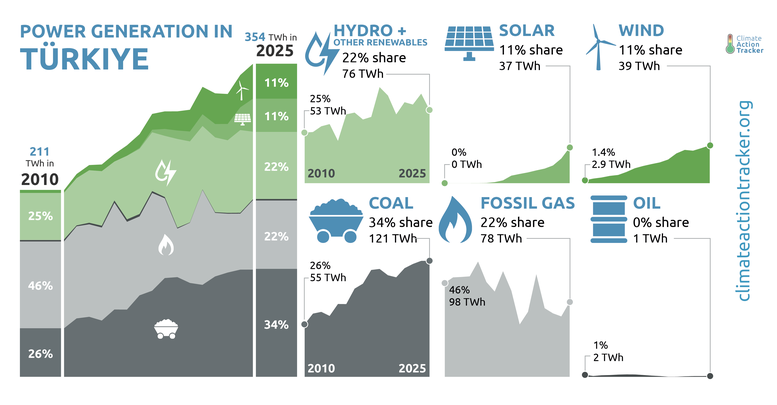
Our memo examines Türkiye’s power sector transformation over the past decade. While the government has successfully expanded new wind and solar generation, increasing the share of renewables in the power mix, total energy use – and fossil fuel use in the power sector – has also been increasing.
As co-host of COP31, Türkiye has a unique opportunity and responsibility to demonstrate how countries can implement the COP28 commitment to transition away from fossil fuels. Yet government plans continue to present coal and fossil gas as important parts of Türkiye’s future energy mix, renewable technologies are already cost-competitive and, in many cases, cheaper than fossil fuel alternatives. Solar power is now the country's lowest-cost source of electricity and significantly undercuts domestic coal generation.
By its own stated logic that fossil fuels should be replaced when cheaper alternatives are available, Türkiye now has a strong economic case to accelerate the transition away from coal and gas.
COP31 leadership starts at home
COP31 President Murat Kurum has repeatedly framed COP31 as the conference where previous climate commitments are translated into implementation. Yet Türkiye has not outlined a clear pathway for phasing out fossil fuels domestically.
As governments move from high-level pledges to concrete action, it will be increasingly difficult for a COP host to champion implementation internationally without demonstrating a credible transition strategy at home.
Türkiye has put a global target of 35% electrification by 2035 at the centre of its COP31 Action Agenda. However, its own National Energy Plan projects electricity’s share of final energy consumption to reach only 24.9% in 2035, from 21.8% in 2020. Meeting the 35% target would therefore require a substantial step-change in electrification policies and in the deployment of renewable power, grids and flexibility. Without a parallel phase-out of fossil fuels, rising electricity demand risks being met in part by coal and fossil gas rather than delivering the emissions reductions the target is intended to achieve.
Türkiye could strengthen its climate leadership ahead of COP31 by building on its recent renewable energy successes and announcing clear plans and targets to phase out coal and fossil gas. Making a fossil fuel phase out a central element of its COP31 agenda would help turn commitments into action while reinforcing their credibility as a COP presidency.
Renewables for energy security
Recent energy crises have demonstrated that fossil fuels are neither a reliable nor affordable basis for long-term energy security. A faster transition towards renewable electricity and electrification would help Türkiye reduce emissions, shield consumers from price volatility and strengthen energy independence.
Türkiye has already highlighted electrification as a key decarbonisation lever by including the 35% electrification target by 2035 in the COP31 Action Agenda. However, electrification alone is not enough. Growing electricity demand must be matched by a rapid expansion of clean energy generation alongside a clear plan to reduce and ultimately phase out fossil fuels.
What needs to happen now
Türkiye can turn its implementation rhetoric into tangible action and demonstrate genuine climate leadership. This would require the government to:
- Develop just phase-out plans for coal and fossil gas
- Update the national energy plan’s wind and solar targets to align with the pace of installed capacity increases needed to meet 1.5°C compatible installed capacity benchmarks
- Accelerate the installation of wind and solar capacity
- Outline plans to remove barriers to the rollout of wind and solar infrastructure
- Accompany renewables scale-up with policies to accelerate end-use electrification
Stay informed
Subscribe to our newsletter