Unpacking electrification for a 1.5°C-aligned world
Summary
This report unpacks electrification to build a common understanding of what it means, how it is measured and the role it will play across the key end-use sectors: transport, buildings and industry in a 1.5°C-aligned future. Decades of insufficient mitigation action means that pursuing the Paris temperature goal requires rapid emissions reductions to minimise the magnitude and duration of overshoot, to achieve net zero greenhouse gas emissions by the second half of the century and to return warming significantly below 1.5°C by 2100. Replacing fossil fuel combustion in transport, buildings and industry with electricity from renewable sources is one of the main ways to deliver those reductions.
"35 by 35"
The goal of achieving 35% electrification by 2035 emerged this year from a campaign initiative and was adopted by the twin COP31 presidency alongside the existing goals of doubling energy efficiency and tripling renewables. Together, these three pillars support a transition aligned with 1.5°C where electrification replaces fossil fuel use, renewables provide clean electricity, and efficiency reduces the amount of electricity needed. However, a single headline share of electricity in final energy figure does not capture all dimensions of the electrification process. Translating global ambition into concrete sectoral and national targets is therefore critical to support policy development and implementation.
Towards meaningful electrification benchmarks
This report demonstrates how meaningful electrification benchmarks can be developed to guide these policy decisions. The report covers key considerations to understand, interpret and assess electrification by clarifying key concepts, technical terms and the choices that affect its measurement, and analyses what electrification means across sectors and countries. It uses these considerations to inform the design of a framework for deriving meaningful sector- and country-level electrification benchmarks, which provide the additional information needed to make headline electrification targets relevant for policy and implementation.
Understanding electrification
This report covers key topics on how to understand electrification and the energy transition in a 1.5°C-aligned world:
- Renewable generation must expand alongside growing electricity demand while fossil generation and direct fossil-fuel use must decline.
- Direct electrification and renewables can deliver the same services with less primary energy than a fossil fuel energy system.
- Energy efficiency is an essential part of the combination of actions needed to decarbonise the energy system.
- Delivering this transition requires complementary action on grids, storage and flexibility and a just transition.
Understanding the "35 by 35" goal
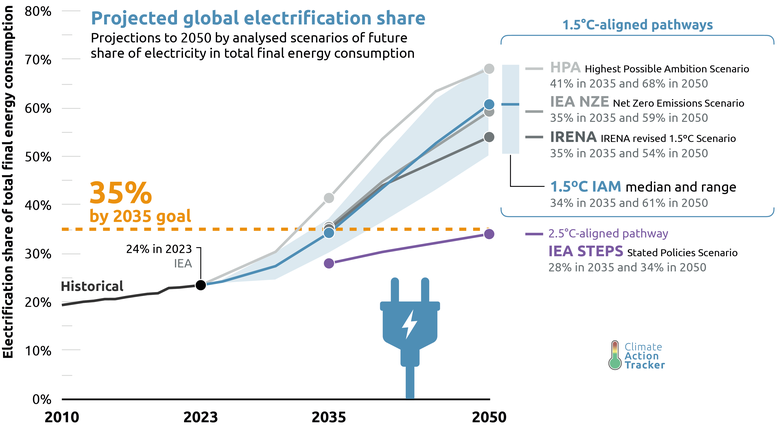
Then it delves further into what the goal for achieving 35% electrification by 2035 means in a 1.5°C-aligned world:
- “35 by 35” is an important milestone, not the destination.
- Reaching the "35 by 35” goal would require current electrification rates to accelerate almost four times compared to historical progress.
- An electricity share of 35% does not mean that 35% of services are electrified.
Understanding the electrification metrics for different sectors and countries
- Clear definitions and boundaries are essential to interpreting electrification numbers and figures.
- Growing electricity use does not necessarily mean fossil fuels are being displaced.
- A common global target does not mean this should be applied equally to each sector or country.
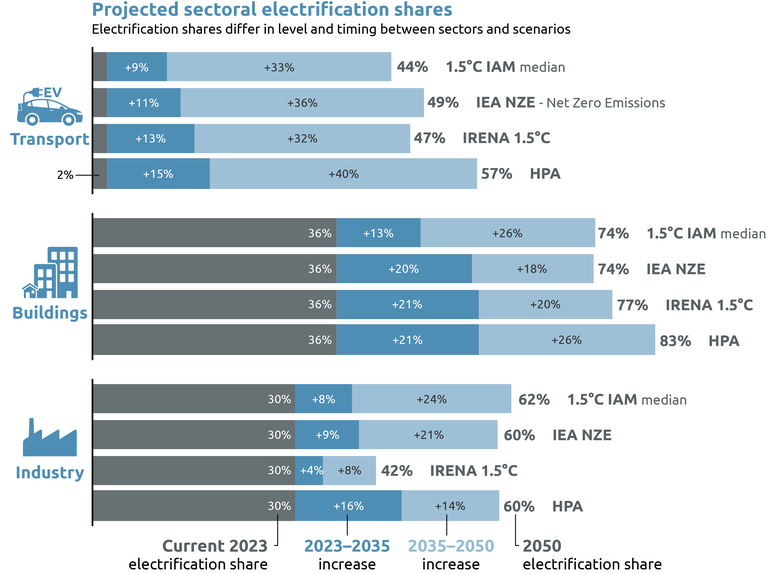
Turning the "35 by 35" goal into meaningful action
Finally, the report looks into how an economy-wide target needs to be complemented by sectoral, technology-deployment and enabling indicators, and how a layered benchmark framework can help bring these requirements together.
For this and more read the full report.
Stay informed
Subscribe to our newsletter