
Australia
Targets
Target Overview
NOTE: This update provides a detailed assessment of Australia's 2035 NDC and net zero target. The rest of the assessment is from our June 2025 update. A full assessment update will be published soon.
Australia submitted its 2035 NDC and adopted a detailed Net Zero plan, which complements its 2021 LTS, in September 2025. The Australian government did not update its 2030 target as part of its 2035 NDC. A detailed analysis of the 2035 NDC is available here.
Australia’s NDC targets a 2030 emissions reduction of 43% below 2005 levels. The CAT excludes emissions from land use, land use change and forestry from this target, resulting in 398 MtCO2e in 2030, excluding LULUCF. The CAT rates this target as “Insufficient” compared to both modelled domestic pathways and its fair share of global efforts.
In October 2021, Australia submitted to the UNFCCC a Long-Term Strategy (LTS) communicating a plan to achieve net zero emissions by 2050 by reducing emissions by 60% below 2005 levels, excluding LULUCF and offsets. In September 2025, Australia adopted a detailed Net Zero plan, which builds on and complements its 2021 LTS. This 2025 Plan is informed by the Treasury’s modelling analysis of Australia’s net zero transformation. The Baseline scenario, which incorporates the existing climate and energy policies but extends beyond to 2050 with expected availability of abatement technologies, suggests that Australia would reach net zero emissions by 2050. However, without putting forward any new and ambitious policies for reaching a minimal level of residual emissions, the modelling results indicate a very high reliance on land-based sink capacity, along with potential novel CDR technologies to offset residual emissions of 167 MtCO2e in 2050 (Australia Government, 2025). Relative to the latest LULUCF projections, this implies a more than threefold increase in sink capacity from 2040 levels if land-based sequestration is the only carbon removal approach. This dependence on a substantial and rapid expansion of sinks and other CDR technologies highlights the limited mitigation effort in other sectors beyond 2035 and introduces significant uncertainty as to whether Australia can achieve its net zero target on time (for detailed discussion refer to the Net Zero tab here).
| AUSTRALIA – Main climate targets |
|---|
| 2030 NDC target | |||
|---|---|---|---|
| Formulation of target in NDC |
43% below 2005 levels by 2030 (including LULUCF) (Implemented as an absolute target for 2030, and as an emissions budget covering the period 2021–2030) |
||
| Absolute emissions level in 2030 excl. LULUCF |
398 MtCO2e by 2030 [9% below 1990] [25% below 2005] [27% below 2010] Note: The effect of the 2030 NDC target on gross emissions (emissions excluding LULUCF) is recalculated each year with the revision of historical emissions and projected LULUCF sequestration. |
||
| Status | Submitted on 16 June 2022 | ||
| Net zero & other long-term targets | |||
|---|---|---|---|
| Formulation of target |
Australia aims to reach net zero by 2050 Australia’s Long-term Emissions Reduction Plan indicates it plans to rely on international and domestic offsets for 10% of reductions required to reach net zero by 2050. The reference to domestic offsets means land based carbon sequestration. |
||
|
Absolute emissions level in 2050 excl. LULUCF and international credits |
167 MtCO2e/yr [62% below 1990] [69% below 2005] [69% below 2010] |
||
| Status | Submitted on 29 October 2021 | ||
NDC Updates
In September 2025, Australia announced a 2035 NDC target, which targets reduction in net national greenhouse gas emissions of 62–70% below 2005 levels by 2035, implemented as an emissions budget covering the period 2031–35. It did not update its 2030 target, a 43% reduction in net emissions by 2030 below 2005, as part of its 2035 NDC.
Australia submitted a stronger 2030 target to the UNFCCC in June 2022 (Australian Government, 2022a) after it had resubmitted its 2016 target in the 2021 round of updates around the Glasgow COP. The target of 2022 is a 43% reduction of greenhouse gas emissions by 2030 below 2005 levels, including LULUCF.
The target will be implemented as both an absolute target and an emissions budget for the period 2021-2030. The 2022 NDC reaffirms Australia’s target to achieve net zero emissions by 2050. The objective has been enshrined into law by the Climate Change Act adopted in 2022.
The NDC also indicates it will make adjustments for “internationally transferred mitigation outcomes” in line with Article 6 of the Paris Agreement, indicating it is also open to using international carbon credits. At present, the detailed rules and quality standards for making use of Article 6 as an ambition raising mechanism are still pending, making it difficult to assess whether they can offer a meaningful contribution to emissions reductions.
Regardless, Australia should first improve its NDC target and climate finance contributions to align with a 1.5℃ Paris Agreement compatible pathway and focus on reducing its domestic emissions, instead of relying on international carbon credits to meet its climate targets.
| AUSTRALIA – History of 2030 NDC updates | First NDC 2016 | 2021 NDC update | 2022 NDC update |
|---|---|---|---|
| 1.5°C compatible |
|
|
|
| Stronger target | N/A |
|
|
| Fixed/absolute target |
|
|
|
Comparison 2030 NDC Targets
| AUSTRALIA | First NDC 2016 | 2021 NDC update | 2022 NDC update |
|---|---|---|---|
| Formulation of target in NDC |
26–28% below 2005 levels by 2030 including LULUCF Implemented as an emissions budget for 2021–2030. |
26–28% below 2005 levels by 2030 including LULUCF Implemented as an emissions budget for 2021–2030. |
43% below 2005 levels by 2030 including LULUCF Implemented as both a target for 2030 and an emissions budget for 2021–2030. |
| Absolute emissions level [excl. LULUCF] | 504–517 MtCO2e in 2030 | Unchanged | 398 MtCO2e in 2030 |
|
Emissions compared to 1990 and 2010 [excl. LULUCF] |
14–17% above 1990 levels by 2030 4–6% below 2005 levels by 2030 6–8% below 2010 levels by 2030 |
Unchanged |
9% below 1990 levels by 2030 25% below 2005 levels by 2030 27% below 2010 levels by 2030 |
| CAT rating |
Overall rating*: Highly Insufficient |
NDC target against modelled domestic pathways: Insufficient NDC target against fair share: Highly insufficient |
NDC target against modelled domestic pathways: Insufficient NDC target against fair share: Insufficient |
| Sector coverage | Economy-wide | Economy-wide | Economy-wide |
| Separate target for LULUCF | No | No | No |
| Gas coverage | All greenhouse gases | All greenhouse gases | All greenhouse gases |
| Target type | Absolute emissions reduction (multi-year emissions budget) | Absolute emissions reduction (multi-year emissions budget) | Absolute emissions reduction (point target from a base year and multi-year emissions budget) |
* Before September 2021, all CAT ratings were based exclusively on fair share and only assessed a country’s target
Target development timeline & previous CAT analysis
CAT rating of targets
The CAT rates NDC targets against each country’s fair share contribution to global climate change mitigation, considering a range of equity principles including responsibility, capability, and equality. The CAT also rates NDC targets against indicative national emissions from global least-cost emissions pathways (called modelled domestic pathways). For assessing targets against the fair share, we consider both a country’s domestic emission reductions and any emissions it supports abroad through the use of market mechanisms or other ways of support, as relevant.
Australia does not intend to use market mechanisms and will achieve its NDC target through domestic action alone. We rate its NDC target against both global domestic pathways and fairness metrics.
The CAT continues to rate Australia’s 2030 NDC target as “Insufficient” when compared to modelled domestic emissions pathways. Australia’s NDC targets emissions 43% below 2005 levels by 2030, including LULUCF.
The quantification of Australia’s NDC target is impacted by continuous recalculations of LULUCF sink estimates for 2030. The government projections of these sinks have systematically increased year-on-year until 2024, thereby reducing the amount of action Australia needs to take on reducing fossil fuels and emissions in other sectors to meet the NDC target. The 2025 projections adjusted down the sink potential due to the moderation of the land sink after consecutive La Niña years, methodological improvements in the National Greenhouse Gas Inventory (including to the savanna fire modelling), and updated modelling for plantation harvesting, cropland and grassland emissions (DCCEEW, 2025a). This also highlights that relying on variable and uncertain land-based sinks can be risky. Given the current changes in climate, it is not a given that the land sector will actually act as such a large sink in the future.
A 2030 NDC target in line with 1.5°C compatible modelled domestic pathways for Australia would require emissions reductions of 43% below 2005 levels by 2030, excluding LULUCF, and 59% when including LULUCF.
Australia has submitted a 2035 target. For 1.5°C compatibility, Australia would need to reduce emissions 58% below 2005 levels by 2035, excluding LULUCF, and 76% when including LULUCF.
Projections for LULUCF sequestration in 2030 increased fourfold between the government’s 2021 and 2024 projections. This effectively reduces the emissions reduction task for energy, industry, agriculture and waste.
The “Insufficient” rating indicates that Australia’s NDC target in 2030 needs substantial improvements to be consistent with modelled domestic pathways limiting warming to 1.5°C. If all countries were to follow Australia’s approach, warming would reach over 2°C and up to 3°C.
The CAT rates Australia’s 2030 NDC target as “Insufficient” when compared to its fair share emissions allocation. The “Insufficient” rating indicates that Australia’s NDC target in 2030 needs substantial improvements to be consistent with its fair share of the global mitigation effort to limit warming to 1.5°C.
Australia’s target is at the least stringent end of what would be a fair share of global effort and is not consistent with the 1.5°C limit, unless other countries make much deeper reductions and comparably greater effort. If all countries were to follow Australia’s approach, warming would reach over 2°C and up to 3°C.
Australia needs to improve its fair share contribution through both strengthened domestic emissions reductions and financing additional climate action in developing countries.
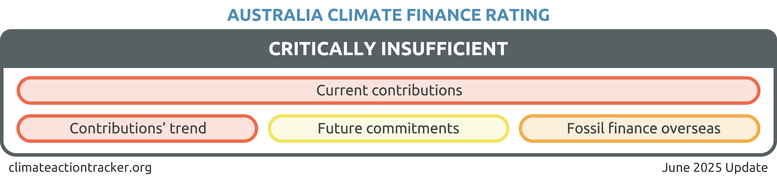
Australia’s international public climate finance contributions are rated “Critically insufficient”. Australia has committed to increasing its climate finance, but contributions to date have been very low compared to its fair share. To improve its rating, Australia needs to increase the level of its international climate finance.
Australia has pledged AUD 3bn towards climate finance, encompassing both mitigation and adaptation, for the 2020–2025 period. This amount represents an increase from an earlier commitment of AUD 2bn (Department of Foreign Affairs and Trade, 2023). However, concerns remain that this commitment will include the relabelling of existing funds (Oxfam, 2023). The government finally rejoined the Green Climate Fund in 2023, after withdrawing in 2019, albeit with a “modest contribution” of AUD 50 million (ABC News, 2023a; Minister for Foreign Affairs & Minister for Climate Change and Energy, 2023b).
At COP28, Australia joined the Clean Energy Transition Partnership, pledging to end direct public investments into international fossil fuels projects within a year (Minister for Foreign Affairs & Minister for Climate Change and Energy, 2023a). This led the CAT to improve Australia’s fossil fuel finance overseas rating from “Highly Insufficient” to “Insufficient”. However, this does not improve Australia’s overall climate finance rating. To receive a better rating, Australia must increase the level of its international climate finance.
Australia's lack of action on climate finance is central to the discussions around COP31. Australia is proposing to host the 2026 Conference of Parties in collaboration with 'the Pacific family'. In March 2023, governments from Vanuatu, Tuvalu, Tonga, Fiji, Niue, and the Solomon Islands issued the Port Vila Resolution. The resolution calls for more public and private funding to facilitate a fair transition away from fossil fuels and a reform of the global climate finance framework (The Australia Institute, 2023).
Net zero and the other long-term target(s)
We evaluate the net zero target as "Average."
Australia submitted its Long-Term Strategy (LTS) to the UNFCCC in 2021, setting a net zero emissions target for 2050.
In September 2025, Australia adopted a detailed Net Zero plan, which builds on and complements its 2021 LTS. It significantly strengthens the framework of the LTS by legislating the 2050 net zero target, anchoring it in a more detailed framework which includes both Australia’s 2030 and 2035 targets (62–70% below 2005 levels) with an associated emissions budget. This new Net Zero Plan provides a more operational roadmap, structured around five decarbonisation priorities and supported by six sectoral emissions reduction plans.
Yet, the 2025 Net Zero plan presents scenarios that assume the removal of large residual emissions through land-based carbon sequestration and other CDR technologies. Due to vulnerability to natural disasters and challenges regarding additionality, permanence, and double counting, land-based sequestration cannot be relied on to compensate for continued fossil fuel emissions. The Plan does not introduce any new and ambitious policies to achieve the minimal level of residual emissions and instead heavily relies on uncertain land sink and CDR technologies. This introduces significant uncertainty as to whether Australia can achieve its net zero target on time. CDR should be reserved for genuinely hard-to-abate residual emissions and for bringing global temperatures back down after overshoot, not used to compensate for emissions that could be avoided.
The full net zero target analysis can be found here.
Further analysis





Latest publications






Stay informed
Subscribe to our newsletter