
China
2035 NDC
2035 NDC Target Overview
This analysis was published in December 2025.
China’s headline 2035 NDC target of reducing economy-wide net greenhouse gas emissions by 7–10 percent from peak levels represents a shift from intensity-based targets to absolute emission reductions for the first time, albeit from an unclear baseline (peak emission level).
However, despite structural improvement, this target is unlikely to further lower emissions, as the CAT projects China to achieve a 10–16 percent decrease in gross emissions (excluding LULUCF) between 2024 and 2035 under current policies and trends.
The other two 2035 NDC targets — raising the share of non-fossil fuels in total energy consumption to over 30 percent and expanding installed wind and solar capacity to 3,600 gigawatts — build upon China’s 2030 NDC targets and signal a continued commitment to the energy transition, although these goals are also expected to be met under existing policies.
There is a substantial gap between the NDC targets and the reductions needed to align with 1.5°C, based on our modelled domestic pathway (MDP) and fair share frameworks. However, China’s 2035 NDC should be seen as a floor rather than a ceiling for its ambition, as indicated by the phrase “...striving to do better.”
Historically, China has calibrated its climate commitments to levels that are largely achievable under existing policies and investment trends, allowing room for over-delivery. It achieved two of its 2030 NDC targets, wind and solar capacity and forest stock volume, ahead of schedule.
China’s 2035 NDC includes another three quantitative targets that build upon its 2030 NDC:
- a 30% share of non-fossil fuels in total energy consumption (up from 25% by 2030),
- 3,600 GW of installed wind and solar capacity (up from 1,200 GW by 2030), and
- a forest stock volume of 24 billion cubic metres (from an estimated 18.59 billion cubic metres, or 6 billion cubic metres above 2005 levels).
There are also three qualitative NDC targets indicating that by 2035, China aims to make new energy vehicles the mainstream in new vehicle sales, expand the National Emissions Trading System (ETS) to cover all major high-emission sectors, and effectively establish a climate-adaptive society.
| CHINA | 2035 NDC target | |||
|---|---|---|---|---|
| 2030 NDC target | ||||
|---|---|---|---|---|
| Formulation of target in NDC |
1. China aims to have CO2 emissions peak before 2030 and achieve carbon neutrality before 2060 (up from the 2021 submission of “around 2030 and making efforts to peak earlier”) China will also: 2. Lower its CO2 emissions per unit of gross domestic product (GDP) by over 65% from the 2005 level (up from the 2021 submission of “by 60–65%”); 3. Increase the share of non-fossil fuels in primary energy consumption to around 25% (up from the 2021 submission of “around 20%”); 4. Increase the forest stock volume by 6 billion m3 from the 2005 level (up from the 2021 submission of 4.5 billion cubic metres); and 5. Bring its total installed capacity of wind and solar power to over 1.2 billion kW (a new target not included in the 2021 submission) |
|||
|
Absolute emissions level in 2035 excl. LULUCF |
14.8 GtCO2e (excl. LULUCF)* 36% above 2010 levels |
|||
| Status | Submitted on 28 October 2021 | |||
| 2035 NDC target | ||||
|---|---|---|---|---|
| Formulation of target in NDC |
China will, by 2035, 1. Reduce economy-wide net greenhouse gas emissions by 7-10% from peak levels, striving to do better; 2. Increase the share of non-fossil fuels in total energy consumption to over 30%; 3. Expand the installed capacity of wind and solar power to over six times the 2020 levels, striving to bring the total to 3,600 gigawatts; 4. Scale up the total forest stock volume to over 24 billion cubic metres; 5. Make new energy vehicles the mainstream in the sales of new vehicles; 6. Expand the National Carbon Emissions Trading Market to cover major high-emission sectors; and 7. Basically establish a climate adaptive society |
|||
|
Absolute emissions level in 2035 excl. LULUCF |
14.2 GtCO2e (exc. LULUCF)** 29% above 2010 levels |
|||
| Status | Submitted on 3 November 2025 | |||
* This value represents the median of the two NDC targets expected to deliver the lowest emissions. The lower bound reflects the lowest estimate for the carbon intensity target, and the upper bound reflects the highest estimate for the peaking target. See assumption tab for details.
** This value represents the median of the two NDC targets expected to deliver the lowest emissions. The lower bound reflects the lowest estimate for the wind and solar capacity target, and the upper bound reflects the highest estimate for the net emission reduction target. See assumption tab for details.
Ambition
For the world to have a significant chance of limiting warming to 1.5°C, governments must switch to emergency mode and strengthen both their 2030 targets and current policies to include substantial emissions cuts and significantly contribute to closing the 2030 emissions gap. China’s submitted 2035 NDC target did not increase the ambition of its 2030 target.
Further information on China’s 2030 target can be found here.
2030 NDC target
| 2030 unconditional NDC target | |
|---|---|
| Is the target 1.5°C compatible compared to modelled domestic pathways? |
|
| Is the target 1.5°C compatible compared to fair share? |
|
| Is this a stronger target than previously submitted? |
|
2035 NDC target
| 2035 unconditional NDC target | |
|---|---|
| Is the target 1.5°C compatible compared to modelled domestic pathways? |
|
| Is the target 1.5°C compatible compared to fair share? |
|
| Does the NDC include sectoral targets? |
|
| Does the NDC include a renewable energy capacity target? |
|
| Does the target align with the country’s net-zero pathway? |
|
* According to our methodology, for developing countries we only compare the conditional target to our modelled domestic pathways.
** According to our methodology, for developing countries we only compare the unconditional target against fair share.
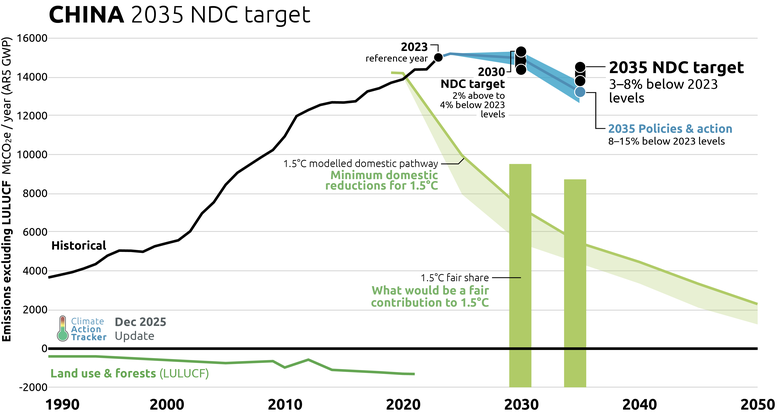
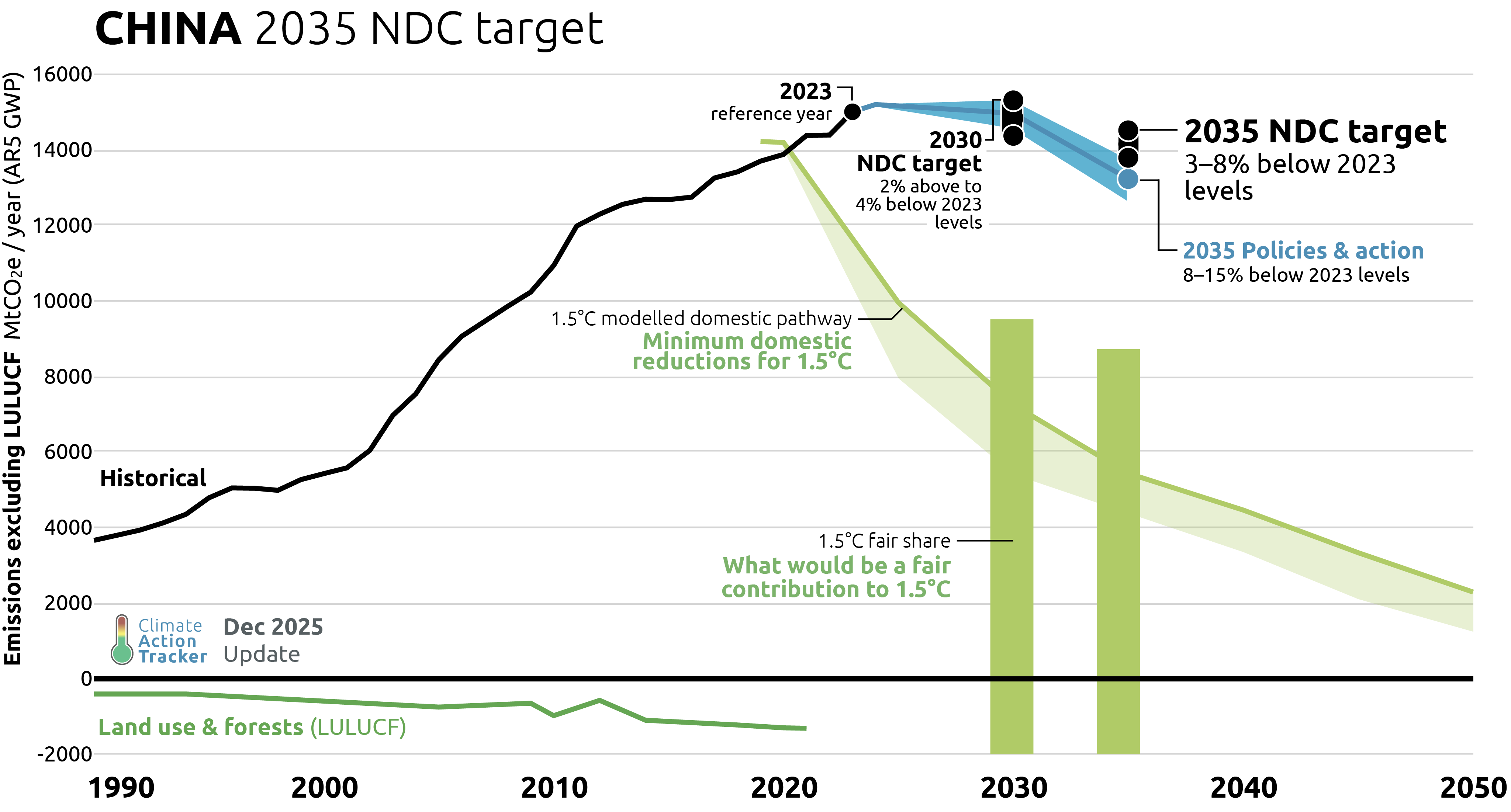
China officially submitted its 2035 NDC mitigation target on 3 November 2025, setting a 2035 target of reducing economy-wide net greenhouse gas emissions by 7-10% from peak levels and striving to do better. The CAT excludes emissions from land use, land use change and forestry (LULUCF) from this target, resulting in 14.2 GtCO2e in 2035 or 29% above 2010 levels.
This target is not 1.5°C compatible, neither relative to China’s fair share contribution to climate change mitigation, nor to the 1.5°C modelled domestic pathway. It would require significantly deeper emission reductions to make a meaningful contribution to global efforts to limit temperature rise to 1.5°C by the end of the century.
Further information on China’s targets can be found here (Chinese only).
| CHINA | Target summary (excluding LULUCF) |
|---|
| 2030 target: Emissions compared to 2023 levels (CAT estimates) | |
|---|---|
| Current policies in 2030 | 3% below to 2% above |
| 2030 NDC target | 4% below to 2% above |
| 1.5°C compatible fair share | 37% below |
| 1.5°C compatible modelled domestic pathway | 52% below |
| 2035 target: Emissions compared to 2023 levels (CAT estimates) | |
|---|---|
| Current policies in 2035 | 9% to 15% below |
| 2035 NDC target | 3% to 8% below |
| 1.5°C compatible fair share | 42% below |
| 1.5°C compatible modelled domestic pathway | 64% below |
Fairness & Finance
Developed countries need to significantly scale up international climate finance and other means of support. They should set 1.5°C aligned domestic mitigation targets in their NDCs and communicate the financial and other support they will provide to developing countries. Developing countries should clearly communicate the climate finance they need to set and achieve ambitious 1.5°C aligned conditional targets.
China does not fit neatly into either of these two categories. Similar to other developing countries, China’s fair-share contribution would allow higher emissions than its modelled domestic pathway (MDP), indicating substantial mitigation potential within its national boundaries. This is broadly consistent with the academic literature on fair-share allocations, which finds that some degree of international support for China can be compatible with the Paris Agreement’s equity principles. At the same time, our methodological assessments do not offer a definitive conclusion on whether, and to what extent, China should receive climate finance from abroad.
Nevertheless, China itself is a provider of climate finance, mainly through bilateral South–South cooperation. It's not clear exactly how much: the World Resources Institute estimates that between 2013 and 2022, China voluntarily provided and mobilised an average of USD 4.5 billion per year to support developing countries in climate mitigation and adaptation. According to the Chinese government, China has provided and mobilised over 177 billion yuan (USD 24.5bn) from 2016 to 2024 to support climate action in other developing countries.
According to its 2035 NDC, China aims to strengthen South-South cooperation on climate change and the Green Belt and Road Initiative, supporting other developing countries, particularly African countries, least developed countries (LDCs) and small island developing states (SIDS), in addressing climate change.
Credibility
Credible NDCs should build on robust national planning processes that translate the economy-wide emissions reduction target into action in all sectors. Governments need to ramp up the implementation of their existing targets and further develop policies to close the – still significant – emissions gap between current policies and the 1.5°C pathway. Contradictory policies must be addressed and reversed: fossil fuel production needs to be phased out, while fossil fuel exploration and fossil fuel subsidies need to stop.
China’s climate targets are aligned with the targets set out in its Five-Year Plans. The 15th Five-Year Plan will be formalised in early 2026, while the newly released recommendations identify a main target for 2026–2030 of making “major new progress in building a beautiful China,” including promoting a “green production and lifestyle” and achieving the 2030 carbon peaking goal on schedule.
China’s NDC is supported by a series of domestic policies under the “1+N” policy framework. The “1” refers to the 2021 Working Guidance, which sets out the overarching strategy and principles for all subsequent policies, aiming to peak carbon dioxide emissions before 2030 and achieve carbon neutrality before 2060. The new 2035 NDC, targeting a 7–10% reduction in GHG emissions by 2035, will also be incorporated.
The “N” refers to a set of supporting plans. The first is the 2021 Action Plan, which provides detailed targets for energy and key industrial sectors, as well as policy areas such as circular economy, carbon trading, and carbon sinks. Additional documents address sectoral climate actions (e.g., buildings, transport), major industries (e.g., steel, chemicals), technological support, carbon sink capacity, statistical accounting, inspection and assessment, and fiscal, financial, and pricing policies.
Having such a domestic policy framework in place helps to ensure the credibility of China’s NDC targets. What further speaks to the credibility of the target is its feasibility: the 7–10% reduction target is relatively conservative and already achievable, with the CAT projecting a 9-16% reduction in absolute emissions excluding LULUCF from 2024 levels by 2035 under current policies. The target should be regarded as a floor rather than a ceiling for ambition, as indicated in the NDC text stating “...striving to do better.” China has a history of overachievement on its 2030 climate targets on installed wind and solar capacity and forest stock volume.
Despite the relatively high credibility of achieving its climate targets, China’s current policy projections and its 2035 NDC targets fall short of the ambition required for a 1.5 °C-aligned emissions pathway.
China’s 2035 NDC does not include a coal phase-out target, apart from the stated aim of “strict control over fossil energy consumption”. The CAT 1.5 °C-aligned benchmark indicates that China should phase out coal in the power sector by 2040. Coal accounts for 58% of China’s power generation in 2024, a record low but still insufficient. From a policy-coherence perspective, China’s continued approval and construction of new coal power plants (also a record high in 2024) and expansion of coal-to-chemicals undermines the credibility of the 2035 target as a climate-ambition instrument.
| 2035 NDC target | |
|---|---|
| Is the target driving more ambitious action? |
|
|
Is there a policy framework in place to meet the target? |
|
|
Does the NDC reference national planning processes for its development? |
|
|
Does the NDC reference an institutional framework/plan in place for its implementation? |
|
|
Does the NDC commit to phase out fossil fuel production? |
|
|
Does the NDC commit to stop fossil fuel exploration & subsidies? |
|
Transparency
Governments should set absolute, economy-wide, emissions reduction pathways including all GHG gases, specifying the emissions levels for each year as an absolute level of gross emissions (excluding LULUCF). This level of transparency will ensure that their reduction targets are immune to creative accounting. NDC targets should primarily focus on their domestic reductions by decarbonising all sectors of the economy rather than relying on forestry sinks, other carbon dioxide removal (CDR) or international carbon markets.
| 2035 NDC target | |
|---|---|
| Is the target based on a fixed year or is it a fixed absolute value? |
|
| Does the target cover all sectors? |
|
| Does the target cover all greenhouse gases? |
|
| Does the target specify an emissions pathway? |
|
| Does the target separate out land use and forestry? |
|
|
Does the target separate out other CO2 removal by type? |
|
|
Does the target separate out the use of carbon credits under Article 6? |
|
China’s 2035 climate target represents an expansion in coverage compared with its 2030 NDC, now encompassing all economic sectors (previously unspecified) and all greenhouse gases (previously only CO2 emissions). It also marks a step toward reducing total emissions following the peak. While the percentage reduction target is limited in ambition, it indicates a policy shift from merely slowing emissions growth and achieving a peak to actively reducing emissions. Establishing a target for absolute emissions rather than intensity is significant, as it allows for a clearer separation between economic growth and emissions, providing a more predictable emissions pathway.
However, China does not set its reduction target relative to a historical year, which would provide greater clarity on the implied reductions. Instead, the reference point is the actual peaking year according to China’s national inventories, which cannot be determined until after the peak occurs. Some say that 2024 could already have marked a peak in China’s CO₂ emissions, while others estimate an increase in 2025. The lack of a clear baseline falls short of best practice for transparency. Achieving the 2030 NDC target for reducing CO₂ emissions intensity will require more ambitious climate action in the near term, leaving limited room for emissions growth.
The 7-10% emissions reduction target applies to net emissions, including the LULUCF sector, which is a net carbon sink in China, as well as other forms of carbon removal, making the target less transparent.
China’s 2035 NDC also does not specify its position on the use of carbon credits under Article 6 of the Paris Agreement. According to the CAT’s latest briefing on Article 6, there are risks to consider for both buyers and sellers:
- Buyer countries risk using international carbon credits to delay or avoid investing in domestic mitigation, especially when developing high-quality, verifiable offset projects remains extremely difficult. They should avoid purchasing “low-hanging fruit” credits from developing countries, burdening them with a more difficult and expensive decarbonisation in the future, and should instead enhance their domestic ambition.
- For seller countries, there are two main risks. First, a country may reduce the ambition of its NDC to generate credits for sale, which contradicts the aim of Article 6 to enable higher ambition and promote sustainable development and environmental integrity. Second, selling emission reductions that are relatively inexpensive or would havWhy Article 6e occurred anyway can leave the country with fewer and more costly options to increase future mitigation ambition.
- Finally, finance generated through the purchase of carbon credits (ITMOs) under Article 6 should not be counted as climate finance. For more information on the promise and pitfalls of Article 6 mechanisms, see the recent CAT briefing here.
For more information, on China’s climate targets and policies, please click here. For the CAT’s full recommendations for setting NDC targets that form the basis of the analysis above, please click here.
Further analysis





Latest publications





Stay informed
Subscribe to our newsletter