
China
Net zero targets
Summary
We evaluate China’s net zero target as: Poor.
China submitted its Mid-Century Long-Term Low Greenhouse Gas Emission Development Strategy (LTS) on October 28, 2021 to the UNFCCC, which contains the country’s commitment to reach “carbon neutrality before 2060”. The commitment was first declared at the UN General Assembly in September 2020 by President Xi Jinping (Xinhua News Agency, 2020).
China’s new Environmental Code, passed in March 2026, represents the country’s first comprehensive climate legislation and provides a legal foundation for long-term decarbonisation toward its 2060 carbon neutrality goal (Xinhua News Agency, 2026b).
Given the LTS submission does not meet the majority of our considerations for a best-practice approach in LTS formulation, we evaluate China’s net-zero target as “Poor”.
China’s “Poor” rating could be upgraded to “Average” if it made minor improvements. Explicit clarification on any of the categories “International aviation and shipping”, “reductions/removals outside of on territory”, “separate reduction & removal targets”, and “carbon dioxide removal” would pass the rating threshold of our methods.
The emissions coverage of China’s LTS target has also been subject to much debate (whether it covers CO2 or GHGs only). If China’s target covered all GHGs, the country would receive an “advanced” rating in this category, and an “Average” rating overall.
The Long-Term Strategy (LTS) appears to cover only CO₂ emissions, but China's Special Envoy for Climate Change, Xie Zhenhua, later clarified that the 2060 neutrality target encompasses all GHGs (China Dialogue, 2021). The expansion of China's 2035 NDC to cover economy-wide GHG emissions further supports the interpretation that the 2060 neutrality target applies to all GHGs, rather than CO₂ alone.
However, in the absence of explicit confirmation in official policy documents, the CAT takes a conservative approach and assumes that China's LTS covers only CO₂ emissions until further official clarification is provided.
CAT analysis of net zero target
Ten key elements
Scope
- Target year – China aims to reach “carbon neutrality” before 2060
- Emissions coverage – China has committed to achieving "carbon neutrality" before 2060, a target that appears to apply only to CO₂ emissions rather than all greenhouse gases. However, researchers at Tsinghua University and China's Special Envoy for Climate Change, Xie Zhenhua, have stated that China's net zero target covers all GHG emissions (China Dialogue, 2021). In the absence of explicit confirmation in official policy documents, the CAT takes a conservative approach and assumes that China's LTS covers only CO₂ emissions until further official clarification is provided.
- International aviation and shipping – China provides unclear information on its intention to cover international aviation and shipping in its long-term target.
- The LTS, however, emphasises the importance of these sectors' greenhouse gas (GHG) emission reductions in international shipping and aviation for implementation of the Paris Agreement’s temperature goals and states it will “actively expand the application of new and clean energy in…aviation and shipping, such as electricity, hydrogen energy, natural gas and advanced liquid biofuels”, “promote the application of low-carbon energy ships and explore the application of biomass fuels and other synthetic fuels in civil aviation”, and “promote the establishment of science-based mechanisms for reducing GHGs emission from international shipping and aviation” in its climate governance system.
- For the Special Administrative Region of Macao, China states it will “accelerate the application of fuel-saving technologies and measures, actively promote the use of aviation biofuels, and strengthen low-carbon renovation and operation management of airports” and outlines the intention to apply China’s Certified Emission Reductions (CCER) and the ICAO’s Carbon Offsetting and Reduction Scheme for International Aviation (CORSIA) to Macao’s aviation industry.
- Reductions or removals outside of own territory – China provides no information on its intention to use international offset credits to meet its net zero target.
Target architecture
- Legal status – China submitted its Mid-Century Long-Term Low Greenhouse Gas Emission Development Strategy (LTS) on October 28, 2021, to the UNFCCC. The target has become a core focus of the nation’s economic strategy and has been implemented in a range of high-level policy documents and guidance papers, such as the Working Guidance for Carbon Dioxide Peaking and Carbon Neutrality (the “1” in the “1+N” framework) and the 15th Five-Year Plan. The target was included in China’s Environmental Code, passed in March 2026, the country’s first comprehensive climate legislation, providing a legal foundation for long-term decarbonisation toward its 2060 goal.
- Separate reduction & removal targets – China provides no information on its intention to communicate separate emission reduction and removal targets. While no separate removal targets have been specified, China implicitly suggests a large role for carbon removal in its 2060 target as China only targets 80% share of non-fossil energy in 2060. This is also suggested in Tsinghua University Institute of Climate Change and Sustainable Development (2022)- the analysis that supported the development of the target, where 2°C and 1.5°C compatible emission pathways show forest sinks of -7 to -8 GtCO₂e/year and removals (from CCS, BECCS) from -5 to -9 GtCO₂e/year.
- Review process – China provides no information on its intention to establish a review cycle for its net zero and intermediate targets. The LTS states that China will improve the legal system surrounding the strategy and to continuously “screen and modify the current laws and regulations that are not compatible with carbon peaking and carbon neutrality and strengthen the coordination between laws and regulations”. While the process is not explicitly outlined, progress towards achieving the target will likely be revisited annually at government convenings and updated in subsequent Five-Year Plan cycles, which have legal basis.
Transparency
- Carbon dioxide removal – China provides no information whether it intends to communicate transparent assumptions on carbon dioxide removals, aside from general statements on its intended dependence on increasing natural carbon sinks and technology-based solutions including CCUS in electric power, steel, cement and chemical industries.
- Comprehensive planning – China has pledged to reach peak carbon emissions by 2030 in its NDC, also reiterated in China’s 15th Five Year Plan (2026-2030) and the Action Plan For Carbon Dioxide Peaking Before 2030 (the “N” in the “1+N” framework). The LTS also contains numerous mid-term sectoral targets and visions with implications for emission pathways, including:
- Implement green building standards in 100% of new buildings by 2025
- Achieve around 40% market share of vehicles sold for NEVs (new energy vehicles, including EVs)
- Strive to reduce carbon emission from the transportation sector by more than 10% in 2030 compared with 2020, and achieve more than 30% reduction compared with 2020 by 2050 (Macao)
- Achieve a 25% forest coverage rate in the country
- Peaking and gradually reducing coal consumption during the 15th FYP period
- Reach a peak-plateau in oil consumption during the 15th FYP period
No other intermediate targets were given, nor were measures outlined, although the government will periodically release updated plans in a five-year cycle (more sectoral details on the current FYP period is due to be released in 2022).
- Clarity on fairness of target – China provides little information on its intention to explain the target’s fairness, although the LTS contains direct references to fairness considerations. There is no explicit explanation on why China’s 2060 target can be considered fair.
No other intermediate targets were given, nor were measures outlined, although the government will periodically release updated plans in a five-year cycle (more sectoral details on the current FYP period is due to be released in 2022).
- Clarity on fairness of target – China provides little information on its intention to explain the target’s fairness, although the LTS contains direct references to fairness considerations. There is no explicit explanation on why China’s 2060 target can be considered fair.
Good practice
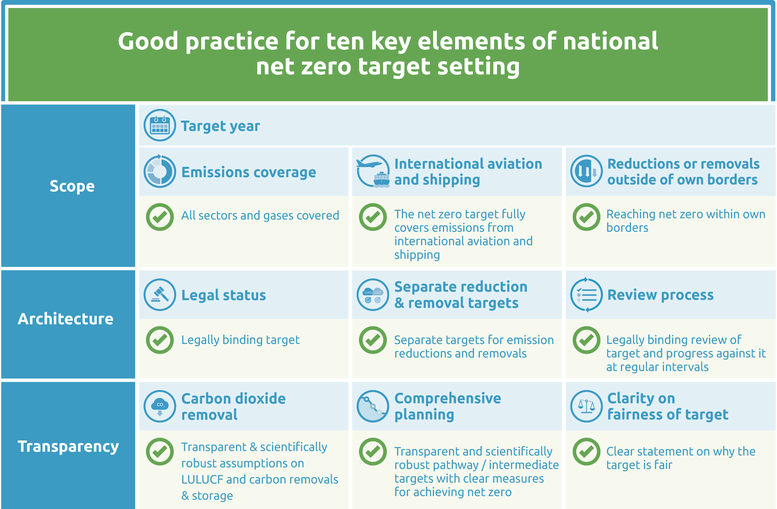
The Climate Action Tracker has defined the following good practice for all ten key elements of net zero targets. Countries can refer to this good practice to design or enhance its net-zero targets.
Further analysis





Latest publications





Stay informed
Subscribe to our newsletter