
Colombia
2035 NDC
2035 NDC Target Overview
Colombia submitted a declarative version of its 2035 NDC to the UNFCCC on September 29, 2025. On December 19 2025, Colombia submitted its full 2035 NDC, expanding on the earlier submission and including a set of detailed technical annexes.
This analysis was published in April 2026.
Colombia's 2035 target, submitted in December 2025, is not aligned with a 1.5˚C pathway, and the gap to a 1.5˚C trajectory has increased compared to its 2030 target.
In this new submission, Colombia ratified its 2030 target and set a 2035 target at a slightly lower emissions level. Colombia aims to limit national emissions to 155–161 MtCO₂e (incl. LULUCF) by 2035, compared to 169 MtCO₂e in 2030. As in its previous NDC, Colombia maintains an absolute target but now presents it as a range.
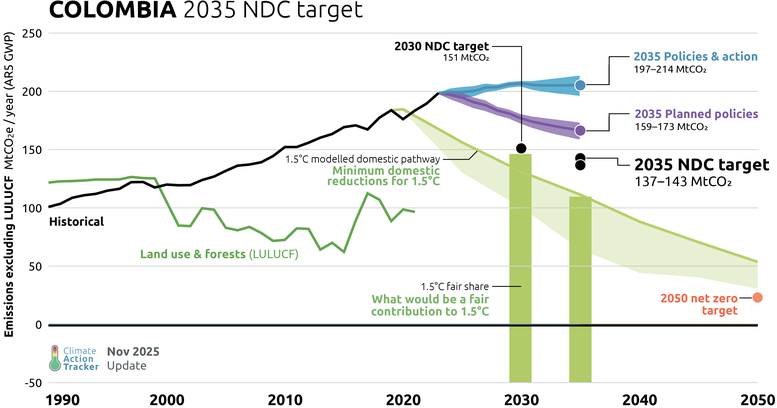
The CAT excludes emissions from land use, land use change, and forestry (LULUCF) when assessing climate targets. Under this approach, Colombia’s NDC for 2030 is estimated at 151 MtCO₂e, while the target for 2035 is estimated at 137-143 MtCO2e (both excluding LULUCF emissions).
Our assessment finds that Colombia’s 2035 target is still not aligned with a 1.5°C pathway. To align with a 1.5°C compatible modelled domestic pathway, Colombia would need to reduce its emissions to 111 MtCO2e, or by at least 44% below 2023 levels by 2035 (excl. LULUCF).
More importantly, the gap between Colombia’s NDC target and its 1.5°C compatible modelled domestic pathways has actually grown—from 12% for 2030 to 28% for 2035. This widening gap shows that emission reductions are not keeping pace with what would be required under a 1.5°C pathway. As a result, despite the seemingly more ambitious headline target, Colombia’s 2035 NDC is proportionally less ambitious than its 2030 target, as it falls further behind the benchmark rather than maintaining a similar relative distance.
The 2035 target sits above a straight-line trajectory between the 2030 target and Colombia’s net zero target by 2050, which aims for a 90% emissions reduction from 2015 levels, with the remaining 10% balanced with national absorptions. We estimate Colombia’s total GHG emissions excluding LULUCF in 2050 to be 23 MtCO2e. This indicates that unless climate action is substantially strengthened past 2035, Colombia will require steeper and more abrupt emission reductions later to remain on track with its long-term commitment.
The revised NDC also acknowledges that the central challenge for Colombia is not the level of ambition but implementation. Our assessment confirms it: current and planned policies are insufficient to meet either its 2030 or 2035 targets, underscoring the urgent need to strengthen implementation as a prerequisite for increasing ambition.
| COLOMBIA | 2035 NDC target | |||
|---|---|---|---|---|
| 2030 NDC target | ||||
|---|---|---|---|---|
| Formulation of target in NDC* |
Emissions limit of 169.4 MtCO2e in 2030 (equivalent to a 51% reduction below BAU), with an emissions peak by 2027 Colombia has not updated the ambition of its 2030 target, please see full 2030 NDC assessment here |
|||
| Status | Submitted on 30 December 2020 | |||
| 2035 unconditional NDC target | ||||
|---|---|---|---|---|
| Formulation of target in NDC* | Emissions limit of 155-161 MtCO2e in 2035 | |||
|
Absolute emissions level in 2035 excl. LULUCF |
137-143 MtCO (28% to 31% below 2023) |
|||
| Status | Declarative version submitted on 29 September 2025, Final version submitted 19 December 2025. | |||
Ambition
For the world to have a significant chance of limiting warming to 1.5˚C, governments must switch to emergency mode and strengthen both their 2030 targets and current policies to include substantial emissions cuts and significantly contribute to closing the 2030 emissions gap. Colombia’s submitted 2035 NDC target did not increase the ambition of its 2030 target.
Further information on Colombia’s 2030 target can be found here.
2030 NDC target
| 2030 NDC target | ||
|---|---|---|
| Is the target 1.5°C compatible compared to fair share? |
|
|
| Is the target 1.5°C compatible compared to modelled domestic pathways? |
|
|
| Is this a stronger target than previously submitted? |
|
|
2035 NDC target
| 2035 NDC target | ||
|---|---|---|
| Is the target 1.5°C compatible compared to fair share? |
|
|
| Is the target 1.5°C compatible compared to modelled domestic pathways? |
️ |
|
| Does the NDC include sectoral targets? |
|
|
| Does the NDC include a renewable energy capacity target? |
|
|
| Does the target align with the country’s net-zero pathway? |
|
|
Colombia submitted its 2035 NDC mitigation target on December 19 2025, committing to limit its emissions to 155-161 MtCO2e in 2035. This target covers all sectors and all gases. The CAT excludes emissions from land use, land use change, and forestry (LULUCF) from this target, resulting in a target value of 137-143 MtCO2e in 2035, or between 28% and 31% below 2023 levels.
- Compared to what would be considered its fair share contribution to global climate action, Colombia's 2035 target of 6-10% below 2023 levels in 2035 is not 1.5°C compatible because it is above the 1.5 °C compatible threshold of 110 MtCO2e (excl. LULUCF). To meet its fair share, Colombia would need to significantly reduce its emissions to 45% below 2023 levels by 2035 (excl. LULUCF).
- On the other hand, the 2035 NDC target is also not compatible when compared to 1.5°C aligned modelled domestic pathways. To reach that threshold, Colombia would need to reduce its emissions to at least 44% below 2023 levels by 2035 (excl. LULUCF).
While Colombia’s 2035 NDC target is set at a lower emissions level compared to 2030, the gap to its 1.5°C compatible modelled domestic pathways has actually grown—from 12% by 2030 to 28% by 2035. This widening ambition gap shows that emissions reductions are not keeping pace with what would be required under a 1.5°C pathway. As a result, despite the low headline target, Colombia’s 2035 NDC is proportionally less ambitious than its 2030 target, as it falls further behind the benchmark rather than maintaining a similar relative distance.
The 2035 NDC includes a detailed list of mitigation measures in its Annex, including their mitigation potential by 2030 and by 2035. However, it does not include specific sectoral mitigation targets.
Further information on Colombia’s targets can be found here.
| COUNTRY | Target summary (excluding LULUCF) |
|---|
| 2030 target: Emissions relative to 2023 levels (CAT estimates)* | |
|---|---|
| Current policies in 2030 | 3% above to 5% below |
| 2030 NDC target | 24% below |
| 1.5ºC fair share | 26% below |
| 1.5ºC modelled domestic pathway | 34% below |
| 2035 target: Emissions relative to 2023 levels (CAT estimates)* | |
|---|---|
| Current policies in 2035 | 1% above to 8% below |
| 2035 NDC target | 28% / 31% below |
| 1.5ºC fair share | 45% below |
| 1.5ºC modelled domestic pathway | 44% below |
*For the table above, 2023 is used as the reference year, as it is the last year for which historical data is available.
Fairness & Finance
Developed countries need to significantly scale up international climate finance and other means of support. They should set 1.5°C aligned domestic mitigation targets in their NDCs and communicate the financial and other support they will provide to developing countries. Developing countries should clearly communicate the climate finance they need to set and achieve ambitious 1.5°C aligned conditional targets.
| 235 NDC target | |
|---|---|
| Does the target clearly communicate the climate finance and support needed to reach the conditional target? |
|
Most developing countries will need financial support to mitigate emissions beyond what would be their fair share according to effort-sharing frameworks. Therefore, the CAT encourages these governments to put forward an ambitious conditional target that is in line with their 1.5°C modelled domestic pathway, and to quantify climate finance needed, including an implementation plan, to meet the set target.
Colombia has not submitted a conditional target nor an economy-wide estimation of climate finance needed, but clearly indicates in its NDC that it expects to receive international support to achieve its targets, especially in the form of concessional financing. It also signals interest in “innovative instruments” such as debt for nature swaps. However, Colombia’s NDC does not clarify what share of the target’s range of emissions reductions is reliant on financial support.
Credibility
Credible NDCs should build on robust national planning processes that translate the economy-wide emissions reduction target into action in all sectors. Governments need to ramp up the implementation of their existing targets and further develop policies to close the – still significant – emissions gap between current policies and the 1.5°C pathway. Contradictory policies must be addressed and reversed: fossil fuel production needs to be phased out, while fossil fuel exploration and fossil fuel subsidies need to stop.
| 235 NDC target | |
|---|---|
| Is the target driving more ambitious action? |
|
| Is there a policy framework in place to meet the target? |
|
| Does the NDC reference national planning processes for its development? |
|
| Does the NDC reference an institutional framework/plan in place for its implementation? |
|
| Does the NDC commit to phase out fossil fuel production? |
|
| Does the NDC commit to stop fossil fuel exploration & subsidies? |
|
Colombia’s 2035 NDC demonstrates credibility through a participatory process that involved multiple levels of government, sectors, and civil society. The formulation and implementation are coordinated by the Ministry of Environment and Sustainable Development and supported by SISCLIMA.
Contributions came from ministries such as energy, transport, and agriculture, as well as from local authorities, academia, the private sector, and civil society organisations. This comprehensive public participation provides transparency, strengthening the credibility of the NDC, although its effectiveness will depend on consistent implementation and coordination.
Colombia’s 2035 NDC target should spur stronger climate action, as it is set below current policy projections. However, our analysis shows that existing policies are expected to largely stabilise emissions or even lead to a slight increase through to 2035.
Planned policies would put emissions on a downward trajectory, but they will not meet Colombia’s 2035 target. The CAT’s latest estimates suggest that these proposed measures would reduce emissions to around 159–173 MtCO₂e by 2035 (excl. LULUCF) — still 11–26% above the 2035 NDC target. Achieving the 2035 target will require faster implementation of existing measures, as well as additional mitigation efforts this decade to ensure emissions decline at the necessary pace.
Phasing out fossil fuels
While the 2035 NDC does not explicitly commit to phasing out fossil fuel production or ending fossil fuel exploration and subsidies, Colombia has recently aligned with international efforts to phase out fossil fuels through a combination of policy measures, international engagement, and sectoral strategies. The government has halted new oil and fossil gas exploration licenses, banned fracking pilot projects, and submitted legislation to prohibit fracking, while also implementing measures to curb coal investment and exports. However, Colombia’s efforts are limited by structural economic and fiscal dependencies. For further information on these limitations, please see the Policies & Action section.
Colombia’s participation in international alliances such as the Powering Past Coal Alliance (PPCA) and Beyond Oil and Gas Alliance (BOGA) signals its alignment with global climate goals. In April 2026, Colombia is hosting the First International Conference for the Just Transition Away from Fossil Fuels, bringing governments to coordinate global efforts to phase out fossil fuels.
However, its policies to phase out fossil fuels remain incomplete, as they do not fully address the country’s economic dependence on revenue from fossil fuels. Many of its targets are scenario-based rather than legally binding. As a result, while Colombia is moving toward a gradual phase-out, the credibility of achieving a 1.5°C-aligned transition will depend on policy continuity across political cycles, economic diversification, and access to substantial international climate finance.
Transparency
Governments should set absolute, economy-wide, emissions reduction pathways including all GHG gases, specifying the emissions levels for each year as an absolute level of gross emissions (excluding LULUCF). This level of transparency will ensure that their reduction targets are immune to creative accounting. NDC targets should primarily focus on their domestic reductions by decarbonising all sectors of the economy rather than relying on forestry sinks, other carbon dioxide removal (CDR) or international carbon markets.
| 235 NDC target | |
|---|---|
| Is the target based on fixed, absolute values |
|
| Does the target cover all sectors? |
|
| Does the target cover all greenhouse gases? |
|
| Does the target specify an emissions pathway? |
|
| Does the target separate out land use and forestry? |
|
| Does the target separate out other CO2 removal by type? |
|
| Does the target separate out the use of carbon credits under Article 6? |
|
Colombia’s NDC target is expressed in fixed, absolute emission values, providing a clear quantitative reference for its mitigation ambition. The target covers all sectors and all greenhouse gases, but it does not specify an emissions pathway over time, nor does it separately account for land use and forestry, other CO₂ removal measures, nor the use of carbon credits under Article 6. As a result, while the target is comprehensive in coverage and absolute in scale, it lacks key details on implementation, such as the role of carbon removals or carbon markets, which can seriously impact the credibility of Colombia´s climate action.
Article 6 use
Colombia intends to use both market and non-market mechanisms of Article 6 of the Paris Agreement, in the case where it exceeds its NDC targets. This presents two risks: first, that Colombia may aim for a lower level of ambition in its NDC in order to meet the criteria to sell carbon credits. This is opposite to the objective of Article 6, which is to allow for higher ambition in a country’s mitigation and adaptation actions and to promote sustainable development and environmental integrity.
Second, Colombia risks selling emission reductions that are relatively inexpensive or would have occurred anyway, leaving it with fewer and more costly options to increase its own mitigation ambition in the future. Finance generated through the purchase of carbon credits (ITMOs) under Article 6 should not be counted as climate finance. ITMO transactions are designed to help the buying country achieve its targets, while the selling country must make a corresponding adjustment that effectively makes the achievement of its target more difficult. For more information on the promise and pitfalls of Article 6 mechanisms, see the recent CAT briefing here.
For more information, on Colombia’s climate targets and policies, please click here. For the CAT’s full recommendations for setting NDC targets that form the basis of the analysis above, please click here.
Further analysis





Country-related publications


Stay informed
Subscribe to our newsletter