Japan
2035 NDC
2035 NDC Target Overview
Analysis published in June 2026.
We have updated the 2035 NDC tab of the Japan assessment. Some figures in that section may differ from those in the rest of the profile because they reflect recent methodological updates, including our shift from AR4 to AR5 Global Warming Potentials and updates to our current policy scenario. The revised current policy scenario has been incorporated into the 2035 tab but has not yet been published across the full assessment. These differences will be fully reconciled in our next comprehensive country update. All other sections remain as published in the last full update (November 2024).
With its new 2035 climate pledge, the Japanese government has once again missed an opportunity to put forward ambitious climate goals and align its emissions reduction targets with a 1.5°C compatible pathway. Instead of narrowing the ambition gap, Japan will have drifted further away from a 1.5°C aligned pathway by 2035 compared to 2030.
Japan’s reliance on land sinks and international carbon credits to meet its target continues to obscure the true scale of its commitment to reducing domestic emissions.
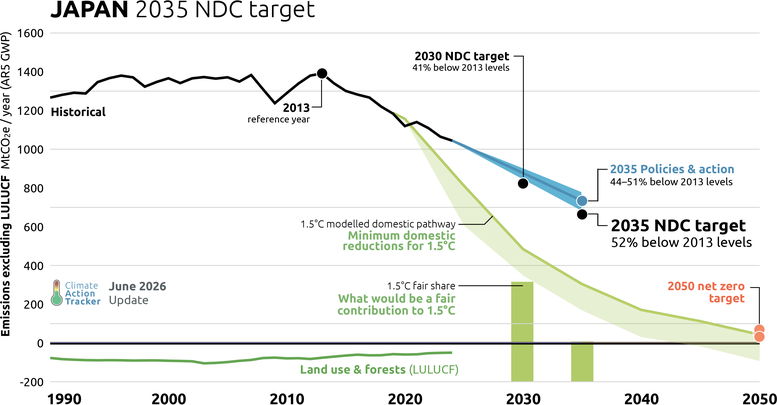
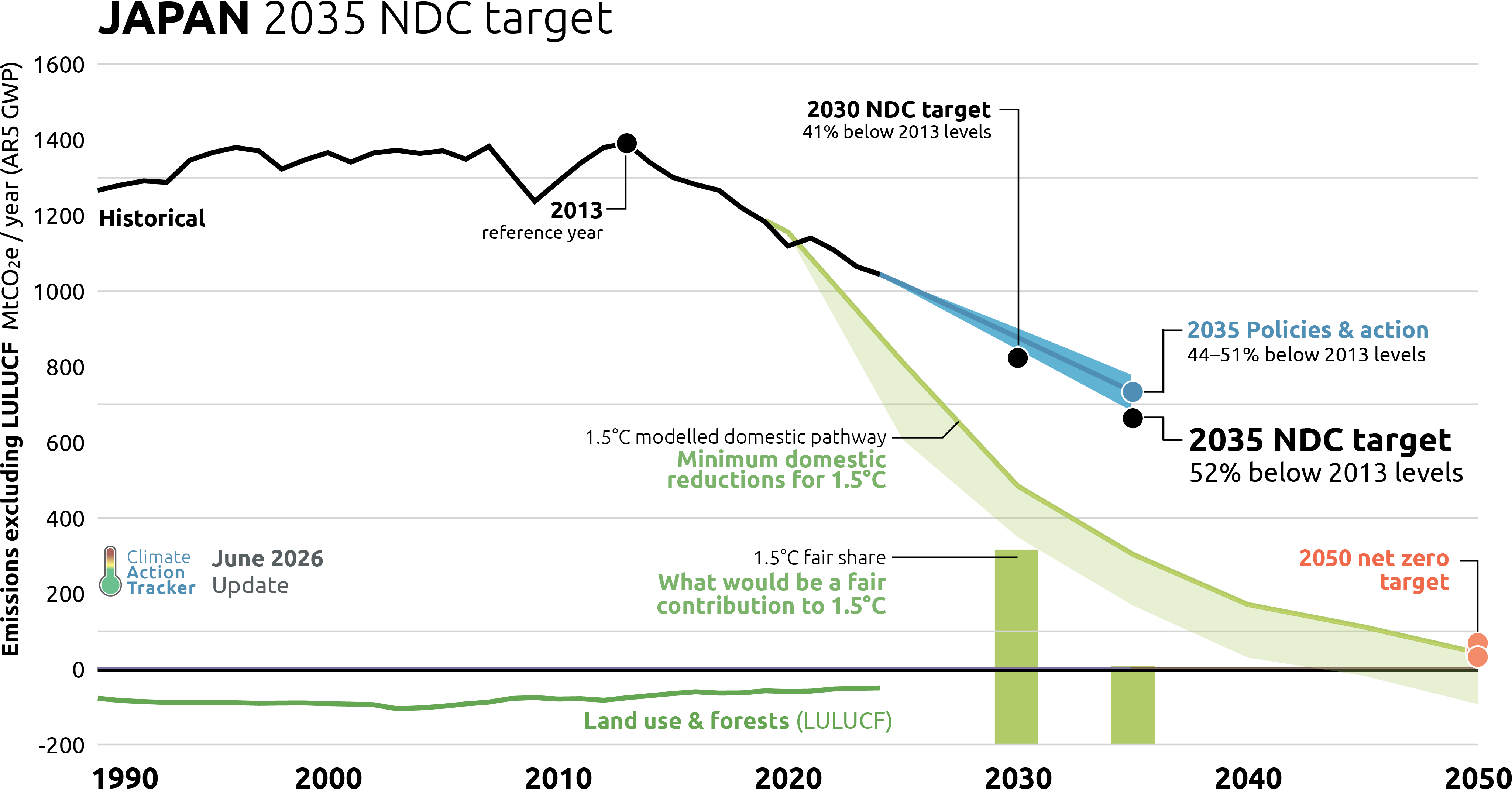
In its new NDC, Japan commits to reducing net emissions by 60% below 2013 levels by 2035 and 73% by 2040. The CAT, which excludes emissions from land use, land use change and forestry (LULUCF), finds that the target results in 664 MtCO2e in 2035 or 52% below 2013 levels by 2035. This target is not 1.5°C-compatible against modelled domestic pathways: a 1.5°C compatible emissions level, excluding LULUCF, would be 304 MtCO2e in 2035 or 78% below 2013 levels by 2035.
While Japan’s 2035 target is set at a lower emissions level compared to its 2030 target, the gap to its 1.5°C compatible modelled domestic pathways has actually grown – the target is 70% above what is required in 2030 to 118% above what is required in 2035. This means that the new target would result in more than twice the emissions level consistent with 1.5°C by 2035. As a result, despite a seemingly stronger target in absolute terms, Japan’s 2035 NDC is proportionally less ambitious than its 2030 target, as it moves further away from a 1.5°C-consistent pathway instead of converging towards it. In other words, Japan is increasingly misaligned with a 1.5°C compatible trajectory.
Japan’s 2035 NDC would lead to emissions just slightly below current policy projections. Under the CAT’s current policy projections, Japan’s emissions are projected to be 44–51% below 2013 levels by 2035 (excluding LULUCF), while its 2035 target aims to reduce emissions by 52% below 2013. While the median of the current policy projection range lies above the target level, and the lower end of the range nearly reaches it (51% vs 52% below 2013 levels), suggesting Japan should have put forward a more ambitious target.
In its new NDC, Japan did not increase the ambition of its 2030 emissions reduction target. If countries do not substantially increase the ambition of their 2030 targets and action, peaking global warming at 1.5°C will be more difficult, and deeper and more rapid emission reduction targets will be required elsewhere. This will likely lead to a multi-decadal, high overshoot of the limit, even if followed by strong 2035 targets.
| Japan | 2035 NDC Target | |
|---|---|---|
| 2030 NDC target | ||
|---|---|---|
| Formulation of target in NDC | Has not updated the ambition of its 2030 target, please see full 2030 NDC assessment here: https://climateactiontracker.org/countries/japan/targets/ | |
| Status | Submitted on 22 October 2021 | |
| 2035 NDC target | ||
|---|---|---|
| Formulation of target in NDC |
Japan aims to reduce its greenhouse gas emissions by 60 percent in FY2035 60% below 2013 levels by 2035 (incl. LULUCF) |
|
| Absolute emissions level in 2035 excl. LULUCF |
Level of emissions to be achieved at home 664 MtCO2e (52% below 2013) |
|
| Status | Submitted on 18 February 2025 | |
Ambition
For the world to have a significant chance of limiting warming to 1.5˚C, governments must switch to emergency mode and strengthen both their 2030 targets and current policies to include substantial emissions cuts and significantly contribute to closing the 2030 emissions gap. Japan’s submitted 2035 NDC target did not increase the ambition of its 2030 emission reduction target.
Further information on Japan’s 2030 target can be found here.
2030 NDC target
| 2030 NDC target | ||
|---|---|---|
| Is the target and international climate finance and other forms of support 1.5°C compatible compared to fair share? |
|
|
| Is the target, international climate finance, and other forms of support 1.5°C compatible compared to fair share? |
|
|
| Is this a stronger target than previously submitted? |
|
|
2035 NDC target
| 2035 NDC target | ||
|---|---|---|
| Is the target and international climate finance and other forms of support 1.5°C compatible compared to fair share? |
|
|
| Is the target 1.5°C compatible compared to modelled domestic pathways? |
|
|
| Does the NDC include sectoral targets? |
|
|
| Does the NDC include a renewable energy capacity target? |
|
|
| Does the target align with the country’s net-zero pathway? |
|
|
Japan submitted its 2035 NDC target on 18 February 2025, setting an emissions reduction target of 60% below 2013 levels by 2035 (incl. LULUCF). This target covers all sectors and all gases. The CAT excludes emissions from land use, land use change, and forestry (LULUCF) and international carbon credits from this target, resulting in 664 MtCO2e in 2035 or 52% below 2013 levels.
- Japan’s 2035 emissions reduction target (equivalent to 52% below 2013 levels) is not 1.5°C compatible compared to modelled domestic pathways because it exceeds the 1.5°C compatible threshold of 304 MtCO2e (excl. LULUCF). To be 1.5°C compatible, Japan would need to reduce its emissions by around 77% below 2013 levels by 2035 (excl. LULUCF).
- When compared to its fair share contribution to climate change mitigation, Japan's 2035 target (equivalent to 52% below 2013 levels) is also not 1.5°C compatible because it is above the 1.5°C compatible threshold of 9 MtCO2e (excl. LULUCF). To make its fair contribution to climate action, Japan would need to cut emissions 99% below 2013 levels by 2035 (excl. LULUCF).
Most importantly, while Japan’s 2035 target is set at a lower emissions level compared to its 2030 target, the gap to its 1.5°C-compatible modelled domestic pathways has actually grown – from 70% for 2030 to 118% for 2035. This means that the new target allows more than double the emissions level consistent with 1.5°C by 2035. As a result, despite a seemingly stronger target in absolute terms, Japan’s 2035 NDC is proportionally less ambitious than its 2030 target, as it moves further away from a 1.5°C-consistent pathway instead of converging towards it. In other words, rather than narrowing the ambition gap over time, Japan’s trajectory is drifting further away from a pathway consistent with limiting warming to 1.5°C.
Japan’s 2035 NDC does not include sector-specific emissions reduction targets. However, the Plan for Global Warming Countermeasures, which is referenced in the NDC and published alongside it, does provide important additional detail (Government of Japan, 2025d). The Plan includes gas-specific targets for CO₂, CH₄, N₂O, and F-gases, and its annexed tables present a detailed list of mitigation measures by sector, including the estimated mitigation potential of each measure by 2035 (Government of Japan, 2025c).
Further information on Japan’s targets can be found here.
| Japan | Target summary (excluding LULUCF) | |
|---|---|---|
| 2030 target: Emissions relative to 2013 levels (CAT estimates)* | ||
|---|---|---|
| Current policies in 2030 | 35 to 39% below | |
| 2030 NDC target | 41% below | |
| 1.5ºC fair share |
77% below [to be reached by providing international climate finance and other forms of support to facilitate substantial emission reductions internationally] |
|
| 1.5ºC modelled domestic pathway | 65% below | |
| 2035 target: Emissions relative to 2013 levels (CAT estimates)* | ||
|---|---|---|
| Current policies in 2035 | 44% to 51% below | |
| 2035 NDC target | 52% below | |
| 1.5ºC fair share |
99% below [to be reached by providing international climate finance and other forms of support to facilitate substantial emission reductions internationally] |
|
| 1.5ºC modelled domestic pathway | 78% below | |
** For the table above, 2013 is used as the reference year, as it is the reference year of Japan’s emissions reduction targets. The emissions value in 2013 is taken from the Japanese government’s latest inventory (see Assumptions section).
Fairness & Finance
Developed countries need to significantly scale up international climate finance and other means of support. They should set 1.5°C aligned domestic mitigation targets in their NDCs and communicate the financial and other support they will provide to developing countries. Developing countries should clearly communicate the climate finance they need to set and achieve ambitious 1.5°C aligned conditional targets.
| 2035 NDC target | ||
|---|---|---|
| Does the target clearly communicate the climate finance contributions and other support to be provided and mobilised to other countries? |
|
|
Our methodology makes it clear that developed countries should set NDC targets that are at least compatible with their 1.5°C modelled domestic pathways <LINK> and should meet these targets within their own borders and using their own resources. Japan’s submitted 2035 NDC is not 1.5°C compatible compared to modelled domestic pathways.
Developed countries are also expected to complement their ambitious domestic mitigation efforts with significant financial support for mitigation in developing countries. In its new NDC, Japan has not clearly communicated the level of climate finance contributions and other support it intends to provide to other countries.
However, the Plan for Global Warming Countermeasures, which complements the NDC and was published alongside it, restates Japan’s previously announced international climate finance commitments for 2021–2025. These include the pledge to provide JPY 6.5 trillion in public and private climate finance over five years, as announced at the 2021 G7 Summit, as well as the additional USD 10 bn and the intention to double adaptation finance—bringing total adaptation support to approximately USD 14.8 bn—announced at COP26 (Government of Japan, 2025d).
Credibility
Credible NDCs should build on robust national planning processes that translate the economy-wide emissions reduction target into action in all sectors. Governments need to ramp up the implementation of their existing targets and further develop policies to close the – still significant – emissions gap between current policies and the 1.5°C pathway. Contradictory policies must be addressed and reversed: fossil fuel production needs to be phased out, while fossil fuel exploration and fossil fuel subsidies need to stop.
| 2035 NDC target | ||
|---|---|---|
| Is the target driving more ambitious action? |
|
|
| Is there a policy framework in place to meet the target? |
|
|
| Does the NDC reference national planning processes for its development? |
|
|
| Does the NDC reference an institutional framework/plan in place for its implementation? |
|
|
| Does the target commit to phase out fossil fuel? |
|
|
Japan’s 2035 NDC would lead to emissions just slightly below current policies. Under the CAT’s current policy projections, Japan’s emissions are projected to be 44–51% below 2013 levels by 2035 (excluding LULUCF), while its 2035 target aims to reduce emissions by 52% below 2013. While the median of the current policy projection range lies above the target level, and the lower end of the range nearly reaches it (51% vs 52% below 2013 levels), showing Japan should have put forward a more ambitious target.
While the NDC references national planning processes in its development, and Japan established committees with a clear mandate to finalise the submission, concerns remain regarding the transparency of these processes. Indeed, several observers have noted persistent issues around the transparency and fairness of energy and climate policy deliberation processes in Japan.
Independent analyses of Japan’s policymaking system indeed point to similar structural problems. Decision making on energy and climate policy is often concentrated within a small group of ministries, with limited visibility into how key choices are made. Opportunities for meaningful public or civil society input can be scarce, and consultations frequently occur only after major decisions have already been shaped internally. Advisory bodies tend to be dominated by industry representatives, creating an imbalance that can sometimes marginalise independent experts (Climate Integrate, 2024).
The 2035 NDC does not commit to phasing out fossil fuels. On the contrary, Japan’s latest Basic Energy Plan still envisions a substantial role for fossil fuels in the country’s energy system. Notably, thermal power (mainly coal and gas) is still expected to account for around 30–40% of electricity generation in 2040. The 2023 Global Stocktake (GST) calls on Parties to transition away from fossil fuels in a just, orderly and equitable manner (UNFCCC, 2023).
Transparency
Governments should set absolute, economy-wide, emissions reduction pathways including all GHG gases, specifying the emissions levels for each year as an absolute level of gross emissions (excluding LULUCF). This level of transparency will ensure that their reduction targets are immune to creative accounting. NDC targets should primarily focus on their domestic reductions by decarbonising all sectors of the economy rather than relying on forestry sinks, other carbon dioxide removal (CDR) or international carbon markets.
| 2035 NDC target | ||
|---|---|---|
| Is the target based on fixed, absolute values? |
|
|
| Does the target cover all sectors? |
|
|
| Does the target cover all greenhouse gases? |
|
|
| Does the target specify an emissions pathway? |
|
|
| Does the target separate out land use and forestry? |
|
|
| Does the target separate out other CO2 removal by type? |
|
|
|
Does the target separate out the use of carbon credits under Article 6? |
|
|
Similar to its previous NDC submission, Japan’s new 2035 target is relatively transparent, expressed as an absolute emissions reduction below a fixed base year, and covers all sectors and GHGs (Government of Japan, 2025a). However, certain aspects of its targets remain opaque and difficult to interpret, which obscures the true scale of Japan’s commitments. In particular, greater clarity is needed in two key areas: land use, land-use change and forestry (LULUCF), and the use of international carbon credits.
The land use and forestry sector
The government continues to rely on its problematic gross-net approach for the land use and forestry (LULUCF) sector, which has been criticised for overstating the contribution of land sinks to Japan’s overall emission reductions. This means that Japan does not include the LULUCF sector in its base-year (gross) emissions, but accounts for net emissions and removals from LULUCF in the target year (net).
Government communications indicate that Japan intends to count its full LULUCF sink toward its 2040 target, consistent with its approach for the 2050 net-zero target, when all removals are expected to be included. However, Japan’s approach to the 2035 target remains unclear. While the Japanese government’s official documentation does include a breakdown of the projected sink in 2035 per sector, it remains unclear how much of the sink will be officially credited toward the emission reduction targets for that year (Government of Japan, 2025c). This lack of clarity raises concerns over transparency and comparability, particularly as methodological revisions could increase the estimated LULUCF sink.
When the 2035 emissions reduction target is recalculated to exclude land use and forestry, the ambition level drops from the stated 60% reduction to 52%. Such an accounting approach undermines the purpose of the Paris Agreement by allowing higher energy and industrial emissions and should be scrutinised.
International carbon credits
Japan intends to use Article 6 mechanisms under the Paris Agreement to help achieve both its 2030 and 2035 NDC targets, primarily through its Joint Crediting Mechanism (JCM). Initiated a decade ago, the JCM is a bilateral scheme that allows Japan to claim part of the emission reductions achieved through projects implemented in partner countries. Similar to its previous NDC submission, Japan intends to count credits generated under the JCM toward achieving its 2035 target. Specifically, through the JCM, Japan aims to secure accumulated emission reductions and removals at the level of approximately 100 MtCO2 by 2030 and approximately 200 MtCO2 by 2040 (Government of Japan, 2025b).
However, the mechanism’s track record raises questions about how much it can realistically contribute to Japan’s mitigation efforts. Despite its long operation and partnerships with more than 30 countries, the JCM has produced relatively few projects and minimal verified emission reductions compared to Japan’s overall targets. As of March 2025, Japan has claimed around 0.8 MtCO2 of JCM credits, very far from its 100 MtCO2 target for 2030 (JCM, 2025). Besides its very limited scale, there are more substantial concerns related to the sustainability and additionality of these claimed reductions.
Indeed, the CAT’s latest briefing on Article 6 cautions against buying international carbon credits to delay or avoid investing in domestic mitigation, especially when developing high-quality, verifiable offset projects remains extremely difficult. As an Annex I country, Japan should avoid purchasing so-called “low-hanging fruit” credits from developing countries, burdening them with a more difficult and expensive decarbonisation in the future, and should instead enhance its domestic ambition.
We excluded JCM credits from the calculation of Japan’s 2035 target to show a clearer picture of Japan’s domestic climate commitment (for more information, see Assumption section).
Further analysis





Latest publications




Stay informed
Subscribe to our newsletter