
Brazil
Net zero targets
Summary
We evaluate Brazil’s net zero target as: Poor.
Brazil aims to achieve carbon neutrality by 2040 and climate neutrality by 2050, a target reiterated in its 2024 NDC submission (Government of Brazil, 2024a). The National Mitigation Strategy articulates the goal of carbon neutrality by 2040, relying on net negative emissions to offset non-CO2 gases, which are considered hard to abate. Between 2010 and 2020, non-CO2 gases represented 45% of Brazil’s total emissions (Government of Brazil, 2026a).
The National Climate Plan (“Plano Clima) outlines the role of land-based removals and carbon capture and storage technologies, particularly BECCS. It is important that this clarity is also articulated for 2050 target, as degradation is expected to significantly constrain Brazil’s carbon sink capacity. While Brazil outlines the role of emission reductions and removals for its 2030 and 2035 NDC targets, similar transparency is lacking for its 2050 target. As of June 2026, Brazil has not submitted a Long-Term Strategy to the UNFCCC.
Aiming for climate neutrality by 2050 is a step in the right direction: transitioning to a low-emissions development pathway in compliance with international climate change commitments. However, Brazil should clearly state its plans for reducing emissions across all sectors of the economy, particularly for non-LULUCF sectors. It is important to avoid overreliance on removals that might not be feasible in the long-term.
CAT analysis of net zero target
Ten key elements
Scope
- Target year – Brazil aims to reach climate neutrality by 2050.
- Emissions coverage – Brazil consistently articulates in its NDC and National Mitigation Strategy that its goal covers all GHG gases and all sectors of the economy.
- International aviation and shipping – Brazil provides no information on its intention to cover international aviation and shipping.
- Reductions or removals outside of own borders – Brazil provides no information on its intention to use international offset credits to meet its net zero target.
Target architecture
- Legal status – As of June 2026, Brazil has not submitted an LTS to the UNFCCC. However, its current NDC commits to climate neutrality by 2050. The goal of climate neutrality by 2050 is stated in the Bill No. 6539, which was approved by the Senate in November 2021, and reiterated in the National Mitigation Strategy.
- Separate reduction & removal targets – In its National Climate Plan (“Plano Clima), Brazil estimates removals of 75 MtCO2e in 2035 and 278–284 MtCO2e in 2035, but does not specify planned removals for 2050.
- Review process – Brazil provides no information on its intention to establish a review cycle for its net zero and intermediate targets.
Transparency
- Carbon dioxide removal – Brazil provides information on its removal assumptions for 2035, but does not provide equivalent assumptions for 2050.
- Comprehensive planning – Brazil provides a general framework for achieving its net zero target in the National Mitigation Strategy.
- Clarity on fairness of target – Brazil provides no information on its intention to explain the target’s fairness.
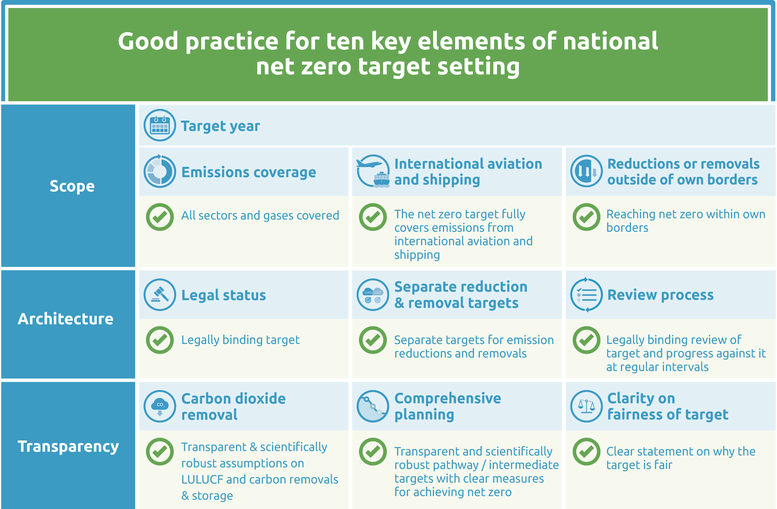
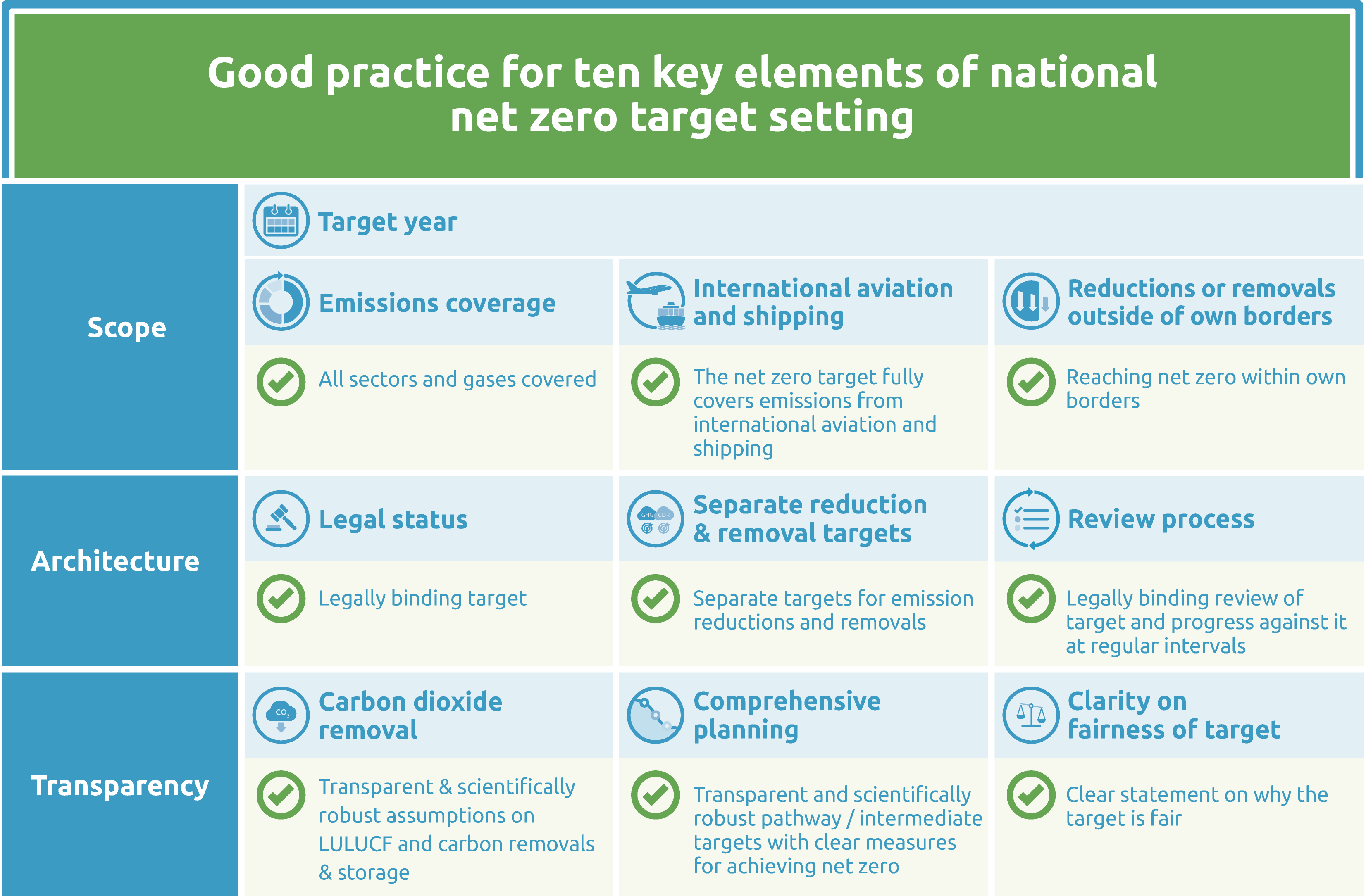
Good practice
The Climate Action Tracker has defined the following good practice for all ten key elements of net zero targets. Countries can refer to this good practice to design or enhance their net zero targets.
Further analysis





Latest publications




Stay informed
Subscribe to our newsletter