
Nigeria
2035 NDC
2035 NDC Target Overview
This analysis was published in May 2026.
Nigeria’s 2035 NDC, submitted in September 2025, stands out as one of the few submissions that strengthened the respective country’s 2030 targets, along with submitting 2035 targets. Not only are Nigeria’s 2035 targets 1.5°C aligned, but now, its 2030 targets are also aligned with 1.5°C. Nigeria’s new targets also align with its 2060 net zero target as outlined in the LT-LEDS of 2024. Overall, this NDC represents a high level of ambition aligned with the 1.5°C temperature limit.
With this 2035 NDC submission, Nigeria has shifted from expressing its NDC targets as reductions below a business-as-usual (BAU) scenario to a reduction below a historical base year value. The CAT welcomes this change, as targets expressed as a reduction from a BAU can change drastically with adjustments of the underlying BAU scenario. This brings much-needed transparency to the target.
Nigeria’s 2035 NDC targets absolute emission reductions of 29% by 2030 and 32% by 2035 below 2018 emissions levels. For both the 2030 and 2035 targets, 80% of these reductions are conditional on international financial support, while the remaining 20% of reductions are unconditional.
Despite the ambitious targets provided, Nigeria's current policies are projected to significantly increase emissions, in conflict with the new targets. There is also no commitment in the NDC to phase out fossil fuels, and the Nigerian economy is still heavily reliant on oil and fossil gas exports. The role of the land sector for achieving the targets and the use of international carbon trading are also not clear and should be clarified by the government.
Nigeria submitted its 2035 NDC to the UNFCCC on September 22, 2025, where the government set a conditional absolute emissions reductions target of 184.9 MtCO2e in 2035 (incl. LULUCF) which represents a 32.2% reduction below 2018 emissions levels. The unconditional target for 2035 is 20% of the absolute emissions reduction of 184.9 MtCO2e (incl. LULUCF). The target covers all major sectors and gases.
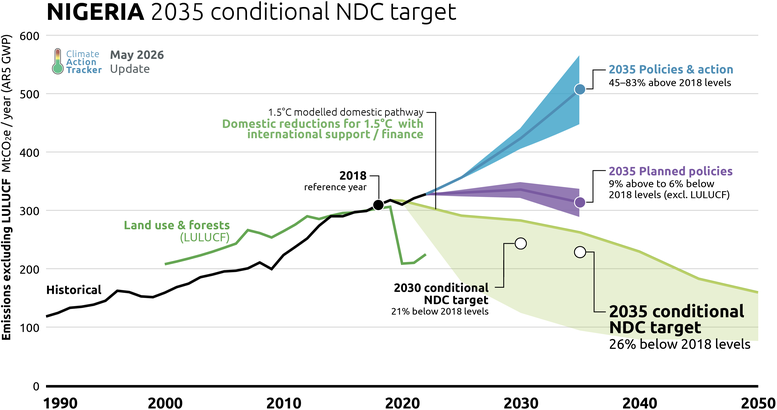
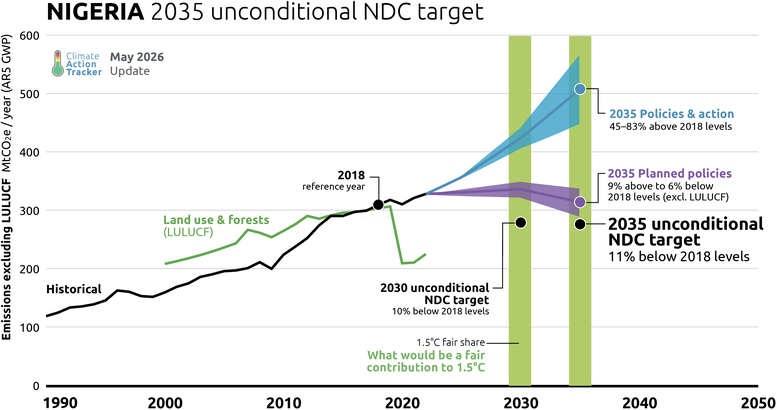
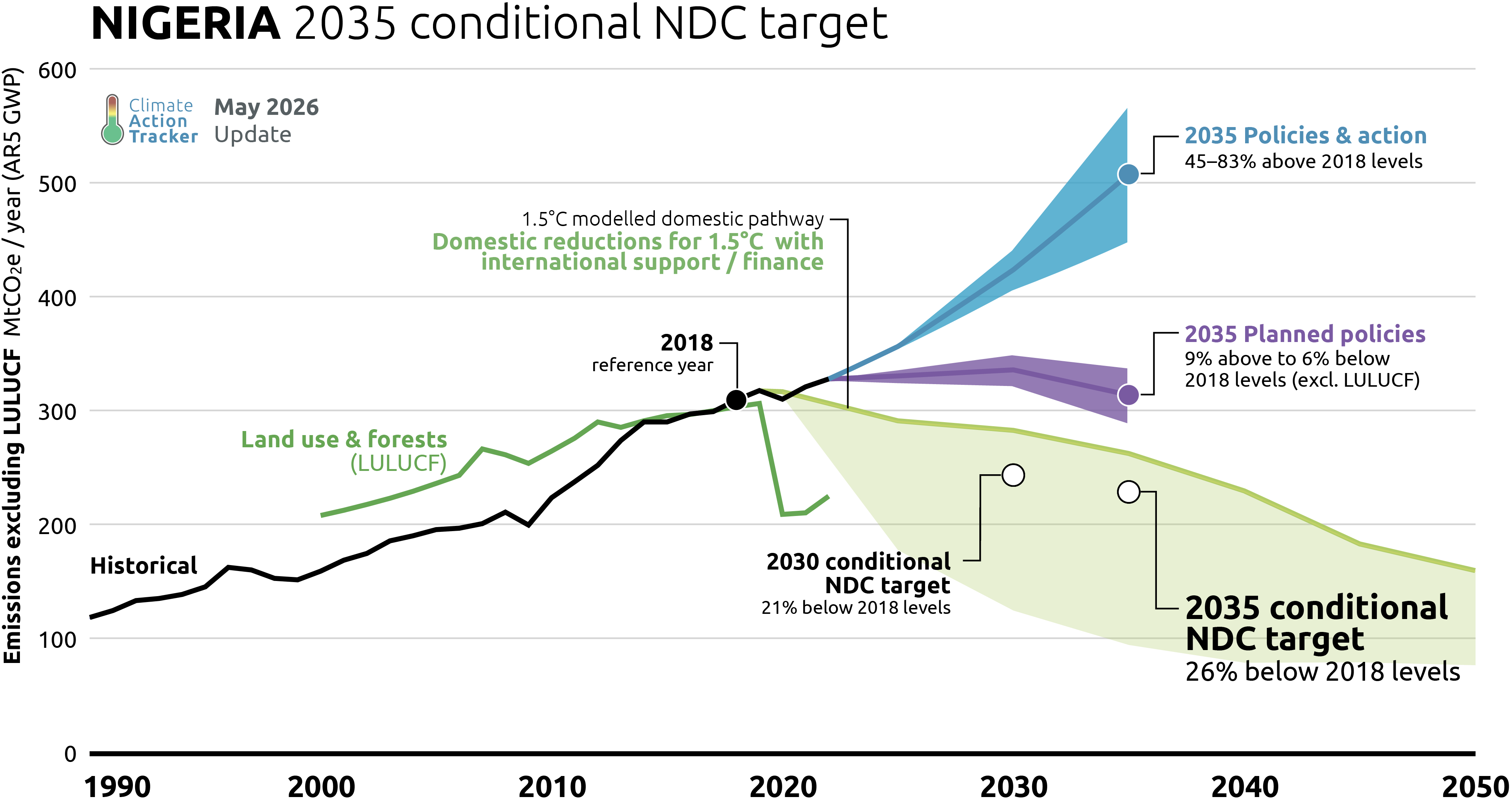
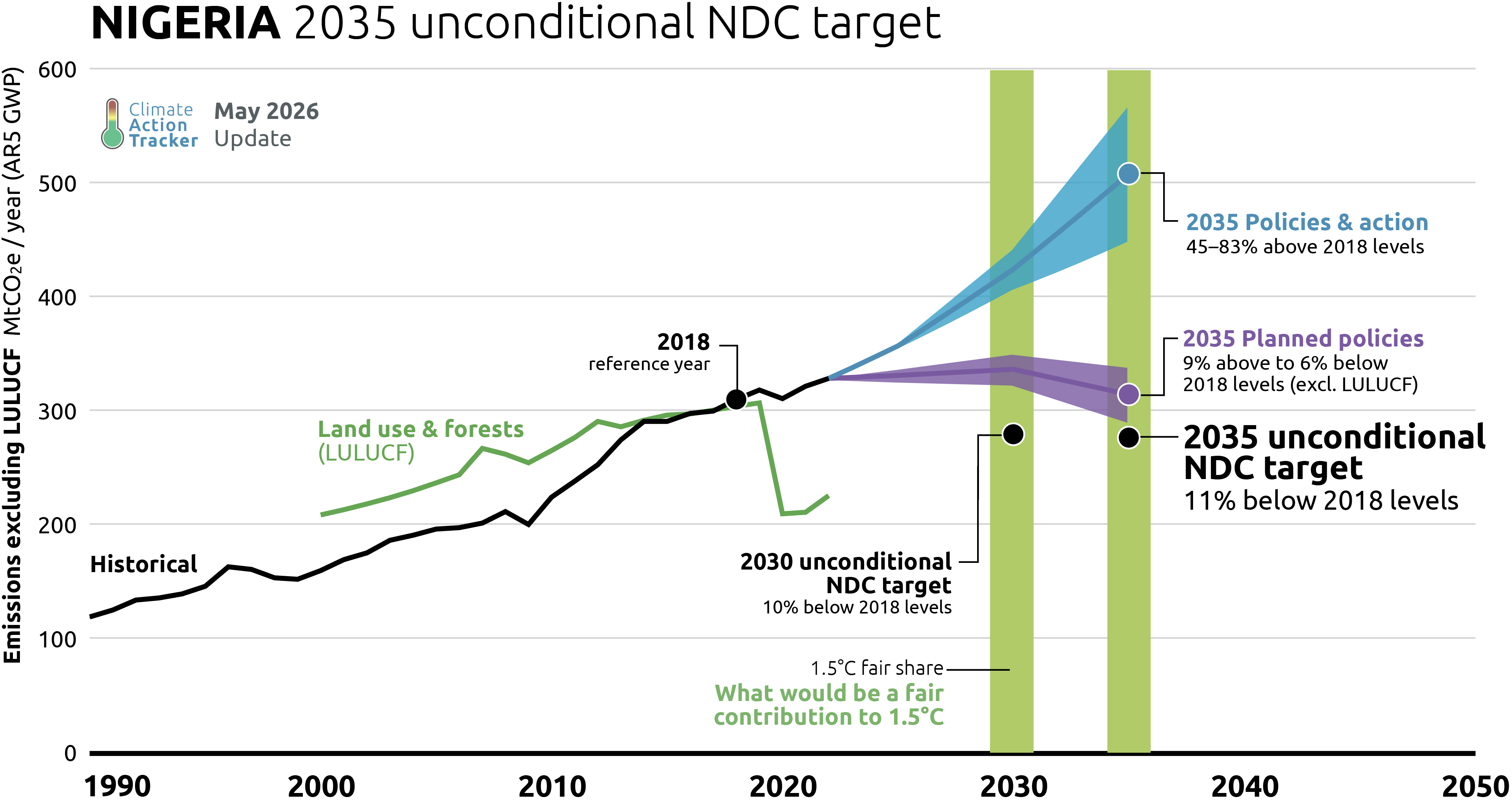
The CAT excludes emissions from the LULUCF sector, resulting in a conditional target in 2035 of 229 MtCO2e or 26% below 2018, and an unconditional target in 2035 of 277 MtCO2e or 11% below 2018.
When compared to its fair share of global climate action, Nigeria's unconditional 2035 target is 1.5°C compatible. The conditional 2035 target is also 1.5°C compatible compared to the CAT’s modelled domestic pathways. To achieve its conditional target, Nigeria needs additional international climate finance and support.
Achieving Nigeria's 2035 NDC would result in emissions below current policies. However, Nigeria’s current policies are projected to significantly increase emissions above 2018 levels, undermining the new targets’ credibility.
| NIGERIA | 2035 NDC | |||
|---|---|---|---|---|
| 2030 unconditional NDC target | ||||
|---|---|---|---|---|
| Formulation of target in NDC | 20% of absolute emissions reduction of 168.2 MtCO2e in 2030 from base year 2018 (incl. LULUCF) | |||
|
Absolute emissions level in 2030 excl. LULUCF |
279 MtCO2e (excl. LULUCF) 10% below 2018 levels 25% above 2010 levels |
|||
| Status | Submitted on 22 September 2025 | |||
| 2030 conditional NDC target | ||||
|---|---|---|---|---|
| Formulation of target in NDC | Absolute emissions reduction of 168.2 MtCO2e in 2030 from base year 2018 (incl. LULUCF) or 29.3% below 2018 levels by 2030 (incl. LULUCF) | |||
|
Absolute emissions level in 2030 excl. LULUCF |
244 MtCO2e (excl. LULUCF) 21% below 2018 levels 9% above 2010 levels |
|||
| Status | Submitted on 22 September 2025 | |||
| 2035 unconditional NDC target | ||||
|---|---|---|---|---|
| Formulation of target in NDC | 20% of absolute emissions reduction of 184.9 MtCO2e in 2035 from base year 2018 (incl. LULUCF) | |||
|
Absolute emissions level in 2035 excl. LULUCF |
277 MtCO2e (excl. LULUCF) 11% below 2018 levels 23% above 2010 levels |
|||
| Status | Submitted on 22 September 2025 | |||
| 2035 conditional NDC target | ||||
|---|---|---|---|---|
| Formulation of target in NDC | Absolute emissions reduction of 184.9 MtCO2e in 2035 from base year 2018 or 32.2% below 2018 levels by 2035 (incl. LULUCF) | |||
|
Absolute emissions level in 2035 excl. LULUCF |
229 MtCO2e (excl. LULUCF) 26% below 2018 levels 2% above 2010 levels |
|||
| Status | Submitted on 22 September 2025 | |||
Ambition
For the world to have a significant chance of limiting warming to 1.5°C, governments must switch to emergency mode and strengthen both their 2030 targets and current policies to include substantial emissions cuts and significantly contribute to closing the 2030 emission gap. Nigeria’s new 2030 target is more ambitious than it was previously, and the 2035 target increases ambition slightly further.
2030 NDC target
| 2030 unconditional NDC target | 2030 conditional NDC target | |
|---|---|---|
| Is the target 1.5°C compatible compared to modelled domestic pathways? |
️ |
Nigeria needs international climate finance and other forms of support to align its 2030 conditional target to 1.5°C modelled domestic pathways. |
| Is the target 1.5°C compatible compared to fair share? |
|
️ |
| Is this a stronger target than previously submitted? |
|
|
2035 NDC target
| 2035 unconditional NDC target | 2035 conditional NDC target | |
|---|---|---|
| Is the target 1.5°C compatible compared to modelled domestic pathways? |
️ |
Nigeria needs international climate finance and other forms of support to align its 2035 conditional target to 1.5°C modelled domestic pathways |
| Is the target 1.5°C compatible compared to fair share? |
|
️ |
| Does the NDC include sectoral targets? |
|
|
| Does the NDC include a renewable energy capacity target? |
|
|
| Does the target align with the country’s own net-zero pathway? |
|
|
With this 2035 NDC submission, Nigeria has shifted from expressing its NDC targets as reductions below a business-as-usual (BAU) scenario to a reduction below a historical base year value. The CAT welcomes this change, as targets expressed as a reduction from a BAU can change drastically with adjustments of the underlying BAU scenario. Therefore, the use of an absolute rather than relative reduction for the targets enhances the transparency of efforts.
Due to this shift to a reduction below a historical base year value, Nigeria’s updated 2030 targets are more definite than those from the previous NDC submitted in 2021. The unconditional 2030 target of 368–388 MtCO2e (excl. LULUCF) has improved to 279 MtCO2e (excl. LULUCF), while the conditional 2030 target of 244–294 MtCO2e (excl. LULUCF) has decreased in range to 244 MtCO2e (excl. LULUCF). This means that Nigeria’s 2030 unconditional falls in the 1.5°C compatible range compared to Nigeria’s fair share, and the conditional target would also align with 1.5°C modelled domestic pathways.
Nigeria commits to a conditional 2035 target of reducing emissions by 32.2% below 2018 levels including LULUCF. When excluding LULUCF, the conditional 2035 target is equivalent to an emissions level of 26% below 2018 levels or 229 MtCO2e in 2035, while the unconditional target equates to an emissions level of 277 MtCO2e in 2035 (excl. LULUCF) or 11% below 2018 levels.
When compared to its fair share contribution to climate change mitigation, Nigeria's unconditional 2035 target of 11% below 2018 levels (excl. LULUCF) is 1.5°C compatible because it is below the 1.5°C compatible threshold of 134% above 2018 levels (excl. LULUCF).
Nigeria’s conditional 2035 target of 26% below 2018 levels (excl. LULUCF) is 1.5°C compatible when compared to modelled domestic pathways but will need additional international climate finance and other international support to reach the target.
The NDC includes a breakdown of the expected emissions reductions from each sector towards achieving the 2035 target. However, the baseline of these sectoral emissions reductions is not specified. This should be clarified in the NDC.
The NDC also provides a list of mitigation policies per sector, alongside the estimated mitigation potential for each policy.
Nigeria does not provide a renewable energy capacity target for 2035 but does include a 50% renewable energy generation target for 2030. This 2030 renewable energy target is not 1.5°C aligned. To be 1.5°C aligned, the CAT estimates that renewable energy should generate 55-71% of Nigeria’s total electricity by 2030.
The 2035 NDC does not specify a deadline to end deforestation but includes a measure which could reduce the deforestation rate by 60% as per government estimates. It is important to note that the government does not specifies a base year for this estimate.
Nigeria has set 2035 targets that align with their 2060 net zero target as outlined in their LT-LEDS. Further information on Nigeria’s net zero target can be found here.
| NIGERIA | Target summary (excluding LULUCF) |
|---|
| 2030 target: Emissions reductions from 2018 levels (CAT estimates) | |
|---|---|
| Current policies in 2030 | 31-42% above |
| 2030 conditional NDC target | 21% below |
| 2030 unconditional NDC target | 10% below |
| 1.5°C compatible fair share | 152% above |
| 1.5°C compatible modelled domestic pathway | 9% below to be reached with international climate finance and other forms of support that facilitate substantial emission reductions domestically |
| 2035 target: Emissions reductions from 2018 levels (CAT estimates) | |
|---|---|
| Current policies in 2035 | 45-83% above |
| 2035 conditional NDC target | 26% below |
| 2035 unconditional NDC target | 11% below |
| 1.5°C compatible fair share | 134% above |
| 1.5°C compatible modelled domestic pathway | 15% below to be reached with international climate finance and other forms of support that facilitate substantial emission reductions domestically |
Fairness & Finance
Developed countries need to significantly scale up international climate finance and other means of support. Developed countries should set 1.5°C aligned domestic mitigation targets in their NDCs and communicate the financial and other support they will provide to developing countries. Developing countries should clearly communicate the climate finance they need to set and achieve ambitious 1.5°C aligned conditional targets.
| 2035 conditional NDC target | |
|---|---|
| Does the target clearly communicate the climate finance and support needed to reach the conditional target? |
|
Most developing countries will need financial support to mitigate emissions beyond what would be their fair share according to effort-sharing frameworks. Therefore, the CAT encourages these governments to put forward an ambitious conditional target that is in line with their 1.5°C modelled domestic pathway, and to quantify climate finance needed, including an implementation plan, to meet the set target.
Nigeria communicated that it would need climate finance and other support of USD 156 billion (80% of the USD 195 billion required to implement the mitigation component of the NDC) to achieve its conditional 2035 NDC target. Nigeria’s submitted 2035 conditional target is 1.5°C compatible compared to modelled domestic pathways.
Credibility
Credible NDCs should build on robust national planning processes that translate the economy-wide emissions reduction target into action in all sectors. Governments need to ramp up the implementation of their existing targets and further develop policies to close the – still significant – emissions gap between current policies and 1.5°C pathway. Contradictory policies must be addressed and reversed: fossil fuel production needs to be phased out, while fossil fuel exploration and fossil fuel subsidies need to stop.
| 2035 NDC target | |
|---|---|
| Is the target driving more ambitious climate action? |
|
| Is there a policy framework in place to meet the target? |
|
| Does the NDC reference national planning processes for its development? |
|
| Does the NDC reference an institutional framework/plan in place for its implementation? |
|
| Does the target commit to phase out fossil fuel production? |
|
| Does the target commit to stop fossil fuel exploration & subsidies? |
|
While Nigeria’s 2035 NDC targets are a step forward in terms of driving more ambitious NDC action, the projected increase in emissions under current policies appears at odds with Nigeria’s new targets for 2030 and 2035. Nigeria does, however, provide a list of additional policies in the NDC with seemingly sufficient mitigation potential to meet targets.
The NDC acknowledges Nigeria’s consideration of exploiting and exporting fossil fuels, such as oil and coal, and highlights the environmental and social impacts associated with fossil fuel production and consumption. The NDC does describe a recent measure to reduce fossil fuel subsidies for domestic use but stresses the importance of ensuring such measures are aligned with a just transition, the need for significant international support, and the prioritisation of renewable energy sources to meet climate goals.
However, the 2035 NDC does not commit to phase out fossil fuel production and suggests using fossil gas as a bridging fuel and, therefore, expanding its domestic production. The CAT does not consider fossil gas a bridging fuel because its continued, or expanded, use and infrastructure locks in high emissions, undermines rapid renewables deployment, and is incompatible with a 1.5°C aligned phase‑out of all fossil fuels. It is critical that Nigeria moves rapidly towards economic diversification, given its current economic reliance on fossil fuel exports to avoid stranded assets linked to extraction and transport of fossil fuels.
Transparency
Governments should set absolute, economy wide, emissions reductions target trajectories including all GHG gases, specifying the emissions levels for each year as an absolute level of emissions (excl. LULUCF) so they are clear, transparent, and immune to creative accounting. NDC targets should primarily focus on their domestic reductions by decarbonising all sectors of the economy rather than relying on forestry sinks, other carbon dioxide removal (CDR) or international carbon markets.
| 2035 NDC target | |
|---|---|
| Is the target based on a fixed year or is it a fixed absolute value? |
|
| Does the target cover all sectors? |
|
| Does the target cover all greenhouse gases? |
|
| Does the target specify an emissions pathway? |
|
| Does the target separate out land use and forestry? |
|
| Does the target separate out other CO2 removal by type? |
️ |
| Does the target separate out the use of carbon credits under Article 6? |
|
The formatting of the NDC targets as absolute reductions below a historical base year value is a welcome change from previous NDC submissions. When the 2030 targets were formulated as a reduction from a BAU scenario, there was a high level of uncertainty resulting from potential future changes to the BAU. An emissions pathway up to 2035 is displayed graphically, which the 2035 NDC asserts is aligned to the LT-LEDS modelling exercise for reaching net zero by 2060, however emissions pathways or figures after 2035 are not provided in the NDC.
The NDC targets cover all major gases relevant for Nigeria, i.e., CO2, CH4, N2O, and HFCs. SF6 has not yet been estimated, while PFCs and NF₃ are not covered since they have not yet been identified as being emitted in the country, but the NDC text suggests they could be.
Nigeria expresses its 2030 and 2035 targets as net targets including LULUCF. It does indicate the percentage share of the total emissions reductions that is expected to come from the LULUCF sector: 73.7% for the 2030 target and 68.1% for the 2035 target.
Apart from LULUCF sinks, the 2035 NDC does not mention the intention to use engineered or novel types of carbon dioxide removal (CDR).
Nigeria intends to use carbon markets, including Internationally Transferred Mitigation Outcomes (ITMOs) under Article 6, to supplement the domestic resources that it mobilises to fund the unconditional component of its NDC targets. Nigeria risks selling emission reductions that are relatively inexpensive or would have occurred anyway, leaving it with fewer and more costly options to increase its own mitigation ambition in the future and to achieve its domestic component of the NDC. This is particularly relevant for Nigeria as its NDC targets are significantly below its current policy projections.
To engage responsibly in Article 6, Nigeria would need, alongside its 1.5°C compatible target, to establish safeguards (such as a positive list) to ensure that only high-quality, additional, and relatively high-cost mitigation options are transferred, and to introduce benefit‑sharing arrangements that support domestic climate ambition.
Finance generated through the purchase of carbon credits (ITMOs) under Article 6 should not be counted as climate finance, which Nigeria does not intend to do. ITMO transactions are designed to help the buying country achieve its targets, while the selling country must make a corresponding adjustment that effectively makes the achievement of its target more difficult. For more information on the promise and pitfalls of Article 6 mechanisms, see the recent CAT briefing here.
For more information on Nigeria’s climate targets and policies, please click here. For the CAT’s full recommendations for setting NDC targets that form the basis of the analysis above, please click here.
Assumptions
NDC and other targets
2035 NDC
Nigeria set its 2035 target as an absolute emissions reduction of 184.9 MtCO2e in 2035 from the emissions of 573.5 MtCO2e in 2018, which represents a 32.2% reduction.
20% of this reduction (the unconditional component of the target) is to come from Nigeria’s own domestic resources and 80% (the conditional component of the target) achieved through climate finance and other international support. This leads to emission levels of 534 MtCO2e under the unconditional target and of 386 MtCO2e under the conditional target, in 2035, including emissions from LULUCF. We assume that if the conditional target is met, the unconditional target is also met first, so the total reduction is 100% of the 32.2% target value.
The CAT excludes emissions from the LULUCF sector. To estimate and remove LULUCF emissions, we assume that the percentage contribution of emissions reductions from the LULUCF sector up to 2030 and 2035 will align with the NDC’s forecast (73.7% and 68.1% respectively). We assume that this percentage applies to both the unconditional and conditional targets. Under this assumption, the targets translate to 2035 emissions levels of 277 MtCO2e under the unconditional target and 229 MtCO2e under the conditional target (excl. LULUCF).
Nigeria also updated its 2030 target in this submission to be a 29.3% reduction below the same 2018 baseline. The calculations and assumptions for the new 2030 target follow the same structure and assumptions as for the 2035 target.
Further analysis





Country-related publications

Stay informed
Subscribe to our newsletter