Peru
2035 NDC
2035 NDC Target
This analysis was published in April 2026.
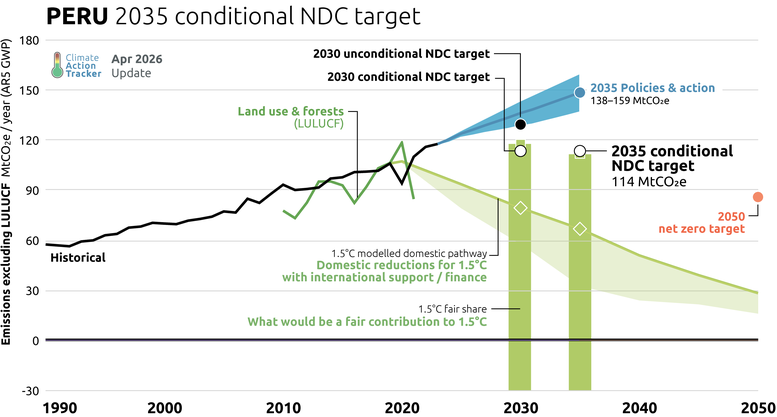
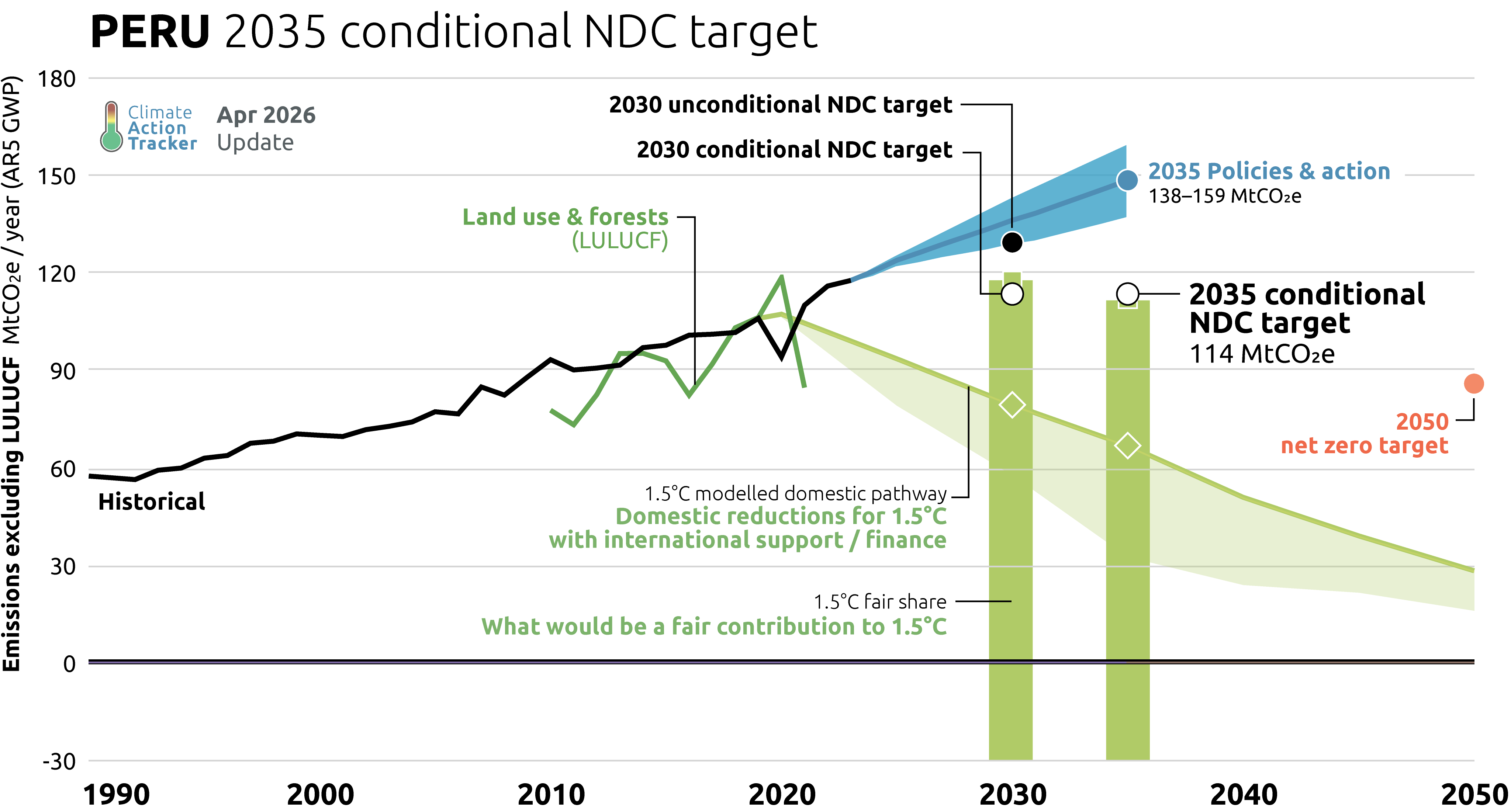
Peru submitted a conditional NDC target for 2035 of the same emissions level as its conditional target for 2030, which is neither 1.5°C aligned in 2030 nor in 2035 and represents a clear lack of ambition. Even more concerning, Peru did not put forward an unconditional target for 2035, as it did for 2030. It is therefore unclear what level of emissions reductions the country is prepared to achieve using its own resources.
This “new” conditional target is a regression in ambition as the gap between a 1.5°C compatible pathway and Peru’s target path has increased from 2030 to 2035 since the target remains the same – despite the need for rapid emissions reductions. This gap grows from 34 MtCO2e in 2030 to 47 MtCO2e in 2035. The conditional target is also unlikely to reverse the current emissions trend, which is projected to continue rising through to 2035.
Peru submitted its 2035 NDC to the UNFCCC on November 6, 2025. In this new pledge, Peru presents a 2035 conditional target identical to its 2030 conditional target – namely, to reduce emissions to 179 MtCO2e (incl. LULUCF). In other words, the government has weakened its target: it is committing to the same emissions level, just five years later, effectively giving itself more time to achieve the exact same goal. This goes against the Paris Agreement’s expectation that each new NDC submission should be more ambitious than the previous one.
Peru has not communicated an unconditional target for 2035. Unlike its 2030 NDC submitted in 2020 that included both unconditional and conditional targets for 2030, this 2035 NDC communicates one target for 2035 that is entirely conditional. The government should specify the share of emissions reductions it is prepared to achieve with its own resources
This “new” 2035 conditional target remains inconsistent with 1.5°C compatible modelled domestic pathways. As the 2035 conditional target is the same as its 2030 target, the gap between Peru’s NDC targets and a 1.5°C compatible trajectory is widening over time. The conditional target in 2030 is 34 MtCO2e above a 1.5°C pathway, while in 2035 that gap has grown to 47 MtCO2e. Instead of narrowing the ambition gap between 2030 and 2035, Peru is moving further away from alignment with 1.5°C.
To align with a 1.5°C compatible modelled domestic pathway, Peru would need to reduce its emissions to 79 MtCO2e in 2030, or by at least 33% below 2023 levels, and to 67 MtCO2e in 2035, or by at least 43% below 2023 levels (excl. LULUCF).
Emissions in Peru are projected to continue rising through to 2035. While the 2035 NDC target is set below Peru’s current policy projections and could, as such, drive stronger action, it does not outline a credible policy framework capable of reversing the upward trend of its emissions. Notably, it includes the same mitigation measures as in the previous NDC submission – most of which have yet to be implemented.
There is no mention of phasing out fossil fuel production, exploration, or subsidies in the 2035 NDC. Instead, Peru continues to expand fossil fuel production, which is incompatible with the emissions reductions needed to achieve its climate targets. Peru also plans to use internationally transferred mitigation outcomes (ITMO) to achieve its 2035 target, which risks decreasing domestic mitigation ambition.
| Peru | 2035 NDC | |||
|---|---|---|---|---|
| 2030 conditional NDC target | ||||
|---|---|---|---|---|
| Formulation of target in NDC | Conditional on the availability of international financing, Peru proposes limiting its GHG emissions to a level of 179 MtCO2e by 2030. It has not updated the ambition of its 2030 target. Please see the full 2030 NDC assessment under the Targets tab. | |||
| Status | Submitted on 18 December 2020 | |||
| 2035 conditional NDC target | ||||
|---|---|---|---|---|
| Formulation of target in NDC | The Peruvian State commits to ensuring that its greenhouse gas emissions do not exceed 179 MtCO2e in 2035, seeking a progressive and fair reduction, adapted to national capacities and circumstances; and conditioned on international external financing under favourable conditions. | |||
|
Absolute emissions level in 2035 excl. LULUCF |
114 MtCO2e (22% above 2010) (4% below 2023) |
|||
| Status | Submitted on 6 November 2025 | |||
Ambition
For the world to have a significant chance of limiting warming to 1.5˚C, governments must switch to emergency mode and strengthen both their 2030 targets and current policies to include substantial emissions cuts and significantly contribute to closing the 2030 emissions gap. Peru’s submitted 2035 NDC target did not increase the ambition of its 2030 target.
Further information on Peru’s 2030 target can be found here.
2030 NDC target
| 2030 unconditional NDC target | 2030 conditional NDC target | |
|---|---|---|
| Is the target 1.5°C compatible compared to modelled domestic pathways? |
️ |
Peru needs international climate finance and other forms of support to align its 2035 conditional target to 1.5°C modelled domestic pathways |
| Is the target 1.5°C compatible compared to fair share? |
|
️ |
| Is this a stronger target than previously submitted? |
|
|
2035 NDC target
| 2035 conditional NDC target | ||
|---|---|---|
| Is the target 1.5°C compatible compared to modelled domestic pathways? |
Peru needs international climate finance and other forms of support to align its 2035 conditional target to 1.5C modelled domestic pathways |
|
| Does the NDC include sectoral targets? |
|
|
| Does the NDC include a renewable energy capacity target? |
|
|
Peru submitted its 2035 NDC to the UNFCCC on November 6, 2025. In this new pledge, Peru presents a 2035 conditional target identical to its 2030 conditional target – namely, to reduce emissions to 179 MtCO2e (incl. LULUCF). The target is weaker – it is the same level of emissions reductions, just applied to 2035 instead of 2030. Peru first introduced this conditional 2030 target in its 2030 NDC submitted in 2020.
The government argues that this represents greater ambition because the 2030 conditional target was previously framed as aspirational, whereas the 2035 conditional target is now presented as a formal mitigation goal. This is a change in framing rather than substance: the numerical level of ambition remains unchanged across NDC submissions. Peru’s latest NDC also omits an unconditional 2035 target, which had been included in its 2020 submission.
The conditional target, which covers all sectors and gases, aims to reduce emissions to 179 MtCO2e (incl. LULUCF) in 2035. The CAT excludes emissions from land use, land use change and forestry (LULUCF) from this target, resulting in 114 MtCO2e in 2035 (or 4% below 2023 levels).
The 2035 NDC target is not compatible when compared to 1.5°C modelled domestic pathways because it is above the 1.5°C compatible threshold of 67 MtCO2e (excl. LULUCF). To reach that level, Peru would need to reduce its emissions to at least 43% below 2023 levels by 2035 (excl. LULUCF).
The NDC includes sectoral plans for reducing emissions from LULUCF, energy (specifically transport and stationary combustion), agriculture, waste (including solid waste and drinking water and sanitation), and industrial processes and product use (IPPU). However, the NDC does not establish sectoral emissions reductions targets for 2035. The NDC also does not set any targets for increasing renewable energy deployment or for halting deforestation, although it does include a target to reduce HFC consumption by 30% by 2035.
Further information on Peru’s targets can be found here.
| PERU | Target summary (excluding LULUCF) |
|---|
| 2035 target: Emissions relative to 2023 levels (CAT estimates) | |||
|---|---|---|---|
| Current policies in 2035 | 17–35% above | ||
| 2035 conditional NDC target | 4% below | ||
| 1.5°C fair share | 5% below | ||
| 1.5°C modelled domestic pathway |
43% below to be reached with international climate finance and other forms of support that facilitate substantial emission reductions domestically |
||
For the table above, 2023 is used as the reference year as it is the last year for which historical data is available.
Fairness & Finance
Developed countries need to significantly scale up international climate finance and other means of support. They should set 1.5°C aligned domestic mitigation targets in their NDCs and communicate the financial and other support they will provide to developing countries. Developing countries should clearly communicate the climate finance they need to set and achieve ambitious 1.5°C aligned conditional targets.
| 2035 NDC | ||
|---|---|---|
| Does the target clearly communicate the climate finance and support needed to reach the conditional target? |
|
|
Most developing countries will need financial support to mitigate emissions beyond what would be their fair share according to effort-sharing frameworks. Therefore, the CAT encourages these governments to put forward an ambitious conditional target in line with their 1.5°C modelled domestic pathway, and to quantify climate finance needed, including an implementation plan, to meet the set target.
Peru has communicated that it would need climate finance and other support totaling S/ 120 million (approximately USD 32m) to achieve its conditional 2035 target. Peru’s submitted 2035 conditional target is not 1.5°C compatible compared to modelled domestic pathways.
Credibility
Credible NDCs should build on robust national planning processes that translate the economy-wide emissions reduction target into action in all sectors. Governments need to ramp up the implementation of their existing targets and further develop policies to close the – still significant – emissions gap between current policies and the 1.5°C pathway. Contradictory policies must be addressed and reversed: fossil fuel production needs to be phased out, while fossil fuel exploration and fossil fuel subsidies need to stop.
| 2035 conditional NDC target | ||
|---|---|---|
| Is the target driving more ambitious action? |
|
|
| Is there a policy framework in place to meet the target? |
|
|
| Does the NDC reference national planning processes for its development? |
|
|
| Does the NDC reference an institutional framework/plan in place for its implementation? |
|
|
| Does the NDC commit to phase out fossil fuel production? |
|
|
| Does the NDC commit to stop fossil fuel exploration & subsidies? |
|
|
The 2035 target could drive more ambitious action because it is set below Peru’s current policy projections. However, Peru’s emissions are projected to keep increasing through to 2035, and its 2035 NDC does not set out a credible policy framework for reversing that trend. While the NDC is accompanied by a list of mitigation measures, these have not yet been implemented, despite being already included in Peru’s previous 2030 NDC submitted in 2020. The absence of a 2035 unconditional target further puts into question the prospect of the mitigation measures’ implementation.
The NDC does reference new sectoral mitigation commitments and a strengthened role for sectoral authorities within the regulatory framework for implementing climate change mitigation policies. However, the sectoral commitments do not specify any emission reduction targets for 2035. The NDC was developed taking into account a multi-stakeholder dialogue process, and the latest list of NDC mitigation measures has been approved for incorporation into national regulations—both of which enhance the NDC’s credibility.
The NDC does not commit to phasing out fossil fuel production, exploration, or subsidies. New oil and gas projects continue to receive approval in the country. Without such a fossil fuel phase-out commitment, the credibility of Peru’s NDC is reduced and its long-term climate goals are threatened.
Transparency
Governments should set absolute, economy-wide, emissions reduction pathways including all GHG gases, specifying the emissions levels for each year as an absolute level of gross emissions (excluding LULUCF). This level of transparency will ensure that their reduction targets are immune to creative accounting. NDC targets should primarily focus on their domestic reductions by decarbonising all sectors of the economy rather than relying on forestry sinks, other carbon dioxide removal (CDR) or international carbon markets.
| 2035 conditional NDC target | ||
|---|---|---|
| Is the target based on a fixed year or a fixed absolute value? |
|
|
| Does the target cover all sectors? |
|
|
| Does the target cover all greenhouse gases? |
|
|
| Does the target specify an emissions pathway? |
|
|
| Does the target separate out land use and forestry? |
|
|
| Does the target separate out other CO2 removal by type? |
|
|
| Does the target separate out the use of carbon credits under Article 6? |
|
|
As in the previous NDC submission, Peru’s “new” 2035 target is based on a fixed absolute value and covers all greenhouse gases and sectors. While the NDC states that the target is aligned with a pathway to reach net zero in 2050, no pathway to 2035 is provided. The target does not disaggregate emissions from the land use and forestry sector, as generally recommended by the CAT. The target also does not separate out other CO2 removals, although such removals are not expected to be highly relevant in the Peruvian context.
Article 6
Peru intends to use market mechanisms of the Paris Agreement's Article 6, where it exceeds its 2035 target. In its latest NDC, the government specifies that it will use a minimum of 9 MtCO2e as internationally transferred mitigation outcomes (ITMO). This strategy presents two risks: first, that Peru may aim for a lower level of ambition in its NDC in order to meet the criteria to sell carbon credits. This is opposite to the objective of Article 6, which is to allow for higher ambition in a country’s mitigation and adaptation actions and to promote sustainable development and environmental integrity.
Peru also risks selling emission reductions that are relatively inexpensive or would have occurred anyway, leaving it with fewer and more costly options to increase its own mitigation ambition in the future. Finance generated through the purchase of carbon credits (ITMOs) under Article 6 should not be counted as climate finance. ITMO transactions are designed to help the buying country achieve its targets, while the selling country must make a corresponding adjustment that effectively makes the achievement of its target more difficult. For more information on the promise and pitfalls of Article 6 mechanisms, see the recent CAT briefing here.
For more information, on Peru’s climate targets and policies, please click here. For the CAT’s full recommendations for setting NDC targets that form the basis of the analysis above, please click here.
Assumptions
2035 NDC target
An absolute emissions level, including LULUCF, is provided directly in the NDC for the conditional target. To distinguish emissions reductions that are attributable to the LULUCF sector, the CAT assumes that the share of LULUCF mitigation efforts will equal the sector’s efforts in the NDC submission from December 2020.
Further analysis





Latest publications




Stay informed
Subscribe to our newsletter