
Saudi Arabia
2035 NDC
2035 NDC Target Overview
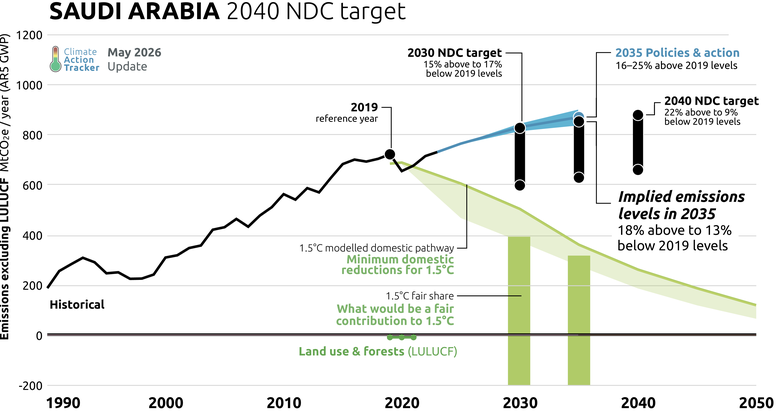
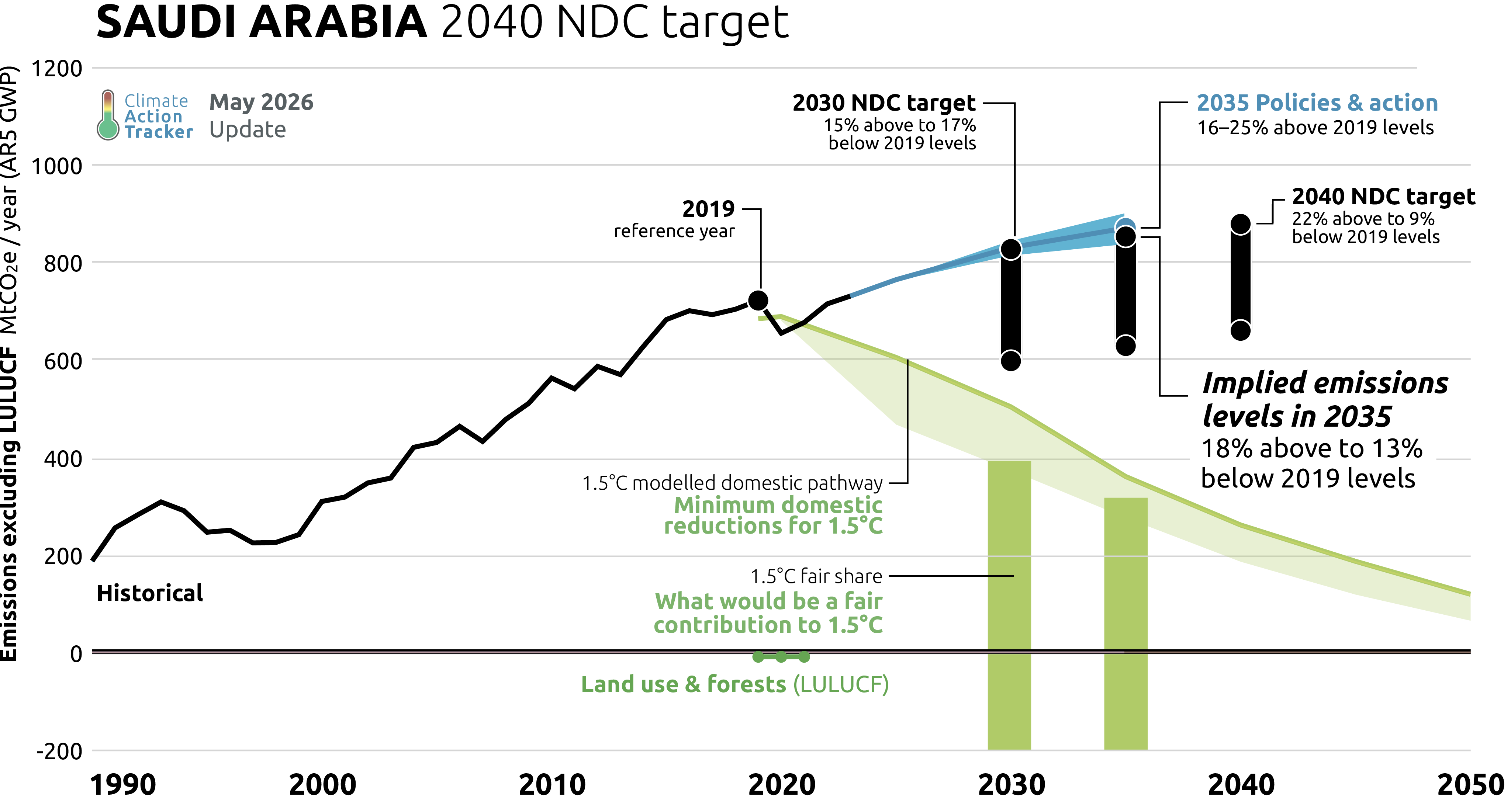
Saudi Arabia’s latest climate pledge is once again marred by opacity: it provides no 2035 emissions reduction target, and its 2040 target is pegged to an unspecified baseline projection, making ambition and progress impossible to measure. This baseline is based on two undisclosed scenarios, both of which envisage the fossil fuel industry continuing to play a pivotal role in Saudi Arabia’s economy—the world’s largest net oil exporter. Indeed, Saudi Arabia’s new pledge explicitly states that its climate ambition is contingent on sustained fossil fuel exports and the revenue and economic growth they generate.
Saudi Arabia’s new target remains far from a 1.5 °C compatible pathway and clearly shows no increase in ambition. On the contrary, the new emissions reduction target is actually set at a higher emissions level than the 2030 target. As a result, the gap between Saudi Arabia’s targets and a 1.5°C compatible trajectory has widened between 2030 and 2035. Instead of narrowing the ambition gap over time, the country is drifting further away from a 1.5°C consistent pathway.
In December 2025, Saudi Arabia submitted its new NDC mitigation target, setting a 2040 target that aims to reduce emissions by 335 MtCO₂e below baseline projections. As with its previous submission, Saudi Arabia has not disclosed the underlying data or modelling assumptions behind its baseline scenario, making it difficult to estimate the level of ambition the country is actually committing to. Crucially, Saudi Arabia did not provide a quantified 2035 target—despite the Paris Agreement expecting countries to include one in this round of NDC submissions—thereby locking in an unambitious target for the decade ahead.
As a result, the CAT had to derive an estimated emissions level in 2035 using an external baseline scenario developed by the King Abdullah Petroleum Studies and Research Centre (KAPSARC) (for more information, see Assumptions). Given the uncertainties around the expected contributions of the land use and forestry sector to emissions reduction, we estimate that Saudi Arabia’s new target would lead to emissions ranging from 630–854 MtCO₂e in 2035, or between 13% below and 18% above 2019 levels (excluding LULUCF). This wide range reflects the lack of transparency in the target design and the lack of underlying data provided.
The new NDC target remains unambitious, offering no improvement over Saudi Arabia’s previous submission. In fact, according to our estimates, the new NDC target is actually set at a higher emission level than the 2030 target, which was also not updated. Consequently, the gap between a 1.5°C compatible trajectory and Saudi Arabia’s emission reduction target has significantly increased between 2030 and 2035. Using the median of the estimated 2030 and 2035 targets, the CAT finds that Saudi Arabia’s emissions gap relative to a 1.5°C pathway increases from 29% in 2030 to 51% in 2035.
Saudi Arabia claims that its new NDC is more ambitious than its predecessor, stating that the 2040 target represents a 20.5% increase in emission reductions compared to 2030. However, this increase simply reflects the higher absolute reduction value (from 278 to 335 MtCO₂e) from an even higher baseline scenario, rather than a stronger target. This claim is misleading because both 2030 and 2040 targets are defined relative to a baseline scenario. The level of ambition, therefore, depends on how emissions are expected to evolve in that baseline, but Saudi Arabia has not communicated the baseline it used for calculating its NDC targets.
In this case, the baseline we used to derive Saudi Arabia’s new target projects higher emissions in 2040 than in 2030, meaning emissions are assumed to grow over time. As a result, the larger absolute reduction mainly reflects higher projected baseline emissions, rather than a stronger mitigation effort. Most importantly, Saudi Arabia’s new target remains far from consistent with a 1.5°C trajectory. This holds both when compared with a cost-optimal 1.5°C benchmark based on modelled domestic pathways (MDPs) and when assessed against what would constitute a fair contribution to global climate action. To align with a 1.5°C compatible modelled domestic pathway, Saudi Arabia would need to reduce its emissions by at least 50% below 2019 levels by 2035 (excl. LULUCF).
It remains difficult to assess whether Saudi Arabia’s new commitment is likely to drive stronger action. While the median of the estimated emissions level in 2035 is below its current policy projections, the upper end is very close to the lower bound of its current policy projections. In any case, the CAT’s current policy projections show that Saudi Arabia’s emissions will continue rising through to 2035. The new NDC does not set out a credible policy framework to reverse this trend. There are no clear additional commitments to expand renewables, scale up electric vehicles, or implement measures that would substantially bring down emissions.
Similar to its previous submission, the new NDC once again avoids addressing the main driver of emissions: fossil fuel production and consumption. Not only is Saudi Arabia showing limited national ambition, but as the world’s largest net oil exporter, it also contributes to the global ambition gap by enabling continued fossil fuel consumption abroad. Indeed, Saudi Arabia’s new pledge is based on two “dynamic” scenarios for 2030–2040, both of which envisage the fossil fuel industry continuing to play a very large role in the economy: either through continued exports (Scenario 1) or expanded domestic industrial use (Scenario 2), with planned measures primarily grounded in Scenario 1.
In the first scenario, climate ambition is made conditional on sustained fossil fuel exports and the national income they generate, but without clear allocation or prioritisation for the energy transition. Scenario 2 relies on domestic fossil fuels partially abated through unproven technologies such as carbon capture and storage (CCS).
Saudi Arabia’s new NDC explicitly states that its commitments are contingent on international climate policies and measures not imposing a disproportionate or abnormal burden on the Kingdom’s economy, i.e., curbing fossil fuels.
| SAUDI ARABIA | 2035 NDC | |
|---|---|---|
| 2030 NDC target | ||
|---|---|---|
| Formulation of target in NDC | Has not updated the ambition of its 2030 target. | |
| Status | Submitted on 23 October 2021 | |
| 2035 NDC target | ||
|---|---|---|
| Formulation of target in NDC | No quantified 2035 target provided. Instead, a 2040 target is defined: The Kingdom aims at reducing, avoiding, and removing GHG emissions by 335 million tons of CO2eq annually reached by 2040. | |
|
Absolute emissions level in 2035 excl. LULUCF |
630–854 MtCO2e (13% below / 18% above 2019) |
|
| Status | Submitted on 31 December 2025 | |
Ambition
For the world to have a significant chance of limiting warming to 1.5˚C, governments must switch to emergency mode and strengthen both their 2030 targets and current policies to include substantial emissions cuts and significantly contribute to closing the 2030 emissions gap. Saudi Arabia’s submitted 2035 NDC target did not increase the ambition of its 2030 target.
Further information on Saudi Arabia’s 2030 target can be found here.
2030 NDC target
| 2030 unconditional NDC target | ||
|---|---|---|
| Is the target 1.5°C compatible compared to fair share? |
|
|
| Is the target 1.5°C compatible compared to modelled domestic pathways? |
|
|
| Is this a stronger target than previously submitted? |
|
|
2035 NDC target
| 2035 unconditional NDC target | ||
|---|---|---|
| Is the target 1.5°C compatible compared to fair share? |
|
|
| Is the target 1.5°C compatible compared to modelled domestic pathways? |
|
|
| Does the NDC include sectoral targets? |
|
|
| Does the NDC include a renewable energy capacity target? |
|
|
| Does the target align with the country’s net-zero pathway? |
|
|
Saudi Arabia submitted its new NDC mitigation target on 31 December 2025, setting a 2040 target that aims to reduce emissions by 335 MtCO₂e below an uncommunicated baseline scenario. This target covers all sectors but only the three main GHGs: CO₂, CH4, and N2O (Kingdom of Saudi Arabia, 2025).
Since Saudi Arabia only provided a 2040 target, the CAT had to derive an estimated emissions level in 2035 using an external baseline scenario developed by the King Abdullah Petroleum Studies and Research Centre (KAPSARC) (for more information, see Assumptions). The CAT excludes emissions from land use, land use change, and forestry (LULUCF) from this target, resulting in a broad range of 630-854 MtCO₂e in 2035, or between 13% below to 18% above 2019 levels (excl. LULUCF).
- The estimated 2035 target is not 1.5°C compatible with modelled domestic pathways because it exceeds the 1.5°C compatible threshold of 362 MtCO₂e (excl. LULUCF). To be 1.5°C compatible, Saudi Arabia would need to reduce its emissions by around 50% below 2019 levels by 2035 (excl. LULUCF).
- When compared to its fair share contribution to climate change mitigation, Saudi Arabia's estimated 2035 target is also not 1.5°C compatible because it is above the 1.5°C compatible threshold of 321 MtCO₂e (excl. LULUCF). To make its fair contribution to climate action, Saudi Arabia would need to cut emissions 56% below 2019 levels by 2035 (excl. LULUCF).
The new NDC target remains unambitious, offering no improvement over Saudi Arabia’s previous submission. In fact, according to our estimates, the estimated emissions level in 2035 is higher than the 2030 target, which Saudi Arabia also did not update. Using the median of both targets, the estimated 2035 target would result in emissions about 4% higher than in 2030. If countries do not substantially increase the ambition of their 2030 targets and action, peaking global warming at 1.5°C will be more difficult, and deeper and more rapid emission reduction targets will be required elsewhere. This will likely lead to a multi-decadal, high overshoot of the limit, even if followed by strong 2035 targets.
Most importantly, the gap between a 1.5°C-compatible trajectory and Saudi Arabia’s emission reduction targets actually increased between 2030 and 2035. Using the median of both the 2030 and 2035 targets, the CAT estimates that, under this new NDC, Saudi Arabia’s emissions gap relative to the 1.5°C pathway significantly widened over this period, increasing from 29% in 2030 to 51% in 2035. Rather than narrowing the ambition gap over time, the country’s trajectory is drifting further away from a pathway consistent with limiting warming to 1.5°C.
The new NDC does not include any specific sectoral targets and does not set a renewable energy capacity or generation target. Its latest target of 50% renewable energy generation by 2030 is not mentioned explicitly. Saudi Arabia states that its contribution is aligned with its “net-zero ambitions” but provides no additional information (Kingdom of Saudi Arabia, 2025). Despite announcing a 2060 net zero target in 2021 as part of the Saudi Green Initiative (SGI), Saudi Arabia has yet to disclose concrete measures about how it plans to meet this objective, giving it little credibility. The government has not provided specific details on the scope, target architecture, and emissions coverage, and has yet to outline clear emissions reduction pathways to net zero.
Further information on Saudi Arabia’s targets can be found here.
* For the table below, 2019 is used as the reference year, as it is the base year of the BAU scenario underpinning Saudi Arabia’s emissions reduction target. The year is taken from the PRIMAP dataset (see Assumptions section).
| SAUDI ARABIA | Target summary (excluding LULUCF) | |
|---|---|---|
| 2030 target: Emissions compared to 2019 levels (CAT estimates) | ||
|---|---|---|
| Current policies in 2030 | 13–17% above | |
| 2030 NDC target | 17% below / 15% above | |
| 1.5ºC fair share | 45% below | |
| 1.5ºC modelled domestic pathway | 30% below | |
| 2035 target: Emissions compared to 2019 levels (CAT estimates) | ||
|---|---|---|
| Current policies in 2035 | 16–25% above | |
| 2035 NDC target | 13% below / 18% above | |
| 1.5ºC fair share | 56% below | |
| 1.5ºC modelled domestic pathway | 50% below | |
Fairness & Finance
In its new climate pledge, Saudi Arabia specified that “the implementation of this NDC is not contingent on receiving international financial support” (Kingdom of Saudi Arabia, 2025).
Whether Saudi Arabia should receive climate finance from abroad to reduce its emissions or rather provide climate finance to other countries is a matter of debate. Our methods do not provide a clear answer to this question.
Credibility
Credible NDCs should build on robust national planning processes that translate the economy-wide emissions reduction target into action in all sectors. Governments need to ramp up the implementation of their existing targets and further develop policies to close the – still significant – emissions gap between current policies and the 1.5°C pathway. Contradictory policies must be addressed and reversed: fossil fuel production needs to be phased out, while fossil fuel exploration and fossil fuel subsidies need to stop.
| 2035 NDC target | ||
|---|---|---|
| Is the target driving more ambitious action? |
|
|
| Is there a policy framework in place to meet the target? |
|
|
|
Does the NDC reference national planning processes for its development? |
|
|
| Does the NDC reference an institutional framework/plan in place for its implementation? |
|
|
| Does the NDC commit to phase out fossil fuel production? |
|
|
It remains difficult to assess whether Saudi Arabia’s new commitment is likely to drive stronger action. While the median of the target range is below its current policy projections, the upper end is very close to the lower bound of its current policy projections. The CAT’s current policy projections show that Saudi Arabia’s emissions will continue rising through to 2035. The new NDC does not set out a credible policy framework to reverse this trend. There are no clear additional commitments to expand renewables, scale up electric vehicles, or implement measures that would substantially bring down emissions.
Saudi Arabia has not committed to phasing out fossil fuel production. On the contrary, its new NDC is built around two “dynamic” scenarios for the period 2030–2040, both of which still envision a very large, albeit different, role for the country’s fossil fuel industry. The baseline projections used for the country’s emissions projections draw on elements from both scenarios, but the planned measures under the NDC are primarily “grounded in Scenario 1” (Kingdom of Saudi Arabia, 2025):
- In Scenario 1, climate ambition is made conditional on sustained fossil fuel exports and the national income they generate. Under this pathway, Saudi Arabia prioritises the continued export of fossil fuels and plans to use subsequent revenues to finance the country’s economic diversification agenda. This includes investment in renewable energy, but these efforts are bundled together with broader development priorities such as tourism and education, without clear allocation or earmarking for the energy transition.
- Scenario 2 shifts the focus from exporting fossil fuels to using them domestically. Rather than maximising exports, Saudi Arabia would build a heavy industrial base that relies on domestic fossil fuels as either feedstock (raw material) or as an energy source. This includes expanding petrochemicals, cement, mining, and metal production. The NDC states that these activities would be “abated with the best suitable technologies,” meaning emissions would supposedly be reduced through measures such as carbon capture and storage (CCS) or efficiency improvements.
However, similar to its previous NDC, the government did not disclose the underlying data, modelling assumptions, nor the weighting assigned to each scenario. For example, there is no information on the economic assumptions, projected fossil fuel production levels, or the scale of technological abatement underpinning the projections.
This lack of transparency makes it impossible to calculate how the baseline was derived or to estimate the actual level of emission reductions that Saudi Arabia is committing to. In fact, it is uncertain whether Saudi Arabia’s NDC implies any reduction in emissions at all. Although the proposed reduction in 2040 (335 MtCO₂e) is larger than in the 2030 NDC (278 MtCO₂e), it is calculated relative to baseline projections. If the baseline scenario assumes emissions continue to increase – as is typically the case – Saudi Arabia could meet its target even if emissions rise between 2030 and 2035. In fact, our estimates show that, under its new NDC, Saudi Arabia’s emissions are set to continue increasing.
It should be noted that neither of the scenarios presented in the NDC appears compatible with a pathway toward full decarbonisation:
- First, the rationale for selecting Scenario 1 as the preferred pathway, which underpins the planned measures under the new NDC, raises concerns. Despite its “Vision 2030” diversification plan, initiated nearly a decade ago, oil export revenues remain the backbone of the Saudi economy.
So far, these revenues, channelled through the Saudi sovereign wealth fund, the Public Investment Fund, have done little to advance the country’s energy transition. Instead, this fund has primarily financed mega-projects such as the construction of the futuristic city, NEOM, and other technology ventures, and it remains uncertain whether this will change in the future. Without a clear allocation of revenues to the energy transition, the credibility of this scenario is questionable.
More importantly, the language around exported emissions is misleading. Saudi Arabia’s new NDC states that “the use of hydrocarbons will raise Saudi Arabia's GHG emissions, while exported hydrocarbons will not contribute to the increase of GHG emissions.” (Kingdom of Saudi Arabia, 2025). Although they are not included in domestic inventories, exported emissions still account for a very large share of global emissions. As the world’s largest crude oil exporter, Saudi Arabia is responsible for a significant share of these emissions. In fact, emissions from burning its exported oil were more than twice the level of its domestic emissions in 2022.
The premises of Scenario 2 also raise concerns. Although the scenario assumes improvements in industrial efficiency, it again relies on expanding domestic fossil fuel use in industry, partially abated by technologies such as carbon capture and storage (CCS). If overall industrial output increases, efficiency gains alone may not be sufficient to reduce total emissions and could even result in higher absolute emissions compared with today’s levels. Also, CCS technologies are not commercially viable, nor are they proven at scale, despite large public subsidies for research and development globally.
Transparency
Governments should set absolute, economy-wide, emissions reduction pathways including all greenhouse gases, specifying the emissions levels for each year as an absolute level of gross emissions (excluding LULUCF). This level of transparency will ensure that their reduction targets are immune to creative accounting. NDC targets should primarily focus on their domestic reductions by decarbonising all sectors of the economy rather than relying on forestry sinks, other carbon dioxide removal (CDR) or international carbon markets.
| 2035 NDC target | ||
|---|---|---|
| Is the target based on a fixed year or is it a fixed absolute value? |
|
|
| Does the target cover all sectors? |
|
|
| Does the target cover all greenhouse gases? |
|
|
| Does the target specify an emissions pathway? |
|
|
| Does the target separate out land use and forestry? |
|
|
| Does the target separate out other CO2 removal by type? |
|
|
|
Does the target separate out the use of carbon credits under Article 6? |
️ |
|
Saudi Arabia’s latest NDC closely resembles its previous submission and shows no meaningful improvement in transparency. As explained above, its emissions reduction target is, once again, based on a baseline projection and two “dynamic” scenarios that have not been transparently communicated (for more information, see the section on Credibility). The government did not disclose the underlying data, modelling assumptions, nor the weighting assigned to each scenario. This makes it difficult to evaluate the ambition of the target or hold the government accountable for achieving it.
Target coverage and formulation
The scope of the target remains narrow: Although Saudi Arabia’s new target is economy-wide, it only covers three main GHGs (CO₂, CH4, and N2O) and notably excludes F-gases. This is a significant gap, as F-gases are highly potent GHGs that should be included in any comprehensive mitigation strategy.
The framing of the emissions reduction target also raises concerns. Saudi Arabia has committed to “reducing, avoiding, and removing” emissions relative to a baseline scenario (Kingdom of Saudi Arabia, 2025). This vague formulation leaves the door open to relying heavily on carbon removal technologies and afforestation measures rather than prioritising actual emissions reductions in key sectors such as energy and transport.
Notably, Saudi Arabia stated it aims to advance the large-scale deployment of carbon capture and storage (CCS) technologies, particularly in gas power plants. CCS technologies are not commercially viable, nor have they been proven at scale, despite large public subsidies for research and development globally.
Relying on CCS diverts attention and resources away from cost-effective mitigation options. The use of CCS should be limited to industrial applications where there are fewer options to reduce process emissions—not to reduce emissions from the electricity sector, where there are cost-effective mitigation alternatives, not least because CCS does not remove 100% of emissions from power plants. Given the levelised cost of renewable energy, it would be far cheaper to increase renewable capacity than to deploy CCS.
Reliance on the land use and forestry sector
The NDC states that part of the emission reductions will come from “planned afforestation, land restoration, and land rehabilitation initiatives of approximately 4 million hectares of land to combat desertification” (Kingdom of Saudi Arabia, 2025). Based on the 2030 NDC and previous government announcements (e.g., at the Saudi Green Initiative Forum in 2021), we assume that LULUCF measures could account for around 200 MtCO₂e of the total 335 MtCO₂e emission reductions, meaning the majority of reductions may come from land use and forestry sector activities rather than direct fossil fuel emission cuts (see the Assumptions section).
While reforesting and bolstering the land sector can be highly beneficial to the climate and biodiversity, such measures risk diverting attention away from the urgent need to phase out fossil fuels and cut GHG emissions. Saudi Arabia’s strong focus on expanding forest sinks could allow emissions in critical sectors like energy and transport to continue rising unchecked. Reducing emissions through tree planting also has inherent limitations. Unlike other sectors, forestry and land use emissions pose unique challenges due to their high variability, measurement complexity and potential reversibility (e.g., forest fires).
Article 6
Currently, Saudi Arabia has no intention to use carbon credits under Article 6 of the Paris Agreement to achieve its 2040 emissions reduction target and specifies that, for now, it “intends to fulfil its NDC objectives through implementation of domestic projects.” (Kingdom of Saudi Arabia, 2025). However, the Kingdom also makes clear that it reserves the right to do so in the future, therefore it may use carbon credits under Article 6 to meet its targets in the future. The CAT cautions against buying international carbon credits to delay or avoid investing in domestic mitigation, especially when developing high-quality, verifiable offset projects remains extremely difficult. Saudi Arabia should avoid purchasing so-called “low-hanging fruit” credits from developing countries, burdening them with a more difficult and expensive decarbonisation in the future, and should instead enhance its domestic ambition.
For more information on Saudi Arabia’s climate targets and policies, please click here. For the CAT’s full recommendations for setting NDC targets that form the basis of the analysis above, please click here.
Further analysis





Latest publications




Stay informed
Subscribe to our newsletter