
Ethiopia
2035 NDC
2035 NDC Target
This analysis was published in November 2026.
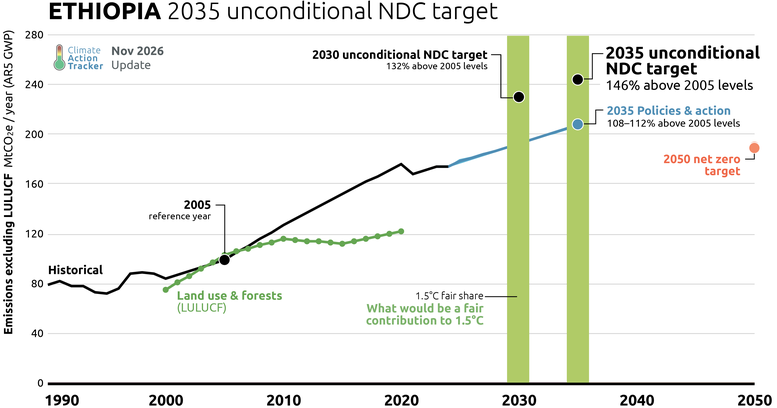
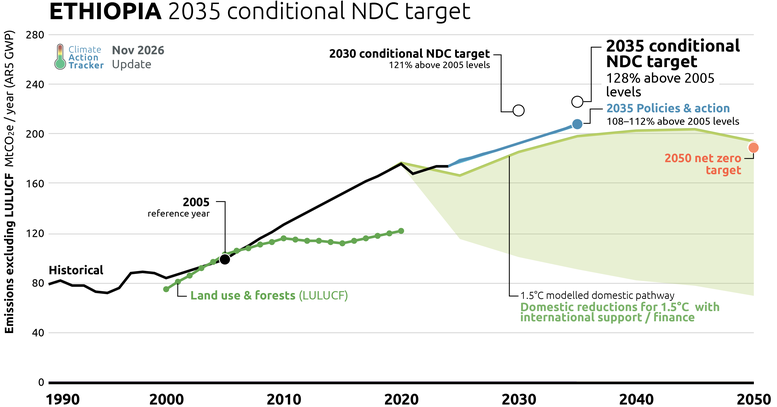
COP32 host Ethiopia stands out as one of the few countries the CAT analyses that has 1.5˚C compatible unconditional 2030 and 2035 targets compared to its fair share. While its conditional targets are not 1.5°C compatible compared to modelled domestic pathways, the gap between the conditional targets and a 1.5°C compatible pathway is narrowing from 2030 to 2035.
However, our projections show that under Ethiopia's 2035 targets, emissions would increase through 2035. It will not drive more ambitious mitigation action as the country is set to overachieve both its 2035 unconditional and conditional targets by a significant margin.
Ethiopia should propose a 1.5°C compatible conditional target and a credible plan with international support. Its current conditional target is compatible with more than 4°C of warming and should thus be strengthened.
Under its new 2035 NDC Ethiopia has updated its conditional and unconditional 2030 targets, resulting in lower absolute emission levels for both. These revised targets are set against an updated BAU scenario, with emission projections substantially revised downwards. Most of the difference between the old and new BAU comes from a revised LULUCF and the agricultural sector.
Ethiopia has a 100% renewable electricity system, although the country remains reliant on imported oil and coal for transportation and industrial activities. Most of its climate action is based on expanding its carbon sink through reforestation projects. Its energy sector is the second largest contributor to projected emission reductions after the LULUCF sector, with transport sector accounts for most of emissions. Energy sector provides about 12.5% of total reductions by 2035 below BAU, through renewable energy expansions, clean cooking and electrification program. While the 2035 NDC refers to the expansion of renewable energy use in energy and industry sectors, it does not include specific measures and targets.
Ethiopia considers the use of Article 6 as a potential means of implementation and has adopted a national carbon market strategy to support its participation. However, selling carbon credits internationally can risk undermining ambition and own NDC achievement. Ethiopia’s current policy projections will lead to emission level below the NDC target, signaling hot air rather than delivering deeper cuts aligned with its policies.
| Ethiopia | 2035 NDC | |
|---|---|---|
| 2030 unconditional target | ||
|---|---|---|
|
Formulation of target in NDC |
GHG emissions are 141.9 MtCO2e in 2030 [incl. LULUCF] | |
| Absolute emissions level in 2030 excl. LULUCF |
230 MtCO2e (81% above 2010) |
|
| Status | Submitted on 26 September 2025 | |
| 2030 conditional target | ||
|---|---|---|
|
Formulation of target in NDC |
GHG emissions are 85.7 MtCO2e in 2030 [incl. LULUCF] | |
|
Absolute emissions level in 2030 exl. LULUCF |
219 MtCO2e (73% above 2010) |
|
| Status | Submitted on 26 September 2025 | |
| 2035 unconditional target | ||
|---|---|---|
|
Formulation of target in NDC |
GHG emissions are 85.7 MtCO2e in 2030 [incl. LULUCF] | |
|
Absolute emissions level in 2035 excl. LULUCF |
244 MtCO2e (92% above 2010) |
|
| Status | Submitted on 26 September 2025 | |
| 2035 conditional target | ||
|---|---|---|
|
Formulation of target in NDC |
GHG emissions 70.3 % below BAU levels by 2035 [incl. LULUCF] | |
|
Absolute emissions level in 2035 excl. LULUCF |
226 MtCO2e (78% above 2010) |
|
| Status | Submitted on 26 September 2025 | |
Ambition
For the world to have a significant chance of limiting warming to 1.5˚C, governments must switch to emergency mode and strengthen both their 2030 targets and current policies to include substantial emissions cuts and significantly contribute to closing the 2030 emissions gap. Ethiopia’s 2035 NDC target did not increase the ambition of its 2030 targets.
Further information on Ethiopia’s 2030 target can be found here.
2030 NDC Target
| 2030 unconditional NDC target | 2030 conditional NDC target | |
|---|---|---|
|
Is the target 1.5°C compatible compared to fair share? |
|
N/A* |
| Is the target 1.5°C compatible compared to modelled domestic pathways? | N/A** |
Ethiopia needs international climate finance and other forms of support to align its 2030 conditional target to 1.5°C modelled domestic pathways |
| Is this a stronger target than previously submitted? |
|
|
The CAT considers a target stronger than the previous target if the target results in (a) lower absolute emissions after excluding LULUCF; (b) emissions falling below current policy projections, and (c) a narrower gap to what is considered 1.5°C compatible. Ethiopia’s 2030 targets result in lower absolute emission levels than the previously submitted 2030 targets (excl. LULUCF) but they remain above our current policy projections. Therefore, we do not consider these targets to have increased ambition in 2030.
2035 NDC Target
| 2035 unconditional NDC target | 2035 conditional NDC target | |
|---|---|---|
|
Is the target 1.5°C compatible compared to fair share? |
|
N/A* |
| Is the target 1.5°C compatible compared to modelled domestic pathways? | N/A** |
Ethiopia needs international climate finance and other forms of support to align its 2035 conditional target to 1.5°C modelled domestic pathways |
| Does the NDC include sectoral targets? |
|
|
| Does the NDC include a renewable energy capacity target? |
|
|
* According to our methodology, for developing countries we only compare the unconditional target to fair share.
** According to our methodology, for developing countries we only compare the conditional target to our modelled domestic pathways.
Ethiopia submitted its 2035 NDC on 26 September 2025, setting both conditional and unconditional 2035 targets and providing an updated BAU scenario.
Ethiopia’s unconditional 2035 NDC target aims to achieve a 40.7% reduction, and the conditional target, a 70.3% reduction below BAU, including LULUCF. When excluding LULUCF, both the unconditional and conditional 2035 NDC targets are set at a higher level of absolute emissions than the corresponding 2030 targets, consistent with a continuing upward emissions trend.
The downward revision of the BAU emissions trajectory resulted in lower absolute emissions levels for Ethiopia’s 2030 NDC targets. Excluding LULUCF, the unconditional target was revised from the previous 256 MtCO2e to 230 MtCO2e, while the conditional target was revised from 226 MtCO2e to 219 MtCO2e[1].
When compared to its fair share contribution to climate change mitigation, Ethiopia's 2035 unconditional target that corresponds to 244 MtCO2e emissions level is 1.5ºC compatible because it is well below the 1.5°C compatible threshold of 649 MtCO2e, excluding LULUCF.
On the other hand, the conditional NDC 2035 target that corresponds to 226 MtCO2e emissions levels (excl. LULUCF) is not compatible when compared to 1.5ºC modelled domestic pathways. To reach that level, Ethiopia would need to reduce its emissions levels to at least 198 MtCO2e in 2035 (excl. LULUCF) and will need additional international climate finance and other international support to reach the target.
The 2035 NDC provides sectoral emissions targets and abatement estimates across all major sectors, including LULUCF, agriculture (managed soils and livestock), energy, industry, and waste. However, these sectoral targets are provided only for the conditional target scenario; the NDC does not outline the level of emission reductions from each sector in its unconditional target.
Under the conditional target, emission reductions rely primarily on the LULUCF sinks (77%), followed by reductions in the energy sector (12.5%). Ethiopia plans to continue the trend from 2020–24 - where the forestry sector contributed about 79% of total emission reductions - to expand its net carbon sink. Under its 2035 conditional target, Ethiopia intends to reach a net carbon sink of -155 MtCO₂e by 2035 through continued large-scale restoration and reforestation projects, building upon programmes like the Green Legacy Initiative (GLI).
The energy sector is the second largest contributor to projected emission reductions after the LULUCF sector, providing about 12% of total reductions by 2035. Ethiopia’s electricity generation is fully renewable, mainly based on hydropower, with expanding solar and wind capacity. While the 2035 NDC refers to the expansion of renewable energy in the energy and industry sectors, it does not include a quantified renewable power capacity target. The NDC refers to an existing target of 16,058 MW of installed electricity capacity by 2030, but does not specify the generation mix behind it. Fossil fuels do not contribute to Ethiopia’s electricity generation, although the country remains reliant on imported oil and coal for transportation and industrial activities.
Further information on Ethiopia’s targets can be found here.
Previous NDC 2030 target values have been recalculated using now AR5 GWP values for consistency and therefore differ from those reported in the previous CAT assessment that are in AR4.
| Ethiopia | Target summary (excluding LULUCF) |
|---|
| 2030 target: Emissions compared to 2024 levels (CAT estimates) | |
|---|---|
| Current policies in 2030 | 11% above 2024 |
| 2030 NDC target |
Unconditional: 32% above 2024 Conditional: 26% above 2024 |
| 1.5ºC fair share | 197% above 2024 |
| 1.5ºC modelled domestic pathway |
7% above 2024 to be reached with international climate finance and other forms of support that facilitate substantial emission reductions domestically |
| 2035 target: Emissions compared to 2024 levels (CAT estimates) | |
|---|---|
| Current policies in 2035 | 18–21% above 2024 |
| 2035 NDC target |
Unconditional: 40% above 2024 Conditional: 30% above 2024 |
| 1.5ºC fair share | 273% above 2024 |
| 1.5ºC modelled domestic pathway |
14% above 2024 to be reached with international climate finance and other forms of support that facilitate substantial emission reductions domestically |
Fairness & Finance
Developed countries need to significantly scale up international climate finance and other means of support. They should set 1.5°C aligned domestic mitigation targets in their NDCs and communicate the financial and other support they will provide to developing countries. Developing countries should clearly communicate the climate finance they need to set and achieve ambitious 1.5°C aligned conditional targets.
| 2035 conditional NDC target | |
|---|---|
| Does the target clearly communicate the climate finance and support needed to reach the conditional target? |
|
Most developing countries will need financial support to mitigate emissions beyond what would be their fair share according to effort-sharing frameworks. Therefore, the CAT encourages these governments to put forward an ambitious conditional target that is in line with their 1.5°C modelled domestic pathway , and to quantify climate finance needed, including an implementation plan, to meet the set target.
Ethiopia has communicated that it would need climate finance and other support to achieve its conditional 2035 NDC target. Ethiopia’s submitted 2035 conditional NDC target is not 1.5°C compatible compared to modelled domestic pathways.
The implementation of Ethiopia's 2035 NDC will require a total investment of an estimated USD 106 billion for the period 2025–2035, of which USD 66 billion is required for mitigation actions. Ethiopia has committed to cover a minimum of 22.5% of the total financing needs using domestic resources, while the remaining 77.5% will be expected to come from external support. The 2035 NDC does not indicate how much of the domestic financing will be allocated to mitigation measures.
Credibility
Credible NDCs should build on robust national planning processes that translate the economy-wide emissions reduction target into action in all sectors. Governments need to ramp up the implementation of their existing targets and further develop policies to close the – still significant – emissions gap between current policies and the 1.5°C pathway. Contradictory policies must be addressed and reversed: fossil fuel production needs to be phased out, while fossil fuel exploration and fossil fuel subsidies need to stop.
| 2035 NDC target | |
|---|---|
| Is the target driving more ambitious action? |
Unconditional NDC Conditional NDC |
| Does the NDC reference national planning processes for its development? |
|
| Does the NDC reference an institutional framework/plan in place for its implementation? |
|
| Does the NDC commit to stop fossil fuel exploration? |
|
Both Ethiopia’s unconditional and conditional 2035 targets result in emission levels above the current policy projections. This means that it can achieve its targets under existing policies and do not require additional mitigation measures; i.e. the 2035 NDC does not drive further mitigation ambition. Both Ethiopia’s current policy projections and NDC targets imply an upward emission trend.
Ethiopia’s 2035 NDC is intended to be aligned with the Long-Term Low-Emission and Climate Resilient Development Strategy (LT-LEDS) and the Ten-Year Development Plan (10YDP). The 2035 NDC outlines an institutional framework and plan for implementation. It includes the revitalisation of the Climate Resilience and Green Economy Strategy (CRGE) governance framework. Under this architecture, the Ministry of Planning and Development (MoPD) is responsible for coordinating sectoral government institutions. The structure includes a unified CRGE Ministerial Committee, chaired by the MoPD and co-chaired by the Ministry of Finance.
Ethiopia’s power sector is fully renewable, with 97% of electricity provided by hydropower in 2025 and the remaining 3% contributed by wind power (EMBER, 2026). Fossil fuels do not contribute to Ethiopia’s electricity generation, although the country remains reliant on imported oil and coal for transportation and industrial activities.
Ethiopia has limited fossil fuel production including coal extraction mainly for industrial use (MoWE et al., 2025). In 2025, the government announced the construction of Ethiopia’s first oil refinery, with an expected production capacity of 3.5 million tonnes of fuel per year (Energy Capital & Power, 2025; S&P Global, 2025). Ethiopia has fossil gas reserves, but the planned Ogaden gas extraction and LNG export project announced in October 2025 was cancelled (EBC, 2025; MoWE et al., 2025). Ethiopia’s 2035 NDC does not explicitly commit to phasing out fossil fuel production, imports or use, nor does it set out a pathway for their phase-out.
Transparency
Governments should set absolute, economy-wide, emission reduction pathways including all GHG gases, specifying the emissions levels for each year as an absolute level of gross emissions (excluding LULUCF). This level of transparency will ensure that their reduction targets are immune to creative accounting. NDC targets should primarily focus on their domestic reductions by decarbonising all sectors of the economy rather than relying on forestry sinks, other carbon dioxide removal (CDR) or international carbon markets.
| 2035 NDC target | |
|---|---|
| Is the target based on fixed, absolute values? |
Unconditional NDC Conditional NDC |
| Does the target cover all sectors? |
|
| Does the target cover all greenhouse gases? |
|
| Does the target specify an emissions pathway? |
|
| Does the target separate out land use and forestry? |
Unconditional NDC Conditional NDC |
| Does the target separate out the use of carbon credits under Article 6? |
|
Ethiopia’s 2035 NDC targets are set as a 70.3% conditional and 40.7% unconditional reduction below BAU in 2035, which CAT calculates to be equivalent to reaching economy-wide emissions of 226 MtCO2e and 244 MtCO2e (exc. LULUCF), respectively. This reduction from a BAU lacks transparency because it can change drastically with adjustments to the underlying BAU.
The target covers all major sectors, but it is not explicitly stated whether it covers all greenhouse gases. Coverage of methane can be inferred from the inclusion of methane-intensive sectors such as agriculture and Ethiopia’s aim to target methane reduction, but the lack of an explicit statement reduces transparency. Despite methane accounting for the majority of emissions, other gases such as N2O are also highly significant sources, yet the NDC does not explicitly mention whether they are covered.
The LULUCF sector would be the main driver of emissions reductions through the projected expansion of Ethiopia's carbon sink under the 2035 conditional target. The 2035 NDC does not provide a separate estimate of LULUCF removals under the unconditional target. For a more transparent climate target, CAT guidelines for good NDC advise separating out the contribution of the LULUCF sector and carbon market use from the overall target.
Ethiopia intends to use the market mechanism of Article 6 of the Paris Agreement and in June 2025 adopted a National Carbon Market Strategy, which sets out the framework for Ethiopia’s participation in carbon markets (Government of Ethiopia, 2025). This planned use of Article 6 mechanisms presents two risks: first, that Ethiopia could oversell credits and thereby compromise the achievement of its own NDC. This is especially the case if Ethiopia sells emission reductions that are relatively inexpensive, leaving it with fewer and more costly options. Second, Ethiopia may not be able to ratchet up its NDC due to an overreliance on international carbon markets. The updated unconditional target currently allows emissions that exceed current policy projections. This could potentially result in the sale of credits that, while exceeding the unconditional target, represent ‘hot air’, since the emission reductions could occur anyway under the current policy projections. This contradicts the objective of Article 6, which is to allow for higher ambition in a country’s mitigation and adaptation actions and to promote sustainable development and environmental integrity.
Finance generated through the purchase of carbon credits (ITMOs) under Article 6 should not be counted as climate finance. ITMO transactions are designed to help the buying country achieve its targets, while the selling country must make a corresponding adjustment that effectively makes the achievement of its target more difficult. For more information on the promise and pitfalls of Article 6 mechanisms, see the recent CAT briefing here.
For more information on Ethiopia’s climate targets and policies, please click here. For the CAT’s full recommendations for setting NDC targets that form the basis of the analysis above, please click here.
Assumptions
2035 NDC
The 2035 NDC does not provide a sectoral breakdown for the unconditional target. This issue does not occur for the conditional NDC, which provides sectoral values explicitly. To estimate the unconditional NDC target excluding LULUCF, we assume that 79.1% of emissions reductions will come from LULUCF under the unconditional target, equal to the share of emissions reductions that came from the sector in the period 2020-2024, as stated in the NDC. The 2035 NDC does not specify the Global Warming Potential (GWP) metric applied to derive the BAU scenario; however, both the LT-LEDS and the Updated NDC 2021 reference the use of AR5 GWP values, which we therefore assume are also applied in the 2035 NDC.
Sources
- EBC. (2025, October). Ethiopia Inaugurates Multi-Billion Dollar Ogaden LNG Project and Associated Infrastructure. https://www.ebc.et/english/Home/NewsDetails?NewsId=2025
- EMBER. (2026). Electricity generation in Ethiopia. https://ember-energy.org/data/electricity-data-explorer/?entity=Ethiopia&temporal_res=yearly
- Energy Capital & Power. (2025, October). Ethiopia Breaks Ground on $2.5B Gode Oil Refinery. https://prospect-intel.com/ethiopia-breaks-ground-on-2-5b-gode-oil-refinery/
- Government of Ethiopia. (2025). ETHIOPIA’S NATIONAL CARBON MARKET STRATEGY (2025 – 2035). https://unfccc.int/sites/default/files/resource/CiACA_Ethiopia_Carbon-Market-Strategy_2025.pdf
Further analysis





Latest publications




Stay informed
Subscribe to our newsletter