EU
Net zero targets
Summary
We evaluate the EU’s net zero target as: Acceptable.
In 2021, the European Union adopted its Climate Law, which enshrines its collective objective of achieving “climate neutrality by 2050.” In November 2025, the EU reached a political agreement on the 2040 climate target which serves as an intermediary long-term net zero trajectory.
While we continue to evaluate the EU’s climate neutrality - or, essentially, net zero GHG emissions – target as “acceptable“ in terms of its architecture, transparency and scope, with a regular review and assessment process, we highlight the risk of the EU potentially weakening its net zero target on the basis of the “Reductions or removals outside of own borders”, “Carbon dioxide removal”, and "Comprehensive planning" assessment criteria. The EU needs to provide further details on the direction of travel for these elements.
There is also room for improvement in the target’s scope, as the European Climate Law currently does not clearly state that international aviation and maritime transport emissions are included, and an explanation of why net zero by 2050 constitutes a fair contribution is lacking.
As required under the Climate Law, in 2023 the Commission assessed for the first time, the progress of the EU’s climate policy towards meeting its net zero target (European Commission, 2023b), finding progress to be insufficient. The assessment stresses that all parts of the Fit-for-55 legislative package must be rapidly implemented and that the EU and its member states need to significantly increase the pace of emissions reductions, to almost triple the average annual reduction achieved over the last decade (European Commission, 2023b).
From 2024 onwards the EU shifted in its ambition towards climate action. While agreement was reached on the 2040 target, the final outcome digresses from the scientific advice by the ESABCC by introducing the use of international carbon credits to count towards 5% of its 2040 target. This digression also differs from the 2040 target impact assessment, making it unclear what the LULUCF and engineered carbon removal pathways will be beyond 2030.
The EU has also made limited progress towards achieving its Fit-for-55 targets in part due to the lack of dedicated policies to support low emission technologies to mature, and sector specific policies. Although the EU begun releasing more of these sector specific plans in 2025, they have not been concretely enshrined into legislation.
CAT analysis of net zero target
Ten key elements
Scope
- Target year – The EU aims to reach net zero by 2050 at the latest, with net negative emissions thereafter.
- Emissions coverage – The target covers all GHG emissions (i.e., the 7 Kyoto gases: CO2, CH4, N2O, HFCs, PFCs, SF6, NF3) and all sectors of the economy.
- International aviation and shipping – The target only covers international aviation. The EU has adopted policies partially covering international maritime emissions, however, this bunker is not covered in its final targets. Both international aviation and maritime emissions are not clearly mentioned in the European Climate Law.
- Reductions or removals outside of own borders – The EU’s 2050 climate neutrality target does not currently explicitly rely on international credits. Against ESABCC advice for a 2040 target of 90-95% net emission reduction target, the agreement on the 2040 target digresses from the planned scenarios in the Impact Assessment for the 2040 target by including the use of international carbon credits.
This newly introduced flexibility to use international credits to count towards achieving its 2040 target creates a material risk that the domestic pathway to net zero is weakened through displaced reductions or removals outside the EU’s own borders. This weakens confidence that the EU will achieve climate neutrality through domestic emissions reductions and domestic removals alone.
Target architecture
- Legal status – The EU passed its net zero target into law with its European Climate Law in 2021 (European Parliament and the Council of the European Union, 2021). The net zero target is further included in the EU’s LTS submitted to the UNFCCC in 2020 (Croatian Presidency and the European Commission, 2020).
- Separate reduction & removal targets – The EU does not provide separate emission reduction and removal targets as part of its net zero target. In the current proposal and political agreement on the 2040 target there is no target or breakdown of carbon removals.
- Review process – The EU has a legally binding process in place to review the net zero target itself. The EU Climate Law includes a legally binding process for the Commission to report on the operation of the regulation within six months of each Global Stocktake (Article 9a). When it does so, the Commission may include proposals for amendments to the regulation. There is also a provision on the tracking of collective progress of the EU towards the achievement of net zero (Article 5), every five years.
Transparency
- Carbon dioxide removal – The EU did not formally adopt any pathways for LULUCF or separate pathways for removals and storage beyond 2030, so there are no transparently laid out assumptions for LULUCF and engineered carbon dioxide removals towards 2050. The EU has made clear its intention to rapidly scale up engineered carbon dioxide removals by already starting to lay out regulatory governance frameworks for carbon removals. Additionally, the EU has developed long established governance frameworks for regulating LULUCF emissions both domestically, as well as indirectly through its nature restoration law.
While the Commission’s impact assessment of the 2040 target did outline possible pathways for LULUCF and industrial removal across sectors between 2030 and 2050, the final decision on the 2040 diverged from the modelled pathways, and did not formally adopt any LULUCF or carbon removal targets. The Commission would need to redo its impact assessment modelling and provide updated pathways for LULUCF and engineered carbon removal pathways, while also formally adopting them into law (Council of the European Union, 2025b; European Commission, 2018c, 2024a).
For the time being, we keep the assessment of this element as in previous ones, while expecting the EU to provide greater transparency and formalised targets on LULUCF and engineered carbon removals as the framework evolves. - Comprehensive planning – The European Climate Law establishes the EU’s legally binding objective of achieving climate neutrality by 2050, together with an intermediate target of reducing net greenhouse gas emissions by at least 55% by 2030 compared with 1990 levels. The EU has also agreed to a 90% net emissions reduction target for 2040, and 66.25% -72.5% target for 2035, intended to provide a bridge between the 2030 target and climate neutrality.
The Commission’s 2024 impact assessment for the 2040 target evaluated different emissions pathways and their implications for the EU’s cumulative emissions budget between 2030 and 2050. However, the final political agreement diverged from elements of the pathway assessed by the Commission, and the underlying constraint imposed by the EU’s remaining carbon budget have not been updated.
The EU has introduced a broad package of legislation, sectoral policies and funding mechanisms. It is now developing its post-2030 climate and energy policy framework to translate the 2040 target into sector-specific objectives and implementation measures. In parallel, the ESABCC has published a series of assessments and recommendations (ESABCC 2024, 2025) outlining sectoral pathways and policy measures that could support the EU in achieving its 2030 and 2040 targets and reaching climate neutrality by 2050. - Clarity on fairness of target – The EU refers to the social fairness of the appropriate measures and fairness between EU Member States but makes no reference to global fairness or equity in the context of its net zero target. In its 2040 target communication, the Commission makes reference to climate diplomacy and partnerships to encourage global decarbonisation but does not provide detail on what fair share elements it considers (European Commission, 2024d).
Good practice
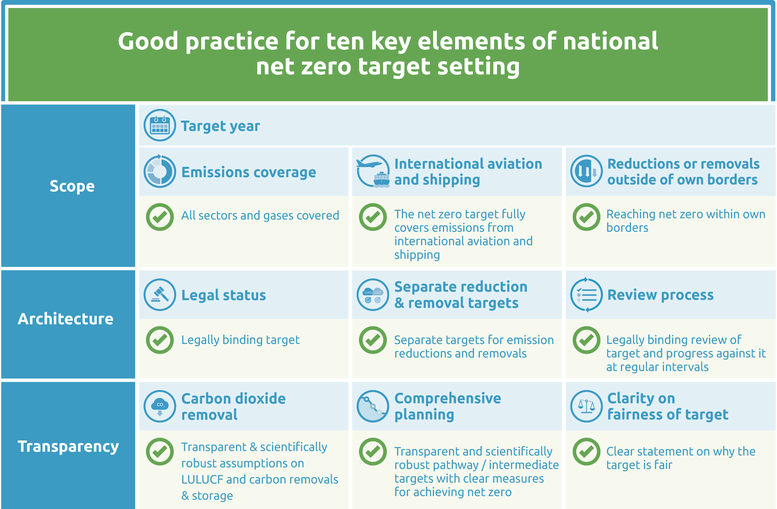
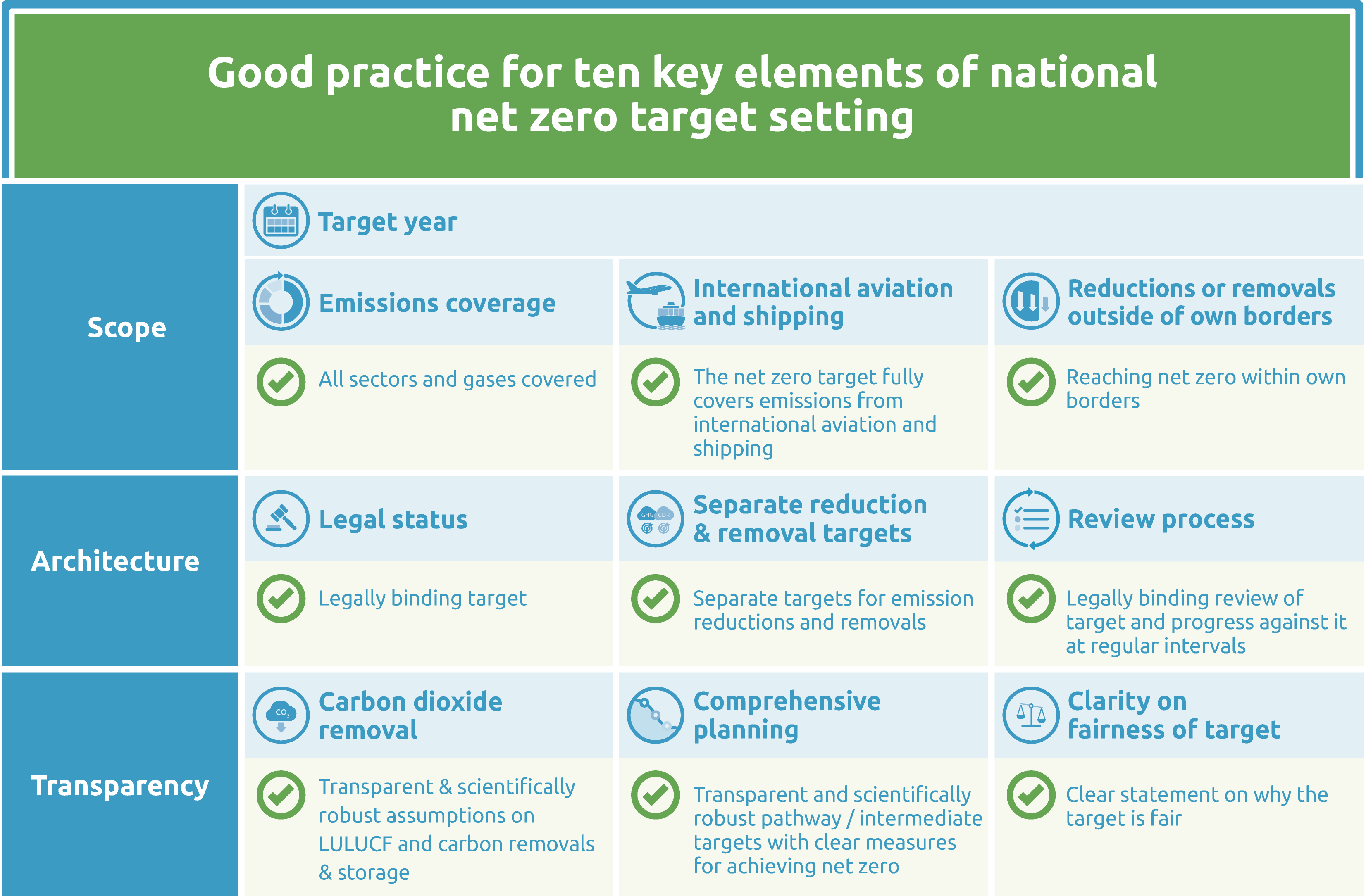
The Climate Action Tracker has defined the following good practice for all ten key elements of net zero targets. Countries can refer to this good practice to design or enhance their net zero targets.
Further analysis





Latest publications




Stay informed
Subscribe to our newsletter