Morocco
Policies & action
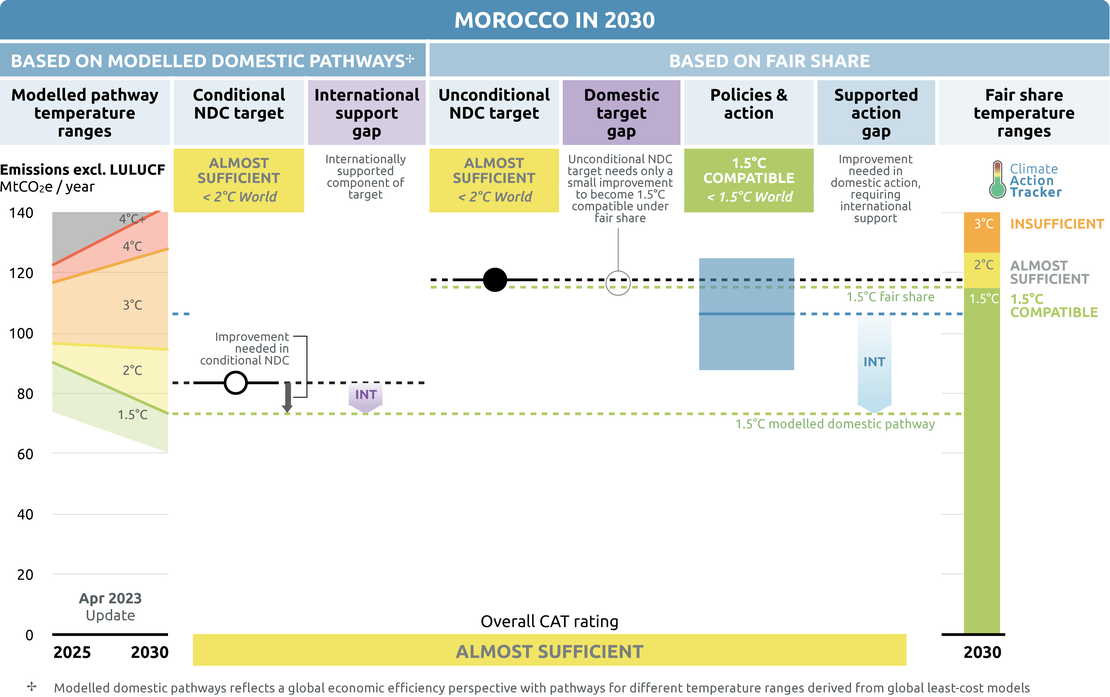
We rate Morocco’s policies and actions as “1.5°C compatible” compared to its fair share contribution. The “1.5°C compatible” rating indicates that Morocco’s climate policies and action are consistent with limiting warming to 1.5°C. Morocco’s climate policies and action do not require other countries to make comparably deeper reductions. When compared to modelled domestic pathways, the policies and action are not yet sufficient for getting on a decarbonisation pathway. Morocco should embark on such a pathway—with international support.
Further information on how the CAT rates countries (against modelled domestic pathways and fair share) can be found here.
Policy overview
The CAT estimates that, under current policies, Morocco’s emissions would reach 88 – 125 MtCO2e excluding LULUCF by 2030. This means that Morocco is likely to meet its unconditional target (i.e., target to be achieved without international financial support) by 2030. However, Morocco will only be able to achieve its conditional target if all planned policies are implemented. The international community will therefore need to provide financial support to help Morocco’s decarbonisation efforts.
Renewable energy targets are driving Morocco’s current emission reduction efforts. Despite its failure to meet its 2020 renewable energy target, Morocco decided to put forward an even more ambitious plan. It currently aims to increase renewable energy capacity to 52% of its electricity mix by 2030. In December 2021, Morocco submitted its LTS to the UNFCCC, where it further committed to increase the share of renewable energy in the electricity mix to 80% by 2050.
Despite delays in building several key solar power plants, Morocco is ramping up efforts to increase renewable energy capacity with many projects on track to start before 2025. However, considering that renewable energy amounted to 30% of electricity capacity in 2020, Morocco will need to keep increasing the roll out of renewable projects to meet its 2030 target.
Morocco is also seeking to decarbonise other key sectors of its economy, including the phosphate industry and the agricultural sector. The government also recently released a roadmap highlighting how green hydrogen could consolidate Morocco’s energy transition while supporting decarbonisation efforts in other countries. Increasing renewable energy generation will therefore be crucial to help position Morocco itself as a leader in green hydrogen.
Despite these ambitious planned policies, Morocco still relies heavily on coal and has recently unveiled plans to expand fossil gas infrastructure, casting doubt over the country’s ability to achieve its NDC target. Continued reliance on coal and further gas expansion risks locking the country into a high-carbon pathway.
Sectoral pledges
In Glasgow, a number of sectoral initiatives were launched to accelerate climate action. At most, these initiatives may close the 2030 emissions gap by around 9% - or 2.2 GtCO2e, though assessing what is new and what is already covered by existing NDC targets is challenging.
For methane, signatories agreed to cut emissions in all sectors by 30% globally over the next decade. The coal exit initiative seeks to transition away from unabated coal power by the 2030s or 2040s and to cease building new coal plants. Signatories of the 100% EVs declaration agreed that 100% of new car and van sales in 2040 should be electric vehicles, 2035 for leading markets. On forests, leaders agreed “to halt and reverse forest loss and land degradation by 2030”. The Beyond Oil & Gas Alliance (BOGA) seeks to facilitate a managed phase out of oil and gas production.
NDCs should be updated to include these sectoral initiatives, if they're not already covered by existing NDC targets. As with all targets, implementation of the necessary policies and measures is critical to ensuring that these sectoral objectives are actually achieved.
| MOROCCO | Signed? | Included in NDC? | Taking action to achieve? |
|---|---|---|---|
| Methane | Yes | No | No |
| Coal exit | Partly | No | No |
| Electric vehicles | Yes | No | No |
| Forestry | Yes | Yes – 2021 update or earlier | Yes |
| Beyond oil and gas | No | N/A | N/A |
- Methane pledge: Morocco signed the methane pledge at COP26. Methane represented 16% of total emissions (including LULUCF) in 2018 and is mainly concentrated in the agricultural and waste sectors (Kingdom of Morocco, 2022b). Morocco’s 2021 NDC does not have explicit reduction targets for non-CO2 gases. However, planned mitigation measures in the agricultural sector are expected to have an impact on overall methane emissions (see section on Agriculture).
- Coal exit: Morocco endorsed clauses 1, 3 and 4 of the coal exit at COP26, agreeing to cease permit issuance or construction of new coal-fired plants (UN Climate Change Conference (COP26), 2021). However, it has not committed to the coal phase-out by 2040 (clause 2). The country still heavily relies on coal and has one of the most coal-intensive power sectors in the world, with around 600 tonnes of CO2 emitted per GWh in 2020 (World Bank, 2022).
- 100% EVs: Morocco adopted the electric vehicle (EV) pledge at COP26. While it did not commit to the 2040 target, Morocco agreed to accelerate the proliferation and adoption of zero-emissions vehicles. However, the government has yet to release a concrete EV strategy.
- Forestry: Morocco signed the Leaders’ declaration on forest and land use at COP26. While its 2021 NDC does not contain specific targets, the Moroccan government recently released the Forests of Morocco 2020–2030 plan (Kingdom of Morocco, 2020a). The strategy set the target to plant 50,000 hectares of new forests across the country every year until 2030.
- Beyond oil and gas: Morocco has not joined the “Beyond Oil & Gas” initiative to end oil and gas exploration and production. In 2022, the government has announced plans to start offshore fossil gas exploration (Maroc Diplomatique, 2022)
Power sector
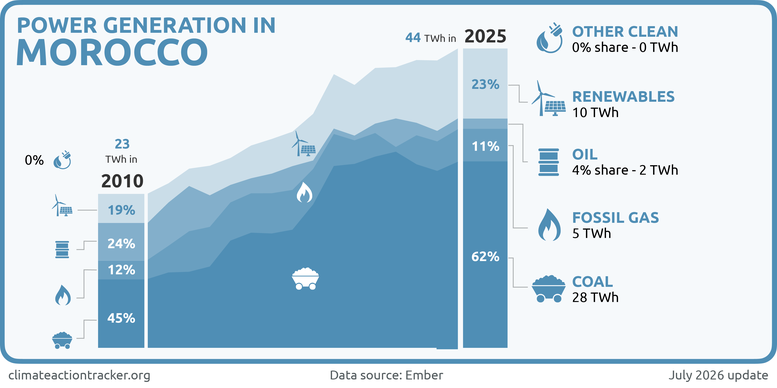
This sub-section was updated in August 2026 to reflect the CAT’s new methodology for evaluating power sector decarbonisation, including updated graphs and assessment criteria.
Coal
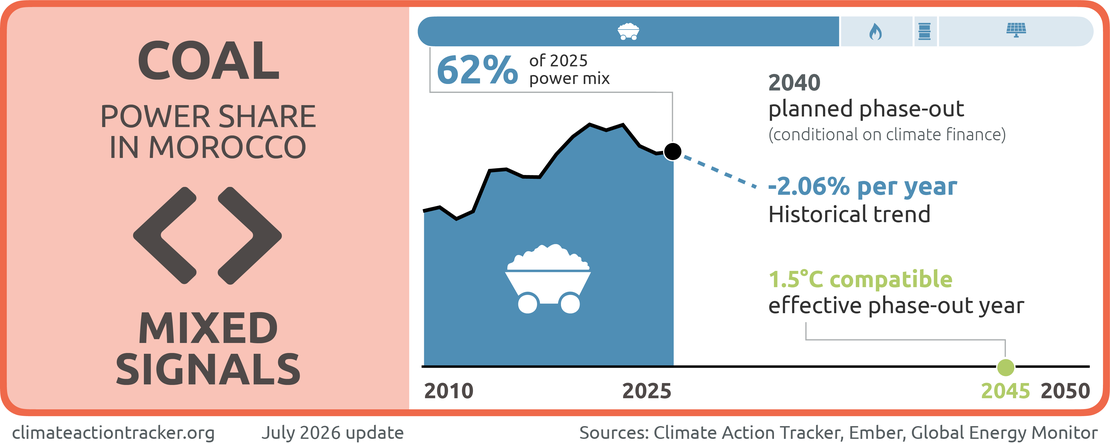
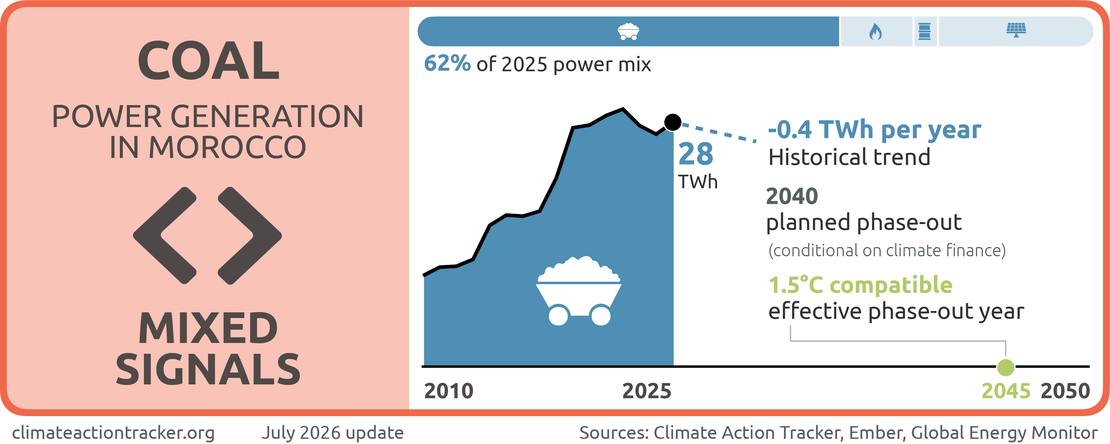
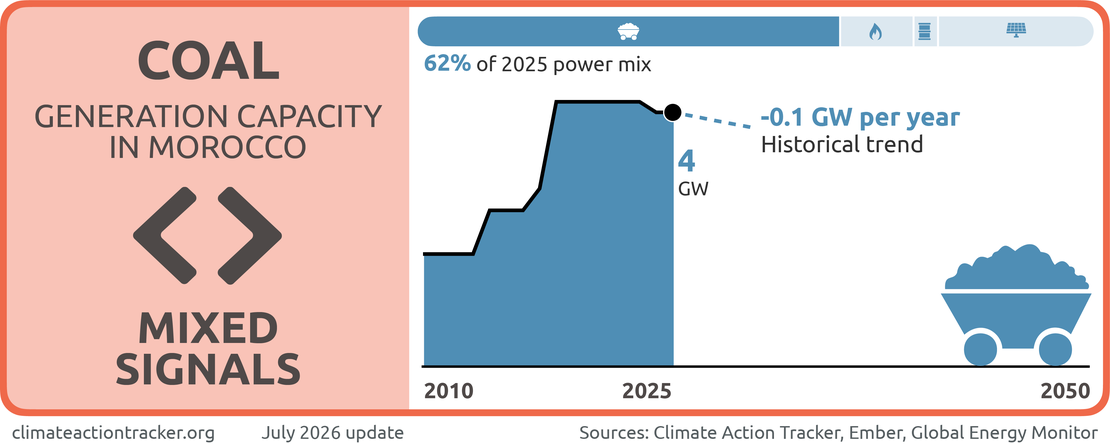
Morocco is sending “Mixed Signals” on coal. Despite its vast renewable energy potential, Morocco still relies heavily on coal, with the electricity sector accounting for almost all of its coal consumption. While the share of coal in the country’s electricity mix has decreased over the last five years, dropping from 70% in 2020 to 62% in 2025, actual coal generation has remained relatively stable (Ember 2026).
However, Morocco is taking steps to address the vulnerabilities induced by its continued reliance on coal. The government has first endorsed parts of the coal exit pledge at COP26, agreeing to cease permit issuance and construction of new coal-fired plants (UK COP 26 Presidency, 2021). This endorsement led Morocco to cancel 1.7 GW of coal pipeline, which included the construction of a coal power plant in the city of Nador and of an additional unit in the Jereda plant (Global Coal Plant Tracker, 2023). In 2023, the government also joined the Powering Past Coal Alliance (PPCA)(Reuters, 2023).
These steps were formalised in its latest NDC, which commits to phasing out coal-based electricity generation by 2040. This target is partly contingent on receiving adequate international financial and technical support, which would enable Morocco to close coal-fired power plants earlier than planned and manage its financial and contractual obligations. However, even in the absence of this external support, Morocco has reaffirmed its unconditional commitment to end coal use by the 2040s.
Fossil gas
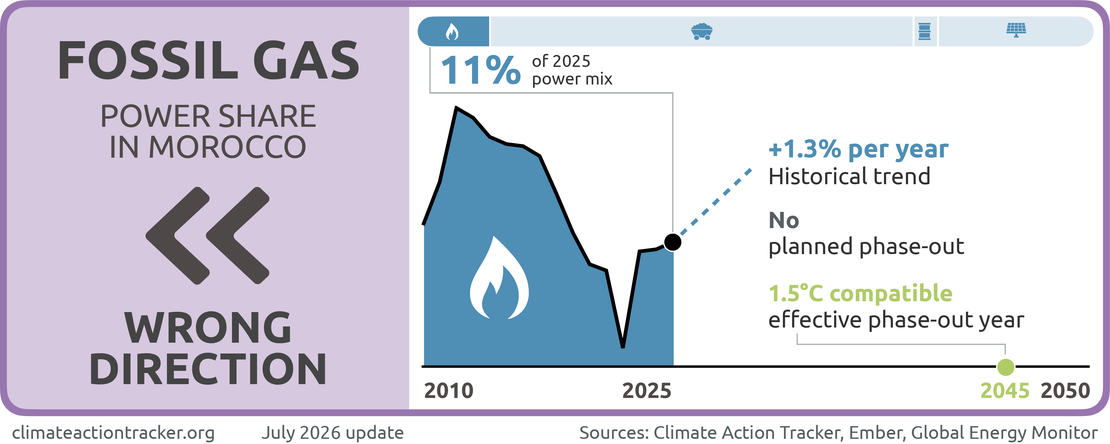
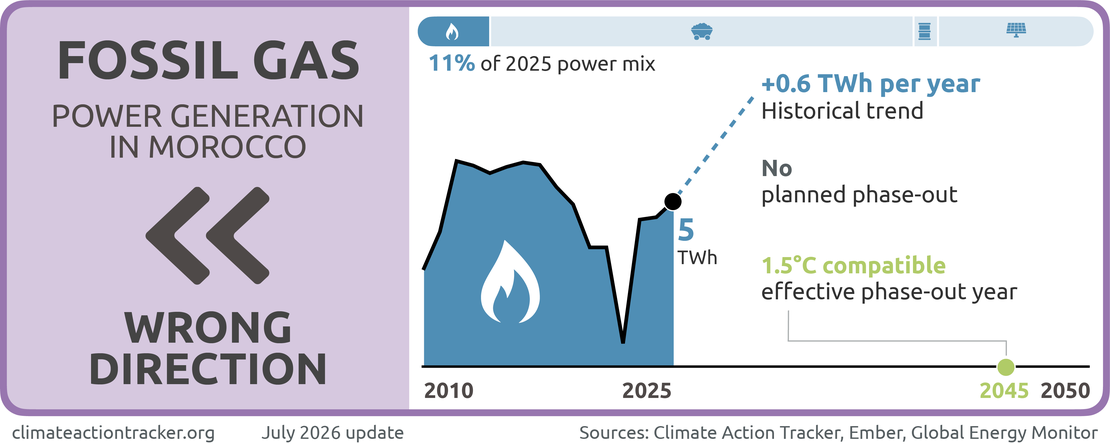
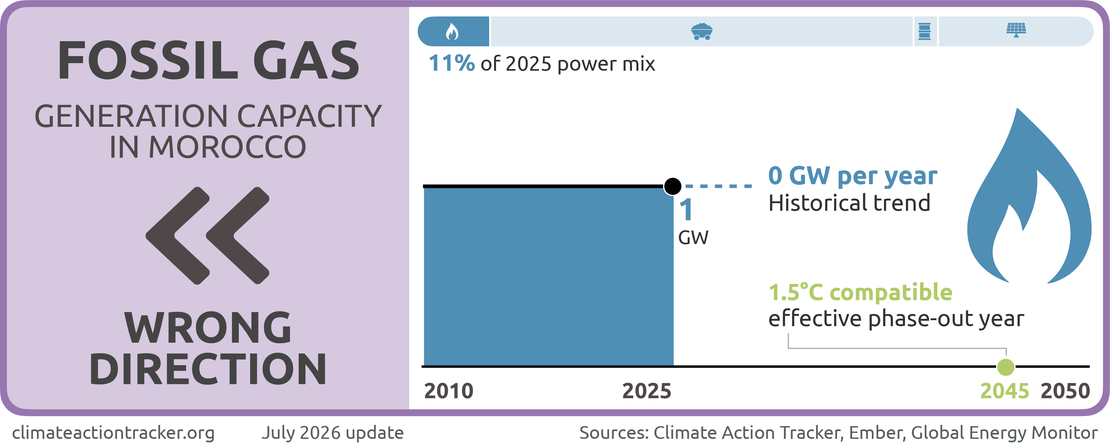
Morocco’s gas policy is going in the “Wrong Direction”. The government aims to expand fossil gas use across the economy, in particular in the power sector.
Fossil gas-based generation has fluctuated in recent years due to regional political tensions. The share of fossil gas in the electricity mix has dropped from 8% in 2021 to just 2% in 2022, following Algeria’s decision to halt gas supply via the Maghreb–Europe pipeline amid a diplomatic spat between the two countries (S&P Global, 2022). In response, the government temporarily increased its reliance on oil.
To make up for the fossil gas shortfall, the government also started importing LNG from global markets via Spain. Since Morocco does not have any LNG terminals, shipments are sent to Spain to be degasified, then back to Morocco via the same Maghreb–Europe pipeline (L’Opinion, 2023). This workaround allowed fossil gas to recover to 11% of Morocco’s electricity mix in 2025 (Ember, 2026).
To eventually reduce its reliance on Spain, Morocco has recently unveiled plans to build four LNG ports, including transport and storage facilities (Gómez, 2022). In 2023, the government issued a new tender to build an LNG terminal in the Nador West Med port, which is expected to start operating in 2026 (Reuters, 2024). The government is also moving forward with plans to build the Nigeria-Morocco Atlantic Gas Pipeline, which would be completed by 2046 (GEM, 2025).
Simultaneously, the government is also looking to pursue domestic fossil gas exploration as outlined in its Natural Gas Roadmap (2021-2050). In June 2024, Morocco and ExxonMobil signed two offshore oil and gas exploration contracts (Rahhou, 2024). However, to meet the objectives of the Paris Agreement, no new investments should be made into fossil gas exploration and production.
Fossil gas expansion would also trap Morocco into a high-carbon pathway, jeopardising its decarbonisation efforts. New fossil gas infrastructure would also be at risk of becoming stranded assets as the world moves to net zero emissions. Instead, investments planned for fossil gas expansion could be redirected to renewables, which are cheaper, lead to a significant increase in jobs and provide more long-term employment opportunities than the fossil fuel industry (Climate Action Tracker, 2022).
Renewable energy
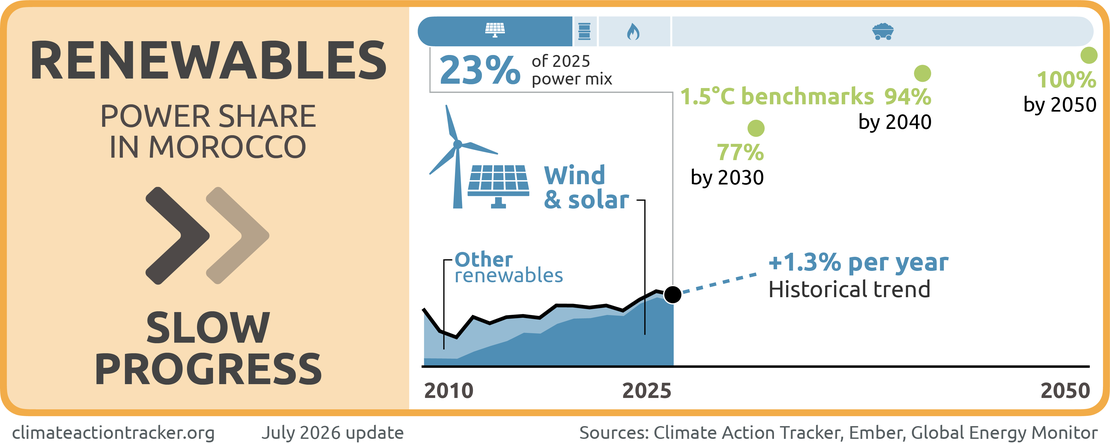
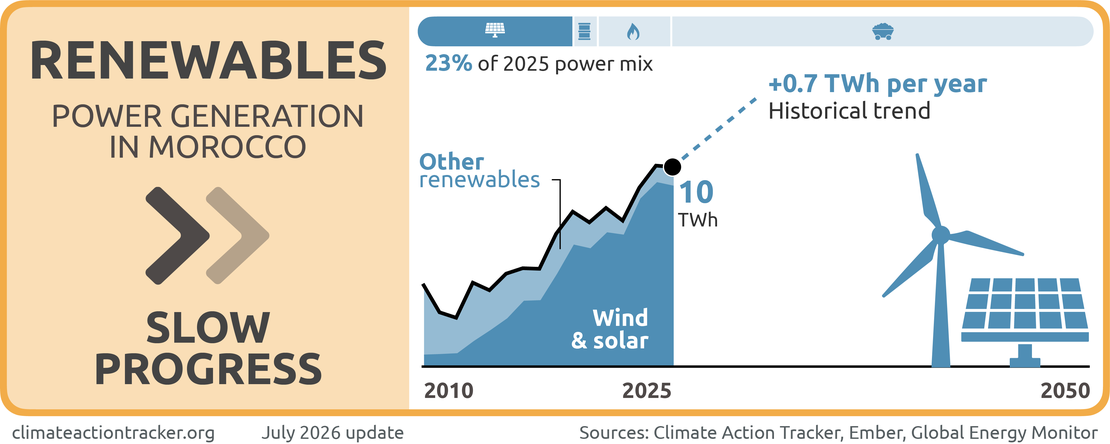
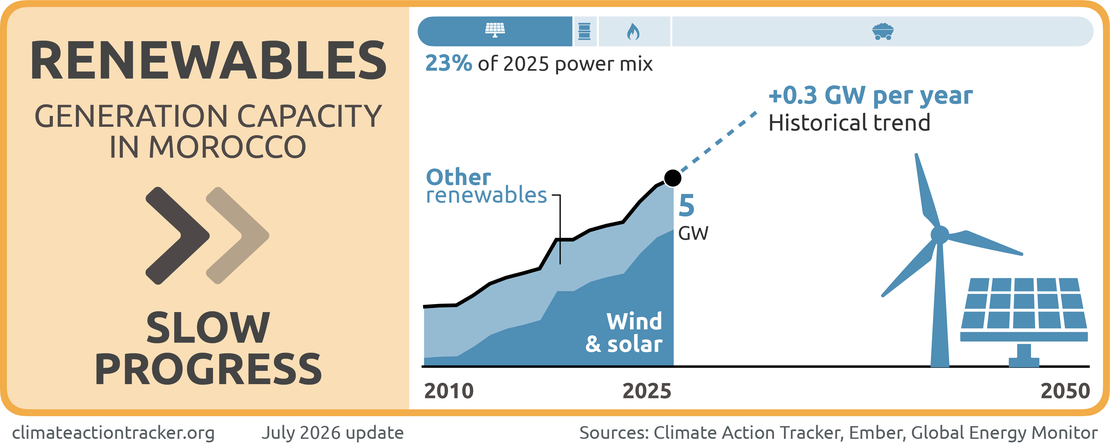
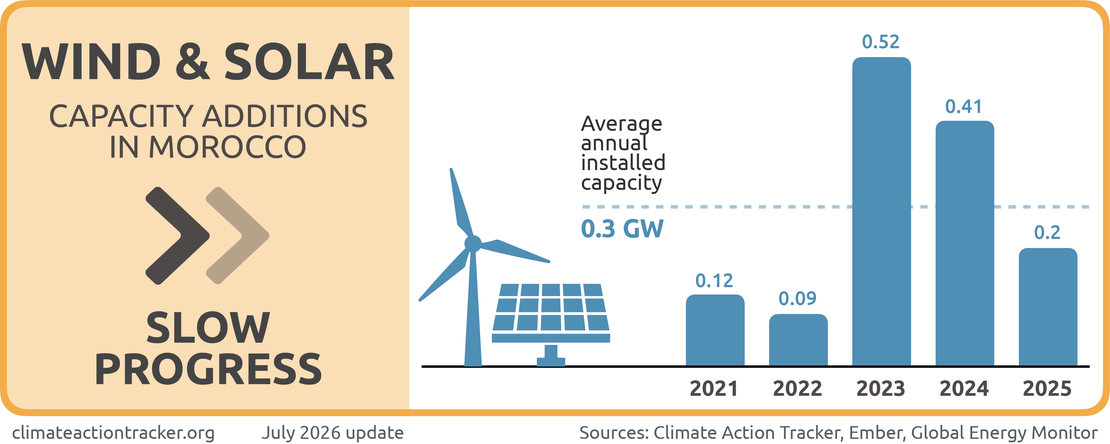
Morocco is making “Slow Progress” in deploying renewables, which remains the key pillar of its decarbonisation efforts. The government has put forward several renewable energy targets. At the core of these efforts is the objective to raise the share of renewable electricity capacity to 52% by 2030 (20% solar, 20% wind and 12% hydropower) (Kingdom of Morocco, 2016a; Government of Morocco, 2021a). In its Long-Term Strategy (LTS), Morocco further committed to increasing the share of renewable energy in the electricity mix to 80% by 2050 (Government of Morocco, 2021b). The new NDC also sets the goal to triple renewable capacity to over 15 GW, to help support the recently announced coal phase-out.
As of 2025, the country’s renewable energy capacity stood at 4.4 GW, amounting to 42% of total installed capacity. The share of renewables in the electricity mix has steadily grown in the last five years, from 19% in 2020 to 23% in 2025. This growth has been driven mainly by wind (15%), with solar and hydropower contributing 6% and 2% respectively. Generation from renewables has also risen from 7 TWh to 10 TWh over the same period of time (Ember, 2026).
While Morocco is making steady progress in deploying renewables, it remains uncertain whether it will meet its 2030 targets – particularly due to the slow deployment of solar power. One of the main issues is that Morocco’s renewable energy strategy has mainly centred on large-scale projects, such as the Noor Concentrated Solar Power (CSP) plants, which require high capital and operational costs. Grid regulations have historically prioritised medium and high-voltage connections while neglecting low-voltage prosumers.
Solar power
Solar power is key to Morocco’s renewable energy strategy, largely because of the country’s high solar energy potential. The 2030 National Solar Plan, which is included in Morocco’s NDC, aims to reach a total capacity equivalent of 4 GW by 2030. The most recent solar benchmarks developed by the CAT show that this target is broadly consistent with a 1.5°C compatible pathway for Morocco’s power sector.
Central to this strategy is the Noor Midelt solar complex, one of the largest solar parks in the world, with a capacity of 580 MW between four power plants, covering 3,000 hectares (CMS, 2024).
However, it remains uncertain whether Morocco will meet its target under the 2030 National Solar Plan as solar energy deployment continues to trail behind other renewable energy sources. Installed solar capacity amounted to only 1.1 GW in 2025, a mere ~0.3 GW increase over the last five years. Similarly, solar-based generation has only slightly increased in the last five years, going from around 4% of the power mix in 2020 to 6% in 2025 (Ember, 2026). Financial and regulatory barriers continue to hinder the development of solar PV. Large-scale solar projects in Morocco have experienced significant delays. For example, the Noor Midelt solar plant started later than originally planned, delaying the project's overall development.
Wind power
Onshore wind power has been the fastest-growing renewable energy source in Morocco, with its share in the total electricity mix rising from 12% in 2020 to 15% in 2025. With 2.5 GW of installed capacity already in place in 2025, Morocco has effectively achieved its 2030 National Wind Plan, which aimed to reach a total wind power capacity of 2.2 GW by 2030 (Government of Morocco, 2021a) + Ember 2026.
However, this target is not consistent with a 1.5°C aligned pathway for Morocco’s power sector. According to the latest wind benchmarks developed by the CAT, to align with a 1.5°C scenario, wind capacity needs to reach 9 GW in Morocco by 2030.
Morocco's extensive Atlantic coastline offers some of Africa's strongest offshore wind potential, as highlighted by a World Bank report, which estimated that it could amount to 200 GW (22 GW fixed and 178 GW floating) (World Bank, 2019). In June 2025, the government unveiled plans to build a 1 GW offshore wind farm off the coast of Essaouira, the first on the continent (Offshore Wind Biz, 2025).
Hydropower
Hydropower generation in Morocco has been on a steady decline since the 2010s, affected by droughts and scarce precipitation. In 2025, Morocco’s installed hydropower capacity totalled 1.3 GW, contributing around 2% of total electricity generation. While installed capacity has remained broadly stable, prolonged drought conditions and lower reservoir levels have reduced hydropower generation, highlighting the sector’s vulnerability to climate change.
In its previous NDC, the government set the goal of installing an additional 1.1 GW of hydropower capacity by 2030 (Government of Morocco, 2021a).
Hydrogen
Morocco’s vast renewable energy potential makes it attractive as a potential supplier of green hydrogen (Finance News Hebdo, 2021). The government intends to invest in green hydrogen to consolidate its energy transition and support decarbonisation efforts in other countries.
In 2021, the Moroccan National Hydrogen Commission unveiled a new roadmap, which expects demand for green hydrogen to reach between 14 TWh and 30 TWh by 2030, and between 156 TWh and 307 TWh by 2050 (Kingdom of Morocco, 2021b). The government estimates that this would require an additional 2 GW in renewable energy sources. Morocco would therefore need to focus its efforts on increasing renewable energy generation, if it hopes to position itself as a leader in green hydrogen.
The roadmap estimates that development of green hydrogen could lead to between 10 MtCO2e to 20 MtCO2e of emissions reductions in Morocco (Kingdom of Morocco, 2021b).
Industry
Morocco is one of the world’s leading exporters of phosphate, which, together with cement, accounts for more than three quarters of total emissions from the industry sector (Kingdom of Morocco, 2022b).
Morocco’s Third Biennial Report submitted to the UNFCCC spells out several mitigation measures in the phosphate sector (Kingdom of Morocco, 2022b). If all these policies are implemented, cumulative avoided emission could amount to 41 MtCO2e between 2020 and 2030. These include the following:
- Covering all electricity needs of the industry with renewable energy sources and cogeneration
- Substituting 30% of the fuel oil used for phosphate drying by solar energy (starting in 2028)
- Implementing a carbon capture and utilisation project from phosphate stacks in 2024 (with a capture rate of 20% to reach 100% in 2028)
Transport
The transport sector accounts for 38% of Morocco’s total final energy consumption (Kingdom of Morocco, 2022b). In recent years, the Moroccan government has sought to expand and improve its public transportation system. In November 2018, Morocco inaugurated a high-speed train line connecting the capital Rabat to Tangier and Casablanca (AFD, 2018).
Several projects are currently underway. While the Rabat Salé Tramway Company announced the finalisation of an extension in Rabat in February 2022 (TramwayRS, 2022), Casablanca Transport is currently extending two new tramway lines (Railway Pro, 2021; Moovit, 2022). The government also plans to expand the tramways in Rabat and Casablanca by 2025. Similar extensions are planned in the cities of Marrakech, Fez, Tangier and Agadir, although actual implementation has yet to start.
From January 2023, Morocco put in place Euro 6 vehicle emissions standards, which tighten limits on air pollutant emissions, to all new vehicles sold in the Moroccan market (Le Matin, 2021).
Through its National Energy Efficiency Strategy, the Moroccan government is seeking to reduce energy consumption in key sectors of its economy. Morocco currently aims for a 24% energy consumption reduction in the transport sector (Kingdom of Morocco, 2020b).
Electric vehicles
The market share of electric vehicles (EV) remains extremely low, but the Moroccan government has taken steps to increase their uptake. It installed charging stations on the highway between Tangier and Agadir. An EV plant was recently built in the city of Kenitra, making Morocco the first North African country with the capacity to produce EVs (Tanchum, 2021). The government has also announced plans to build an electric battery factory in the Casablanca region (Ortiz, 2022).
Morocco’s Exemplary Administration Plan aims to have 30% of the government’s state fleet be ecological vehicles (hybrid or electric) (Kingdom of Morocco, 2021a). However, the government has yet to set up concrete national targets or release an EV strategy.
Agriculture
Agriculture is an important component of the Moroccan economy, representing 12.5% of GDP and employing 37% of its workforce (Kingdom of Morocco, 2021a). It is also the second largest emitting sector in Morocco, accounting for 23% of all emissions in 2018 (excluding LULUCF). The agriculture sector emitted around 18 MtCO2e in 2010 and 20 MtCO2e in 2021 (Gütschow et al., 2022). The main source of emissions is agricultural land (52.5% in 2018), followed by enteric fermentation (39,6% in 2018) (Kingdom of Morocco, 2022b).
In 2020, the government set out its new agricultural policy in the Green Generation Strategy 2020-2030 (Kingdom of Morocco, Ministry of Agricultural, Fisheries, Rural Development, 2020), replacing the previous Morocco Green Plan. The new strategy aims to double the share of the agricultural sector in Morocco’s GDP and create 350,000 new jobs.
There is a limited number of policies targeted at climate change mitigation in this sector, as the plan mostly focuses on enhancing the resilience and adaptability of the Moroccan agricultural sector. The mitigation measures mostly consist of increasing plantations (e.g. of olive and citrus trees, date palms, cactus etc.), preventing soil erosion and developing solar water pumping systems (Kingdom of Morocco, 2021a). However, no information on the state of their implementation is currently available.
The National Energy Efficiency Strategy also targets the agricultural sector (together with maritime fishing), and aims for 13.5% energy consumption reduction by 2030 (Kingdom of Morocco, 2020b).
Further analysis





Latest publications




Stay informed
Subscribe to our newsletter