
Australia
Net zero targets
Summary
We evaluate the net zero target as: Average.
Australia’s long-term emissions reduction plan for achieving net zero by 2050, submitted to the UNFCCC as a Long-Term Strategy (LTS), was published in October 2021. Australia included its 2050 net zero target in its previous 2030 NDCs submitted in 2021 and 2022, and again in its 2035 NDC submitted in September 2025. The 2022 Climate Change Act enshrined the 2030 and 2050 targets into law and mandated regular progress reviews and consultation processes for setting future targets.
In September 2025, Australia published its new Net Zero Plan for achieving net zero by 2050 (The Treasury, 2025). The 2025 Net Zero Plan is anchored in a stronger and more detailed target framework. It includes the 2030 and 2035 targets with an associated emissions budget, whereas the 2021 LTS largely focused on the 2050 goal and a technology-led pathway without a comparable interim architecture.
The 2025 Net Zero Plan substantiates the 2021 LTS by providing a more operational roadmap, which is structured around five decarbonisation priorities and supported by six sectoral emissions reduction plans, along with the modelling of three detailed transition scenarios commissioned by the Australian Treasury.
However, the key weakness of the Plan is the scale of residual emissions, 167 MtCO2e by 2050, which points to limited mitigation effort beyond 2035, particularly in sectors where deeper cuts are feasible. All countries will need some carbon dioxide removal to reach net zero, but residual emissions on this scale leave the Plan relying far too heavily on land-based sequestration and other removals to compensate for them. Because the availability, permanence and scalability of these removal options are uncertain, the priority should be to reduce residual emissions to the lowest feasible level. The scale of the residual emissions therefore points to limited mitigation effort in other sectors beyond 2035 and creates substantial uncertainty about whether Australia can achieve its net-zero target on time.
In the Treasury Baseline scenario, out of 167 MtCO2e of residual gross emissions remain in 2050, around 80 MtCO2e is already present in 2035, with a further 87 MtCO2e needed by 2050 to balance 167 MtCO2e of residual emissions. The modelled 2050 contribution is dominated by new reforestation, supported by the existing land-sector sink, forest regeneration and blue carbon, soil carbon, and savanna fire management, while engineered carbon removals are only flagged as an alternative that is projected to remain relatively high-cost to 2050.
Yet the plan itself concedes there is “considerable uncertainty” around the scale of land-based sequestration that can realistically be achieved, due to uncertainties in abatement cost pathways, data and analytical constraints on sequestration potential of different land types, leaving significant doubt that these residual emissions can in practice be fully compensated (Australian Government, 2025a).
When compared with the latest LULUCF projection, which shows a declining sink that stabilises at around 50 MtCO2e from 2035 to 2040, the gap between the projected land sink and the additional removals required widens to about 115 MtCO2e to reach net zero by 2050 if land-based sequestration is the only carbon removal approach (DCCEEW, 2025a).
At the same time, the plan continues to endorse gas as “transitional fuel” for renewables, projecting only 70% emissions reduction in gas use by 2050 under the Baseline Scenario, a compromised step that risks undermining progress toward the long-term net zero goal (Australian Government, 2025b). This outcome does not reflect the full potential for deeper decarbonisation through renewable energy, storage, transmission and demand-side measures. By preserving significant fossil-gas use in 2050, the pathway increases residual emissions, prolongs dependence on carbon removals and risks undermining achievement of the net-zero target.
CAT analysis of net zero target
Scope
- Target year – Australia aims to reach net zero by 2050.
- Emissions coverage – The target covers all six major GHG emissions and all sectors of the economy (Australian Government, 2021a).
- International aviation and shipping – The target excludes both international aviation and shipping (Australian Government, 2021a).
- Reductions or removals outside of own borders – Australia’s Net Zero Plan and its modelling consider only domestic abatement and removals, but does not clearly state that net zero will be achieved entirely within Australia’s borders, nor does it define a quantitative limit (or explicit prohibition) on the use of international units beyond 2035 (Australian Government, 2025d; The Treasury, 2025). However, the government has acknowledged uncertainty around closing the removal shortfall for the 2050 net zero target (The Guardian, 2025a), which may open the door for the use of international units under Article 6 of the Paris Agreement. Currently, there is no clarity on how this gap would be met domestically. Australia’s 2035 NDC states that it does not plan to use Article 6 market or non-market mechanisms and that the 2035 target should be treated as an interim target in the 2025 Net Zero plan (Australian Government, 2025b). However, this should not be interpreted as a firm exclusion of using international units, as Australia’s broader policy engagement suggests it is maintaining optionality, including through the development of potential Article 6–relevant activities such as the AUD 6.3 million Pacific Blue Carbon Program during 2018-2024 (Alinea International, 2024).
Target architecture
- Legal status – Australia enshrined its net zero by 2050 target in its Climate Change Act 2022 (Australian Government, 2022b).
- Separate reduction & removal targets – Australia does not provide separate emission reduction and removal targets.
- Review process – Australia’s Climate Change Act 2022 legislates the Ministerial reporting of an Annual Climate Change Statement in Parliament, which reports on progress against the targets and the effectiveness of current policies, and the independent advice from the Climate Change Authority (CCA) on future emissions reduction targets at least every five years (Climate Change Act 2022, 2025). Furthermore, the CCA is legally mandated to provide advice on this annual statement and the emissions reduction targets (Climate Change Act 2022, 2025).
Transparency
- Carbon dioxide removal – Australia recognises the need to significantly scale up carbon removals and develop new carbon removal technologies to meet its net zero target (Australian Government, 2025b). However, compared with the 2021 LTS, the 2025 Net Zero Plan is more transparent about the role of LULUCF and other carbon dioxide removals. It explicitly quantifies residual emissions of 167 MtCO2e in 2050 and identifies land-based sequestration as the primary balancing mechanism. This transparency mainly clarifies the scale of the problem rather than resolving it.
The Treasury’s Baseline scenario underpinning the Agriculture and Land Sector Plan assumes that the existing land sink will be maintained and that the remaining 167 MtCO2e will be met through a substantial expansion of new land-based sequestration. However, the Plan also notes that the current land sink is expected to weaken over time and that, under this scenario, the land sink must increase by 126% by 2050 (Australian Government, 2025a).
Engineered removals are acknowledged but are simultaneously characterised as remaining relatively high-cost to 2050, leaving most of the burden on land-based options for which the Plan concedes there is “considerable uncertainty” in achievable scale.
Although the government has tasked CSIRO with preparing the Carbon Dioxide Removal Roadmap, most emerging CDR technologies remain unproven at scale (CSIRO, 2025b). The government has also acknowledged the uncertainty in closing an 87 MtCO2e removal shortfall for the 2050 net zero target, and has not outlined concrete plans for how this gap will be met if carbon dioxide removal technologies are used (The Guardian, 2025b). - Comprehensive planning – Australia’s current 2025 Net Zero Plan shows stronger implementation planning than its predecessor, reflected in its 2030 and 2035 NDC targets. This includes a legislated five-year ‘review and refine’ cycle for future targets, multi-year emissions budgets, and six sectoral plans (Australian Government, 2025b, 2025d; Climate Change Act 2022, 2025). However, the plan does not provide any binding sectoral targets and an actionable strategy to close the shortfall for achieving net zero by 2050 and continues to rely heavily on future technology development and offsets, including ongoing use of gas for electricity, indicating the need for further implementation planning (Lauder, 2025; The Guardian, 2025a).
- Clarity on fairness of target – An improvement from its 2030 NDC, Australia’s 2035 NDC provides a detailed discussion of equity and fairness, including its interpretation of national circumstances and contribution to global mitigation (Australian Government, 2021b, 2025d). However, the justification reflects a particular framing of fairness and does not clearly demonstrate consistency with widely used equity approaches (e.g. responsibility–capability metrics), leaving its adequacy open to question.
Good practice
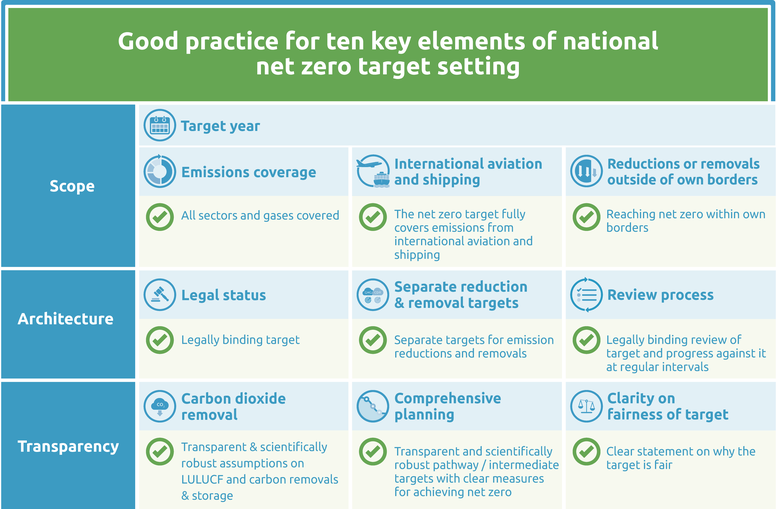
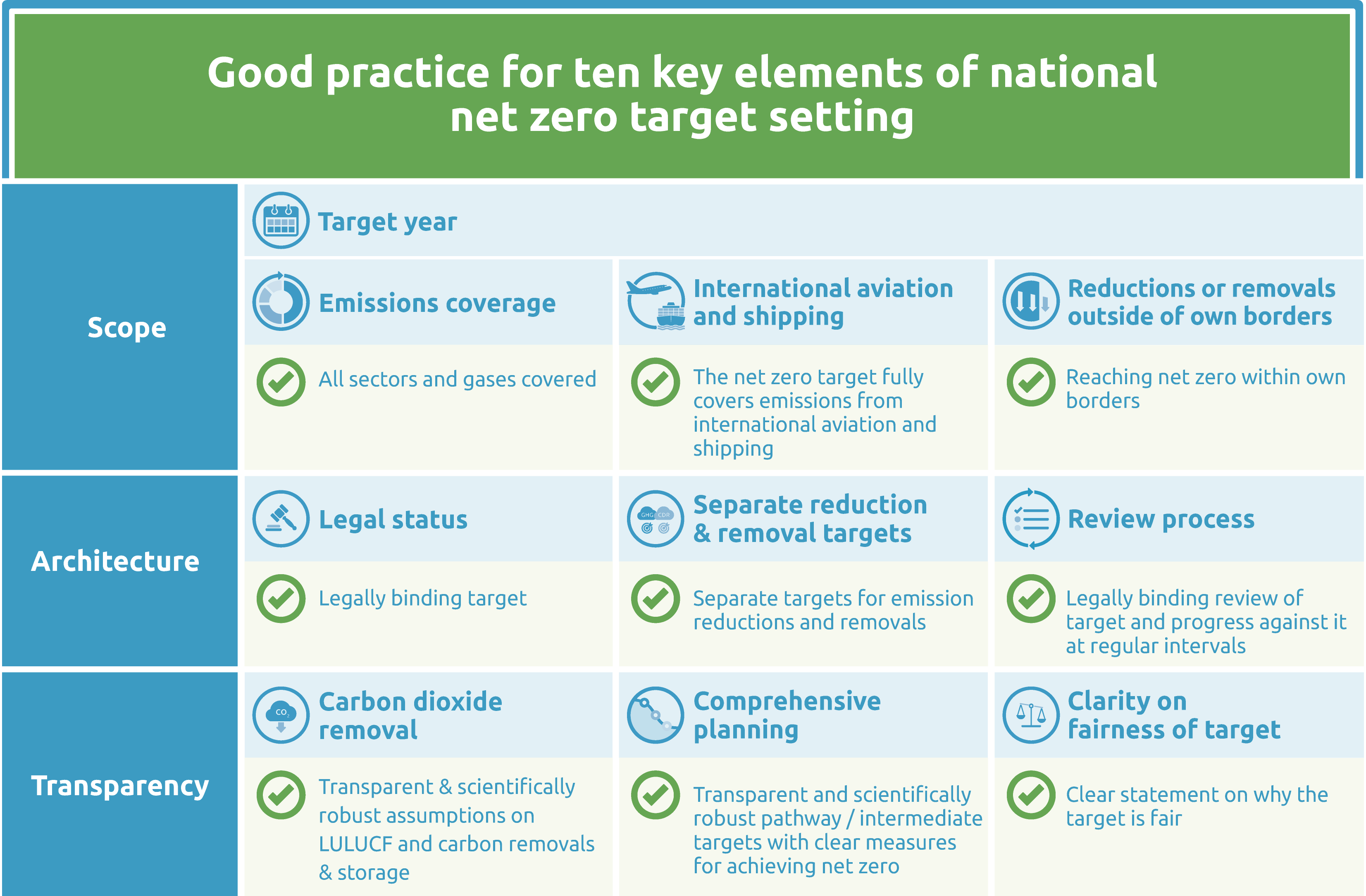
The Climate Action Tracker has defined the following good practice for all ten key elements of net zero targets. Countries can refer to this good practice to design or enhance their net zero targets.
Further analysis





Latest publications






Stay informed
Subscribe to our newsletter