
Türkiye
2035 NDC
2035 NDC Target
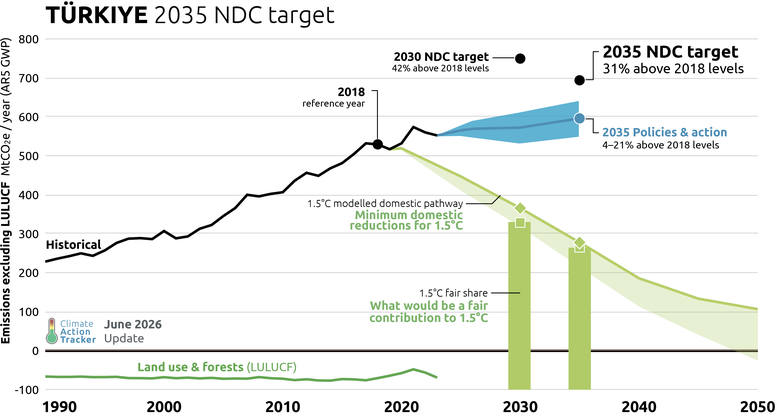
This analysis was published in June 2026. Since our last assessment in October 2025, we have updated our modelled domestic pathways for Türkiye. Further information on how the CAT derives country-level pathways can be found here. An update to the full country profile will follow soon.
As it stands, COP31 host Türkiye’s climate ambitions and policy actions are not 1.5°C compatible and set to deteriorate further by 2035, with the gap between targets and a 1.5°C compatible pathway actually widening from 2030 to 2035. The fact that the country’s 2030 and 2035 NDCs would lead to emissions well above current policies is in no way consistent with the Paris Agreement’s requirement to put forward climate targets with the highest possible ambition. The 2035 target would see Türkiye’s emissions plateau or even increase over the next decade, which is clearly at odds with the goals of the Paris Agreement, while the 2030 target has not been revised and remains off-track.
Türkiye continues to express its NDC targets as a reduction from a business-as-usual (BAU) scenario and provides no information on how it constructed this scenario. This framing lacks transparency because it can change drastically with adjustments to the underlying BAU, which appears unrealistically high compared to historical data and our current policy projections.
As the host of COP31, Türkiye should substantially increase its climate ambition by strengthening its climate targets and committing to phasing out the use of coal and fossil gas.
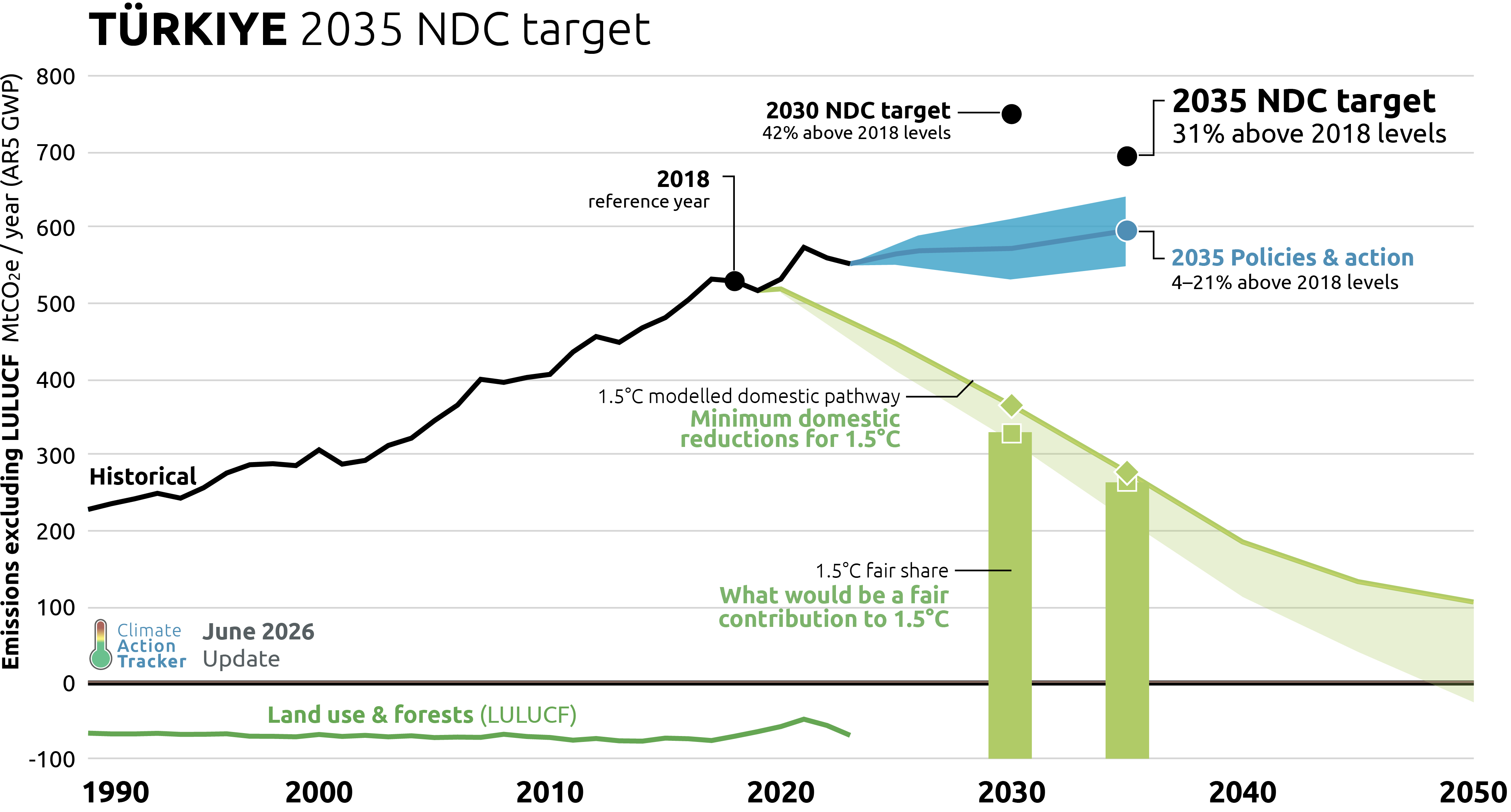
Türkiye’s 2035 NDC sets a target of reducing emissions by 466 MtCO2e below a BAU scenario, limiting emissions to 643 MtCO2e in 2035 including emissions from land use, land use change, and forestry (LULUCF). Excluding LULUCF, Türkiye’s new target is equivalent to an emissions level of 694 MtCO2e in 2035. This is far from being 1.5°C compatible under modelled domestic pathways and Türkiye’s fair share contribution.
As in its previous NDC, Türkiye’s 2035 submission includes the LULUCF sector in its BAU scenario, and intends to count removals from LULUCF towards achieving the 2035 target. However, this 2035 NDC lacks transparency on the scope of the land sink, providing neither the land sector’s estimated contribution in 2035, nor the methodology used to determine its contribution.
By building on positive developments and existing momentum, such as declining costs for wind and solar energy, and efforts to establish an emissions trading system (ETS), Türkiye is in a strong position to step up its climate efforts. The Turkish government should strengthen its 2030 and 2035 climate targets, as well as increase the speed of implementation of its climate policies, to align with a 1.5°C compatible pathway.
| Türkiye | 2035 NDC | |||
|---|---|---|---|---|
| 2030 target | ||||
|---|---|---|---|---|
| Formulation of target in NDC |
41% reduction in GHG emissions from the BAU level by 2030 incl. LULUCF. Has not updated the ambition of its 2030 target, please see full 2030 NDC assessment in the Targets tab. |
|||
|
Absolute emissions level in 2030 excl. LULUCF |
749 MtCO2e (42% above 2018) (84% above 2010) |
|||
| Status | Submitted on 13 April 2023 | |||
| 2035 target | ||||
|---|---|---|---|---|
| Formulation of target in NDC | Reduce GHG emissions by 466 MtCO2e below to the BAU level of 1,109 MtCO2e, limiting GHG emissions to 643 MtCO2e by 2035 incl. LULUCF. | |||
|
Absolute emissions level in 2035 excl. LULUCF |
694 MtCO2e (31% above 2018) (71% above 2010) |
|||
| Status | Submitted on 9 November 2025 | |||
Ambition
For the world to have a significant chance of limiting warming to 1.5˚C, governments must switch to emergency mode and strengthen both their 2030 targets and current policies to include substantial emissions cuts and significantly contribute to closing the 2030 emissions gap. Türkiye’s submitted 2035 NDC target did not increase the ambition of its 2030 target.
Further information on Türkiye’s 2030 target can be found here.
2030 NDC target
| 2030 NDC target | ||
|---|---|---|
| Is the target 1.5°C compatible compared to modelled domestic pathways? |
|
|
| Is the target 1.5°C compatible compared to fair share? |
|
|
| Is this a stronger target than previously submitted? |
|
|
2035 NDC target
| 2035 NDC target | ||
|---|---|---|
| Is the target 1.5°C compatible compared to modelled domestic pathways? |
|
|
| Is the target 1.5°C compatible compared to fair share? |
|
|
| Does the NDC include sectoral targets? |
|
|
| Does the NDC include a renewable energy capacity target? |
|
|
Türkiye submitted its 2035 NDC mitigation target on 9 November 2025, setting a 2035 target of reducing emissions by 466 MtCO2e compared to a BAU scenario, limiting emissions to 643 MtCO2e in 2035, including LULUCF. This target covers all sectors and all gases. The CAT excludes emissions from LULUCF from this target, resulting in a target of 694 MtCO2e in 2035 or 31% above 2018 levels.
Türkiye’s 2035 target is not 1.5°C compatible when compared to modelled domestic pathways because it is above the 1.5°C compatible threshold of 278 MtCO2e, excluding LULUCF. To be 1.5°C compatible, Türkiye would need to reduce its emissions to at least 47% below 2018 levels in 2035 (excl. LULUCF).
The 2035 target is also not 1.5°C compatible when compared to Türkiye’s fair share contribution to climate change mitigation. To make its fair share contribution to climate action, Türkiye would need to further reduce its emissions to 50% below 2018 levels (excl. LULUCF).
The 2035 NDC target includes neither sectoral plans nor targets. Nor does it include a renewable energy target or other sector-specific pledges, such as ending deforestation by 2030 or phasing out fossil fuels from power generation.
This NDC does reference existing strategies adopted by the Turkish government in recent years to drive economy-wide and sectoral climate action. Türkiye’s recently adopted Climate Law sets out the legal foundation for a Turkish ETS, with key elements such as the cap-setting methodology currently under development. It also requires provincial governments to develop their own Local Climate Action Plans to implement national strategies. The Turkish government has also released the Climate Change Mitigation Strategy and Action Plan and the Climate Change Adaptation Strategy and Action Plan, policy roadmaps intended to translate Türkiye’s climate commitments into real action.
Further information on Türkiye’s targets can be found here.
| TÜRKIYE | Target summary (excluding LULUCF) |
|---|
| 2030 target: Emissions change from 2018 levels (CAT estimates) | |
|---|---|
| Current policies in 2030 | 1–15% above |
| 2030 NDC target | 42% above |
| 1.5°C modelled domestic pathway | 31% below |
| 1.5°C fair share | 38% below |
| 2035 target: Emissions change from 2018 levels (CAT estimates) | |
|---|---|
| Current policies in 2035 | 4–21% above |
| 2035 NDC target | 31% above |
| 1.5°C modelled domestic pathway | 47% below |
| 1.5°C fair share | 50% below |
The reference year used in the NDC for Türkiye’s 2030 target is 2012, while the reference year for the 2035 target is 2018. For consistency, we use 2018 as a reference year throughout this assessment.
Fairness & Finance
Developed countries need to significantly scale up international climate finance and other means of support. Developed countries should set 1.5°C aligned domestic mitigation targets in their NDCs and communicate the financial and other support they will provide to developing countries. Developing countries should clearly communicate the climate finance they need to set and achieve ambitious 1.5°C aligned conditional targets.
In terms of ambition, developed countries should set NDC targets that are at least compatible with the 1.5°C threshold according to the modelled domestic pathways (MDP) framework, and they are expected to meet these targets domestically using their own resources. Developing countries are expected to meet the 1.5°C fair share level using their own resources and, with adequate international support, to progress toward achieving their 1.5°C compatible MDP targets.
For Türkiye, the 1.5°C compatible emission reduction levels for 2030 and 2035 are close under both frameworks. Based on this, we expect Türkiye to be able to align its emissions pathway with a 1.5°C compatible trajectory largely using its own domestic resources. This fits with Türkiye’s status under the UNFCCC as an Annex I country, which makes it ineligible to receive climate finance through the Green Climate Fund (GCF). Nevertheless, additional international support—including technical assistance and policy cooperation—could help accelerate implementation and increase ambition.
In its recently submitted 2035 NDC, Türkiye has not indicated whether any share of the target is conditional on international support, nor has it communicated an intention to seek international finance for mitigation.
Further information on how the CAT assesses climate finance can be found here.
Credibility
Credible NDCs should build on robust national planning processes that translate the economy-wide emissions reduction target into action in all sectors. Governments need to ramp up the implementation of their existing targets and further develop policies to close the – still significant – emissions gap between current policies and the 1.5°C pathway. Contradictory policies must be addressed and reversed: fossil fuel production needs to be phased out, while fossil fuel exploration and fossil fuel subsidies need to stop.
| 2035 NDC target | ||
|---|---|---|
| Is the target driving more ambitious action? |
|
|
| Is there a policy framework in place to meet the target? |
|
|
| Does the NDC reference national planning processes for its development? |
|
|
| Does the NDC reference an institutional framework/plan in place for its implementation? |
|
|
| Does the target commit to phase out fossil fuel production? |
|
|
Türkiye can easily meet its 2035 NDC targets with current policies, meaning they do not drive further climate action. In fact, Türkiye’s targets would lead to emissions above current policies. The 2035 target would see Türkiye’s emissions remain stable or even increase over the next 10 years, which is clearly at odds with the goals of the Paris Agreement.
The business-as-usual (BAU) scenario outlined in the new NDC is also significantly higher than our current policy projections for Türkiye in 2035. The BAU sees emissions reach 1,109 MtCO2e in 2035 including LULUCF. Our current policy projections see emissions levels reach 551–641 MtCO2e in 2035 excluding LULUCF. The use of this BAU baseline makes it seem as though the 2035 target is a significant change from the current trajectory, but we expect Türkiye to already reduce its emissions well below the 2035 target under current policies.
In a serious lack of transparency, Türkiye does not provide a baseline emissions pathway in its 2035 NDC nor offers any information on how it was constructed other than that it uses GHG emissions from the 2018 National Inventory Document (NID). The 2035 NDC asserts that further methodological details will be communicated in Türkiye’s next Biennial Transparency Report (BTR) which are expected to be submitted by the end of 2026.
A critical weakness of Türkiye’s 2035 NDC is its failure to adopt a target or plan for phasing out coal and other fossil fuels. Given that a coal phase-out is low-hanging fruit for decarbonising the economy, Türkiye should commit to phasing out existing coal capacity from its power sector, where coal provided 34% of electricity generation in 2025 – up from 29% just a decade before (Ember, 2026).
According to the CAT’s latest benchmarks on clean power, Türkiye must fully phase out fossil fuels in the power sector before 2045 to align with 1.5°C (Climate Action Tracker, 2026). Despite progress on deploying renewable energy and institutionalizing climate goals, the Turkish government still intends to become a fossil gas hub for demand from Europe, which risks locking Türkiye into a carbon-intensive economy in the future.
Transparency
Governments should set absolute, economy-wide, emissions reduction pathways including all GHG gases, specifying the emissions levels for each year as an absolute level of gross emissions (excluding LULUCF). This level of transparency will ensure that their reduction targets are immune to creative accounting. NDC targets should primarily focus on their domestic reductions by decarbonising all sectors of the economy rather than relying on forestry sinks, other carbon dioxide removal (CDR) or international carbon markets.
| 2035 NDC target | ||
|---|---|---|
| Is the target based on reductions from a historical base year? |
|
|
| Does the target cover all sectors? |
|
|
| Does the target cover all greenhouse gases? |
|
|
| Does the target specify an emissions pathway? |
|
|
| Does the target separate out land use and forestry? |
|
|
| Does the target separate out the use of carbon credits under Article 6? |
|
|
Türkiye's approach to setting targets (i.e. expressing reductions relative to a BAU scenario) makes it difficult to determine its level of ambition for reducing emissions. It also makes direct comparisons between the 2030 and 2035 targets more difficult, as each target uses its own BAU baseline, based on Türkiye’s 2012 and 2018 emissions inventories, respectively. This raises an issue of transparency, not only on the comparability of Türkiye’s targets, but with regards to the recency and accuracy of its BAUs.
Türkiye’s 2035 target is also constructed as a reduction below a business-as-usual (BAU) scenario rather than a percentage reduction below a historical year. The BAU is significantly higher than Türkiye’s current emissions level, with a BAU of 1,109 MtCO2e (incl. LULUCF) in 2035 compared to 483 MtCO2e (incl. LULUCF) in 2023. This construction makes the 2035 target seem ambitious, although it is framed as a reduction from an unrealistic reference level.
Türkiye does not provide a baseline emissions pathway in its NDC and offered no information on how its BAU was constructed. The level of an NDC’s ambition depends heavily on how emissions are expected to change compared to a baseline or reference scenario, so without any information on Türkiye’s baseline, it is difficult to assess the target’s ambition in a meaningful or comparable way.
As with its last NDC submission, Türkiye does not have a separate target for LULUCF and has not published detailed projections of the sink’s estimated removals. This is concerning, as the ability of Türkiye’s land sink to continue absorbing CO2 is under threat from wildfires, logging, and forest degradation. Further information on LULUCF projections and their methodology is expected to come in Türkiye’s Second Biennial Transparency Report (BTR2).
Article 6
Türkiye reserves the right to use market mechanisms under Article 6 of the Paris Agreement, but does not specify whether it intends to do so to meet its 2035 target, nor how much of the expected emissions reductions would come from the use of carbon credits. It is also unclear whether Türkiye might position itself as a seller of carbon credits.
In general, buying carbon credits risks being a substitution for domestic mitigation and thereby reduces the ambition of domestic action, whereas selling credits risks providing low-cost mitigation measures while leaving more expensive measures for domestic use. This is contrary to the objective of Article 6, which is to enable higher overall ambition in a country’s mitigation actions through cooperation. A responsible use of Article 6 requires a combination of high (domestic) ambition, adequate levels of climate finance, high-quality projects, and robust accounting practices.
For more information on the promise and pitfalls of Article 6 mechanisms, see the recent CAT briefing here.
For more information on Türkiye’s climate targets and policies, please click here. For the CAT’s full recommendations for setting NDC targets that form the basis of the analysis above, please click here.
Further analysis





Latest publications



Stay informed
Subscribe to our newsletter