
Argentina
2035 NDC
2035 NDC Target
Argentina submitted its 2035 NDC to the UNFCCC on November 6, 2026. We will update this target analysis in the coming weeks.
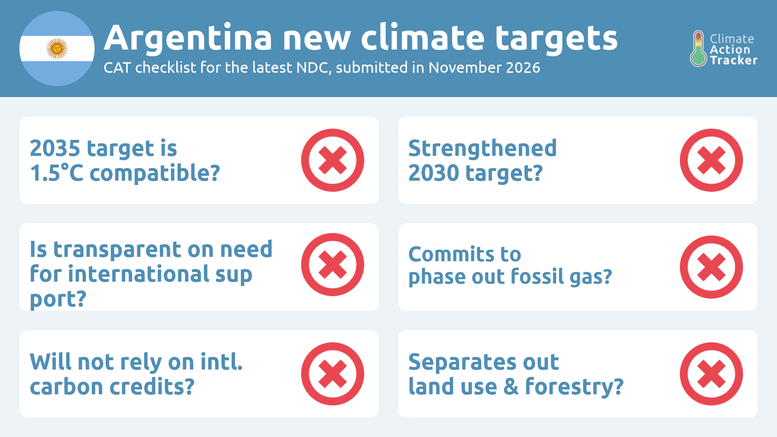
Argentina’s 2035 NDC submission presents neither a step up in ambition nor transparency compared to previous NDCs. It includes an updated 2030 NDC target and a new 2035 target. In both target years, Argentina commits to keeping its economy-wide emissions under 375 MtCO2e, which represents only a 6% decrease compared to 2022 levels. Neither of the new targets are 1.5°C-aligned compared to modelled domestic pathways, and Argentina's NDC targets move it further away from a 1.5°C trajectory over time rather than closer to it. While Argentina is belatedly maintaining its international climate commitments, the lack of progress reflected in its new NDC shows that climate policy remains a low priority for Javier Milei's administration.
Argentina’s 2030 and 2035 targets both cover all gases and sectors of the economy. When excluding emissions from land use (LULUCF), the CAT estimates Argentina’s emissions limits to be 360 MtCO2e in 2030, and 365 MtCO2e in 2035. This means that under Argentina’s targeted trajectory, emissions would continue increasing, rather than decline as would be required for 1.5°C.
Given Argentina does not clearly communicate the contribution of land use emissions to its NDC targets, the CAT assumes emissions from LULUCF to follow the pathway presented in the latest available current policy projections (see assumptions below). Argentina’s previous NDC target, submitted in 2021, committed to limiting emissions to 349 MtCO2e by 2030. At face value, the new 2030 NDC target appears to represent a decrease in Argentina’s ambition. However, the CAT estimates that Argentina’s previous target, when converted to AR5 and excluding LULUCF, is at approximately the same level as its new target: 360 MtCO2e. The GWP conversion has a particularly large effect in Argentina due to methane accounting for a significant proportion of the country’s national GHG emissions.
Argentina’s new NDC targets would need to be set at least 133 MtCO2e or 37% lower for the year 2030, and 180 MtCO2e or 49% lower for the year 2035 to be compatible with the 1.5°C pathway. To demonstrate a clearer progression of ambition over time, Argentina should set a 2035 target that is more, not less, ambitious than its 2030 target.
Argentina clearly signals that it will require international climate finance in order to achieve its climate commitments. Its new NDC presents a list of key mitigation areas and activities where it believes it will require international finance. However, it falls short of presenting more detailed information on the cost and mitigation contribution of key areas and measures towards its NDC target.
To further increase transparency and incentivise the inflow of climate finance, Argentina should further develop this aspect of its NDC, detailing the key mitigation measures it plans to implement, and clarifying whether it would implement these measures using its own resources - or if they are conditional on international support. The government should also develop two separate NDC targets, one to be achieved with its own resources (unconditional target) and one to be achieved if sufficient climate finance is provided (conditional target).
Argentina’s new NDC takes a clearer stand than previous submissions in favour of using market mechanisms under Article 6 of the Paris Agreement. This presents two risks: that Argentina could oversell credits and thereby compromise the achievement of its own NDC. This is especially the case if Argentina sells emission reductions that are relatively inexpensive, leaving it with fewer and more costly options.
Reliance on international carbon markets may also disincentivize Argentina from ratcheting up its NDC. This contradicts the objective of Article 6, which is to allow for higher ambition in a country’s mitigation and adaptation actions and to promote sustainable development and environmental integrity.
Finance generated through the purchase of carbon credits (ITMOs) under Article 6 should not be counted as climate finance. ITMO transactions are designed to help the buying country achieve its targets, while the selling country must make a corresponding adjustment that effectively makes the achievement of its target more difficult. For more information on the promise and pitfalls of Article 6 mechanisms, see the recent CAT briefing here.
For further guidance on how Argentina could strengthen its 2035 target, see our guide for new NDCs.
Further analysis





Latest publications





Stay informed
Subscribe to our newsletter