
Brazil
2035 NDC
2035 NDC Target Overview
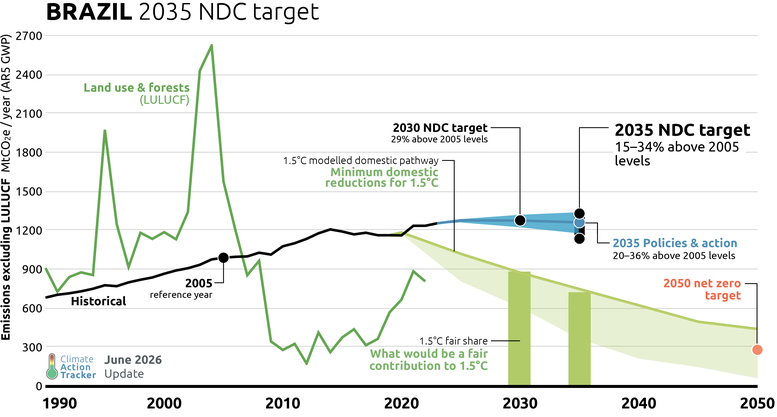
Brazil’s 2035 NDC is not 1.5˚C aligned and the gap between its target and a 1.5˚C modelled domestic pathway has grown compared to 2030. The target is also broadly in line with current policy projections, meaning that it is unlikely to drive additional mitigation beyond existing policies.
In November 2024, during COP29, the Brazilian government submitted its 2035 NDC, committing to reduce net greenhouse gas emissions by 59–67% below 2005 levels by 2035 across all sectors and gases, and to reach net zero emissions for all GHGs by 2050. However, according to our latest assessment of what a 1.5°C compatible NDC would require, Brazil would need to cut emissions much more by 2035: to at least 24% below 2005 levels excluding LULUCF, or at least 84% below 2005 levels including LULUCF (CAT, 2025).
The 2035 NDC submission did not increase the ambition of the 2030 target but the government published the National Mitigation Strategy (ENM) and the National Climate Plan (“Plano Clima”), which included sectoral contributions to the 2030 and 2035 targets, an important transparency step welcomed by the CAT. However, the new information reveals that Brazil plans to heavily rely on transforming the land use and forests sector into a net sink. While reducing emissions from deforestation is needed globally, in Brazil’s case, it is effectively reducing incentives for the much needed fossil fuel phase out and emissions reductions in other sectors. The new policy documents expect large reductions in the land use, land use change and forestry (LULUCF) sector, while projected emissions in other key sectors such as industry, agriculture, energy and transport remain stable or even increase. The recalculation of the 2030 target (excl. LULUCF) based on the new information makes it clear that Brazil’s decarbonisation of the economy is planned to be significantly slower than what we had initially assumed.
We also recalculated the 2035 target (excl. LULUCF), with revised LULUCF assumptions reflecting the updated sectoral contributions, which significantly narrows our initial estimates. Now, the range of emissions for the 2035 NDC (1,134–1,328 MtCO2e, excl. LULUCF) is very close to our current policy projections range (1,182–1,338 MtCO2e, excl. LULUCF), suggesting the new target is unlikely to drive emissions reductions beyond existing policies and trends.
Brazil also indicated its intent to use Article 6 to sell part of their emission reductions internationally, which poses a risk as it could constrain future domestic ambition.
| BRAZIL | 2035 NDC TARGET | ||
|---|---|---|---|
| 2030 NDC target | |||
|---|---|---|---|
| Formulation of target in NDC | Has not updated the ambition of its 2030 target but made available new assumptions for sectoral contributions to the target which effectively impact our calculations of the target excl. LULUCF, please see full 2030 NDC assessment in the Targets tab. | ||
| Status | Resubmitted on 27 October 2023 | ||
| 2035 NDC target | |||
|---|---|---|---|
| Formulation of target in NDC | A reduction of 59−67% below 2005 emissions by 2035 (consistent with an emission level of 850–1,050 MtCO2e, including LULUCF and in AR5) | ||
| Absolute emissions level in 2035 excl. LULUCF |
1,134–1,328 MtCO2e [15% to 34% above 2005 levels] [5% to 23% above 2010 levels] |
||
| Status | Submitted on 13 November 2024 | ||
Ambition
For the world to have a significant chance of limiting warming to 1.5˚C, governments must switch to emergency mode and strengthen both their 2030 targets and current policies to include substantial emissions cuts and significantly contribute to closing the 2030 emission gap. Brazil’s submitted 2035 NDC target did not increase the ambition of its 2030 target.
Further information on Brazil’s 2030 target can be found here.
2030 NDC Target
| 2030 NDC target | ||
|---|---|---|
| Is the target 1.5°C compatible compared to modelled domestic pathways? |
|
|
| Is the target 1.5°C compatible compared to fair share? |
|
|
| Is this a stronger target than previously submitted? |
|
|
2035 NDC Target
| 2035 NDC target | ||
|---|---|---|
| Is the target 1.5°C compatible compared to modelled domestic pathways? |
|
|
| Does the NDC include sectoral targets? |
|
|
| Does the NDC include a renewable energy capacity target? |
|
|
| Does the target align with the country’s net-zero pathway? |
|
|
In November 2024, during COP29, the Brazilian government submitted its 2035 NDC which includes a target to reduce net greenhouse gas emissions by 59–67% below 2005 levels by 2035. This target covers all sectors and all gases. According to the latest national inventory data for 2005, this is consistent with an emissions level of 850–1,050 MtCO2e in 2035 (incl. LULUCF) and 1,134–1,328 MtCO2e in 2035 (excl. LULUCF).
This target is not 1.5˚C aligned, and the gap between Brazil’s targets and a 1.5˚C modelled domestic pathway has grown: in 2030, Brazil’s NDC was 46% above a 1.5˚C pathway; while in 2035, the target lands 52%–78% above the 1.5C pathway.
Brazil’s 2035 NDC did not mention, let alone update, its 2030 target. Following the 2035 NDC submission, the government published the National Mitigation Strategy (ENM) and the National Climate Plan (“Plano Clima”), which included sectoral contributions to the 2030 and 2035 targets, an important transparency step welcomed by the CAT. However, the new information reveals that Brazil plans to heavily rely on transforming the land use and forests sector into a net sink. While reducing emissions from deforestation is needed globally, in Brazil’s case, it is effectively slowing down the much needed fossil fuel phase out and emissions reductions in other sectors. The new policy documents expect large reductions in the land use, land use change and forestry (LULUCF) sector, while projected emissions in other key sectors such as industry, agriculture, energy and transport remain stable or even increase. The recalculation of the 2030 target (excl. LULUCF) based on the new information makes it clear that Brazil’s decarbonisation of the economy is planed to be significantly slower than what we had initially assumed.
We also recalculated our initial assessment of the 2035 target (excl. LULUCF) based on the sectoral contributions indicated in the National Mitigation Strategy, which led to a significant shrinking of the range we had initially estimated. The 2035 NDC range, now resulting in emission levels of between 1,134–1,328 MtCO2e in 2035 (excl. LULUCF), lands very close to our current policy projections range (1,182–1,338 MtCO2e for the same year, see the Assumptions section for more details).
Brazil’s 2035 NDC includes a goal of reaching net zero emissions by 2050 (for all GHGs) but it has not yet submitted a Long-term Strategy (LTS). The recently-published National Mitigation Strategy, referenced in the 2035 NDC submission, sets out the goal of carbon neutrality by 2040 (for CO2 only) and to reach net zero by 2050 (for all GHGs), relying on net negative emissions to offset non-CO2 gases, which are considered hard to abate.
Fairness & Finance
Brazil’s 2035 NDC does not include a conditional target and sets only an unconditional target, demonstrating its commitment to domestic climate action. In the NDC, Brazil indicated its intent to use Article 6 to sell part of their emission reductions internationally (see Transparency section below for more info).
Whether Brazil should receive climate finance to reduce its emissions is a matter of debate. Our methods do not provide a clear answer to this question. On balance, the CAT methodology shows a small amount of international support is technically consistent with a wide range of literature on fair share contributions to meet the Paris Agreement's goals. However, this contribution would likely be small under most equity perspectives.
Brazil’s submitted 2035 NDC is not 1.5°C compatible with modelled domestic pathways and our analysis shows a widening gap between Brazil’s targets and its 1.5ºC modelled domestic pathway.
Credibility
Credible NDCs should build on robust national planning processes that translate the economy-wide emissions reduction target into action in all sectors. Governments need to ramp up the implementation of their existing targets and further develop policies to close the – still significant – emissions gap between current policies and 1.5°C. Contradictory policies must be addressed and reversed: fossil fuel production needs to be phased out, while fossil fuel exploration and fossil fuel subsidies need to stop.
| 2035 NDC target | ||
|---|---|---|
| Is the target driving more ambitious action? |
|
|
| Is there a policy framework in place to meet the target? |
|
|
| Does the NDC reference national planning processes for its development? |
|
|
| Does the NDC reference an institutional framework/plan in place for its implementation? |
|
|
| Does the target commit to phase out fossil fuel production? |
|
|
| Does the target commit to stop fossil fuel exploration & subsidies? |
|
|
According to our latest assessment, Brazil’s total emissions (excl. LULUCF) will reach between 1,182 and 1,338 MtCO2e in 2035 under current policies and actions. The 2035 NDC range (1,134–1,328 MtCO2e in 2035) lands almost exactly in the current policies range, which signals the NDC is aligned with the current policy projections but is not driving further mitigation ambition. Current policy projections are essentially plateauing until 2035, when they would need to peak and then rapidly decline, in order to limit warming to 1.5°C. This highlights the fact that both Brazil’s targets and policies are lacking ambition to align with the 1.5°C temperature goal of the Paris Agreement.
Brazil’s 2035 NDC includes a description of national planning and implementation processes, including references to recently published relevant policies, like the update of the National Plan on Climate Change (Plano Clima) and the development of the National Mitigation Strategy, which outlines the expected contribution of each sector to both the 2030 and 2035 NDC targets. The CAT welcomes this added transparency in Brazil’s decarbonisation plans and encourages other countries to follow a similar approach.
While the 2035 NDC states an intention to reduce reliance on fossil fuels by promoting biofuels and electrification solutions, it fails to include a fixed timeline for phasing out fossil fuels. Meanwhile, recent policies continue to allocate significant resources to the production and development of oil and fossil gas in the next decade, which raises serious concerns about the prioritisation of sustainability and environmental goals within Brazil and the credibility of its mitigation targets.
Transparency
Governments should set absolute, economy-wide, emission reduction target trajectories including all GHG gases, specifying the emissions levels for each year as an absolute level of emissions (excluding LULUCF) so they are clear, transparent, and immune to creative accounting. NDC targets should primarily focus on their domestic reductions by decarbonising all sectors of the economy rather than relying on forestry sinks, other carbon dioxide removal (CDR) or international carbon markets.
| 2035 NDC target | ||
|---|---|---|
| Is the target based on a fixed year or is it a fixed absolute value? |
|
|
| Does the target cover all sectors? |
|
|
| Does the target cover all greenhouse gases? |
|
|
| Does the target specify an emissions pathway? |
|
|
| Does the target separate out land use and forestry? |
|
|
| Does the target separate out other CO2 removal by type? |
|
|
| Does the target separate out the use of carbon credits under Article 6? |
|
|
Brazil’s 2035 NDC includes a target that covers all gases and sectors of the economy. However, the formulation of the target has reverted from an absolute emissions level reduction to a percentage reduction compared to 2005. The target explicitly indicates that Brazil will adopt the latest National Inventory Report available at the time of assessing progress towards the NDC.
Essentially, Brazil is reserving the right to revise its baseline emissions, which in the case of Brazil is particularly relevant given the significant fluctuations in LULUCF emissions. This could potentially lead to revisions heavily influenced by changes in LULUCF sinks, rather than concentrating efforts on reducing emissions in all other sectors of the economy.
At the sectoral level, the 2035 NDC itself does not include clear sectoral contributions to the 2035 target, but refers to the National Mitigation Strategy which was subsequently published to include them. In particular, the strategy includes the expected contributions of the LULUCF sector to the 2035 target. In Brazil's case, transparency around the share of expected LULUCF emissions (or removals) has huge implications for the level of decarbonisation required for other sectors of the economy. The CAT welcomes this added transparency in Brazil’s decarbonisation plans and encourages other countries to follow a similar approach.
Brazil communicated its intention to use Article 6 of the Paris Agreement, allowing the international sale of emission reductions within its 2035 target range of 59–67% below 2005 levels. While Brazil presents this as a way to raise ambition beyond its base target of 59%, this also represents a risk, as selling emission reductions that are relatively inexpensive or would have occurred anyway leaves Brazil with fewer and more costly options to increase domestic mitigation ambition in the future.
Further, as Brazil’s current policy projection range partially leads to lower emissions than its 59% reduction target, some of the emissions reductions it could sell under Article 6 may not represent real, additional reductions.
Finance generated through the purchase of carbon credits (ITMOs) under Article 6 should not be counted as climate finance. ITMO transactions are designed to help the buying country achieve its targets, while the selling country (in this case, Brazil) must make a corresponding adjustment that effectively makes the achievement of its own target more difficult.
Click here for more information on Brazil’s climate targets and policies.
For the CAT’s recommendations on setting ambitious NDC targets, on which the analysis above is based, please click here.
Further analysis





Latest publications




Stay informed
Subscribe to our newsletter