EU
Policies & action
The CAT rates the EU’s current policies and actions compared to modelled domestic pathways as “Insufficient”. The “Insufficient” rating indicates that the EU’s climate policies and action in 2030 need substantial improvements to be consistent with limiting warming to 1.5°C. If all countries were to follow the EU’s approach, warming would reach over 2°C and up to 3°C.
With its current policies in place, the EU’s emissions will reach between 2,441 and 2,491 MtCO2e (excluding LULUCF) in 2030. This current policies pathway does not set it on track to meet its existing 2030 NDC target of 2,295 MtCO2e (excluding LULUCF) by 2030— there is a 6–9% implementation gap. For more details on our projections, see the Assumptions tab.
To be 1.5°C compatible, current policies would need to reduce emissions to at most 1,853 MtCO2e (excluding LULUCF) by 2030. Our 1.5°C modelled domestic pathway is based on global least-cost mitigation and defines the minimum level of emission reductions needed domestically to be 1.5°C compatible. It should be taken as the floor, and not the ceiling, for domestic ambition, and should be combined with the provision of adequate climate finance.
When also accounting for planned policies we project the EU to reach 2,272–2,334 MtCO2e (excluding LULUCF) in 2030. These figures reflect the EU’s 2030 indicative renewable energy goal (of adding a further 2.5%, totalling 45%) as well as policies under the European Green Deal which are still to be fully adopted and implemented.
Notably there is still no sign of the adoption of the Energy Taxation Directive. In 2025 the EU decided to drop the 2025 CO2 standards target for new passenger vehicles. This will result in additional emissions, which have been factored into the current and planned policy projections. In late 2025 the EU also announced its intention to revise and revoke the 2035 ban on ICE vehicles, which is expected to result in an additional 720 MtCO2e in GHG emissions in 2050 (Transport & Environment, 2026a). We also factored this this into our latest policy projections.
If the EU adhered to the full list of planned policies, then it would be close to achieving its 2030 NDC target. However, given the recent backsliding, there is a risk that this target, itself insufficient, will not be met.
The full spectrum of policies proposed and adopted under the Fit-for-55 and REPowerEU legislative packages have been effective in improving projected emission reductions by 2030, though as mentioned, some of the regulations are yet to come into effect, and some have been weakened in implementation.
Despite the enormous regulatory exercise that the EU has been pursuing, many gaps still remain, with loopholes and lax enforcement mechanisms in the policy design. Additional action is required to address these issues, including:
- eliminating loopholes that allow for fossil fuel investments, particularly LNG
- a full phase-out of fossil fuels and remaining committed to existing fossil fuel phase-out targets
- setting strong electrification and renewable energy targets at the sectoral level in its Electrification Action Plan in 2026
- designing measures to ensure that vulnerable and low-income groups are not disproportionately impacted by mitigation measures, ensuring no one is left behind
- bringing forward timelines for target implementation
- ensuring implementation at member state level
- limiting the dependence on carbon capture and storage in certain sectors.
Further information on how the CAT rates countries (with modelled domestic pathways and fair share) can be found here.
Policy overview
Economy-wide emissions across the EU continued to fall during the 2019–2024 legislative cycle, by roughly 16% from 2019 to 2024 (the last available data point). In June 2024, the European Parliament elections saw a marked political shift across all EU Institutions. The new agenda for the Commission has signalled a shift towards framing climate action in the context of cutting “red tape”, competitiveness and an increasing attention towards developing a new market for carbon removals.
Most EU policies and measures do not go beyond 2030. In 2026, the discussion is now shifting towards discussion of the post-2030 framework – outlining how the EU will continue to address emission reduction measures beyond its cornerstone 2030 targets (CAN Europe, 2026a)
During this previous legislative cycle, the European Green Deal, which included the Fit-for-55 and REPowerEU legislative packages, set out a path for the EU to achieve climate neutrality by 2050. Some key policies and regulations introduced and revised include the:
- Renewable Energy Directive (RED III)
- Energy Efficiency Directive
- New EU ETS II covering transport and buildings
- Carbon Border Adjustment Mechanism
- Effort Sharing Directive
For more detail, see our assessment from November 2024 (here).
In early 2025, the EU adopted the Clean Industrial Deal (CID), which represents the new flagship initiative of the European Green Deal. The CID is a strategic roadmap to boost European industry’s competitiveness while achieving climate neutrality by 2050 (European Commission, 2025d).
It aims to lower energy costs for energy-intensive sectors, stimulate demand for EU-made clean products through sustainable public procurement, and mobilise over EUR 100 bn in financing via state aid, the Innovation Fund, InvestEU, and a proposed Industrial Decarbonisation Bank.
The CID also seeks to strengthen circularity and critical materials supply, promote global trade partnerships, and develop workforce skills for the green transition. It sets an overall electrification target to reach 32% electricity in final energy demand by 2030. To achieve this, the CID is linked to a series of sector-specific plans to operationalise the deal, such as the Automotive Action Plan, the Electrification Action Plan and the Grids Package (Jäger, 2025).
In December 2025, the EU agreed to the Omnibus Package to simplify sustainability reporting requirements for companies by revising key regulatory frameworks: The Corporate Sustainability Reporting Directive (CSRD) and the Corporate Sustainability Due Diligence Directive (CSDDD), now exclude roughly 80% of firms previously in scope.
Simplification as a starting point was supposed to improve clarity and coherence without shrinking scope. But rather than simplifying, the package actually deregulates a key emissions reporting requirement. It reduces transparency, postpones sector-specific reporting and weakens evidentiary infrastructure for sustainable finance (Todeschini, 2025). Without monitoring and reporting of emissions from companies, devising effective polices and measures to cut emissions is made harder.
In July 2026, the Commission released its proposal to revise the EU ETS (European Commission, 2026b). Amid growing pressure from some member states and energy-intensive industries, the proposed changes would slow emissions reductions by lowering the linear reduction factor from 4.4% to 3.7% from 2031 and to 1.7% thereafter, allowing more pollution from power generation and heavy industry. It would also extend free allowances for CBAM sectors until 2038 and introduce international credits and carbon removals into the system, weakening the carbon-price signal and creating new opportunities to delay emissions reductions at source. Weakening the ETS would be counterproductive and would undermine investment certainty, reward laggards over early movers, reduce revenues available for clean industrial transition, and dilute one of the EU’s core instruments for meeting its 2030, 2040 and 2050 climate objectives (Marullaz, 2026; Mramor & Tagliapietra, 2026)
The EU Methane Regulation is also facing pressure from fossil gas interests and some policymakers, who frame import rules and penalties as a threat to energy security. Weakening it would protect fossil gas interests, reduce regulatory certainty, and undermine low-cost methane cuts while failing to address Europe’s real vulnerability, furthering Europe’s dependence on imported gas.
Current debates around weakening the regulation target its import-compliance and enforcement provisions, including delaying penalties for non-compliance, softening importer obligations, and allowing more flexible or suspended implementation during 2027–2029. These changes would significantly reduce the regulation’s effectiveness, weaken regulatory certainty, and protect fossil gas interests under the guise of energy security, while doing little to address Europe’s underlying dependence on imported fossil gas (Bollendorff & Locke, 2026; CAN Europe, 2026b; Nicholas Cunningham, 2026).
Power sector
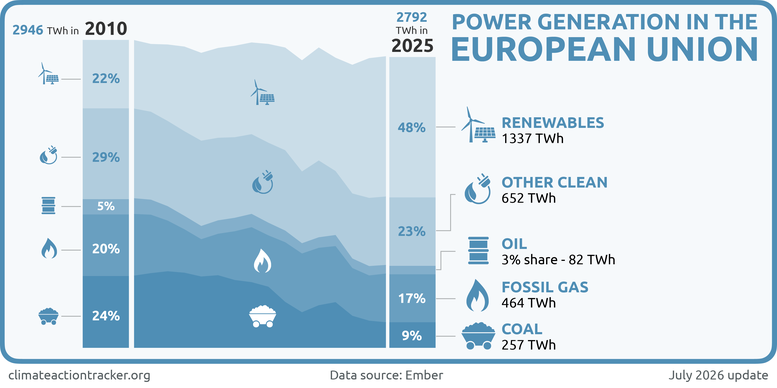
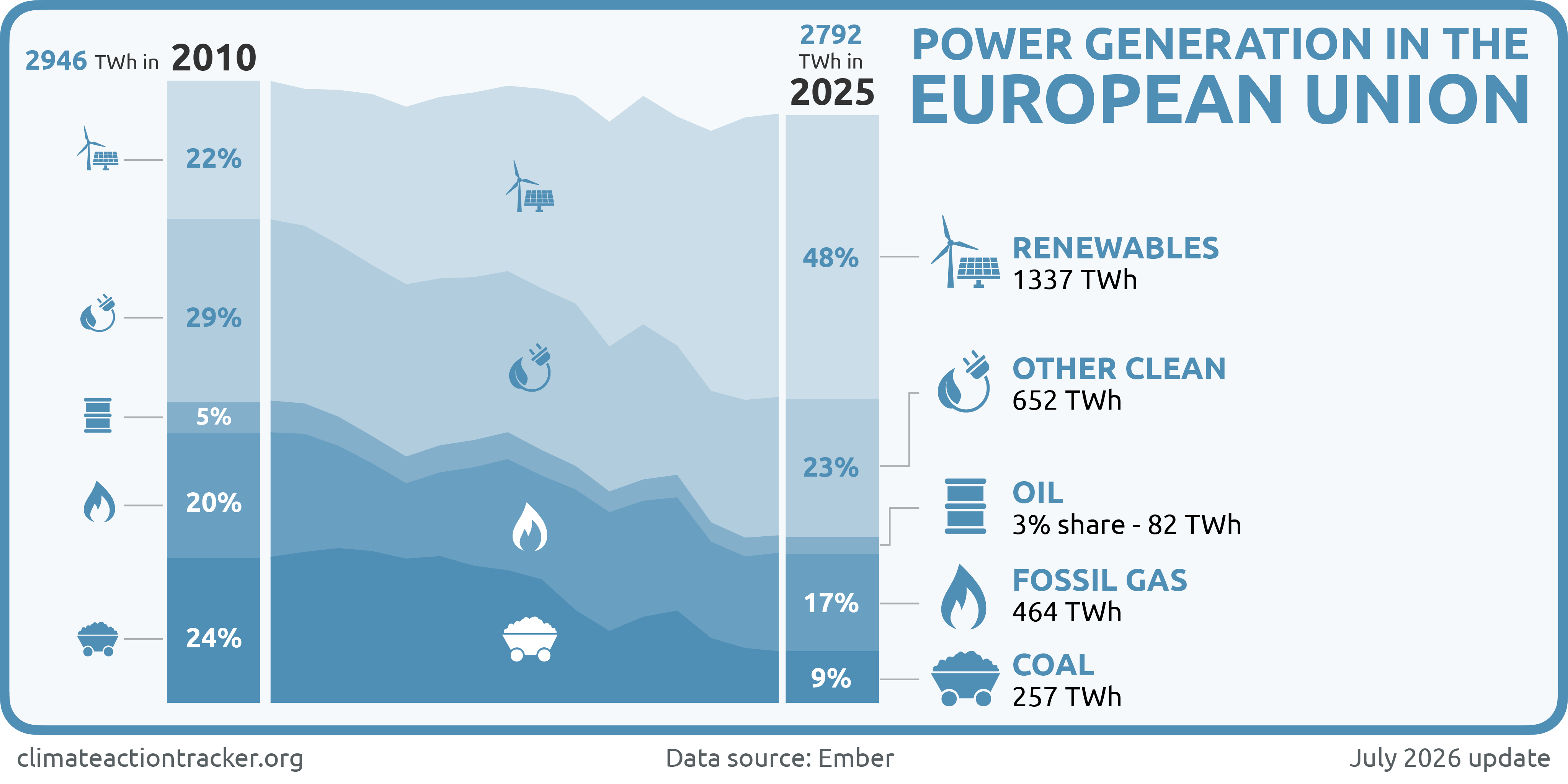
The power sector accounted for around 25% of the EU’s total 2024 GHG emissions (European Environment Agency, 2026). The EU is making progress, albeit slowly, on phasing out coal and ramping up renewables, but fossil gas remains a sticking point. with the EU sending mixed signals around its phase-out. While the share of total electricity generated from renewable sources has increased to 48% (Ember, 2026a) and while wind deployment remains slower than solar, collectively renewables are on-track to meet the EU’s own targets. (ECNO, 2025b).
Complementary to the uptake of renewables in the power sector is developing a modern grid to support electrification. The EU has neglected grid development and is increasingly facing bottlenecks, long connection queues for new renewables, amid rising electricity demand across transport, industry and buildings, and growing renewable curtailment. The high connection taxes have been a major barrier to ensure affordable energy is available for households and business, as highlighted in the 2024 Draghi Report (European Commission, 2024e).
In response, the Commission released its Grids Package, which aims to prepare Europe’s electricity grid for the surge of renewables expected by 2030 and mobilise EUR 584 bn in investment. However, it lacks specific target dates for many of its actions, putting their implementation at risk (Mindekova & Cremona, 2024). This is complemented by the Action Plan for Affordable Energy published in February 2025, which seeks to lower electricity prices through network tariff reform, reduced electricity taxation, faster permitting, and investment in grid expansion, flexibility and digitalisation (European Commission, 2025b).
Coal
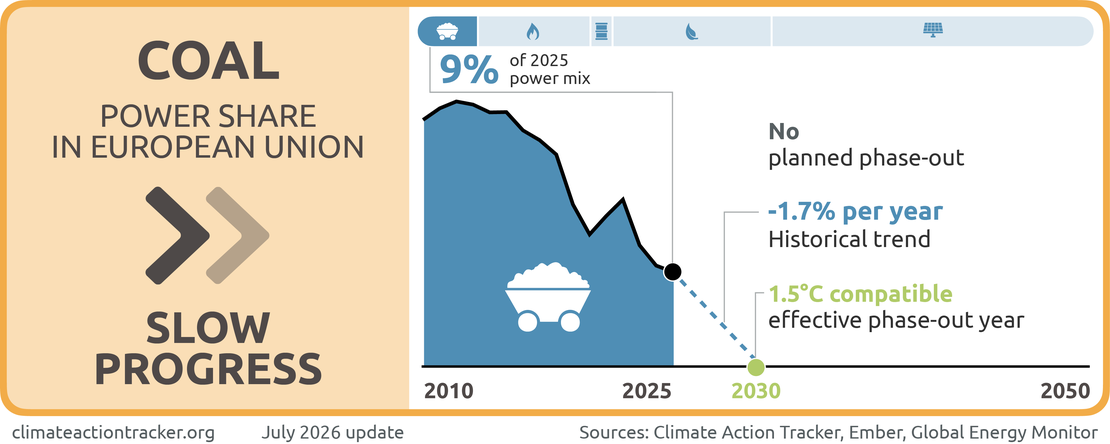
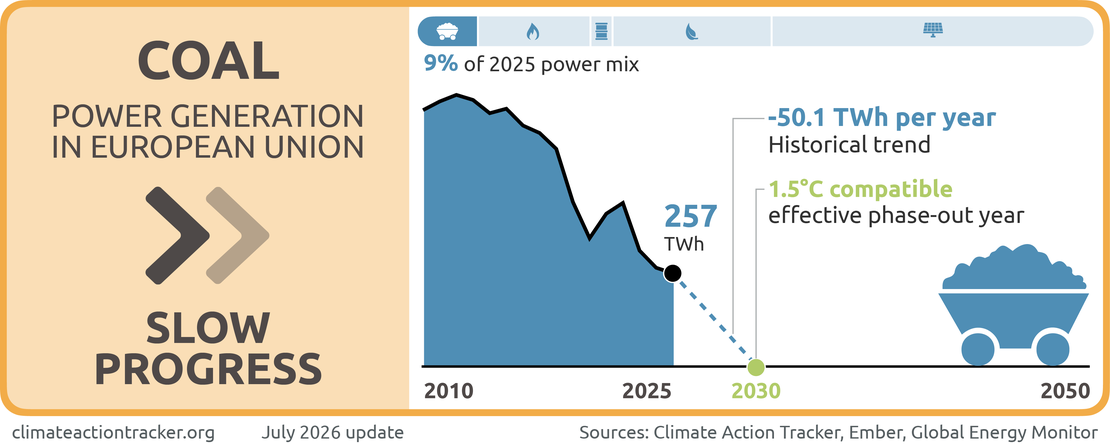
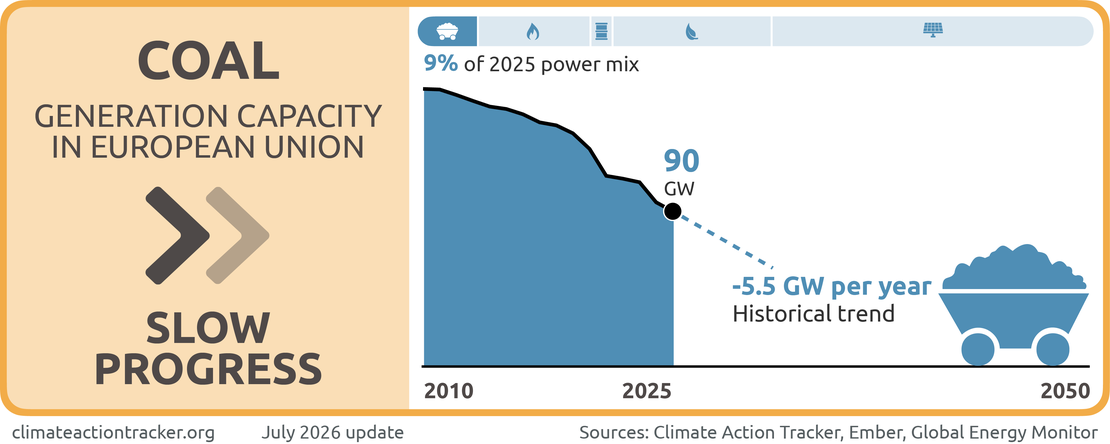
The EU’s share of coal in the power mix has decreased only marginally from 13% in 2020 to 9% in 2025 (Ember, 2026a). Despite this relatively small share in the power mix and having signed up to the coal exit pledge at COP26, the EU has not committed to a coal phase-out date. Given the slow decrease of coal use in the power sector and the lack of a phase-out target, we evaluate the EU as making "Slow progress" on phasing out coal use in the power sector.
Although the EU did not include the coal exit in either its 2023 or 2025 NDC update, a large majority of EU member states either no longer use coal power or have set an exit date before 2030, while a handful still have later dates. As of 2025, 20 EU member states already have no coal in their electricity generation or have coal power phase-out dates prior to 2030, while six countries have a phase-out date beyond 2030 and only one country, Poland, has not committed to phasing out coal entirely. In 2023, France, Italy and Hungary delayed their coal exits but still maintain a deadline before 2030 (Beyond Fossil Fuels, 2025). To be 1.5°C compatible, the EU needs to phase out coal by 2030 at the latest (Climate Action Tracker, 2023).
The EU does not seem to fund coal projects overseas. However, some European investors have investments or shareholdings in coal projects and major coal companies across several non-EU countries including India, China, the US, Indonesia and South Africa, through investment funds classified as “green”, and amounting to around EUR 60 million as of April 2024 (Civillini & Rodriguez, 2024).
The Sustainable Finance Disclosure Regulation (SFDR) was introduced in 2021 to improve transparency and prevent greenwashing, but its Article 8 and Article 9 categories have proven too broad and inconsistent. The Commission’s 2025 revision proposes new investment categories (European Commission, 2025l); with one labelled “Sustainable” being the strictest category requiring a clear sustainability objective, at least 70% Environmental, Social and Governance strategy alignment, and exclusions for coal, oil and gas-related activities (Morrison Foerster, 2025).
Fossil gas
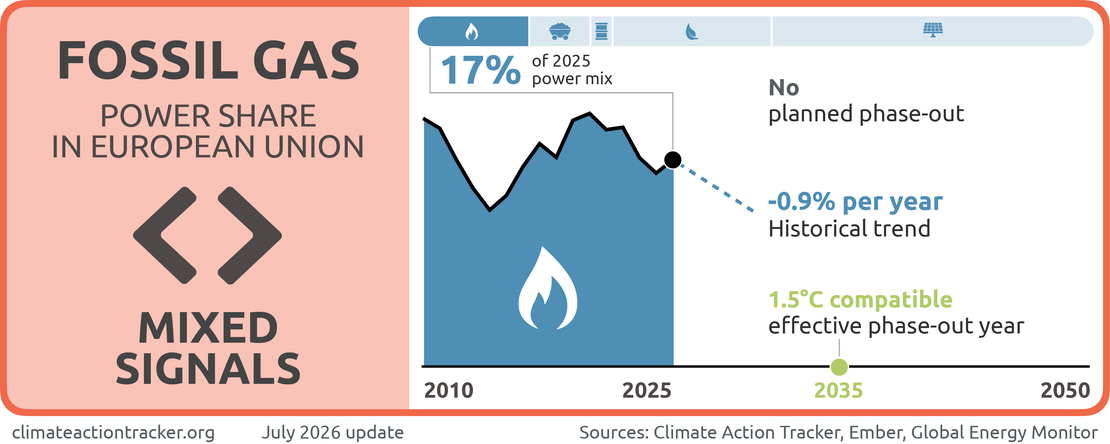
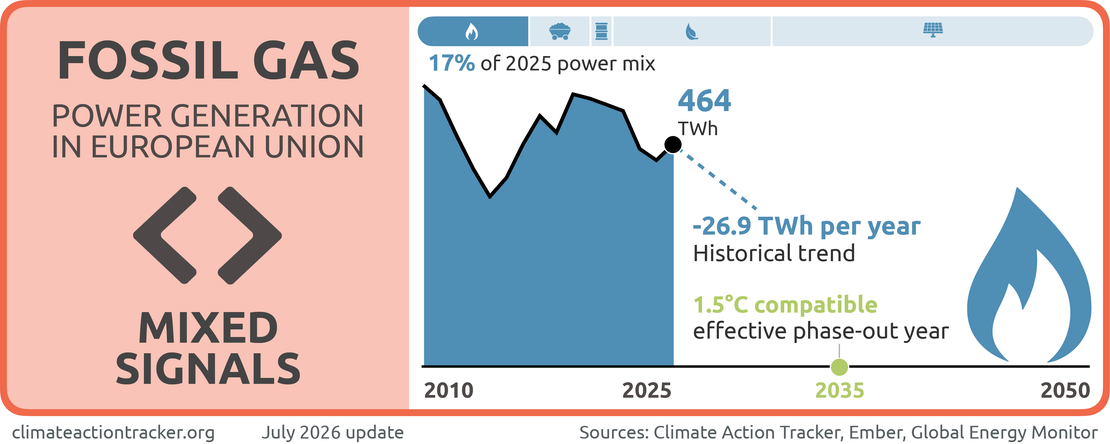
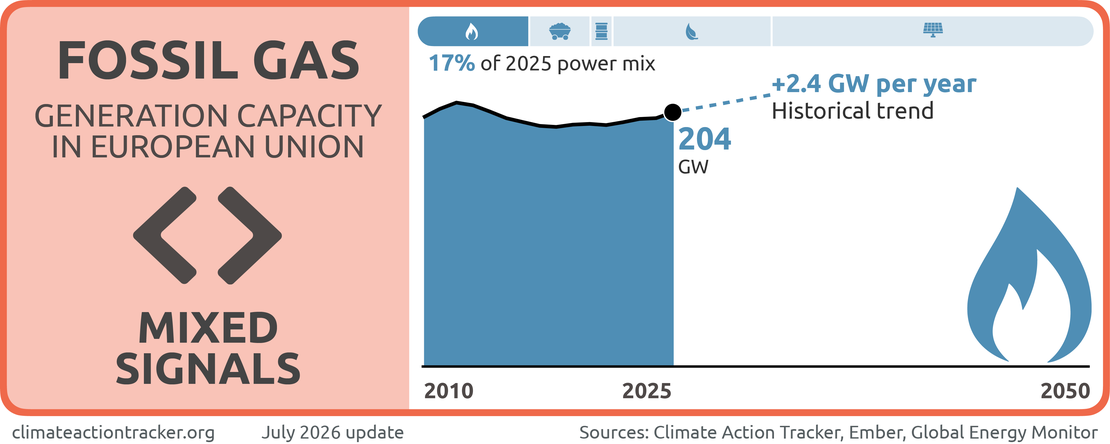
The amount of EU electricity generated with fossil gas has dropped in the last five years, however, it still makes up a sizeable portion of the overall power mix at nearly 17% in 2025 (Ember, 2026a). At the same time, fossil gas generation capacity has grown, reaching 205 GW in 2024. Like coal, the share of fossil gas in the overall EU power mix has decreased minimally over the last five years at just over 1% per year. But rather than setting a clear fossil gas phase-out date, the EU continues to invest in the buildout of LNG terminals and gas pipelines. We evaluate the EU’s progress on gas as sending “Mixed signals.”
CAT analysis shows that the EU’s fossil gas strategy risks carbon lock-in and undermines global climate action. To be 1.5°C compatible, the CAT finds that the EU would need to phase out fossil gas by 2035 (Climate Action Tracker, 2023).
This is the second energy crisis the EU is facing this decade, however, even after the 2022 energy crisis triggered by the Russian invasion of Ukraine, the EU still continued its reliance on gas.
Through its efforts to move away from Russian gas in response to the Russian invasion of Ukraine, the EU and its member states have diversified their fossil gas imports towards other countries in the form of LNG. This has been accompanied by massive investment buildout in LNG terminals and gas pipelines to the tune of EUR 84 bn (Rozansk & Hassan, 2024).
As a result, Europe now has an overcapacity of LNG facilities, risking long-term stranded assets, further exacerbated by the decreasing demand for gas, and forcing consumers to bear the high price of LNG (Jaller-Makarewicz, 2023). This buildout comes as demand for gas in the EU is falling and is projected to continue declining as the switching to renewables and electrification continues to make progress (Hanoteaux & Pastukhova, 2024).
The EU is moving on converting or expanding twelve LNG terminals to import hydrogen derivatives. This could prolong fossil gas reliance, as many projects are tied to existing LNG terminals and lack clear plans for sourcing green hydrogen. Additionally, many projects are still in early stages and lack crucial details, further adding uncertainty to their viability (Rozansky, 2025).
The EU remains overly reliant on imported fossil gas. The US-Israel war on Iran in March 2026 has highlighted the EU’s dependence and reliance on gas – and its vulnerability to price and supply shocks (Jaller-Makarewicz, 2026). It has triggered a rapid shift towards focusing on improving the EU’s energy security but concentrating on home-grown energy sources. Since the start of the war the EU has spent an additional EUR 35 bn on energy imports without getting an additional molecule of fuel (Jørgensen, 2026). This marks an opportunity for the EU to accelerate its shift away from renewables and towards domestically produced renewables.
In October 2025, the EU decided to phase out all imports of Russian fossil gas by 2027 under the REPowerEU plan, thereby ending its reliance on Russian energy (Council of the European Union, 2025c). In parallel to this shift, the EU is strengthening its energy ties with the United States. A new EU–US trade framework includes an estimated USD 750 bn in energy trade (European Commission, 2025j), the majority of which is expected to go towards additional gas purchases.
The diversification away from Russian gas should not serve as an excuse to replace one supplier with another, but rather as a motivation to accelerate the complete phase-out of fossil gas. Long-term fossil gas supply contracts are allowed to run until 2049, weakening the overall transition signal. The gas package was a missed opportunity to introduce a legally binding commitment to phase out fossil gas. Needless to say the current policy direction is still heading in the wrong direction.
Renewables
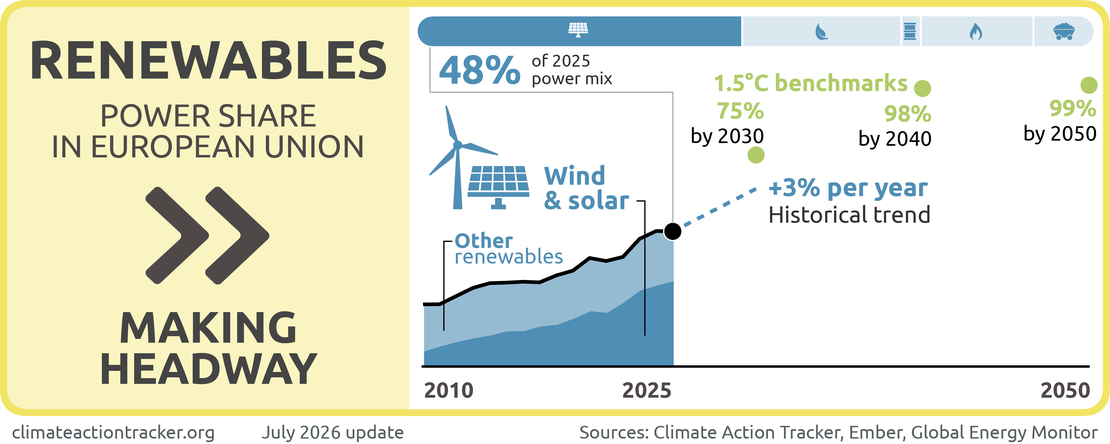
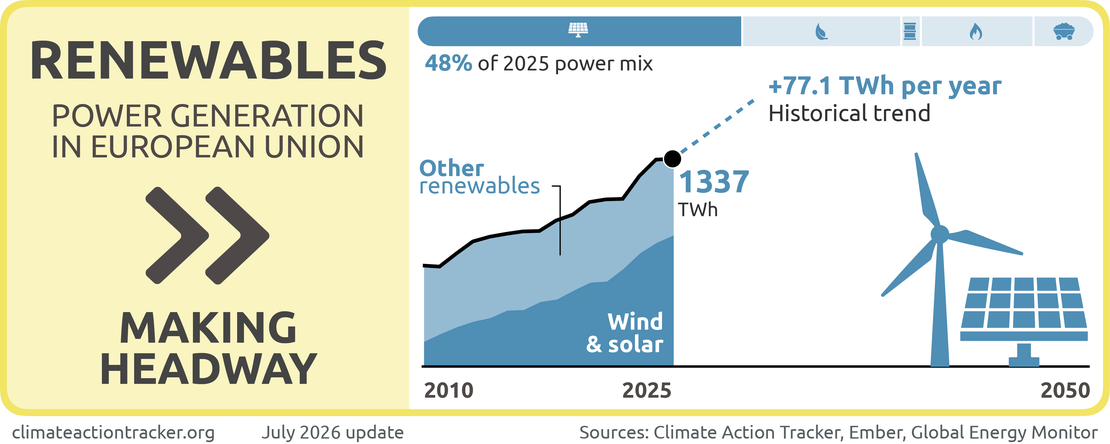
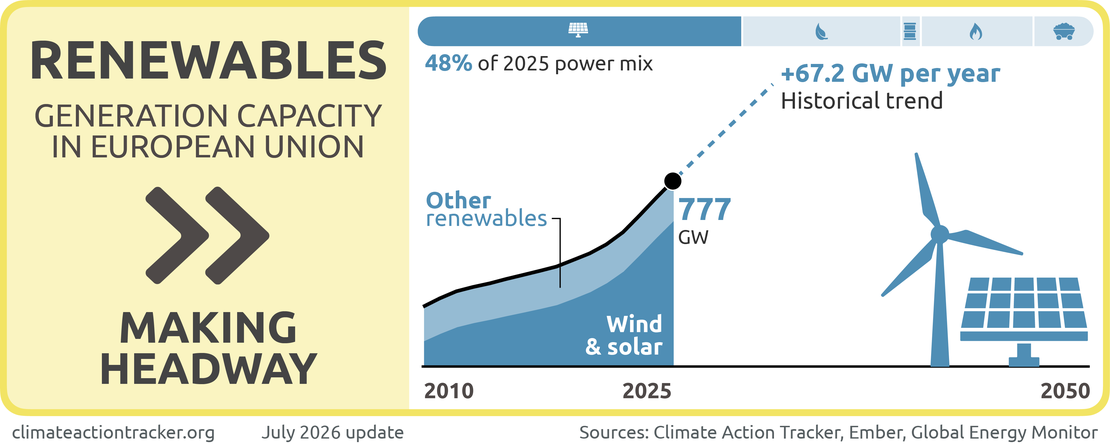
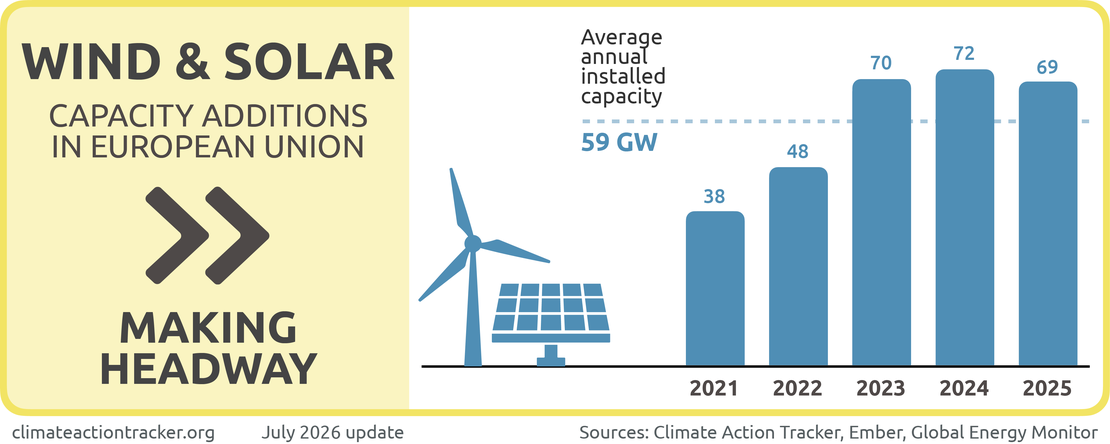
Renewables make up about half of the EU’s power mix, with wind and solar generating about 30% of electricity in 2025 (Ember, 2026a). Other renewables, such as hydro and bioenergy, contributed the remaining 18% to a total of 48%. For the first time, in 2025 wind and solar overtook fossil fuels in EU electricity generation (Ember, 2026b). Although wind and solar generation has been increasing at 2.71% per year over the last five years, it is still increasing at too slow a pace to meet the uptake needed to align with 1.5°C compatible pathways. We evaluate the EU as making “Making headway” on ramping up renewables in the power sector.
Since the EU’s average historical trend for wind and solar has increased to adding over 2.5% per year and the share of renewables in the power mix sits at 48%, the evaluation of the EU’s progress has improved from “Slow progress” to the “Making headway” category under our evaluation. To align with 1.5°C compatible benchmarks, the EU would need to fully decarbonise the power sector by 2035 (Climate Action Tracker, 2023).
The EU has a binding economy-wide target of 42.5–45% renewable energy in final energy consumption, and an indicative target of 45% by 2030, set by the revised Renewable Energy Directive (European Parliament & European Council, 2023a).
Under the REPowerEU package, the Commission has indicated that the EU would need to achieve 69% renewable energy in power generation to achieve its overarching renewable target. Member states outline how they will achieve their share of this target in their updated NECPs. As of December 2025, all but one of the 27 member states, Poland, have submitted their final version (Ember, 2025).
The final updated NECPs bring collective ambition closer to the EU’s 2030 climate target, but still fall slightly short (European Commission, 2025h). Although renewable energy targets have improved, a persistent ambition gap remains, and many plans lack the concrete policies, financing strategies, and enforcement mechanisms needed for delivery. As a result, key shortcomings persist, undermining confidence that member states will fully implement their climate commitments (CAN Europe, 2025a).
Nuclear energy
Nuclear power generated 23% of electricity in the EU in 2025 (Ember, 2026a), but the CAT does not see nuclear energy as a viable long-term solution to the climate crisis. The EU included nuclear energy in the Net-Zero Industry Act (NZIA), recognising it as a "strategic" technology. The NZIA supports nuclear technologies like small modular reactors, highlighting their potential to provide low-carbon energy with minimal waste, crucial for decarbonisation and energy security (European Commission, 2023d).
Although nuclear electricity generation does not emit CO2, the CAT does not see nuclear as a solution to the climate crisis due to its risks, such as nuclear accidents and proliferation, high and increasing costs compared to alternatives such as renewables, long construction times, incompatibility with the flexible supply of electricity from wind and solar and its vulnerability to heat waves.
In March 2026, the European Commission released the Strategy for the development and deployment of Small Modular Reactors (SMRs), which sets out plans to deploy the first SMRs in Europe by the early 2030s. This further signals the EU’s intention to continue to rely on nuclear energy to meet its emission reduction targets (European Commission, 2026b).
Industry
The EU’s industrial emissions, both energy-related and from industrial processes, accounted for about 22% of its total GHG emissions in 2023 (European Environment Agency, 2025). Industrial emissions have been falling, on average, by about 2.3% per year but this is not fast enough. The EU’s industry will need to accelerate this 1.3 times faster than its current trend to reach 1.5°C compatibility (ECNO, 2025a). It could achieve this through faster electrification, energy and operational efficiency, and switching to zero and low emission fuels and heat sources.
The EU has not signed the Beyond Oil and Gas (BOGA) declaration but eight of its member states have. Six member states — Denmark, France, Ireland, Portugal, Spain and Sweden — are core members of the Alliance and have committed to ending oil and fossil gas exploration and development (Beyond Oil and Gas Alliance, 2021).
In July 2026, the Commission released its proposal to revise the EU Emission Trading Scheme (ETS) on the basis of strengthening the EU’s industrial competitiveness (European Commission, 2026b). However, the proposed revisions could weaken the carbon-price signal and delay investment in cleaner industrial processes. Worryingly, the proposal risks locking in emissions-intensive assets and disadvantaging early movers that have already invested in low-carbon technologies.
To decarbonise its industries, the EU introduced indicative targets in the revised Renewable Energy Directive (EU 2023/2413) for the share of renewables in industry. Article 22 requires the industry sectors in member states to increase the share of renewables in their energy mix by an average annual rate of 1.6% between 2021 and 2030. This annual 1.6% indicative benchmark was watered down by the Commission from the initial 1.9% growth rate it estimated it would need to deliver on the REPowerEU objectives (European Commission, 2022a).
The revised Renewable Energy Directive also requires that only 42% of incorporated hydrogen be derived from renewable energy by 2030 and 60% by 2035 (European Parliament & European Council, 2023a). This means that industry can use a mix of renewable and fossil fuel-derived hydrogen. This design will allow industries to start their shift to hydrogen but access cheaper fossil fuel-derived hydrogen until the green hydrogen is affordably available at scale. The EU does not have any provisions to fully eliminate fossil fuel-derived hydrogen from industry beyond 2035, risking the long-term dependence on fossil-derived hydrogen.
Green hydrogen
The Commission’s Hydrogen Strategy states that installed capacity of electrolysers in the EU should reach 40 GW by 2030, resulting in the production of up to 10 million tonnes of green hydrogen, complemented with similar capacity installed in neighbouring countries (European Commission, 2020). The EU hydrogen policy framework has several key gaps hindering market development and does not go far enough to address issues such as high-cost entry barriers and uncertainties.
Renewable hydrogen is also much more expensive than fossil fuel-based hydrogen. Financial support is fragmented, with a shortage of targeted funds necessary to meet the 2030 REPowerEU goals. In 2023, the EU adopted the Delegated Act on Low-carbon Hydrogen, establishing a methodology for defining low-carbon hydrogen (European Commission, 2023c), but challenges remain in ensuring consistent implementation and aligning investment incentives with 2030 targets.
At the same time the EU established the European Hydrogen Bank – a framework to support the financing of hydrogen projects Europe and abroad. In December 2025, the EHB allocated a EUR 3 bn budget, in addition to EUR 2.9 bn in hydrogen investment allocation from the Innovation Fund, totalling EUR 6 bn to be auctioned for projects (Hydrogen Europe, 2025). While the EU has been progressing in providing finance for hydrogen, overall outcomes have been constrained by stringent completion guarantees, regulatory uncertainty, lagging demand, and high competition barriers, despite strong underlying interest and oversubscription.
In 2025, the EU launched the Hydrogen Mechanism to create a transparent, structured marketplace connecting suppliers of renewable and low-carbon hydrogen and derivatives (like ammonia, methanol, and eSAFs) with industrial buyers, supporting infrastructure planning and investment without providing direct funding. This will seek to reduce market uncertainties and facilitate access to financing (IEA, 2025b; Marcus Köttering & Youssef Kassem, 2025).
Developing a net zero technology industry
To tackle replacing industrial technology with cleaner alternatives, the EU has been developing a nexus of polices through its Green Industrial Plan (European Commission, 2023a) and Clean Industrial Deal (European Commission, 2025e) to facilitate the growth of:
(1) its net zero technology industry:
- Net Zero Industry Act (NZIA) (EU) 2024/1735
- Industrial Decarbonisation Accelerator Act (2026): to establish a low-carbon label and set minimum requirements in public procurements for sustainable EU-made low carbon products
- Clean Industrial Deal State Aid Framework (CISAF), and
and
(2) industrial carbon removals:
- Industrial Carbon Management Strategy
- Carbon Removal Certification Framework
The EU has placed a large emphasis on regulating industry to scale up its carbon removal capabilities. Greater emphasis is needed to support industrial decarbonisation by accelerating electrification and switching to zero emission fuels.
One good example of this is the Clean Industrial Deal State Aid Framework (CISAF), providing new guidelines on what projects can qualify for state financial aid from member states to support industrial decarbonisation, uptake of renewables, support for sufficient manufacturing capacity in clean technologies, among others (European Commission, 2025e). This includes technologies covering the grid, hydrogen, heat pumps, energy storage, wind and solar, and CCS, but also covers nuclear technologies and investments into fossil gas.
The CISAF is a major step in the right direction to mobilise financial support towards the green transition, but the inclusion of fossil gas and nuclear technologies is concerning as it continues to lock the EU into fossil fuel dependency and nuclear technology (CAN Europe, 2025b). Already in 2026, the Commission approved a EUR 3 bn request from the German government to support net zero technology manufacturing capacity. However, it has not been made clear as to which technologies are targeted (European Commission, 2026a).
The Electrification Action Plan published in July 2026 (European Commission, 2025f), could be an opportunity for the EU to set strong electrification targets for the region's industry, providing a clear signal where investment needs to be made and to allow for companies to plan their transition in line with 1.5°C compatible transition pathways.
For a detailed assessment on Europe’s net zero technology industry and CCS reliance see the previous CAT EU assessment.
Transport
Transport is the only major sector in the EU where emissions have increased over the last 30 years, accounting for around 27% of total EU GHG emissions in 2023 (European Environment Agency, 2025). It is too early to say whether emissions from this sector have peaked: the trend to bigger vehicles may undermine the impact of increasing EV sales on emission levels.
Progress on EV uptake and zero emission fuel transition
In 2024, electric vehicles, battery electric (BEV) and plug-in hybrid (PHEV), made up 21% of vehicle sales, down from 22% in 2023 (IEA, 2025a) but increased again in 2025 to 27% (IEA, 2026). Following the start of the US-Israel war on Iran, EV sales began surging, with the market share covered by BEVs up 4% in the first quarter of 2026 compared to the same time last year. Worryingly, PHEV and hybrid vehicles have collectively increased by 5% of the market share – meaning the potential to switch to actual zero emission vehicles is being diluted towards hybrids, which still rely on fossil fuels and continue to release emissions (ICCT, 2025c).
To be 1.5°C compatible in line with the Paris Agreement, the CAT finds that the EU would need to achieve 95–100 % sales of light-duty electric vehicle sales by 2030 (Climate Action Tracker, 2024). The EU did not sign the Zero Emissions Vehicle pledge at COP26 and did not include this target in its NDC.
To reach full decarbonisation in the transport sector globally by mid-century, the EU would need to increase the share of zero emission fuels (electricity, hydrogen and biofuels) from 7% in 2019 to 55% by 2030. This covers all modes of domestic transport collectively – road, rail, domestic aviation and maritime travel (Climate Action Tracker, 2024).
Current policy developments
In March 2025, the Commission released the Industrial Action Plan for the Automotive Sector (European Commission, 2025i). While the plan included elements of the EU’s clean mobility agenda, such as expanded charging infrastructure, incentives for zero-emission vehicles, a new battery manufacturing support package, it did not propose the EU’s emissions reduction pathway in the transport sector.
At the same time, the Commission proposed and, later in May, adopted a ‘targeted amendment’ to the CO2 standards for car and van manufacturers, introducing a three-year averaging flexibility for emissions for 2025–2027, instead of a single-year target (European Commission, 2025c). This mechanism effectively delays the 2025 targets, resulting in substantial excess emissions and lower EV uptake, with estimated additional lifetime emissions of 26-51 MtCO2 from new vehicles, and a reduction in battery electric vehicle shares by 4–7 percentage points in 2025, compared with current policy projections (ICCT, 2025b). This is a clear rollback of previously-agreed ambition.
Under the revised CO2 standards regulation, the EU had established a requirement of 100% emission free vehicles by 2035 – a cornerstone of the European Green Deal. However, in late 2025, the EU chose to scrap the 2035 ban, instead allowing for a 90% emission reduction target, with the remaining 10% offset by sourcing green steel in the manufacturing of vehicles and use of biofuels. Car manufacturers will still be allowed to continue manufacturing ICE vehicles beyond 2035 (Euronews, 2025). While 10% sounds little at first sight, it may actually be resulting significant additional emissions, as green steel has to be implemented anyway and therefore would not be additional. Meanwhile, plug-in hybrid EVs, which count towards achieving this target have real-world CO2 emissions that are five times higher than official tests and have been shown to emit as much CO2 as petrol vehicles (Transport & Environment, 2025). PHEVs risk further delaying the full electrification of the transport sector, which current EU policies do not account for.
The weakening of the rules took place after many car manufactures requested the EU to not reopen the 2035 ICE ban which was democratically approved and mandated, and after companies had already started aligning their strategies to it. The decision goes against what the evidence shows is needed to align with 1.5°C compatible pathways.
Following the start of the US-Israel war on Iran, and the subsequent global energy crisis and spiking fuel prices, EV sales surged in the EU since March 2026, up 50% compared to the same time last year (Mealha, 2026). The conflict marks another reason why the need to move away from fossil fuels should be accelerated.
Electric vehicles have a lower total cost of ownership compared with ICE vehicles, since charging is cheaper than refuelling, and electric vehicles don’t require regular maintenance. Therefore, owning an electric vehicle saves money for consumers (Agora Verkehrswende, 2022). This means that EVs are now the more affordable option for households. The EU decision to prolong the sale of ICE vehicles – and therefore the existence of a fossil fuel-based transport system – contradicts the growing demand for affordability.
There are other gaps in EU transport policies still remaining for some regulations. For example, the FuelEU Maritime Regulation (EU) 2023/1805 (European Parliament & European Council, 2023d) and the Alternative Fuel Infrastructure Regulation (EU) 2023/1804 (European Parliament & European Council, 2023c) consider LNG a “low carbon fuel” in shipping. As LNG is a fossil fuel, its prolonged or expanded use will make it difficult to achieve future emission reductions given the long lifetime of ships and infrastructure, resulting in stranded assets.
Buildings
In 2023, buildings accounted for 13% of the EU’s total GHG emissions (European Environment Agency, 2025), representing 40% of the EU’s final energy consumption. The buildings sector has traditionally been heavily reliant on fossil gas and oil. High energy prices have had some impact on consumer behaviour and have spurred policy action in the sector. GHG emissions in buildings have been steadily falling since 1990 but not at a pace fast enough to meet the EU’s target of 218 MtCO2e by 2030 (ECNO, 2025a).
To reach full decarbonisation in the buildings sector by mid-century, the EU would need to reduce the emission intensity (kgCO2/m2) in residential buildings and commercial buildings by 60% and 75% respectively by 2030, compared to 2015 levels. In energy saving terms, the EU would need to reduce the energy intensity (kWh/m2) by 30% and 25%, respectively, by 2030.
Current policy developments
The revised Renewable Energy Directive sets an EU-wide target to achieve 49% share of renewables in buildings' final energy consumption by 2030 (European Parliament & European Council, 2023a). The revised Energy Efficiency Directive (EED) sets a binding target to reduce final energy consumption by 11.7% relative to 2020, or a target of 763 Mtoe of final energy consumption by 2030 across all sectors (European Parliament & European Commission, 2023).
The EED lacks robust measures specifically targeting the buildings sector, focusing instead on general improvements in energy efficiency and renovation rates linked to the Energy Performance of Buildings Directive. Most of the updated NECPs still meet only the minimum EED requirements, lacking the measures needed to align with Paris Agreement compatible limits (CAN Europe, 2025a).
The revised Energy Performance of Buildings Directive (EPBD), adopted in 2024, includes several important measures aimed at achieving a zero emission buildings sector by 2050. One of the most significant changes is the mandate that all new buildings must meet "zero emission" standards by 2030.
While a step in the right direction, the proposal was watered down from the EU Commission's initial plan, which called for binding EU-level minimum energy performance standards. It requires that member states stop subsidising or incentivising the sale of fossil fuel boilers. As of 2025, member states have begun implementing this, but the coverage of the ban varies across countries – with some requiring only new building to comply. The heating market has been shifting towards heat pumps in 2024, which represented 28% of space heating sales in 2024 (EHPA, 2025). It is estimated that the EU will need 60 million heat pump units installed to meet the 2030 climate target. Based on current market trajectory it is expected that 45 million units will be installed, or a 25% implementation gap by 2030 (Uguen & Azau, 2025).
While the EPBD targets a 3.5% annual renovation rate by 2030, which aligns with 1.5oC compatible benchmarks, the EU’s current renovation rate stands at only around 1% annually (ECNO, 2025). The Directive also targets the renovation of 15% of the EU's building stock by 2030, but this is widely regarded as insufficient to meet climate goals (ECNO, 2025a).
The buildings sector will be covered by a new emissions trading scheme (EU ETS II). Instead of starting from 2027 as originally planned, in December 2025 the EU decided to postpone its implementation until 2028 (Pacheco, 2025). The ETS II, which sets the requirement to purchase emission allowances to cover the sale of fossil fuels used in the transport and buildings sectors, will further increase the incentive for home insulation and installation of clean sources of heating. It is seen a crucial tool to meet the goals of the Fit-for-55 by 2030 (Nguyen, 2025).
However, support to vulnerable and low-income groups would be needed to avoid a disproportionate burden of high costs. The Social Climate Fund would be crucial for ensuring financial support for these groups. Delaying the ETS II by a year is expected to shrink the funds by 16% while increasing the initial carbon price, making it costly for consumers. This diminishes the intention of the ETS II’s safeguards for social fairness and credibility (Graichen et al., 2025).
For the summary of the main EPBD targets please see the Buildings section of the previous assessment from November 2024.
Agriculture
Agriculture accounts for 13% of the EU’s total GHG emissions in 2023 (European Environment Agency, 2025). The EU agriculture sector generates about 60% of its emissions from methane, nearly all of which comes from livestock, primarily through enteric fermentation and manure management (Eurostat, 2022). Despite this, methane reduction efforts remain insufficient.
While the EU is a co-initiator of the Global Methane Pledge, aiming to cut global methane emissions by 30% below 2020 levels by 2030, only 11 member states have committed to reducing methane from livestock, covering less than 3% of the EU’s livestock units. Leaked reports indicate the EU is not on track to meet its methane reduction target, signifying the need for stronger measures (Ainger, 2022; Changing Markets, 2022).
The EU also failed to introduce an emissions reduction target for the agricultural sector in the 2040 climate targets agreed to in November 2025. This was in part due to backlash from farmers for added environmental and climate regulation imposed without proper support, leading to widespread protests across Europe in 2024.
Yet at the same time, climate related impacts have resulted in the EU agriculture sector, losing EUR 28 bn annually, and this is expected to increase by 66% by 2050 as climate impacts worsen (European Investment Bank & European Commission, 2025).
In this context, cattle farming was also excluded from revisions to the Industrial and Livestock Rearing Emissions Directive (IED 2.0) made in August 2024, which now applies to large, intensive pig and poultry farms, and requires pollution permits, use of “best available techniques” (BATs), and emissions monitoring, including for ammonia (European Parliament & European Council, 2024a). This was a watering down of the original proposal, which originally included more farms, and cattle farms in particular (Igini, 2024).
In 2025, the EU made some small progress in advancing climate policy affecting agriculture mainly through political recalibration and implementation rather than new specific legislation. The Commission’s Vision for Agriculture and Food (European Commission, 2025a) reframed climate and environmental objectives alongside competitiveness, resilience and reduced administrative burden.
In May, the Commission put forward the CAP simplification package (European Commission, 2025k) introducing greater flexibility in the application of environmental conditionality and controls, followed by a political agreement later in the year supporting adjustments to the existing green architecture. These flexibilities and simplification of CAP conditions in favour of a strong focus on technological solutions risk weakening mitigation outcomes if not accompanied by structural reforms to livestock production and clear methane-reduction pathways. Reliance on offsets, biomethane expansion or external flexibility under the 2040 framework could reduce incentives for domestic emission reductions in agriculture (IATP Europe, 2025a).
With the next Multiannual Financial Framework (MFF) budget negotiations ongoing, the EU has an opportunity to broaden the context of the what the CAP and other funds should focus on, and appropriate further financial support to farmers and rural communities to ensure a fair and just transition. This should focus on efforts to shift away from industrial livestock farming (IATP Europe, 2025b).
In 2026, the EU reached an agreement on the trade deal with the South American Mercosur block after decades of negotiating. The trade deal, which eliminates most custom duties between the EU and Mercosur nations, seeks to increase trade in industrial and agricultural products. The trade agreement is seen to have potentially negative impacts for climate and farmers, because it will not impose the same level of social and environmental standards faced in Europe.
The deal is likely to oblige the EU to contribute to rising global emissions by increasing trade in emission-intensive goods, such as beef. In addition, the agreement’s “rebalancing mechanism” could deter or weaken future EU measures aimed at cutting trade-related emissions (e.g., “mirror measures” that condition market access on production standards), because such measures could trigger claims for compensation or countermeasures (Eckes & Krajewski, 2025).
While it is crucial for the EU to have emission reduction targets and measures for the agricultural sector domestically, it equally needs to ensure the necessary financial and capacity building resources for farmers and local agricultural communities, to support the implementation of decarbonisation policies and to ensure their livelihoods can be maintained.
From 1990 to 2010, the land use, land-use change and forestry sector (LULUCF) constituted an emissions sink averaging around 300 MtCO2e. However, since 2010, the sink has decreased significantly, amounting to around 210 MtCO2e (EEA, 2025b). Forested land cover also continuously fell by about 1.2 million hectares annually between 2016 and 2020 (Climate Analytics, 2025c).
The EU revised its LULUCF regulation in 2023 (European Parliament & European Council, 2023b). It increased its 2030 target to 310 MtCO2e, up from the 225 MtCO2e limit referenced in its Climate Law. The revisions include individual targets for each member state towards the 310 MtCO2e level. Net removals from the LULUCF sector are projected to decline to 160–200 MtCO2e between 2030-2050 (EEA, 2025b), putting the EU off track from achieving its own target.
While increasing forest cover and restoring biodiversity and ecosystems to healthy status is critical to improve the LULUCF sink, with the current rate of decline in forest cover and increasing disturbances from worsening climate-related impacts, it is unlikely that the EU will achieve this target (Springer & Bognar, 2025). Given the uncertainty and observed variability in land sector removals, a prudent approach would be to base LULUCF expectations on 1.5°C compatible projections, equating to 290 MtCO2e by 2030, while treating any over-performance as additional benefit rather than a precondition for meeting economy-wide targets (Climate Analytics, 2025c).
In the impact assessment for the 2040 climate targets, the modelling indicated that the removals from LULUCF in 2040 could amount to somewhere between 215 MtCO2e and 376 MtCO2e with 317 MtCO2e as the central value (European Commission, 2024b).
In the 2040 target proposal released in July 2025, the Commission made no inclusion of a separate LULUCF target (European Commission, 2025m). But in the political agreement reached on the 2040 target reached, the Council recognised that the future of carbon sinks is uncertain due to climate change but takes a worrying approach on how to address it.
If the LULUCF removals fall short of projections, the agreement says that other sectors should not be burdened to cut emissions. If LULUCF removals exceed expectations, the surplus can be used to offset emission in other sectors. This approach is unfair and asymmetric because risk is shifted away from fossil fuel heavy sectors and is used to justified higher emissions and slower action elsewhere (Council of the European Union, 2025b; Graichen et al., 2025).
The EU created the Carbon Removal Certification Framework to create a market for carbon removal projects but this will also have ramifications for emissions in the forestry sector (Carbon Gap, 2025; European Commission, 2022b). Worryingly the CRCF is riddled with concerning elements that could go against climate action. The regulation lacks a distinction between emission reductions and removal, potentially allowing removals to offset emissions that should be reduced. It also risks offsetting and greenwashing through the permitting of sales of carbon credits as offsets in voluntary carbon markets, especially if large emitters are allowed to buy these credits (EEB, 2024).
Waste
Waste sector emissions have continuously fallen since the mid-90s, accounting for 3.7% of total EU GHG emissions in 2023 (European Environment Agency, 2025).
Regulation of waste sector emissions is covered by the Effort Sharing Regulation (ESR), along with those from transport, buildings, and agriculture. Combined, emissions from these sectors needs to decrease by 40% below 2005 levels by 2030 (European Parliament & Council of the European Union, 2023e), in accordance with the European Climate Law.
In 2025, the EU adopted the Revised Waste Framework Directive, with the Extended Producer Responsibility (EPR) schemes for textiles and binding food-waste reduction targets for 2030. The EU will have to reduce food waste by 10% in processing and manufacturing, and by 30% per capita in retail and households by 2030. This represents the first legally binding food-waste targets in EU (European Commission, 2025g).
Methane
In 2022, methane emissions accounted for 11% of the EU’s total GHG emissions. The majority of these emissions came from the agriculture sector, followed by waste management and energy. Methane emissions have fallen by about 60% since 1990 (UNFCCC, 2024).
The EU signed the methane pledge at COP26 in 2021. Methane is covered in the overall scope of the EU’s latest NDC from 2023 but is also specifically mentioned in the context of mitigating methane emissions from maritime transport under the revised EU ETS. In 2020, the EU released its methane reduction strategy laying out its intention to cut emissions from energy, agriculture, and waste.
As part of the strategy, in 2024, the EU adopted the regulation on methane emission reduction in the energy sector (EU) 2024/1787 (European Parliament & European Council, 2024b) covering emissions from oil and fossil gas exploration, production, transmission, distribution, coal mining and imports of fossil fuels.
The regulation introduces new measures to measure, report and verify (MRV) methane emissions, methane abatement measures and a ban on routine venting and flaring. While a step in the right direction, the regulation does not go far enough – starting with the lack of an overarching methane reduction target and prolonged implementation timeline, which does not reflect the urgency and pace needed.
In addition, many exemptions and loopholes diminish the effectiveness of regulation. The regulation excludes the petrochemical sector and LNG consumption. Methane intensive LNG can be expected to grow considerably given the signal that other EU polices are pushing, such as the FuelEU Maritime for LNG fuel in shipping, as well as the build-up of LNG infrastructure over the past few years following the shift away from imported Russian gas (Climate Action Network Europe, 2023).
A recent study finds that LNG exported from the U.S., which the EU is increasingly importing, has an emissions footprint 33% greater than that of coal due to the associated methane leakage (Howarth, 2024). Additionally, agriculture, the largest source of methane is not included but rather is counted under the overall GHG emissions reduction target for member states under the Revised Effort Sharing Directive.
Further analysis





Latest publications




Stay informed
Subscribe to our newsletter