
Australia
2035 NDC
2035 NDC Target
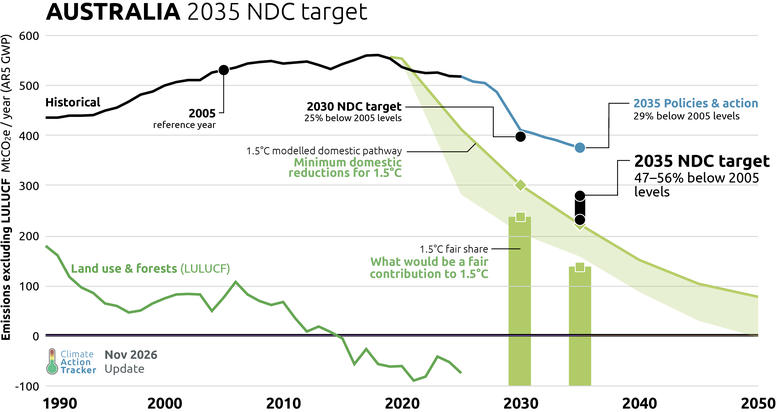
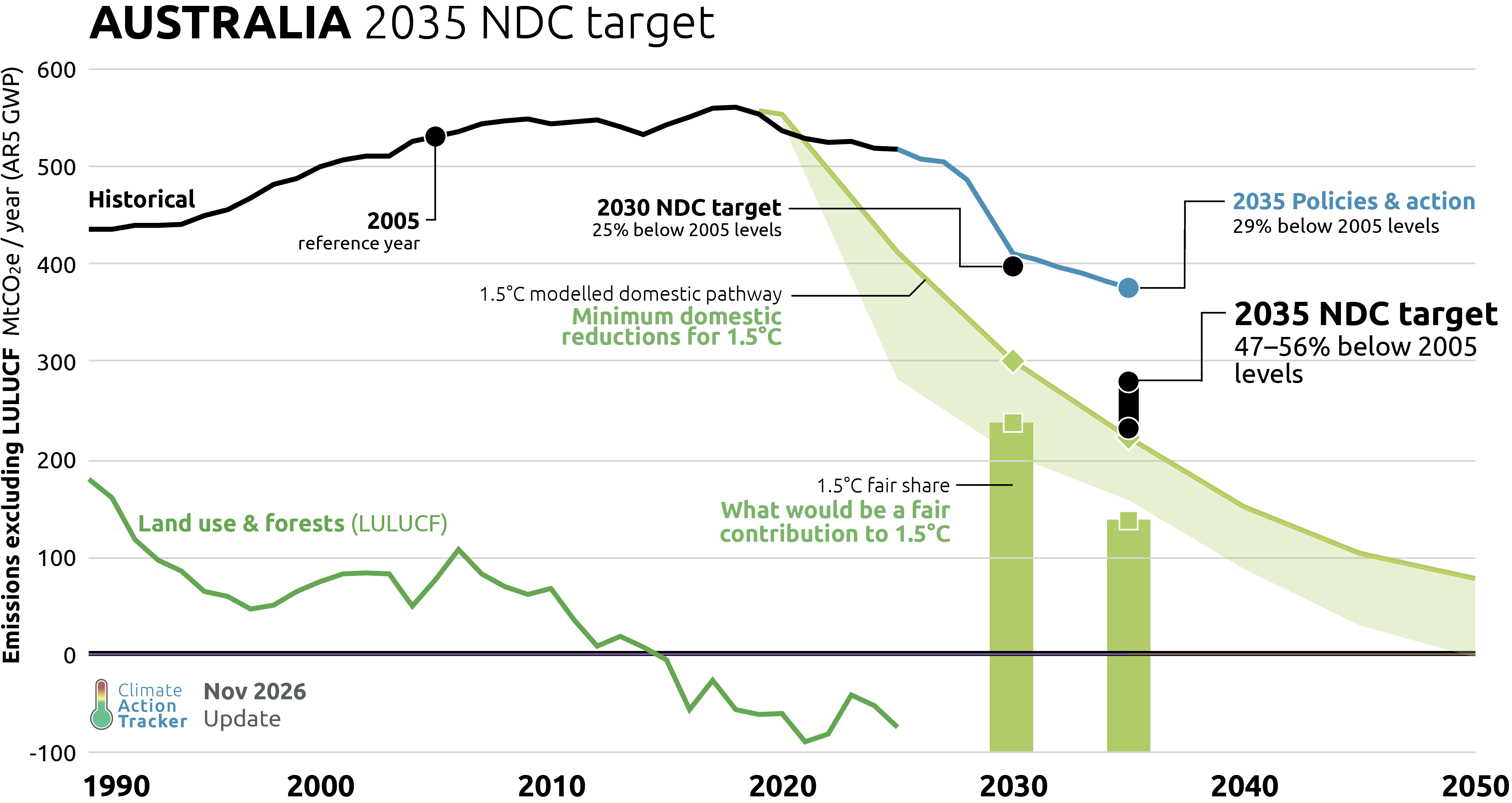
In September 2025, the same week the Australian government released a grim assessment of the huge economic and social risks a warming climate will bring to the country, it announced a new 2035 climate target that is neither 1.5˚C aligned nor supported by sufficient policies to meet it. The government would need to develop policies to bridge the significant gap between its current policy trajectory and the 2035 target. These two announcements came in the wake of the government approving the continuation of a huge LNG fossil gas project through 2070, which will emit 10% more over the period 2025 to 2070 than Australia will emit if it achieves its net zero target by 2050.
Given the current slow pace of renewable energy deployment, it seems unlikely that Australia will meet its 2030 renewable target. With no mention of a 2035 renewable energy target, Australia continues to support fossil fuel projects through massive subsidies totalling at least 1.1% of its GDP. This signals the government’s insufficient political commitment to a comprehensive and accelerated clean energy transition.
Australia’s 2035 NDC pledges a 62–70% reduction target in net emissions below 2005 levels, which translates into a 47–56% reduction in gross emissions (excl. LULUCF) below 2005 levels. It is positive that the new 2035 NDC target narrows the gap in percentage point reduction relative to 2005 between its targets and the 1.5°C modelled domestic pathway, from an 18% gap in 2030, to a 2–11% gap in 2035 (excl. LULUCF). While this represents progress, both Australia's 2030 and 2035 targets still fall short of the reductions needed for 1.5°C compatibility.
The Australian government did not update its 2030 target as part of its 2035 NDC. So, its 2030 target remains the same as what the government submitted in 2022 at a 43% reduction in net emissions below 2005 levels or a 25% reduction in gross emissions (excl. LULUCF) below 2005 levels.
On 18 September 2025, Australia submitted its 2035 NDC, setting a target to reduce net national greenhouse gas emissions by 62–70%, below 2005 net emissions levels, including LULUCF. Based on the latest inventories, this is equivalent to 182–231 MtCO2e, including LULUCF. When excluding the LULUCF sector, Australia’s 2035 NDC target corresponds to 232–280 MtCO2e, a 47–56% reduction below 2005 levels.
To be 1.5°C compatible, Australia would need to limit its emissions from all sectors (excluding LULUCF) to 58% below 2005 by 2035 or to 223 MtCO2e. To achieve its fair share of climate action, Australia would need to reduce its domestic emissions further and/or also provide support equivalent to an additional 16% reduction (excl. LULUCF) abroad through climate finance and other forms of support.
Australia is not on track to meet its 2035 target with its current policies, implying the government needs to put forward significant additional measures to reach a target which is already not ambitious enough. Based on the government’s 2025 emission projections with current policies, Australia to meet its 2030 net target (41% vs 43%) but would largely miss the 2035 net target (46% vs 62–70%). In gross emission terms, the government’s projected effect of current policies would reduce gross emissions by about 29% rather than the 47–56% implied by its target – in other words, some 18–27% above its 2035 target. To bridge the gap, Australia would need to implement more ambitious climate policies and actions.
Less than a week before submitting its 2035 NDC, the government released Australia’s first Climate Risk Assessment, which warned of severe and far-reaching environmental, social and economic consequences from the escalating climate crisis.
Yet, in stark contradiction to this evidence, the government continues to support large-scale fossil fuel production (e.g. the extension approval of the Northwest Shelf LNG project that will run until 2070) and relies on domestic offsets rather than reductions at source in the Safeguard Mechanism in its Industry Sector Plan (Australian Government, 2025e), jeopardising its progress towards achieving its net zero target and casting doubts on its climate ambition.
| Australia | 2035 NDC | |||
|---|---|---|---|---|
| 2030 target | ||||
|---|---|---|---|---|
| Formulation of target in NDC | Has not updated the ambition of its 2030 target, please see the full 2030 NDC assessment. | |||
| Status | Submitted on 16 June 2022 | |||
| 2035 target | ||||
|---|---|---|---|---|
| Formulation of target in NDC | Reduction in net national greenhouse gas emissions of 62–70% below 2005 levels by 2035, implemented as an emissions budget covering the period 2031–35. | |||
|
Absolute emissions level in 2035 excl. LULUCF |
232–280 MtCO2e by 2035 [336–457% below 1990] [457–546% below 2005] |
|||
| Status | Submitted on 18 September 2025 | |||
Ambition
For the world to have a significant chance of limiting warming to 1.5˚C, governments must switch to emergency mode and strengthen both their 2030 targets and current policies to include substantial emissions cuts and significantly contribute to closing the 2030 emissions gap. Australia’s submitted 2035 NDC target did not increase the ambition of its 2030 target.
Further information on Australia's 2030 target can be found here.
2030 NDC target
| 2030 NDC target | ||
|---|---|---|
| Is the target 1.5°C compatible compared to modelled domestic pathways? |
|
|
| Is the target, along with international climate finance and other forms of support, 1.5°C compatible compared to fair share? |
|
|
| Is this a stronger target than previously submitted? |
|
|
2035 NDC target
| 2035 NDC target | ||
|---|---|---|
| Is the target 1.5°C compatible compared to modelled domestic pathways? |
|
|
| Is the target, along with international climate finance and other forms of support, 1.5°C compatible compared to fair share? |
|
|
| Does the NDC include sectoral targets? |
|
|
| Does the NDC include a 2030 and 2035 renewable energy target? |
|
|
Australia commits to reduce its net emissions by 62–70% by 2035 (including LULUCF). This new 2035 target narrows the gap between the target and the 1.5°C modelled domestic pathway in 2035 compared to in 2030 but not sufficiently enough to align with a 1.5°C pathway, as it falls short of the minimum 76% reduction required in net emissions to align with the 1.5°C compatible pathways (Climate Action Tracker, 2025).
Australia’s commitment for 2035 is equivalent to an emissions level of 47–56% below 2005 levels by 2035 when excluding emissions from the LULUCF sector. This leads to 232–280 MtCO2e in 2035 (excl. LULUCF), which is not 1.5°C compatible compared to modelled domestic pathways. To be 1.5°C aligned, Australia would need to reduce its gross emissions to at least 58% below 2005 or to 223 MtCO2e in 2035 (excl. LULUCF). The new 2035 target leads to a smaller gap in percentage point reduction relative to 2005 between the target and the 1.5°C pathway than in 2030, going from a 18% gap in 2030 to a 2–11% gap in 2035. While this represents progress, Australia's 2035 target still falls short of the reductions needed for 1.5°C compatibility. The Australian government did not update its 2030 target as part of its 2035 NDC, despite repeated requests to align with 1.5°C, in particular from the Global Stocktake.
Australia’s fair share of climate action goes beyond what our 1.5°C pathways say it should do domestically. Australia should therefore increase the climate finance it provides to developing countries to facilitate substantial emission reductions internationally and ultimately update this as part of its NDC. To contribute to its fair share of climate action, Australia would need to go beyond a reduction of domestic emissions of at least 58% below 2005 levels (excl. LULUCF) and support emission cuts abroad through climate finance and other forms of support, leading to an equivalent of at least a 74% reduction (excl. LULUCF).
The 2035 NDC refers to existing sectoral policy benchmarks rather than establishing a comprehensive set of quantified 2035 sectoral targets, thus the yellow dash for the question on sectoral targets. The NDC mentioned the renewable target 82% renewable electricity generation by 2030 in its main national grids as a key sectoral target, when accounting for off-grid generation, this reduced to 77%. For the industrial sector, the NDC points to the Safeguard Mechanism, which requires Australia's largest industrial emitting facilities to meet legislated emissions limits called baselines. Covered facilities emitted 136.0 MtCO2e in 2023–24, around 31% of national emissions. Under the reformed mechanism, aggregate Safeguard net emissions are intended to fall from 127.3 MtCO2e in 2023–24 to no more than 100 MtCO2e in 2029-30. According to DCCEEW, the reformed Safeguard Mechanism is expected to deliver more than 200 MtCO2e of cumulative abatement by 2030 relative to the department’s pre-reform business-as-usual projections. However, the Safeguard Mechanism sets rather weak baselines and allows carbon offsets, including Australia carbon credit units (ACCUs) and Safeguard Mechanism credits, to manage excess emissions, significantly weakening its effectiveness in reducing emissions.
While it does not include targets for all sectors, it does mention sectoral plans in energy, industry, transport, buildings, agriculture, and waste sectors. Absence of a comprehensive set of sectoral targets weakens the overall effectiveness of the NDC in driving the meaningful, sectoral emission reductions critical for targeted policy implementation and achieving Australia’s net zero by 2050 goal. Australia has enshrined its 2050 net zero target in law and released a detailed net zero plan that takes into account the new 2035 target. The 2035 NDC also references the enshrined net zero goal many times. However, the plan leaves around 167 MtCO2e of residual emissions to be balanced annually by removals in 2050, implying a heavy reliance on LULUCF sinks and technological CDR, weakening the credibility of the net zero pathway given the scale, permanence and deployment risks associated with these removals.
The absence of a renewable energy target for 2035 undermines the NDC's credibility. The modelling from Australia’s Treasury and Australian Energy Market Operator (AEMO) suggests that a 90% renewable energy generation target by 2035 is feasible under the most likely scenario, but the government decided to maintain its 82% renewable generation target for main national grids by 2030 in its electricity mix (AEMO, 2024; Australian Government, 2025b, 2025c; The Treasury, 2025a, 2025b). We have found that for Australia’s power sector to align with a 1.5°C-compatible pathway, it would need to effectively phase out of fossil fuels by 2035.
Although the Australian Government re-emphasises its commitment to the 2030 through the Rewiring the Nation program and the Capacity Investment Scheme (CIS). The CIS comprises 26 GW of new renewable generation and 14 GW of clean dispatchable capacity by 2030, while small-scale rooftop solar is projected to reach around 37.2 GW by June 2030. The capacity task is therefore substantially larger than the CIS alone and depends on accelerated large-scale renewable construction, storage and timely transmission delivery. While rooftop solar is on track, studies indicate that large-scale deployment is not yet proceeding at the rate required to meet the 82% renewable electricity target.
The key implementation risk of 82% renewable generation target is the current slow pace of deployment. AEMO’s 2026 ISP scenario has flagged that, under delayed delivery of renewable generation, storage and transmission, renewables would reach only 75% of NEM supply by 2030. Alongside continued support for fossil fuel projects, slow electrification in end-use sectors such as transport, buildings and industry, signals a lack of commitment to a comprehensive and accelerated clean energy transition.
| AUSTRALIA | Target summary (excluding LULUCF) |
|---|
| 2030 target: Emissions reduction from 2005 levels (CAT estimates) | |
|---|---|
| Current policies in 2030 | 23% below |
| 2030 NDC target | 25% below |
| 1.5°C fair share | 55% below (to be reached by providing international climate finance and other forms of support to facilitate substantial emission reductions internationally) |
| 1.5°C modelled domestic pathway | 43% below |
| 2035 target: Emissions change from 2005 levels (CAT estimates) | |
|---|---|
| Current policies in 2035 | 29% below |
| 2035 NDC target | 47–56% below |
| 1.5°C fair share | 74% (to be reached by providing international climate finance and other forms of support to facilitate substantial emission reductions internationally) |
| 1.5°C modelled domestic pathway | 58% below |
Fairness & Finance
Developed countries need to significantly scale up international climate finance and other means of support. They should set 1.5°C aligned domestic mitigation targets in their NDCs and communicate the financial and other support they will provide to developing countries. Developing countries should clearly communicate the climate finance they need to set and achieve ambitious 1.5°C aligned conditional targets.
| 2035 NDC target | ||
|---|---|---|
| Does the NDC clearly communicate the level of climate finance contributions and other support to be provided and mobilised for climate mitigation to other countries? |
|
|
Our methodology makes it clear that developed countries should set NDC targets that are at least compatible with their 1.5°C modelled domestic pathways and should meet these targets within their own borders and using their own resources. Australia’s submitted 2035 NDC is not 1.5°C compatible compared to modelled domestic pathways.
Developed countries are also expected to complement their ambitious domestic mitigation efforts with significant financial support for mitigation in developing countries.
While Australia has communicated that it is on track to provide over $3 billion towards global climate finance over 2020–2025 and set a goal in 2023 that 80% of new bilateral and regional investments valued at over $3 million must have a climate change objective by 2028–2029, Australia still needs to commit to an ambitious, post-2035 climate finance goal, as the current level of climate finance is “Critically Insufficient” according to our analysis. For more detail, see the Targets section here.
Credibility
Credible NDCs should build on robust national planning processes that translate the economy-wide emissions reduction target into action in all sectors. Governments need to ramp up the implementation of their existing targets and further develop policies to close the – still significant – emissions gap between current policies and the 1.5°C pathway. Contradictory policies must be addressed and reversed: fossil fuel production needs to be phased out, while fossil fuel exploration and fossil fuel subsidies need to stop.
| 2035 NDC target | ||
|---|---|---|
| Is the target driving more ambitious action? |
|
|
| Is there a policy framework in place to meet the target? |
|
|
| Does the NDC reference national planning processes for its development? |
|
|
| Does the NDC reference an institutional framework/plan in place for its implementation? |
|
|
| Does the NDC commit to phase out fossil fuel production? |
|
|
| Does the NDC commit to stop fossil fuel exploration & subsidies? |
|
|
Australia’s 2035 target would not be achieved under its current policies. Under the CAT’s current policy projections,Australia’s emissions are projected to be 29% below 2005 levels by 2035 (excl. LULUCF), while its 2035 target aims to reduce emissions by 47–56% below 2005 (excl. LULUCF).
To close this gap, Australia will need to introduce far more ambitious and immediate climate measures, rather than relying on incremental adjustments. This would include not only enhancing the pace of renewable energy deployment but also revisiting key sectors like industry, transport, and energy to drive deeper emissions reductions. Without substantial policy shifts and enhanced climate action, Australia will fall short of its climate goals for both 2030 and 2035.
Australia has a well-established planning process and implementation plans, including legislating its 2030 target and the requirements to monitor the progress towards the targets, consider expert independent advice on the five-yearly targets, and conduct public consultation. At the centre of this framework is the Climate Change Authority (CCA), an independent consultation body, tasked with advising the government on target setting and pathways consistent with the Paris Agreement. In an interim report in 2024, the CCA suggested a 65–75% emissions reduction was achievable by 2035, but their final recommendation is what the government adopted (CCA, 2024, 2025).
The 2035 NDC does not commit to phase out fossil fuel production or even just end new fossil fuel development. The 2023 Global Stocktake (GST) calls on Parties to transition away from fossil fuels in a just, orderly and equitable manner (UNFCCC, 2023).
On the contrary, the government has approved the extension of Woodside’s North West Shelf LNG project, which also contradicts the recent International Court of Justice (ICJ)’s advisory opinion on the obligations of states to align their policies and actions with the Paris Agreement's 1.5°C limit (International Court of Justice, 2025). The ICJ ruled that States have a legal obligation to protect the environment and limit greenhouse gas emissions – breaching this responsibility may incur legal consequences. The UN has now adopted a resolution supporting the ICJ resolution, which Australia voted for.
Transparency
Governments should set absolute, economy-wide, emissions reduction pathways including all GHG gases, specifying the emissions levels for each year as an absolute level of gross emissions (excluding LULUCF). This level of clarity and transparency will ensure that their reduction targets are immune to creative accounting. NDC targets should primarily focus on their domestic reductions by decarbonising all sectors of the economy rather than relying on forestry sinks, other carbon dioxide removal (CDR) or international carbon markets.
| 2035 NDC target | ||
|---|---|---|
| Is the target based on a fixed base year or is it a fixed absolute value? |
|
|
| Does the target cover all sectors? |
|
|
| Does the target cover all greenhouse gases? |
|
|
| Does the target specify an emissions pathway? |
|
|
| Does the target separate out land use and forestry? |
|
|
| Does the target separate out the use of carbon credits under Article 6? |
* |
|
*At this time the Australian government does not intend to use carbon credits under Article 6, but if it does decide to use them it will report them in its Biennial Transparency report.
Australia’s 2035 target is framed as a percentage reduction below a net historical base year. By including the contributions from land use and forestry or other CO2 removal methods without a separate target for gross emissions (that exclude the contribution from the LULUCF sector), the Australian government misses an opportunity to provide clarity on the emission reductions to be achieved by cutting fossil fuels production and consumption. This is particularly problematic as the government has, since 2018, made many revisions to its LULUCF sector emissions, both historical and projected, that have obscured the lack of progress across the rest of the economy.
The target is framed also as a multi-year budget for 2031–2035 and covers all sectors and all major greenhouse gases. For the implementation of the 2035 reduction target, Australia refers to a system of five-year period emission budgets, a Net Zero Plan, and six sector emissions reduction plans to reach its target (Australian Government, 2025b).
In its 2035 NDC, Australia specifies that it does not intend to use market mechanisms or non-market mechanisms of Article 6 of the Paris Agreement to achieve its target. However, its NDC also indicates that should the situation change, Australia would adjust accordingly, opening a door for potential use of Article 6. The CAT’s latest briefing on Article 6 cautions against buying international carbon credits to delay or avoid investing in domestic mitigation, especially when developing high-quality, verifiable offset projects remains extremely difficult.
The attainment of Australia’s 2030 and 2035 targets, though, relies heavily on domestic offsets. The reformed Safeguard Mechanism, one of the government’s flagship climate reforms, assigns large industrial facilities net emissions allocations that decrease year on year. Because those allocations are for net emissions, companies can purchase offsets to meet their legal requirement under the Safeguard Mechanism instead of conducting on-site emissions abatement and therefore tackling their gross emissions.
Offsets are not an alternative to emission reductions. Scientific evidence has raised serious doubts about the environmental integrity of Australian Carbon Credit Units. Several studies have found that many offsetting projects that generate ACCUs do not result in actual emissions abatement, for example, by crediting human-induced regeneration projects that, in fact, saw a decline in forest cover (Macintosh et al., 2024).
The Safeguard Mechanism’s current structure, coupled with the low prices of Australian Carbon Credit Units, makes the gross emission reductions deliverable under the mechanism uncertain. There is a risk that Safeguard emissions, around half of which come from coal mines, LNG facilities and other fossil fuel projects, remain stable, rather than reducing them as per its stated purpose (for more details, please refer to the Policies & Action tab here).
For more information on Australia’s climate targets and policies, please click here. For the CAT’s full recommendations for setting NDC targets that form the basis of the analysis above, please click here.
Further analysis





Latest publications




Stay informed
Subscribe to our newsletter