EU
2035 NDC
2035 NDC Target
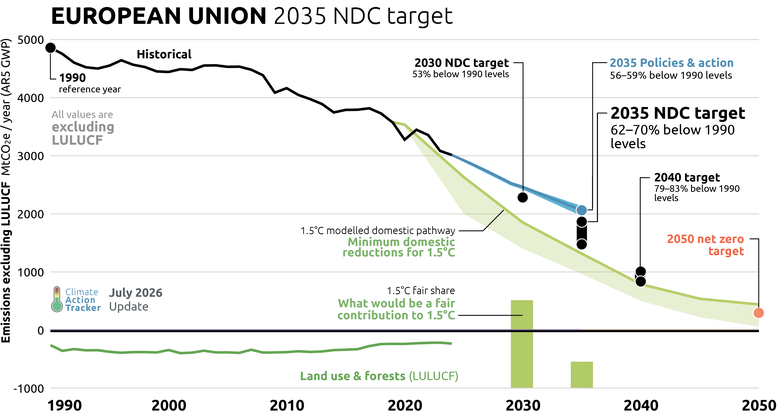
The European Union's 2035 target is neither 1.5˚C aligned, nor does it meet the EU's fair share to fight climate change. The target slows the EU's emissions reduction rate after 2030. The 2040 target has unfortunately been significantly watered down from the EU Commissions original recommendations: the net reduction weakening from 90% net reduction below 1990 to 85%, adding the use of international carbon credits, reducing domestic action. The EU has not committed to a fossil fuel phase-out, has no sectoral targets in the NDC, and its climate finance is deficient.
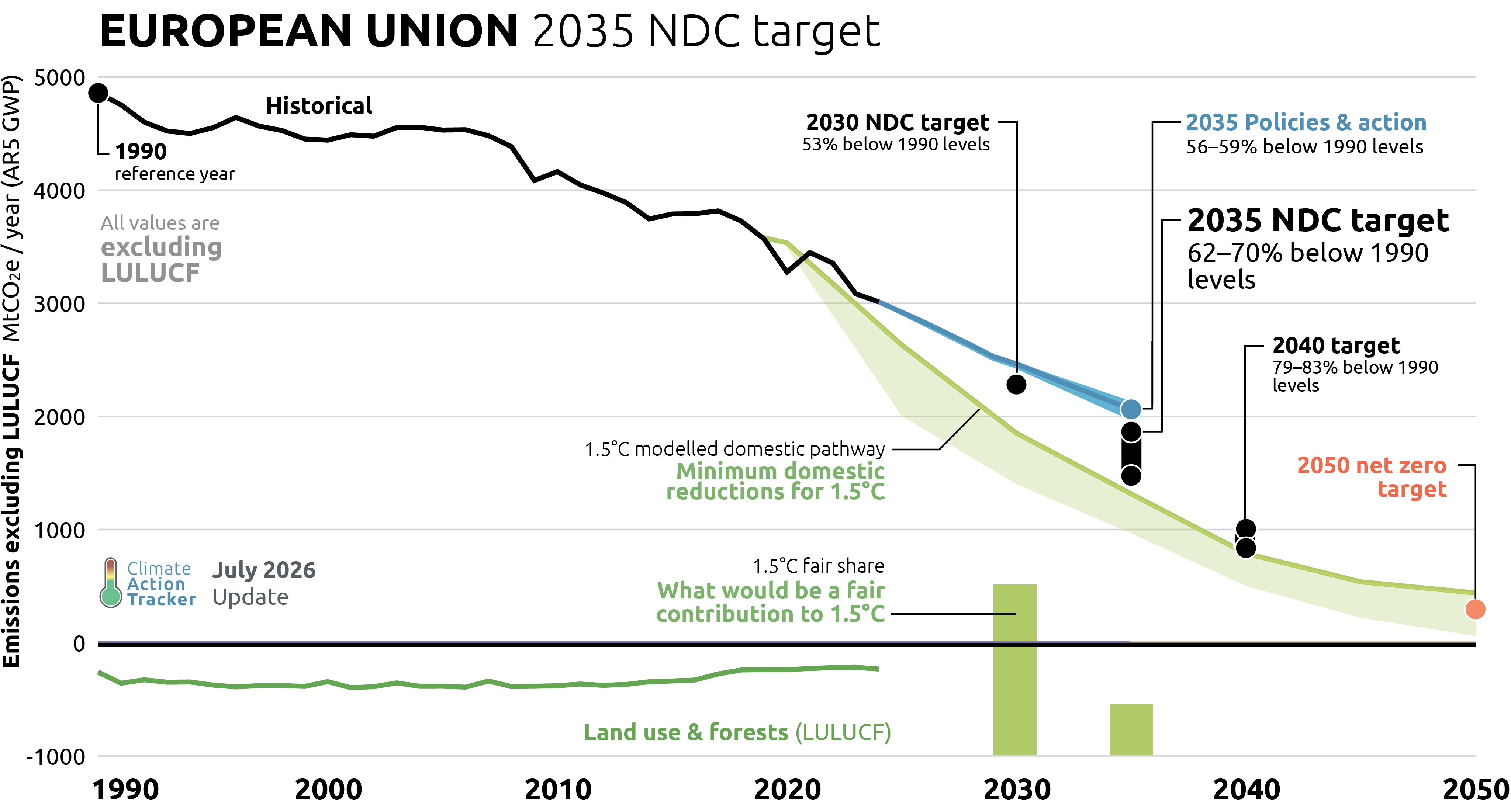
The EU submitted a 2035 NDC target just ahead of COP30 in late 2025, aiming to reduce emissions by 66.25–72.5% below 1990 levels (incl. LULUCF). The less ambitious end of the target would see the EU reduce emissions between 2030-35 at a slower rate than what it has planned between now and 2030, further widening the ambition gap compared to the 2030 target.
The Climate Action Tracker finds that to align with 1.5°C compatible modelled domestic pathways, the EU would need to set a 2035 target of at least 77% (incl. LULUCF) reduction from 1990 levels, alongside a 2040 target of at least 90%, and ideally 95% (incl. LULUCF) below 1990 levels, and to achieve these reductions within its own borders, as recommended by the EU’s own scientific advisory board back in 2023. While the 2035 target range is broadly consistent with the EU’s long-term net-zero pathway, it remains far from 1.5° compatibility.
The EU did not strengthen its 2030 NDC target of 55% reduction below 1990 levels (incl. LULUCF), which is rated "Insufficient" according to the CAT.
Coupled with the 2035 NDC is the 2040 climate target proposal endorsed by EU member states, which has been significantly watered down from the European Commission's original recommendations in February 2024. Instead of a 90% net reduction below 1990 domestically, the 2040 target would now see the EU committing to a net reduction of 85% domestically, with the use of international carbon credits accounting for up to another 5% points of 1990 emissions. This essentially means the EU would be allowing itself to emit 50% more emissions in 2040 by purchasing carbon credits from abroad. The 2040 target still needs to be officially adopted in law following final negotiations between EU institutions.
While the EU maintains a separate LULUCF target of 310 MtCO2 by 2030 (of which 225 MtCO2 can be counted towards the target), it has not provided any LULUCF targets for 2035, nor 2040. The lack of separate LULUCF targets means that it is impossible to know the level to which the EU plans to rely on land sinks, effectively reducing the pressure on member states to reduce emissions across the other sectors of their economies. At the same time, due to climate related impacts, the EU’s land sink is expected to shrink in the future (Climate Analytics, 2025a; EEA, 2024).
With the submitted 2035 target range, the gap between the EU’s targets and a 1.5°C aligned pathway compared to its fair share has grown in comparison with the 2030 target, which again signals a weakening rather than a strengthening of ambition. The EU needs to scale up its climate commitments both domestically and in terms of climate finance for both 2030 and 2035 to ensure alignment with a 1.5°C compatible pathway.
The EU's 2035 NDC would lead to emissions below current policies, meaning that existing measures fall short to achieve an already unambitious target. This highlights the need for near-term action to align policies with the target.
The EU’s submitted 2035 NDC target did not increase the ambition of its 2030 mitigation target. A failure to substantially increase the ambition of the EU’s 2030 targets and action would mean limiting peak global warming to 1.5°C will be more difficult, and deeper and more rapid emission reduction targets will be required elsewhere, which will likely lead to a multi-decadal, high overshoot of the limit, even if followed by strong 2035 targets. The EU has signalled that it does not intend to re-open its 2030 GHG target.
| EU | 2035 NDC | |||
|---|---|---|---|---|
| 2030 target | ||||
|---|---|---|---|---|
| Formulation of target in NDC | Has not updated the ambition of its 2030 target, please see full 2030 NDC assessment for details. | |||
| Status | Submitted on 19 October 2023 | |||
| 2035 target | ||||
|---|---|---|---|---|
| Formulation of target in NDC | A reduction of net GHG emissions of between 66.25-72.5% below 1990 levels by 2035 [incl. LULUCF] | |||
|
Absolute emissions level in 2035 excl. LULUCF |
1476–1866 MtCO2e (61–70% below 1990) (55–64% below 2010) |
|||
| Status | Submitted on 5 November 2025 | |||
Ambition
For the world to have a significant chance of limiting warming to 1.5˚C, governments must switch to emergency mode and strengthen both their 2030 targets and current policies to include substantial emissions cuts and significantly contribute to closing the 2030 emissions gap. The EU’s submitted 2035 NDC did not increase the ambition of its 2030 target.
Further information on the EU’s 2030 target can be found here.
2030 NDC target
| 2030 unconditional NDC target | ||
|---|---|---|
| Is the target and international climate finance and other forms of support 1.5°C compatible compared to fair share? |
|
|
| Is the target 1.5°C compatible compared to modelled domestic pathways? |
|
|
| Is this a stronger target than previously submitted? |
|
|
2035 NDC target
| 2035 NDC target | ||
|---|---|---|
| Is the target and international climate finance and other forms of support 1.5°C compatible compared to fair share? |
|
|
| Is the target 1.5°C compatible compared to modelled domestic pathways? |
|
|
| Does the NDC include sectoral targets? |
|
|
| Does the NDC include a renewable energy capacity target? |
|
|
The CAT rates the EU’s NDC 2030 target, which remains unchanged at a 55% reduction below 1990 levels (incl. LULUCF), is rated "Almost Sufficient". To be 1.5°C compatible, the EU would need to set an emissions reduction target of at least 65% (incl. LULUCF) below 1990 levels by 2030.
The EU’s 2035 NDC target range is neither 1.5°C aligned, nor does it meet the EU’s fair share effort to fight climate change. The less ambitious end of the target range would widen the ambition gap compared to 2030, taking the EU even further away from a 1.5°C-compatible trajectory. This lower ambition is coupled with the 2040 target proposal which has been watered down from the EU Commission’s original recommendations. Instead of a 90% domestic reduction below 1990, the 2040 proposed target sets an 85% domestic reduction and allows the remaining 5% to be met with the use of international carbon credits.
The EU submitted its 2035 NDC mitigation target on 5 November 2025, setting a 2035 target of reducing net GHG emissions by between 66.25–72.5% below 1990. This target covers all sectors and all gases. The CAT excludes emissions from land use, land use change and forestry (LULUCF) from this target, resulting in 1476–1866 MtCO2e in 2035 or 62–70% below 1990 levels.
The submitted NDC is not 1.5°C compatible compared to modelled domestic pathways because it is above the 1.5°C compatible threshold of 1316 MtCO2e, excluding LULUCF. To be 1.5°C compatible, the EU would need to reduce its emissions by 73% below 1990 (excl. LULUCF) or, in terms of net emissions, to at least 76% below 1990 levels (incl. LULUCF).
To contribute to its fair share of climate action, the EU would need to further reduce its domestic emissions and support emission cuts abroad through climate finance and other forms of support, equivalent to a total of at least a 111% reduction from 1990 levels (excl. LULUCF) by 2035.
The 2035 NDC target does not include sector-specific emissions reduction targets for major emitting sectors, but it refers to sector-specific plans and targets adopted under existing EU legislation. These include renewable hydrogen requirements for industry, renewable energy share obligations in buildings, sub-targets for transport fuels, and CO2 standards for road transport mandating 100% zero-emission new cars and vans in 2035 (which has since been weakened, see transport policies above). However, these do not constitute sectoral emission reduction targets within the NDC.
The EU’s sectoral plans and targets link to parts of the Global Stocktake (GST) agenda through measures to increase renewable energy shares, reduce methane emissions, increase energy efficiency and accelerate decarbonisation. Yet, the NDC does not include a target for tripling renewable energy capacity, nor does it provide a clear commitment to phasing out fossil fuels or ending deforestation by 2030.
Further information on the EU’s targets can be found here.
| EU | Target summary (excluding LULUCF) |
|---|
| 2030 target: Emissions reductions from 1990 levels (CAT estimates) | |
|---|---|
| Current policies in 2030 | 48–50% |
| 2030 NDC target | 53% |
| 1.5°C fair share |
89% [62% + 27% to be reached by providing international climate finance and other forms of support to facilitate substantial emission reductions internationally] |
| 1.5°C modelled domestic pathway | 62% |
| 2035 target: Emissions reductions from 1990 levels (CAT estimates) | |
|---|---|
| Current policies in 2035 | 56–59% |
| 2035 NDC target | 62–70% |
| 1.5°C fair share |
111%1 [73% + 38% to be reached by providing international climate finance and other forms of support to facilitate substantial emission reductions internationally] |
| 1.5°C modelled domestic pathway | 73% |
1 We have expressed the fair share contribution in these emissions reduction terms to convey the scale of support that’s needed, but acknowledge that physical reductions of that scale would not be feasible within the EU in these time frames. In practical terms, this means that the EU could do more than the modelled domestic pathway levels indicated above for domestic reductions, but most of the effort would need to come from support the EU provides internationally.
Fairness & Finance
Developed countries need to significantly scale up international climate finance and other means of support. They should set 1.5°C aligned domestic mitigation targets in their NDCs and communicate the financial and other support they will provide to developing countries. Developing countries should clearly communicate the climate finance they need to set and achieve ambitious 1.5°C aligned conditional targets.
| 2035 NDC target | ||
|---|---|---|
| Does the NDC clearly communicate the climate finance contributions and other support to be provided and mobilised to other countries? |
|
|
Our methodology makes it clear that developed countries should set NDC targets that are at least compatible with their 1.5°C modelled domestic pathways, and should meet these targets within their own borders and using their own resources. The EU’s submitted 2035 NDC is not 1.5°C compatible compared to modelled domestic pathways.
Developed countries are also expected to complement their ambitious domestic mitigation efforts with significant financial support for mitigation in developing countries.
The EU has communicated that it intends to contribute towards achieving the new global climate finance goal (NCQG) of at least USD 300 billion annually by 2035. However, it has not communicated an indicative level of its planned contributions beyond 2025. Given the scale of the NCQG and the EU’s role as the largest provider of climate finance, the absence of a quantified contribution leaves uncertainty about whether its future support will meet the increased level required.
Credibility
Credible NDCs should build on robust national planning processes that translate the economy-wide emissions reduction target into action in all sectors. Governments need to ramp up the implementation of their existing targets and further develop policies to close the – still significant – emissions gap between current policies and the 1.5°C pathway. Contradictory policies must be addressed and reversed: fossil fuel production needs to be phased out, while fossil fuel exploration and fossil fuel subsidies need to stop.
| 2035 NDC target | ||
|---|---|---|
| Is the target driving more ambitious action? |
|
|
| Is there a policy framework in place to meet the target? |
|
|
| Does the NDC reference national planning processes for its development? |
|
|
| Does the NDC reference an institutional framework/plan in place for its implementation? |
|
|
| Does the target commit to phase out fossil fuel production? |
|
|
| Does the NDC commit to stop fossil fuel exploration & subsidies? |
|
|
The EU’s 2035 NDC does not set a clear commitment to phase out fossil fuels however has set more ambitious action in 2035 compared to the EU’s current policy projections. The EU has a limited policy framework in place beyond 2030 but is currently negotiating its post-2030 framework.
Along with opting for weaker targets, the EU has also been chipping away at some existing climate policies and measures. EU member states have now sought to delay the start of the EU ETS II by a year - from 2027 to 2028. Earlier this year, the Commission also opted to delay the CO2 standards target for vehicle manufacturers by two years, from 2025 to 2027, a change expected to effectively add 26–51 MtCO2 emissions to the atmosphere. These adjustments, together with the watered-down 2040 target, continue to delay the pace of emission reductions needed to limit overshooting 1.5°C.
The EU is clearly not committed to phasing out fossil fuels. Although it intends to end fossil gas imports from Russia, it continues to pursue further LNG arrangements, notably through a EUR 700 bn trade deal signed with the US in 2025. This would effectively replace rather than phase out fossil gas. Neither has the EU committed to a full coal phase-out, instead seeking only to "phase down" coal, "striving to" achieve this before 2030. Several EU member states still have coal phase-out dates beyond 2030 (e.g. Germany) or in the case of Poland, have not set a date at all.
Transparency
Governments should set absolute, economy-wide, emissions reduction pathways including all GHG gases, specifying the emissions levels for each year as an absolute level of gross emissions (excluding LULUCF). This level of transparency will ensure that their reduction targets are immune to creative accounting. NDC targets should primarily focus on their domestic reductions by decarbonising all sectors of the economy rather than relying on forestry sinks, other carbon dioxide removal (CDR) or international carbon markets.
| 2035 NDC target | ||
|---|---|---|
| Is the target based on a fixed year or is it a fixed absolute value? |
|
|
| Does the target cover all sectors? |
|
|
| Does the target cover all greenhouse gases? |
|
|
| Does the target specify an emissions pathway? |
|
|
| Does the target separate out land use and forestry? |
|
|
| Does the target separate out the use of carbon credits under Article 6? |
|
|
The EU’s 2035 NDC is based on fixed values for emission reductions below 1990 levels. The target covers all sectors and all major greenhouse gases and is presented as an economy-wide net emissions reduction of 66.25%-72.5% by 2035. The 2035 NDC outlines the indicative trajectory underlying the target, drawing on linear pathways from the EU’s legally binding 2030 and 2050 goals, as well as proposed 2040 target.
While the EU maintains a separate LULUCF target of 310 MtCO2 by 2030 (of which 225 MtCO2 can be counted towards the target), it has not provided any LULUCF targets for 2035, nor 2040. The lack of separate LULUCF targets means that it is impossible to know the level to which the EU plans to rely on land sinks, effectively reducing the pressure on member states to reduce emissions across the other sectors of their economies. Neither does the new NDC separate the contribution of different types of CO2 removals.
The EU’s 2035 NDC does not clearly state whether it intends to use market mechanisms of Article 6 of the Paris Agreement to achieve its 2035 NDC target. At the same time, the EU’s 2040 target proposal would allow a pilot period to initiate an international carbon credit market as early as 2031.
The CAT’s latest briefing on Article 6 cautions against buying international carbon credits to delay or avoid investing in domestic mitigation, especially when developing high-quality, verifiable offset projects remains extremely difficult. As an Annex I country, the EU should avoid purchasing so-called “low-hanging fruit” credits from developing countries, burdening them with a more difficult and expensive decarbonisation in the future, and should instead enhance its domestic ambition
More information:
- The EU’s climate targets and policies
- The CAT’s full recommendations for setting NDC targets that form the basis of the analysis above
Further analysis





Latest publications



Stay informed
Subscribe to our newsletter