EU
Targets
Target Overview
2030 and 2035 NDC
The EU’s target of reducing emissions by at least 55% below 1990 levels by 2030 (incl. LULUCF and international aviation) is the same as its previous December 2020 NDC (Spain & European Commission, 2023). The EU’s 2030 NDC is not close to the 1.5°C limit when compared to modelled domestic pathways. It remains far behind on its fair share contribution to the 1.5°C limit and needs to substantially increase its support for emissions reductions abroad and climate finance generally.
For 2035, the EU has set an emissions reduction target of between 66.25–72.5% below 1990 levels. The 2040 target has now been formally agreed at 90% below 1990, albeit including contributions from international credits.
2040 target
In 2025, EU adopted a 2040 target of a 90% net GHG emissions reduction below 1990 levels, which is reflected in the EU’s updated NDC submitted to the UNFCCC in November 2025 (Denmark & European Union, 2025). However, the 2040 target will allow 5% of reductions to come from international carbon credits under Article 6 of the Paris Agreement, lowering the EU’s effective domestic target to 85% below 1990 levels. Initial versions of the compromise stipulated limiting the use of “high quality” international credits to 3%, from 2036, the final agreement could see the carbon offset projects abroad start as early as 2031 but not counting towards the project until 2036. Foregoing domestic action for international credits, even if only 5%, would increase net emissions by 20–30% between 2036 and 2050 compared to a fully domestic target (Graichen et al., 2025; WWF, 2025).
This 2040 target falls short of the reductions required domestically to align with 1.5°C compared to modelled domestic pathways. The final outcome deviates from the ESABCC’s recommendation that the 90–95% reduction be achieved domestically, without the use of Article 6 (European Scientific Advisory Board on Climate Change (ESABCC), 2023). In addition, the 2040 target agreement delays the implementation of the EU ETS II, which applies a carbon price in the transport and building sectors, which will lose EUR 50 bn in revenues from credit auctions (Graichen et al., 2025). Any domestic reduction of less than 90%, or only reaching the 90% with offsets, represents a decrease in ambition, contrary to the intention of Article 6 to increase ambition (Climate Action Tracker, 2025).
The CAT quantifies the domestic 2040 target to be between 838–1,007 MtCO2e (excl. LULUCF) or a 79–83% reduction from 1990 (excluding LULUCF, but including industrial removals from DACCs and BECCS). The EU did not outline any LULUCF targets and it is currently uncertain how effective the LULUCF sector will be at sequestering carbon due to growing climate impacts, deforestation and settlement expansion (Climate Analytics, 2025b). There is a risk that the EU may be over relying on a LULUCF sink that has been shrinking – and is projected to continue to shrink in the future (EEA, 2025d).
In order to be in line with 1.5°C modelled domestic pathways, EU would have to adopt at least a 95% reduction below 1990 levels (incl. LULUCF) by 2040, excluding any use of international carbon credits, seeing as it is failing to contribute its fair share to global climate action. If credits cover up to 5% of 1990 emissions, EU domestic emissions in 2040 could be 50% higher than under a fully domestic target.
The financial risk of using international credits is estimated to cost the EU up to around EUR 50 billion, money that would be better invested in EU domestic decarbonisation, industrial competitiveness and fossil-fuel independence. However, if the EU is to pursue use of credits it should adhere to the following guidelines to minimise their impact:
- If credits are used at all, they should be a last resort, used as late and as little as possible, and should be used to go beyond achieving a 1.5°C compatible target – rather than counting towards existing targets.
- Purchasing credits should not be counted as international climate finance, because the transaction benefits the buyer’s target compliance and could reduce genuine climate finance for developing countries.
- They should be limited to permanent carbon dioxide removals, not emissions-reduction offsets nor non-permanent land-sector credits.
- From 2031, Member States should notify the Commission annually if they intend to use credits after 2036, and justify why domestic mitigation cannot close their gap.
- At least 50% of mitigation benefits should stay with host countries; at least 5% should go to the UN Adaptation Fund; and at least 2% should be cancelled for overall mitigation of global emissions.
- Any purchasing should be done through the Member states' own prerogative, subject to approval from the EU.
| EU - Main climate targets |
|---|
| 2030 unconditional NDC target | |||
|---|---|---|---|
| Formulation of target in NDC | Economy-wide net domestic reduction of at least 55% in greenhouse gas emissions by 2030 compared to 1990 | ||
| Absolute emissions level in 2030 excl. LULUCF |
2283 MtCO2e [53% below 1990] [45% below 2010] |
||
| Status | Submitted on 19 October 2023 | ||
| 2035 unconditional NDC target | |||
|---|---|---|---|
| Formulation of target in NDC | Reduction of net greenhouse gas emissions of between 66.25–72.5% by 2035 below 1990 | ||
| Absolute emissions level in 2035 excl. LULUCF |
1476-1866 MtCO2e [62–70% below 1990] [55–64% below 2010] |
||
| Status | Submitted on 5 November 2025 | ||
| Net zero & other long term targets | |||
|---|---|---|---|
| Formulation of target | Net zero domestic GHG emissions by 2050 at the latest | ||
| Absolute emissions level in 2050 excl. LULUCF |
297 MtCO2e [94% below 1990] [93% below 2010] |
||
| Status | Submitted on 06 March 2020 | ||
NDC updates
The EU submitted an updated NDC in November 2025 with a 2035 target. The EU’s updated NDC does not set an updated 2030 target but for the first time sets a 2035 target range of 66.25–72.5% below 1990 levels. Based on modelled domestic pathways, the CAT estimates that a 2035 emissions reduction of at least 73% excluding LULUCF would be required for a 1.5°C compatible pathway, along with substantially increased climate finance.
The EU’s 2035 NDC is derived from linear trajectories between its 2030 and 2050 targets, as well as 2030 and 2040 targets. The CAT emphasises that a non-linear trajectory based on 1.5°C compatible pathways is needed, as delayed climate action only makes limiting warming to 1.5°C more difficult. For more information on the EU’s 2035 NDC please see the 2035 NDC tab.
Other than the increase in the LULUCF sink, the 2023 EU NDC update includes a summary of regulatory developments, and the main domestic policies adopted in view of the 2030 climate target of 55%. It also clarifies that only CO2 emissions from flights within the European Economic Area (EEA), departing flights to Switzerland and to the United Kingdom are included in the target. Based on this clarification, the CAT considers international aviation to be included in the EU’s NDC, but not international maritime emissions. Please see the Assumptions tab for more details on the quantification of the EU’s 2030 NDC.
The EU has adopted the full “Fit for 55” legislative framework to meet its “at least 55%” 2030 reduction target. However, even with the framework in place, the policies still fall short of the domestic reductions needed to be consistent with limiting warming to 1.5°C. Domestic emission reductions of at least 62% (excl. LULUCF and international aviation) below 1990 levels, together with an improvement in climate finance provision, are needed to make the EU’s effort compatible with 1.5˚C, while the EU’s current target results in a 53% emissions reduction (excl. LULUCF and international aviation) below 1990 levels.
| EU — History of 2030 NDC updates | First NDC (2016) | 2020 NDC update | 2023 NDC update | 2025 NDC update |
|---|---|---|---|---|
| 1.5°C Paris Agreement compatible |
|
|
|
|
| Stronger target | N/A |
|
|
|
| Fixed/absolute target |
|
|
|
|
Comparison table
| 2016 NDC | 2020 Update | 2023 Update | |
|---|---|---|---|
| Formulation of target in NDC | Domestic emissions reductions of at least 40% below 1990 levels by 2030 | Domestic net emissions reductions of at least 55% below 1990 levels by 2030 | Domestic net emissions reductions of at least 55% below 1990 levels by 2030 |
| Absolute emissions level in 2030 excl. LULUCF | 3,391 MtCO2e (EU28) | 2,307 MtCO2e by 2030 (EU27) | 2,307 MtCO2e by 2030 (EU27) |
| Emissions compared to 1990 and 2010 excl. LULUCF |
40% below 1990 emissions by 2030 29% below 2010 emissions by 2030 |
52% below 1990 emissions by 2030 44% below 2010 emissions by 2030 |
52% below 1990 emissions by 2030 44% below 2010 emissions by 2030 |
| CAT rating |
Overall rating*: Insufficient |
NDC target against modelled domestic pathways: Insufficient NDC target against fair share target: Insufficient |
NDC target against modelled domestic pathways: Insufficient NDC target against fair share target: Insufficient |
| Sector coverage | Economy-wide, excl. LULUCF | Economy-wide, incl. LULUCF | Economy-wide, incl. LULUCF |
| Separate target for LULUCF | No | No | No |
| Gas coverage | All greenhouse gases | Unchanged | Unchanged |
| Target type | Absolute emissions reduction | Unchanged | Unchanged |
* Before September 2021, all CAT ratings were based exclusively on fair share and only assessed a country’s target.
Target development timeline & previous CAT analysis
- 12.05.2025 EU missing in action?
- 21.11.2024 EU CAT Assessment
- 21.05.2024 EU's Green Deal improved its climate performance: a 1.5°C pathway is close
- 06.02.2024 EU Commission's proposed 2040 target not quite 1.5°C compatible, pre-2030 action is key
- 06.02.2024 EU CAT Assessment
- 18.12.2020: EU Member states submitted to the UNFCCC a stronger 2030 domestic emissions target
- 11.12.2020: EU Member states agreed on a stronger 2030 domestic emissions target
CAT rating of targets
The CAT rating compares NDC targets to country fair share contribution to global climate change mitigation, considering a range of equity principles including responsibility, capability, and equality. The CAT also compares NDC targets to indicative national emissions from global least-cost emissions pathways (called modelled domestic pathways). For assessing targets against the fair share, we consider both a country’s domestic emission reductions and any emissions it supports abroad through the use of market mechanisms or other ways of support, as relevant.
The EU does not intend to use market mechanisms and will achieve its NDC target through domestic action alone. For the rating we compare its NDC target to both modelled domestic pathways and fairness metrics.
In November 2025, the EU submitted an updated NDC with a 2035 target.
The 2030 target of reducing emissions by at least 55% below 1990 levels (incl. LULUCF and international aviation) is the same as the previous NDC from October 2023. The EU has maintained its land sector target of 310 MtCO2e implying that it is aiming to reduce net emissions by more than 55%. Excluding LULUCF and international aviation, the target equates to 53% below 1990 levels.
The CAT rates the 2030 target as “Almost Sufficient” when compared to the level of emissions reductions needed within the EU’s borders. The rating however comes close to the boundary of the almost sufficient rating. The “Almost Sufficient” rating indicates that the EU’s NDC target in 2030 needs improvements to be consistent with limiting warming to 1.5°C. If all countries were to follow EU’s approach, warming would reach over 1.5°C and up to 2°C.
The CAT’s assessment of the EU’s total fair share contribution takes into account its emissions reduction target and its climate finance.
When compared to a fair share emissions allocation, we rate the EU’s NDC target as “Insufficient”. The “Insufficient” rating indicates that the EU’s NDC target in 2030 needs substantial improvement to be consistent with limiting warming to 1.5°C. The EU’s target is at the least stringent end of what would be a fair share of global effort, and is not consistent with the 1.5°C limit, unless other countries make much deeper reductions and comparably greater effort.
Some of these improvements should be made to the domestic emissions target itself, others could come from supporting additional emissions reductions achieved in developing countries in the form of finance. If all countries were to follow the EU’s approach, warming would reach over 2°C and up to 3°C.
The EU’s international climate finance is rated “Insufficient” and is not enough to improve the EU’s fair share rating.
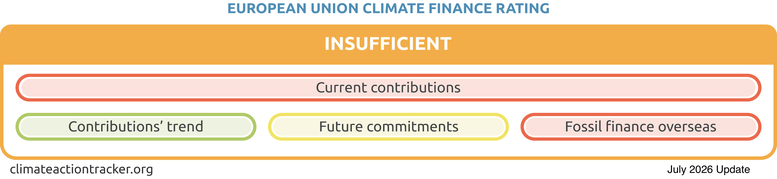
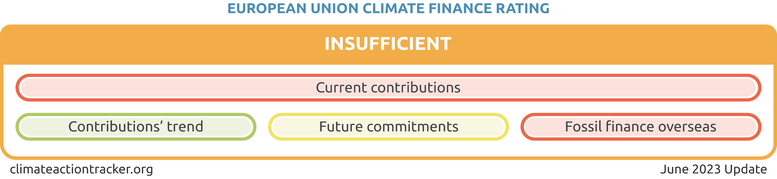
The EU’s international public climate finance contributions are higher than those of most other governments, but we still rate them “Insufficient.” The EU has committed to increasing its climate finance, but contributions to date have been low compared to its fair share. To improve its rating, the EU needs to ramp up the level of its international climate finance contributions post-2020 and accelerate the phase-out of fossil fuel finance abroad.
In 2024, the EU and its member states provided EUR 31.7 bn to developing countries (Council of the European Union, 2025d), but contributions still fall short of their fair share. The EU remains committed through 2025 to the USD 100 bn collective goal of climate finance for developing countries, but the USD 100 bn goal itself has been insufficient for the post-2020 period.
In its November 2025 NDC submission, the EU reaffirmed that it will contribute towards the achievement of the New Collective Quantified Goal (NCQG) adopted at COP29, which aims to mobilise at least USD 300 bn annually by 2035. While reconfirming this position, the EU has not specified the amount of its planned international climate finance contributions in the coming years. The EU also continues to emphasise that other countries beyond the traditional developed contributors, which are in a position to do so, should contribute towards achieving the collective goal (Council of the European Union, 2025a).
Further information on how the CAT rates countries (against modelled pathways and fair share) can be found here.
Net zero and other long-term target(s)
In April 2021, the European Union adopted its Climate Law, setting into law the objective of collectively achieving “climate neutrality by 2050.” The objective of achieving climate neutrality by 2050, as agreed in the European Council’s conclusions from December 2019, has further been included in the EU’s LTS submitted to the UNFCCC in 2020.
The EU’s climate neutrality – or, essentially, net zero – target is rated 'Acceptable in terms of its architecture, transparency and scope, including a legally-binding review and assessment process.
There is room for improvement in the target’s scope, as the European Climate Law currently does not clearly state that international aviation and maritime transport emissions are included, and it lacks an explanation of why net zero by 2050 constitutes a fair contribution. The 2040 target is less ambitious than anticipated, and brings into question whether the EU will meet the net zero target domestically.
For the full analysis click here.
Further analysis





Latest publications



Stay informed
Subscribe to our newsletter