
India
Policies & action
The CAT rates India’s current policies and action as “Insufficient” when compared to its fair share contribution. The “Insufficient” rating indicates that India’s climate policies and action in 2030 are not yet consistent with the 1.5°C temperature limit, and need substantial improvements. If all countries were to follow India’s approach, warming could be over 2°C and up to 3°C.
The CAT estimates that India’s emissions will be around 4.5-4.6 GtCO2e in 2030 under current policies, or 140-146% above 2005 levels. With each update, projected emissions for 2030 under current policies continue to rise, indicating that India is moving further away from a 1.5°C-compatible pathway. This underlines the need for more effective policy design and implementation.
India will need to implement additional policies using its own resources to make a fair contribution to addressing climate change, but it will also require international support to implement all the policies necessary for achieving 1.5°C compatibility.
Please refer to the assumption section here for details on CAT current policy and action projection.
Further information on how the CAT rates countries (against modelled domestic pathways and fair share) can be found here.
Policy overview
India’s climate policy is articulated through a range of policy documents, sector-specific strategies, and legislative frameworks, with the National Action Plan on Climate Change (NAPCC) serving as the overarching policy framework. Recent and notable policy documents and laws include the National Electricity Plan 2023 (NEP2023), the National Green Hydrogen Mission and the recently amended Energy Conservation Act(Government of India, 2023; Ministry of Law and Justice, 2022; Ministry of Power, 2023b).
In 2026, the Central Electricity Authority released the National Generation Adequacy Plan for 2026-27 to 2035-36, which aims to reliably meet India’s projected electricity demand. This plan reiterates India’s ambition for scaling non-fossil energy sources for power generation, reaching 63% of capacity share in 2030 and 69% in 2035, surpassing conditional targets of 2030 and 2035 NDCs. However, this plan continues to emphasise the need for coal power for system stability in the mid to long term (CEA, 2026).
Sustained and comprehensive policy pushes have played a pivotal role in the steady increase in renewable energy deployment in the power sector, but remain constrained by continued fossil fuel dependence. Renewable capacity, including large hydro, has reached around 256 GW in 2025-26, representing more than 50% of total installed capacity. Solar has expanded particularly rapidly, with around half of current solar capacity installed in the last three years, and around 40 GW of solar and wind added in 2025 alone.
However, this capacity growth has not yet translated proportionately into generation: renewables, including large hydro, account for only around 26% of electricity generation, while coal continues to dominate power generation with a 70% share. India still has almost 23 GW of coal capacity under construction and 107 GW in pre-construction (as of January 2026) (Global Energy Monitor, 2026).
At the same time, curtailment of renewable energy is increasing due to inadequate grid and storage capacity.
India is also planning to expand the use of fossil gas. While gas currently contributes only a small share of power generation, and its share of primary energy supply remains stable around 5%, the government has recently put more emphasis on gas infrastructure development, including LNG terminals, regasification capacity and pipelines(IEA, 2025d; PIB, 2026a). This creates risks of fossil fuel lock-in and greater exposure to imported fuel volatility.
India’s continued reliance on coal and fossil gas is increasingly framed by the government as an energy security imperative, particularly in the context of rising peak electricity demand and heat-driven cooling needs. However, in the context of the current volatility of global energy markets, this approach has exposed India to a greater energy security risk. Without having any sustainable long-term plan to move away from fossil fuels, particularly its imports, India is increasing its utilisation of coal power plants as a short-term solution.
Expanding domestic coal production and increasing generation from coal-based power plants, along with expanding LNG and gas infrastructure, might give some flexibility in the short-term, but it is inconsistent with a 1.5°C-compatible pathway and increases the risk of stranded assets. A more sustainable long-term energy security strategy would prioritise accelerated renewable energy deployment, storage, grid modernisation, and demand-side efficiency rather than continued fossil fuel expansion.
India is making significant strides in non-power sectors to advance its decarbonisation agenda.
The government’s updated National Green Hydrogen Mission sets a target of producing five million tonnes of green hydrogen annually by 2030, aiming to decarbonise hard-to-abate sectors such as refineries and fertiliser production. Several financial and other policy support measures are under discussion, including a potential green hydrogen purchase mandate for industry.
India is also preparing to launch its national compliance carbon market by mid-2026 under the Carbon Credit Trading Scheme (CCTS), and compliance obligations have entered into force for several sectors, with legally binding emissions-intensity targets for 2025–26 and 2026–27. The scheme will set emissions intensity targets for energy-intensive industrial sectors, building on the earlier Perform, Achieve, and Trade (PAT) system, but will not impose absolute emissions reduction caps.
In transport, while overall adoption of EVs is slow, with support of the PM E-DERIVE scheme, which replaces FAME II and provides incentives for battery-powered vehicles, mainly two- and three-wheelers. Electric bus deployment is expanding, but plans to shift long-haul trucks to LNG risk locking in fossil fuel use.
Power sector
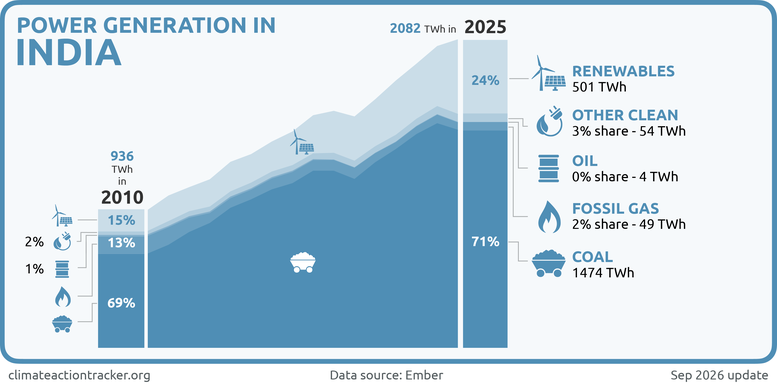
The power sector is India’s largest emitter, contributing more than half of total emissions. Since 2019, emissions from the sector have increased by around 25% (IEA, 2025c).
Rising temperatures and the corresponding increase in cooling demand are among the key drivers behind India’s growing electricity consumption. In 2025, India experienced extreme summer temperatures once again, as in previous years. The peak demand in June 2025 reached 241GW, lower than last year’s peak of 246 GW due to unusual rains (Michael et al., 2025; Ministry of Power, 2025). In 2026, early-season heatwaves across large parts of the country pushed electricity demand upward again, and peak load had reached 270 GW in May, aligning with the summer peak projection under sustained high-temperature conditions (IEA, 2026; Sethuraman, 2026).
As in previous years, the response to meet peak summer energy demand has largely been to rely on increased utilisation of coal and gas-fired generation, with limited push for structural, long-term planning to manage rising cooling loads through demand-side measures and system transformation with more renewable generation.
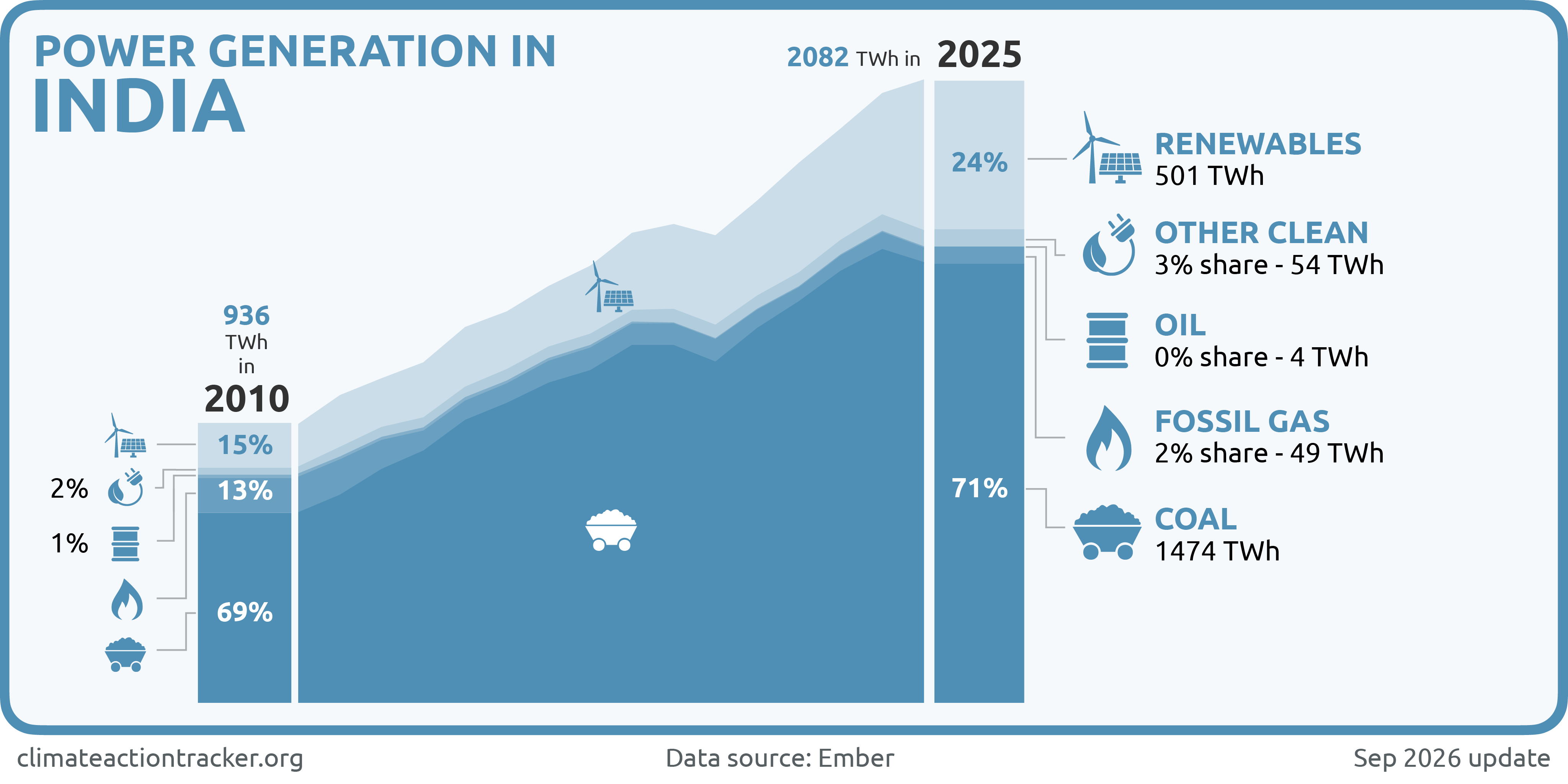
India relies heavily on fossil fuel-based power generation, predominantly coal, which accounted for 70% of the country's current electricity generation in 2025. Renewables (including large hydro) make up the second-largest share of India’s power generation at ~26% (NITI Aayog, 2026a).
Over the past five years, both coal and renewables have increased significantly in terms of absolute power generation, but their respective shares of power generation have remained close to constant. In 2025, fossil fuel-based generation declined in absolute terms for the first time outside the pandemic period; however, this appears to be driven by slower growth in electricity demand. As mentioned above, milder summer conditions contributed to lower cooling demand and overall electricity consumption (Kennedy, 2026).
India has made significant progress in renewable energy deployment, with around 256 GW of renewable energy capacity installed (including large-scale hydropower), representing ~50% of the country’s total installed capacity (NITI Aayog, 2026a). This includes 51 GW of large hydro, 10 GW of bioenergy, 98 GW of wind, and 134 GW of solar power, with about half of its solar capacity installed in the last three years alone. In 2025 alone, a total of 40 GW of solar and wind capacity has been installed.
The consistent dominance of renewables in capacity additions signals policy effectiveness, investor confidence, and declining technology costs. However, the slower reflection of these trends in actual power generation highlights persistent structural challenges, such as a lack of grid integration due to limited storage capacity and seasonal dependence on hydropower.
Given the continued dominance of coal in India’s electricity mix, decarbonising the power sector will also be essential to fully realise emission reduction potential in the energy end-use sectors.
For our detailed methodology on power sector evaluation, please see here.
Coal
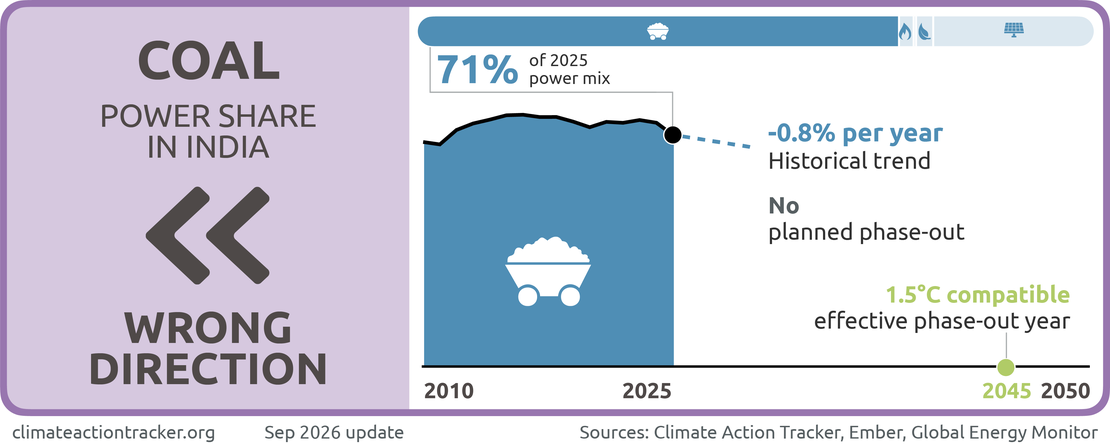
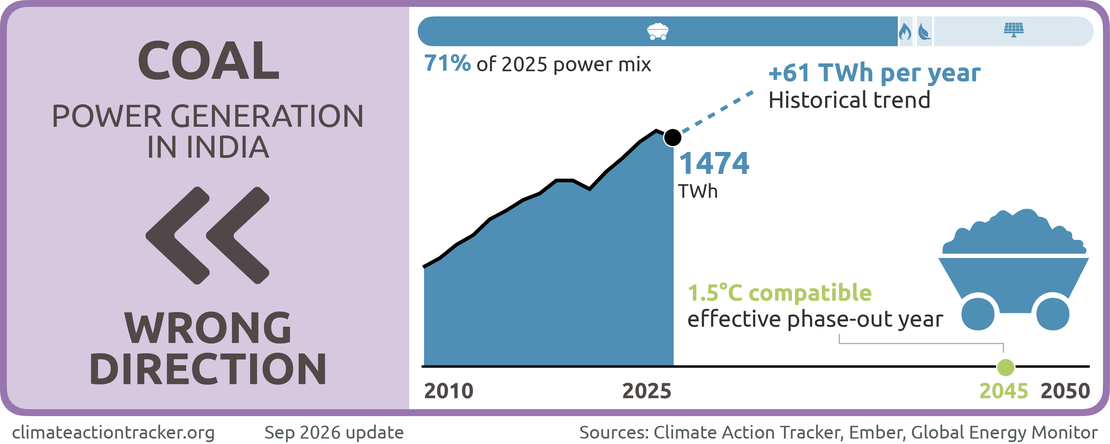
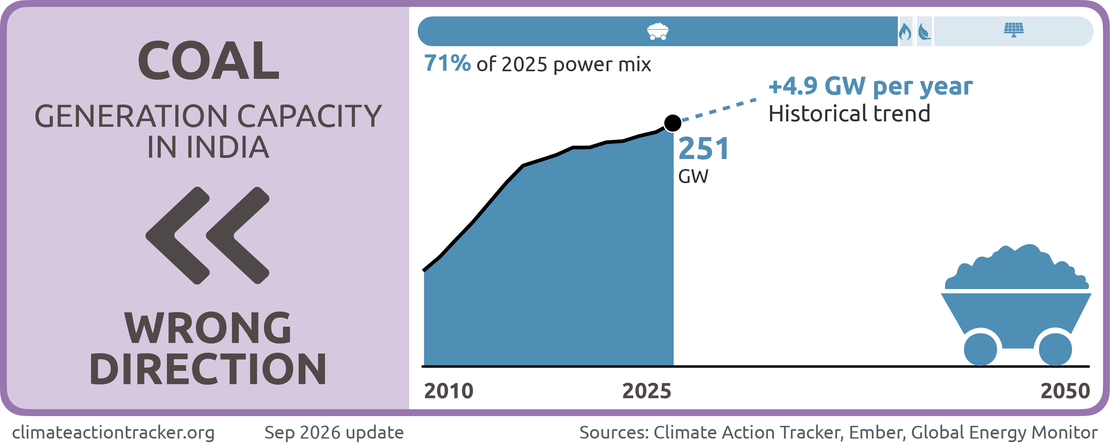
India’s electricity generation relies heavily on coal, representing around 60% of the country’s power mix (NITI Aayog, 2026a). While the expansion of renewable energy has reduced coal’s share in installed capacity significantly, now standing at 43%, its contribution to actual generation remains high (NITI Aayog, 2026a).
As of January 2026, almost 23 GW of new coal capacity is currently under construction and 107 GW in pre-construction (Global Energy Monitor, 2026). This continued reliance on coal is clearly inconsistent with the 1.5°C temperature limit. Due to slower electricity demand growth, coal-based generation has declined from 1332 TWh in 2024-2025 to 1162 TWh in 2025-26 (NITI Aayog, 2026a).
Given the substantial operational and planned coal capacity, and the absence of a clear phase-out strategy, we assess progress in this sector as moving in the “Wrong direction.”
To be 1.5°C compatible, India's coal power generation would need to be significantly reduced by 2035 (to reach 12-17% of total generation) and effectively phased out by 2045 (Climate Action Tracker, 2026). India will need international support to achieve a transition of this scale.
However, the Indian government has no plans to shut down any coal power plants before 2030 (Global Energy Monitor, 2024a), and is instead planning to increase coal capacity. The recent National Generation Adequacy Plan also indicated long-term reliance on coal-based generation for system reliability (CEA, 2026).
Although India witnessed slower coal-fired power generation growth in 2025, ongoing energy market disruptions have reinforced a policy tilt toward coal. In response to supply risks and price volatility in imported fuels, the government has prioritised both domestic coal-based generation and continued operation of plants reliant on imported coal to ensure reliability (The Economic Times, 2026b).
India’s coal power sector is facing several challenges, including operational inefficiencies and technological hurdles, as reflected in falling plant load factors. The sector is also becoming less cost-competitive than renewables, and is under financial stress (Buckley et al., 2019; Business Standard News, 2021; Chakravarty & Somanathan, 2021). More than 500GW of coal projects have been cancelled since 2010, primarily due to lack of financial viability.
These factors create a strong case for the early retirement of the existing capacity. However, a challenge to phasing out coal is India's young coal fleet: the average age of coal plants is between 13 and 15 years (IEA, 2020). Without an effective early retirement plan in place, the existing capacity could potentially remain operational for another 40 to 50 years. There is a significant risk that India’s coal infrastructure will become stranded assets in a 1.5°C compatible world (Malik et al., 2020; Montrone et al., 2021).
A study by Ember revealed that, in 2024, around 19% of the total electricity demand in India was attributed to hotter temperatures compared to 2023 (Ember, 2025). Although India experienced a comparatively less harsh summer in 2025, as climate change continues to influence weather patterns in the country, it is crucial to develop a robust power sector demand and supply plan, as India has a significant unmet cooling demand due to low air-conditioning ownership. This should be based on a transition to renewable energy to meet the peak load, supported by storage infrastructure. In the absence of transferring the peak load to renewable energy sources with infrastructural support, the dependence on coal will persist to fulfil the summer demand.
Coal production for power
India is the world’s second-largest coal producer after China, yet remains a net importer, with around about 20–25% of the country’s total coal demand met through imports (Ministry of Coal, 2026).
Approximately 90% of domestically-produced coal is used for electricity generation. In response to rising electricity demand, the government has implemented measures to ramp up domestic production and reduce import dependence by 30% in 2026 (Reuters, 2026c). Domestic production reached one billion tonnes in 2024-25 and has increased from 565 Mt in 2014 (Ministry of Coal, 2023).
The fact that coal continues to play a central role in India’s energy strategy is directly attributable to its domestic reserves – unlike in the case of oil and gas, of which it is not a significant producer (Argus Partners, 2023; Mining Technology, 2023). In pursuit of expanding domestic supply, India held its fifteenth coal mine auction in April 2026, with 11 new blocks on offer (ETEnergyworld.com, 2026). Over the past decade, more than 160 coal blocks have been auctioned, representing a combined peak capacity of 575 million tonnes per year. Recent institutional developments further reinforce this direction. Plans to establish a national coal exchange aimed at formalising coal trading and improving market efficiency signal continued structural support for the sector (Kumar, 2026).
Fossil gas
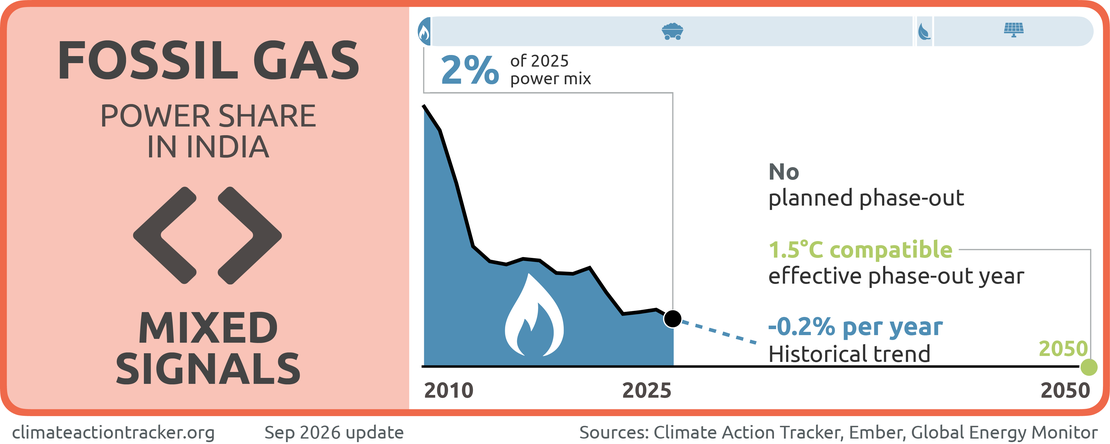
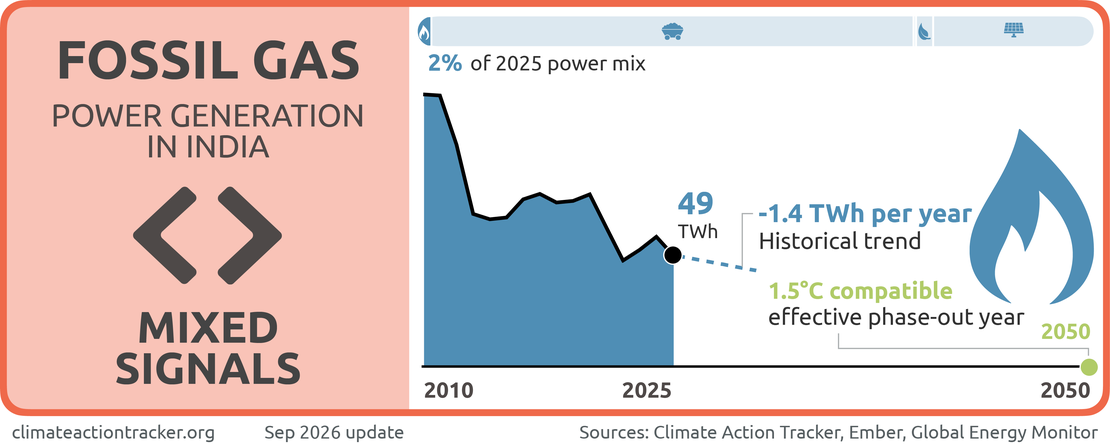
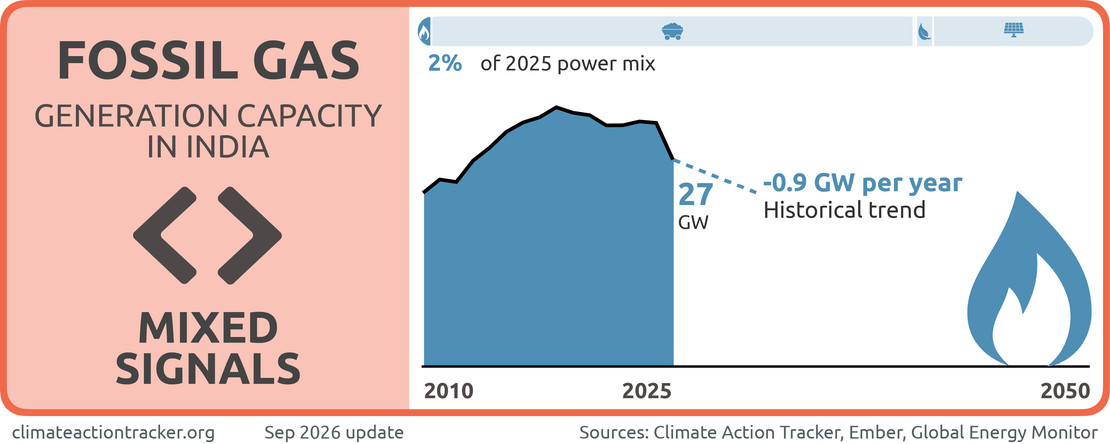
Although the share of fossil gas in total power generation remains low and has declined over the last five years, the absolute amount of fossil gas-fired generation has increased year-on-year since 2022, primarily to meet rising summer peak demand (NITI Aayog, 2026a; Reuters, 2026b). At the same time, two additional fossil gas-fired power plants are currently in the pipeline – totalling 1.27 GW of capacity.
We evaluate India’s progress in phasing out fossil gas in the power sector as a “Mixed signals.”
As of 2026, India has 20 GW of operational fossil gas power capacity (NITI Aayog, 2026a). However, its share of total generation declined to 1% in 2025 from 11% in 2010, partly due to the limited availability of domestic gas supply (IEA, 2023; NITI Aayog, 2026a). As in previous years, a surge in summer electricity demand has led to gas-fired power plants being brought back online temporarily to help meet peak loads. The government even invoked emergency laws, directing power producers to operate under-utilised gas-based plants at higher capacity between May 26 and June 30 of 2025 (Reuters, 2025; R. K. Singh & Sharma, 2025). A significant share of gas-based generation is fuelled by imports, with 45% of total gas used in power plants being sourced from abroad (S&P Global, 2023).
In 2016, India announced its intention to be a “gas-based economy” and has set a target of increasing the share of gas in its energy mix to 15% by 2030 (ETEnergyworld.com, 2025). However, since then, the share of gas in primary energy has increased only marginally to 7% in 2024 from 5% in 2015 (IEA, 2025d).
India is emerging as one of the main buyers of LNG in Asia, following China and Japan, with a record import of 2.72 million tonnes in June 2024 – a 54% increase compared to the same month in 2022 (Reuters, 2024).
However, this growing reliance on imported LNG also increases India’s exposure to external price volatility and geopolitical supply risks. Recent disruptions affecting Qatar-linked supply chains and India’s search for alternative cargoes from non-Middle Eastern sources underline that vulnerability (Verma, 2026). From an energy security perspective, this strengthens the case for directing more investment toward domestic renewables, storage, grids and efficiency, which can reduce import dependence more durably than expanding LNG use.
Fossil gas infrastructure
The government continues to support the expected fossil gas import growth through the expansion of LNG terminals and re-gasification capacity, and infrastructure development to facilitate LNG transportation (The Economic Times, 2020). In March 2026, the government explicitly ordered further strengthening of fossil gas infrastructure in response to supply disruptions triggered by the USA-Israel war on Iran and the need to expand piped gas access(Ministry of Petroleum and Natural Gas, 2026).
India's LNG regasification capacity has expanded significantly, increasing by 90% over the last decade. As of late 2024, the total capacity is 65 bcm/yr across seven terminals (IEA, 2025a). To meet projected demand, India plans to add nearly 40 bcm/yr of additional regasification capacity by 2030 (Global Energy Monitor, 2024b).
Pipeline expansion is also continuing. As of January 2026, more than 25,400 km of gas pipelines are operational, with approximately 34,233 km authorised nationwide(PIB, 2026a). These pipelines are being developed with the potential to accommodate green hydrogen in the future.
Amidst the Middle East crisis, the Indian government has sanctioned a scheme for coal gasification, where it will provide a 20% subsidy to cover the cost of plant and machinery, in a scheme worth USD 3.92 billion (Reuters, 2026a).
Industry is the biggest consumer of fossil gas in India. Besides being used for energy purposes, it is used as a feedstock for manufacturing fertiliser and petrochemicals. While fossil gas only accounted for 4% of industrial final energy consumption in 2023, the current policy scenario shows a doubling of gas use by 2030 and a four-fold increase by 2050.
India’s plans on fossil gas combustion and infrastructure expansion are not consistent with a 1.5°C world. India could save billions if it ditched its gas plans and shifted to a 1.5°C compatible pathway (Climate Action Tracker, 2022). Investing in capital-intensive gas infrastructure further exposes India to risks such as a carbon lock-in, stranded assets, and increased energy import dependency (Climate Action Tracker, 2022).
Taxes and subsidies for fossil fuels
In India, subsidies are available for both fossil fuels and renewable energy in the form of direct subsidies, fiscal incentives, price regulation and other government support. However, total subsidies for fossil fuels, including both demand and supply sides, are three times higher than those for renewables, although this gap has narrowed substantially from nine times in FY2021 (IISD, 2026, 2022).
The support for fossil fuels is being channeled through state-owned enterprises (SOEs), which continue to invest in fossil assets. IISD finds that overall government support through SOEs for fossil fuels was five times that for clean energy. While fossil fuel subsidies have declined by 70% since FY2014, coal subsidies remain significant, reaching INR 47,397 crore (USD 5.7 billion) in FY2024, largely through concessional taxation and underpricing mechanisms. Coal India Ltd., a public limited company and the largest government-owned coal producer in the world, receives an annual USD 2 bn in subsidies (The New York Times, 2022).
Renewables
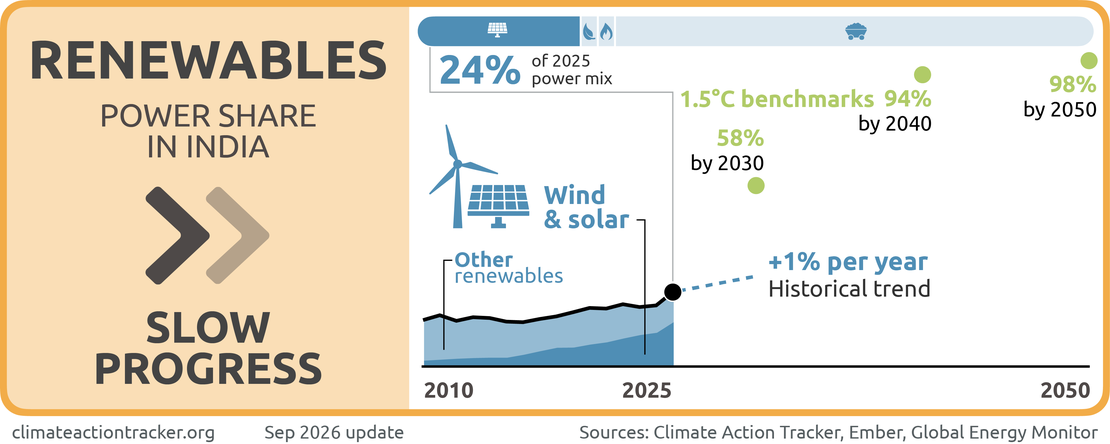
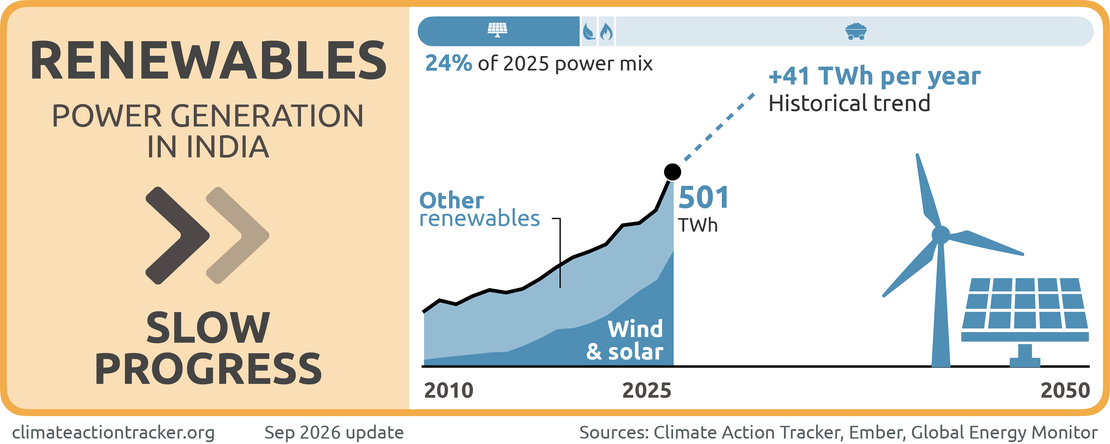
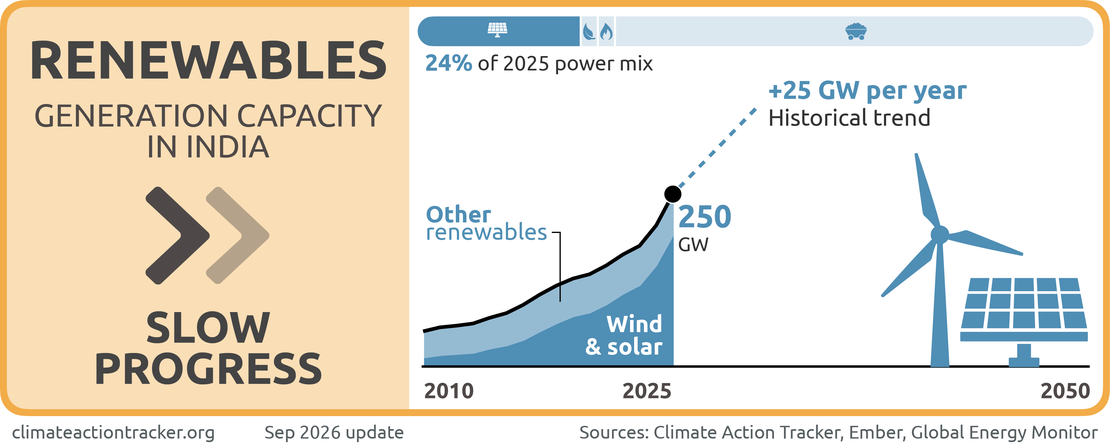
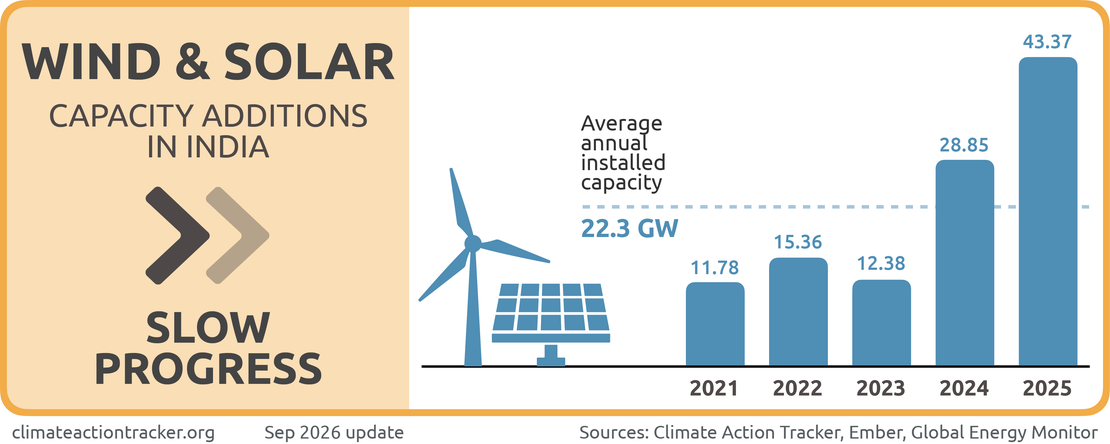
India is making notable progress in renewable energy deployment – both in terms of total installed capacity and total electricity generation. Renewable capacity (including large hydro) amounts to 256 GW, representing 49% of its total generation capacity (NITI Aayog, 2026a). This includes 51 GW of large hydro, 10 GW of bioenergy, 55 GW of wind, and 134 GW of solar. Installed capacity of solar has been doubled in the last three years.
However, these increased in capacity additions are not proportionately reflected in power generation: the share of renewables (including large hydro) has been rather stable at around 22% until 2024-25 and increased on 26% in 2025-26 (NITI Aayog, 2026a).
We evaluate India’s progress in renewables in the power sector as “Slow progress” (for detailed methodology on power sector evaluation, please see here).
In 2025, India’s renewable electricity generation continued to grow both in terms of share and absolute generation (NITI Aayog, 2026a). However, this should be interpreted cautiously. The increase in renewable share in total generation also appears to be driven by a decline in total generation due to slower electricity demand growth and a relatively less harsh summer this year, rather than any structural change. However, with the intensifying heatwaves in 2026, peak demand has already exceeded last year’s peak, resulting in increasing coal generation (Bloomberg, 2026).
The National Electricity Plan 2023 (NEP 2023), adopted in May 2023, envisages adding considerable solar and wind capacity by 2031-32: 311 GW and 82 GW, respectively (Ministry of Power, 2023b). More recently, the National Generation Adequacy Plan is projecting total solar and wind capacity to reach 320 GW and 103 GW, respectively, in 2031-32 and 509 GW and 155 GW in 2035-36 (CEA, 2026).
India’s targets for 2030 and 2035 aim for non-fossil sources to account for 50% and 60% of installed power capacity, respectively, with international support. Both targets are expected to be overachieved under the National Generation Adequacy Plan outlook, which projects the share of non-fossil capacity to reach approximately 64% by 2030 and 70% by 2035 and that without any mention of international support.
The growth in solar capacity deployment has been observed in both utility-scale and the rooftop format. Large-scale renewable energy projects in India continue to gather momentum, with 59 GW of mainly solar power out for tender, surpassing the government’s annual target of 50 GW (IEEFA, 2025b). There has also been a record increase in wind-solar hybrid energy storage systems, comprising over half of the complex auction volumes. The growth in solar rooftop is driven by various favourable policies and financial mechanisms, particularly for households, which are receiving substantial support through the PM Surya Ghar rooftop solar scheme (ETEnergyworld, 2024).
Solar and wind have become the lowest-cost electricity sources in India, even without subsidies. Large-scale auctions have contributed to the rapid development of renewable energy at decreasing prices (IEEFA, 2019). The solar tariff has declined by around 60% between 2016 and 2024 (from USD 0.0786/kWh to USD 0.028/kWh), mainly because of falling capital costs (MERCOM, 2022). Solar with storage has also become competitive in India. Solar plus batteries could supply up to 90% of India’s electricity demand at an LCOE of about INR 5.06/kWh (USD 56/MWh), compared with an estimated INR 4.78/kWh (USD 54/MWh) for India’s existing coal fleet (Ember, 2026a).
Access to capital for the sector has improved significantly. This is attributed to key policies like long-term Power Purchase Agreements (PPAs), ‘must-run’ status, and transmission waivers, which have successfully helped mobilise private capital at scale.
Renewable Energy Certificates (RECs) are in place that promote renewable energy and facilitate Renewable Purchase Obligations (RPOs), which legally mandate a percentage of electricity to be produced from renewable energy sources. The Ministry of New and Renewable Energy (MNRE) has also issued clarifications that Renewable Energy (RE) Generating Stations have been granted ‘must-run’ priority dispatch status, which will allow grid operators to prioritise the dispatch of electricity from renewable energy (PIB India, 2021).
The Indian government has taken a multifaceted approach to encourage solar module manufacturing, recognising its importance for a self-reliant energy transition in India. As of August 2025, India had crossed 100 GW of solar PV module manufacturing capacity under the Approved List of Models and Manufacturers (ALMM) framework (MNRE, 2025). Broader industry estimates are higher, and it is reported that the total module manufacturing capacity had reached about 210 GW, while solar cell capacity stood at around 27 GW (Mercom India, 2026).
As positive as the recent growth and plans for renewables are, they are not sufficient for 1.5 °C compatibility. A recent analysis by the CAT shows that aligning India’s power sector with a 1.5°C pathway would require renewables to supply 52-65% of electricity generation, with wind and solar alone providing 36-49% by 2030. Meeting this trajectory would require average annual additions of around 44 GW of solar and 13 GW of wind capacity to 2030. Combined wind and solar capacity would need to reach about 610 GW by 2030 (Climate Action Tracker, 2026).
International support is critical to achieving this. India is already on track to achieve its 2030 and 2035 targets under current policies. With international support, this could be strengthened.
Energy storage and transmission
Grid-scale energy storage technologies will play a critical role in addressing peak demand. There is a notable shift towards more capital-intensive projects such as Battery Energy Storage Systems (BESS) and Pumped Storage Plants (PSPs), in addition to hybrid projects and Round-The-Clock (RTC) power tenders (IEEFA, 2025c).
The NEP 2023 indicates a need for 236 GWh of BESS capacity to integrate planned renewable energy by 2030. However, more recent planning suggests substantially higher long-term needs, potentially approaching ~320 GWh by the mid-2030s (CEA, 2026). India had only installed 0.2 GWh of BESS capacity – a vast gap to the target (IEEFA, 2025c).
Overall policy support for storage has been strengthened. The government has introduced INR 54 billion (~USD 630 million) in Viability Gap Funding to support around 30 GWh of BESS, alongside transmission charge waivers for storage until 2028 and regulatory reforms enabling broader market participation (MNRE, 2026). Project pipelines have expanded rapidly, with over ~90 GWh of BESS under tender or development (Asian Power, 2026).
India has around 4.7 GW of installed PSP capacity, but its electricity authority estimates that the total PSP potential is over 100 GW. However, concerns expressed by environmental experts over the exemption from environmental clearance of PSPs located in old dams and off-the-river have not been taken into account (Ministry of Power, 2023a; Mongabay, 2023).
In July 2022, India introduced an Energy Storage Obligation as part of its broader renewable energy purchase requirements (Ministry of Power, 2022). The Energy Storage Obligation (ESO) continues to require increasing shares of stored renewable energy, rising to ~4% by 2029–30. However, in the latest revision of RPO rates, this ESO appears to have been dropped (MERCOM, 2023).
The National Green Hydrogen Policy (more below) also envisages using green hydrogen as a storage option.
India’s rapid renewable energy build-out is increasingly running ahead of transmission expansion, creating a growing risk that clean power will be curtailed rather than absorbed by the grid. In the second half of 2025, India curtailed 2.3 TWh of solar generation, which resulted in a loss of around USD 63 – 76 million and in the first quarter of 2026, the total loss from curtailment is already 3 TWh (Ember, 2026b, 2026c).
Some estimates show that 35–37 GW of renewable energy capacity could be exposed to curtailment risk in FY2027, mainly because projects under temporary general network access lack dedicated transmission infrastructure (CRISIL, 2026; Gupta, 2026). The risk is particularly acute for the states with high renewable build-out, such as Rajasthan, Tamil Nadu and Gujarat, which account for 45% of India’s renewable generation capacity, where some projects have faced curtailment of up to 50% (Das, 2025; Guruvanmikanathan, 2025).
This points to a widening mismatch between renewable capacity additions and transmission infrastructure and risks losing usable renewable electricity unless transmission, storage and grid-management capabilities expand at a comparable pace. It could also complicate compliance with Renewable Purchase Obligations (RPOs), as distribution companies and other obligated entities may struggle to meet renewable procurement targets if available renewable generation cannot be reliably delivered to demand centres.
Industry
In 2024, industry was India's largest emitting end-use sector, accounting for 29% of total CO2 emissions (excluding LULUCF). This includes both energy-related emissions (IEA, 2025d). Industrial process emissions, accounts for 9% of total emissions (Gütschow et al., 2025). Industry also accounts for the largest share of total primary energy demand (38%), having grown at an annual rate of 5% over the last 10 years (IEA, 2025d).
Pathways compatible with a 1.5°C temperature increase show that the share of electricity in the industrial energy mix must increase from 15% to 48% by 2030 (Climate Analytics, 2024). The electrification of industry is essential to reduce the use of fossil gas and limit the need for green hydrogen, the production of which requires various conversion steps and leads to much lower process efficiency compared to the direct use of renewable electricity (see sub-section on Green Hydrogen below).
Energy efficiency
The Indian government amended the 2001 Energy Conservation Act in 2022 (having last revised the law in 2010). The Act regulates energy consumption by equipment, appliances, buildings and industries. The major amendments include:
- An obligation to use non-fossil sources of energy for industry, transport, and buildings
- Carbon trading
- Energy conservation code for buildings, both commercial and residential
- Standards for vehicles and vessels
- Allotment of regulatory powers of State Electricity Regulatory Commissions
- Changes in the governing council of the Bureau of Energy Efficiency
Specifically, the Act mandates the use of non-fossil fuel sources for industries such as mining, steel, cement, textile, chemicals and petrochemicals. The amendments also allow industries to buy renewable energy directly from the producers, providing them with price certainty.
The main instrument to increase energy efficiency in India’s industry is the Perform, Achieve and Trade (PAT) Mechanism, which has been in place since 2012. The Mechanism continues to evolve and is expected to be integrated into the broader carbon market framework, which has started to issue compliance of the emissions intensity target for selected sectors.
Steelmaking is one of India’s most important manufacturing sectors, both for domestic consumption and export, with the country ranking as the world’s second-largest steel exporter. The sector accounts for approximately 10–12% of India’s total greenhouse gas emissions (Hidayat, 2026). Its emissions intensity is around 2.65 tCO2/tone of finished steel, which remains higher than the global average of 2 tCO2/tone of finished steel, contributing to increased exposure to trade measures such as the EU-CBAM. Following the launch of CBAM, India has released a draft National Steel Policy 2025, which aims to reduce the sector’s emissions intensity to the global average by 2035–36 (Arora, 2026).
Industry is the biggest consumer of fossil gas in India, where, apart from being used for energy purposes, it is used as a feedstock for manufacturing fertilisers and petrochemicals. Initial steps toward defining low-carbon industrial materials, including green steel and cement, are emerging, though standards and large-scale deployment remain under development (Ministry of Steel, 2024). Green hydrogen is going to play an important role in the decarbonisation of these industries, notably steel and fertiliser (Argus Partners, 2023).
The India Hydrogen Alliance (IH2A) has urged the Indian government to implement mandatory green hydrogen purchase obligations (HPOs) to meet the National Green Hydrogen Mission target of producing five million tonnes of green hydrogen annually by 2030 (Business Today, 2025). Without such mandates, less than 1% of this target is currently being met, putting over USD 80 bn in planned hydrogen investments at risk.
Micro, Small and Medium Enterprises (MSMEs) contribute around 30% of India’s Gross Domestic Product (GDP), 40% of its exports and 20-25% of its heavy industry energy consumption (IEEFA, 2023). MSMEs are significant energy consumers, responsible for approximately 110 MtCO2 of emissions annually (Gowthami & Shah, 2024). With energy consumption for this sector projected to rise by 50% by 2030, enhancing energy efficiency within this sector is crucial for India's clean energy transition. In 2026, NITI Aayog released a roadmap for the green transition of MSMEs, outlining pathways based on energy efficiency, renewable electricity, and alternative fuels. While this marks an important step toward structured planning, implementation remains at an early stage(NITI Aayog, 2026b).
The 2024 Budget announced special reforms for MSMEs, including easier access to loans, a modern and inclusive approach to credit assessment and extending financial support for shifting to cleaner energy and implementing energy efficiency measures (Climate Group, 2024).
Green hydrogen
The National Green Hydrogen Mission, launched in 2021 and updated in January 2023, targets five million tonnes per annum (MMTPA) of green hydrogen production by 2030, supported by ~125 GW of dedicated renewable energy capacity and significant investment incentives (Government of India, 2023).
A core intention of the Mission is to use green hydrogen to decarbonise critical industries, specifically steel, fertilisers, refineries, and cement, where direct electrification is less feasible (GH2 India, 2026). The government has allocated an annual green hydrogen production capacity of 862,000 tonnes to 19 companies and awarded 3,000 MW of electrolyser manufacturing capacity to 15 firms. Pilot projects have been initiated across various sectors, including steel, mobility, and shipping, to demonstrate the viability of green hydrogen applications (PIB, 2025).
There is strong financing policy support, including production-linked incentives for the manufacturing of electrolysers and green hydrogen production (Ministry of New And Renewable Energy, 2023). A key financial measure, the Strategic Interventions for Green Hydrogen Transition (SIGHT) Programme, has an outlay of USD 2.1bn, split between financial incentives for electrolyser manufacturing and hydrogen production (PIB, 2023).
India also aims to become a major exporter of green hydrogen, targeting 10% of the global green hydrogen market by 2030 (Ministry of New And Renewable Energy, 2023). To support this, the government is actively engaging with international partners – including Singapore, Europe, and Japan – to explore export opportunities (DownToEarth, 2023).
In addition to its green hydrogen production targets, the government has introduced several supportive measures. A key initiative is the 25-year waiver of the inter-state transmission charges for renewable energy, now extended to green hydrogen plants commissioned before 2031, providing a financial incentive for their development (Reuters, 2023b).
Complementing this, the government has recently launched ‘Green Hydrogen Certification Scheme’, to verify that hydrogen is produced exclusively using renewable energy. Green hydrogen and green ammonia plants have also been exempted from environmental clearance, simplifying the regulatory process and promoting faster project implementation (The Economic Times, 2025b).
Carbon markets
Since the amendment of the Energy Conservation Act in December 2022, India is rapidly developing a compliance carbon market through its Carbon Credit Trading Scheme (CCTS), aimed at launching full operations by 2026. The Ministry of Power (MoP) oversees the regulatory framework of the CCTS, with the BEE serving as the designated administrator responsible for implementing and managing the scheme.
The CCTS uses a baseline-and-credit approach under which obligated entities that outperform their greenhouse-gas emissions-intensity targets receive carbon credit certificates, while entities that fail to meet their targets must purchase and surrender credits.
India’s carbon market:
- Sets annual emissions intensity targets rather than absolute emissions caps, which may limit its effectiveness in driving deep emission reductions.
- Includes 13 high-energy intensive industries, including those under PAT, such as aluminium, cement, fertilisers, iron & steel, petroleum refineries, and textiles. It will initially exclude the power sector.
- Covers CO2 and PFCs, with scope for adding more GHGs,
- Will be governed by BEE, which will set sector-specific emissions intensity pathways aligned with national climate goals.
It has been anticipated that CCTS may face relatively limited liquidity and price discovery in its early years, reflecting ex-post credit issuance, capital-intensive industrial abatement and the initial exclusion of financial intermediaries. Studies have highlighted the importance of predictable benchmark tightening, clear banking rules and mechanisms to manage credit supply and price stability (CEEW, 2026; IEEFA, 2026b).
As of early 2026, compliance obligations have entered into force for nine sectors, with legally binding emissions-intensity targets for 2025–26 and 2026–27 (International Carbon Action Partnership, 2025).
Carbon capture and storage
India is considering carbon capture, utilisation and storage (CCUS) technologies as an emissions reduction strategy to achieve deep decarbonisation in hard-to-abate sectors, and to allow a continued use of coal for energy and non-energy purposes (PIB, GoI, 2022). CCUS technologies are not commercially viable, nor are they proven at scale, despite large public subsidies for research and development globally. The use of CCUS should be limited to industrial applications where there are fewer options to reduce process emissions.
The government has recently emphasised CCUS in terms of budgetary measures. The Union Budget 2026–27 allocated INR 200 billion (~USD 2.4 billion) over five years to support CCUS technologies targeting emissions from power, steel, cement, chemicals and refineries (Shenbagaraj & Upadhyay, 2026).
Several organisations are actively exploring the role of CCUS in industrial decarbonisation, such as the roadmap for CCUS by the Department of Science and Technology and Policy Framework and Deployment Mechanism for CCUS, prepared by NITI Aayog (Department Of Science & Technology, 2025; NITI Aayog, 2022a).
Major Indian companies are also exploring and implementing CCUS technologies, for which they have partnered with global technology firms (Carbon Herald, 2026).
However, actual commercial CCUS deployment in India remains limited to date, with most activities at the pilot stage, supported by both government and private sector funding.
Transport
Transport was responsible for 13% of India’s energy-related CO2 emissions in 2024, accounting for 17% of total primary energy consumption (IEA, 2025d). The transport sector is dominated by fossil fuels (98% in 2024), mostly oil (88%) (IEA, 2025d).
For India to align with 1.5°C compatible pathways, the share of electricity in all domestic transport would need to reach 5% by 2030 and 25-76% by 2050 (Climate Analytics, 2024).
Road transport
At COP26, India signed the 100% EV declaration, aiming to increase the share of electric vehicle (EV) sales penetration to 30% in private cars, 70% in commercial vehicles, 40% in buses, and 80% in two and three-wheelers by 2030 (Clean Energy Ministerial, 2019).
Total annual EV sales reached 2.45 million vehicles in FY2025-26, increasing from two million vehicles in the previous fiscal year (Dalvi, 2026). Two-wheelers remained the largest category, contributing around 57% of total EV sales, while three-wheelers held a substantial share of about 34%.
Total EV sales grew by around 25% in FY2025-26 over FY2024-25, with a 22% growth in two-wheelers and 19% in three-wheelers (Dalvi, 2026). However, despite this increase, EV stock remains relatively low at around 8% across all vehicle categories: around 6.5% in the two-wheeler segment, ~30% in three-wheelers, and just ~5% in four-wheelers (EVreporter, 2025). To be compatible with 1.5°C, the share of total EV sales in India (including two and three-wheelers) must reach at least 35% by 2030, and 100% by 2040 (Climate Action Tracker, 2024).
According to NITI Aayog, the main barriers to accelerating EV penetration are high upfront costs, limited range, and insufficient charging infrastructure. To address these issues, NITI Aayog has proposed 'soft mandates', i.e. policies that encourage gradual change rather than abruptly enforcing targets. To lower the EV manufacturing cost, the government has fully exempted customs duties on critical minerals (such as lithium and cobalt), battery scrap, and select EV components (D. Singh, 2025).
Deployment of charging stations is also progressing at a slower pace. As of 2025, the country had only around 30,000 public charging stations, which corresponds to one charger per 235 vehicles, falling far short of the global benchmark of one charger per 6-20 EVs (Meta Materials Circular Markets, 2026). As per the revised EV guidelines, there should be at least one charging station per square kilometre by 2030 (Business Standard, 2024; ICCT, 2025). Expanding the EV charging network remains a government priority and is expected to create opportunities for small vendors engaged in the manufacture, installation, and maintenance of charging infrastructure (The Indian Express, 2024).
To support both EV adoption and expand charging infrastructure, the Faster Adoption and Manufacturing of Electric Vehicles in India (FAME) was launched in April 2019 and ended in March 2024 with a total outlay of INR 115 bn (USD 1.4 bn). In 2025, FAME was replaced by the PM Electric Drive Revolution in Innovative Vehicle Enhancement (PM E-DERIVE) scheme, which will provide INR 36.79 bn (USD 438m) in incentives for battery-powered two-wheelers, three-wheelers, ambulances, trucks, and other advanced EVs (ICCT, 2025).
PM E-DRIVE scheme was allocated INR 10.9 bn (~USD 10.9 mn) for the procurement of public buses in major cities, to be rolled out from April 2024 to March 2026 (The Economic Times, 2025a). However, this is far from achieving the target of 50,000 new electric buses under the National Electric Bus Programme (NEBP).
Heavy-duty vehicles, particularly trucks, accounted for 45% of India's road transport emissions in 2022 – despite representing only a small portion of the overall vehicle fleet. As of 2022, India has around four million trucks in operation, but this is projected to increase to 17 million by 2050 (Verma, 2024). Adopting zero-emission fuel trucks is a central component of India’s decarbonisation strategy for transport.
The government launched its Bharat Zero Emission Trucking (ZET) Policy Advisory in 2024, outlining potential interventions to achieve 100% ZET deployment by 2050. In this context, demand for green hydrogen is expected to grow in India’s transport fleet in 2025: the government awarded EUR 2.3 million in project funding to Indian vehicle manufacturers to develop 22 hydrogen internal combustion engines and 15 fuel cell electric trucks (IFRI, 2025). The government is further planning to replace its diesel-fuelled long-haul trucks with LNG in the coming five to seven years (Verma, 2024) – risking a sustained lock-in of fossil fuel use (IEEFA, 2025a).
India strengthened its fuel emissions standards in April 2020 with the adoption of the Bharat Stage VI (BS VI) emissions standard for all major on-road vehicles (the same as Euro VI standards) (DieselNet, 2021).
The Indian government has advanced different targets and policy frameworks to introduce alternative fuels in the transport sector. Blending of 20% ethanol in petrol is part of such an initiative, for which the target year was brought forward to 2025 from the earlier target of 2030 (NITI Aayog, 2021).
The rapid nationwide shift to E20 has recently triggered debate over vehicle compatibility, fuel efficiency and consumer choice, particularly for older vehicles (The Economic Times, 2026a). The ethanol programme is also facing a broader food-versus-fuel debate (Jadhav et al., 2026). Blending ethanol with fossil fuels does not eliminate transport emissions. Biofuels can still generate significant lifecycle greenhouse gas emissions through land-use change and potential deforestation, fertiliser use, cultivation and processing. Their expansion can also increase competition for land needed for food production and other uses, while creating additional pressures on ecosystems and biodiversity (Climate Action Tracker, 2023).
The government has also launched a voluntary vehicle scrappage policy in April 2022 to phase out old vehicles from Indian roads (Garg, 2022) . As of January 2026, there were 129 Registered Vehicle Scrapping Facilities (RVSFs) operational across 21 states and union territories. Approximately 430,000 vehicles have been scrapped through these facilities, showing some progress in the actual execution of the policy (PIB, 2026b).
India is pursuing elements of an industrial strategy by linking transport decarbonisation with domestic manufacturing ambitions. Production-linked incentive (PLI) schemes for advanced batteries and EV manufacturing aim to build domestic supply chains, reduce import dependence, and create employment opportunities (IEEFA, 2026a).
Railways and waterways
In July 2020, Indian Railways, one of the world's largest railway networks, which is fully owned and operated by the government, announced plans to achieve net zero emissions by 2030. In February 2023, it achieved 100% electrification of its network (International Railway Journal, 2023).
Indian Railways is planning to increase its use of renewable energy and to install 30 GW of renewable energy capacity by 2030 (Bloomberg, 2022). As of 2024, only 209 MW of solar capacity has been added on the rooftops of various stations and administrative buildings.
Indian Railways further seeks to introduce hydrogen-fuelled trains on its narrow gauge heritage routes from 2024 and has issued tenders for procuring 35 trains powered by green hydrogen (Railway Technology, 2023). In early 2025, the trial runs of the hydrogen-powered trains started (Fuel Cell Works, 2025).
The Maritime India Vision 2030 outlines a target for Indian ports to reduce carbon emissions by 30% per tonne of cargo handled by 2030 and 70% by 2047 (Ministry of Ports Shipping and Waterways, 2021). In November 2022, the National Centre of Excellence for Green Port & Shipping was launched. It is tasked with providing policy and regulatory support to the Ministry of Ports, Shipping and Waterways to develop a regulatory framework and roadmap to foster carbon neutrality and a circular economy in India’s shipping sector (Press Information Bureau, 2022).
Buildings
India’s buildings sector is a smaller but steadily growing contributor to national emissions, driven by urbanisation, rising incomes, and increasing cooling demand. Buildings emitted about 125 MtCO2 in 2023 (5% of total emissions) (IEA, 2025b). While this is relatively modest compared to power and industry, energy consumption in residential buildings is projected to increase by more than eightfold by 2050, driven by increasing cooling demand. This underscores the urgent need for greater energy efficiency (Climate Analytics, 2024).
Energy demand from the urban buildings sector is increasing as summer temperatures rise. It is projected that by 2050, 45% of India's peak electricity demand could come from space cooling (CEEW, 2022). Government-adopted initiatives like the Energy Conservation Building Code (ECBC), voluntary initiatives on green building guidelines and a push for the adoption of thermal performance standards in building design and construction materials can help reduce the internal heat load and lower space cooling requirements (BEE, 2021).
The Energy Conservation Act 2022 amendment has expanded the scope for the buildings sector: it now includes offices and residential buildings with a minimum connected load of 100 kW. The amendment of the Energy Conservation Act has upgraded ECBC to “Energy Conservation and Sustainable Building Code” (ESCBC), which specifies norms and standards for energy efficiency, use of renewable energy, and other sustainability-related requirements for different types of buildings.
India’s building-sector efficiency framework is further supported by Eco-Niwas Samhita, appliance efficiency standards, and the India Cooling Action Plan (ICAP). Eco-Niwas Samhita extends the efficiency agenda to the residential sector by setting guidance for thermally efficient building-envelope design to improve indoor thermal comfort and reduce cooling demand (BEE, 2019).
In 2024, BEE, in collaboration with CLASP, advanced 18 new and revised appliance efficiency regulations with a projected savings of 180 TWh of electricity and 146 MtCO2 emissions by 2030 (CLASP, 2025).
ICAP provides a broader strategic framework for reducing cooling demand across buildings, cold chains, transport and industry (MoEFCC, 2019). ICAP provides a 20-year roadmap (2037–38) to reduce cooling demand by 20–25%, cooling energy requirements by 25–40%, and refrigerant demand by 25–30%. It promotes sustainable cooling through passive design, energy-efficient technologies, and training.
Agriculture
Agriculture is the second-highest GHG emitting sector in India after energy, accounting for around 11% of total emissions in 2024 (excluding LULUCF), and it is mainly methane (69%) and nitrous oxide (24%) (Gütschow et al., 2025).
India is the world's second-largest emitter of nitrous oxide (N2O) after China, contributing around 11% of global emissions in 2020, primarily due to the use of nitrogen-based fertilisers (Tian et al., 2024). The government has implemented measures to reduce N2O emissions associated with fertiliser (urea) use and has programmes in place to assist farmers in reducing emissions and building resilience (Department of Fertilizers, 2022).
India is also a major emitter of methane (CH₄), and recent estimates identify India as the world’s largest emitter of agricultural methane (Statista, 2026). India is not a signatory of the Global Methane Pledge, where governments commit to contribute to the global goal of reducing methane emissions by 30% by 2030 from 2020 levels. A recent CAT analysis shows that, to align with the Global Methane Pledge, India needs to reduce its methane emissions by 18% by 2030 below 2020 levels (Climate Action Tracker, 2025).
Although India does not have a dedicated national methane policy, various programs indirectly address methane emissions. These include the National Mission for Sustainable Agriculture (NMSA), which promotes climate-resilient farming and efficient water use in rice paddies; the National Livestock Mission, which supports improved fodder and feeding practices; and the GOBAR-Dhan scheme, which facilitates biogas production from agricultural and cattle waste.
The agricultural sector further accounts for a non-negligible share of energy use, such as for water pumping in irrigation systems. Heavily subsidised electricity for the agricultural sector has led to the widespread use of inefficient pumps, resulting in excessive consumption of both water and electricity (Sagebiel et al., 2015).
To address this, the Bureau of Energy Efficiency (BEE) launched the Agricultural Demand Side Management (AgDSM) programme in 2023 to reduce power consumption and ease the subsidy burden on power utilities (BEE, 2023). Another major intervention is the PM-KUSUM (Pradhan Mantri Kisan Urja Suraksha evam Utthan Mahabhiyan), which targets the installation of 10 GW of decentralised, grid-connected solar power on barren land and the deployment of 17.5 million solar pumps (MNRE, 2020).
Forestry
India’s LULUCF sector is a net carbon sink, with net emissions of -572 MtCO2e in 2022 (Government of India, 2025). In 2015, India’s first NDC set a target of 2.5–3 GtCO2e of an additional carbon sink by 2030, reconfirmed in its 2022 update. In its 2035 target, this additional carbon sink target has been increased to 3.5–4 GtCO2e by 2035. To achieve this target, a comprehensive forest policy is essential.
In the Fourth Biennial Update Report, the government provides an estimate of an additional carbon sink of 2.29 GtCO2e over 2005-2021, through additional forest and tree cover (Government of India, 2024). This brings the country close to its 2030 NDC target of creating an additional 2.5-3.0 GtCO2e sink. More recently, in July 2026, the government reported that the additional sink had reached 2.44 GtCO2e over 2005-2022 (PIB, GoI, 2026).
In 2023, forest and tree cover accounted for about 25% of India’s land mass compared to 23% in 2005, against a national target of 33% forest cover of its geographical area, as proposed in the 1952 National Forest Policy (World Bank Open Data, 2026). However, at the same time, between 2010 and 2023, India lost around 134 kha of natural forest, equivalent to emissions of 81.9 MtCO2e, mainly because of developmental activities such as road construction (CNBCTV18, 2022). While increasing in total forest cover is important, it cannot replace the richness and resilience of natural forest.
In August 2023, the Forest (Conservation) Amendment Bill 2023 was passed by the parliament (PIB, GoI, 2023). This amendment of the 1980 Forest Conservation Act (FCA) acknowledges the role of forest carbon sinks towards achieving the net zero target by 2070. However, it has been criticised by various quarters, including government opposition members, former officials, and civil society (ETEnergyWorld, 2023). One issue is the absence of a legal definition of forests, causing uncertainty of coverage, given that the amendment allows the removal of FCA protections for private forested land and unrecorded forested parcels.
The amendment also exempts the construction of 'linear projects', such as roads, railways, transmission lines, or pipelines, within 100 km of disputed national borders from the Forest Conservation Act (FCA). This exemption is particularly relevant for the Himalayan region in the north and northeast of the country, given its vulnerability as part of a global biodiversity hotspot (Dialogue Earth, 2023). The bill also eliminates pre-clearance checks, such as seeking consent from indigenous people for affected lands, and opens up forests for activities like eco-tourism zones and zoos, raising concerns about potential ecological impact (Dialogue Earth, 2023).
Further analysis





Latest publications




Stay informed
Subscribe to our newsletter