
Türkiye
Net zero targets
Summary
We evaluate Türkiye’s net zero target as: Poor.
In 2021 Türkiye announced a net zero target for 2053 (Presidency of the Republic of Türkiye, 2021), reiterated in its 2053 Long Term Climate Strategy (LTS) released at COP29 (İklim Değişikliği Başkanliği [Climate Change Directorate], 2024).
The LTS lays out how Türkiye intends to reach net zero by 2053. Despite its 2053 net zero target, Türkiye’s LTS aligns with its 2030 NDC goal of peaking emissions by 2038 at the latest. Based on the historical data and our current policy projections, it is doubtful that Türkiye can reach net zero just 15 years after peaking its domestic emissions. A net zero pathway requires emissions to start falling as soon as possible – not near the end of the next decade.
The LTS does provide specific emission reduction targets in some subsectors, for example in the cement, iron and steel, aluminium, and fertiliser subsectors. However, these subsectors are exceptions rather than the norm. The LTS generally lacks clear emissions reduction targets for different sectors, instead leaning towards specific policy targets without showing how these targets, taken together, would place Türkiye on a path to net zero. Indeed, Türkiye does not provide any underlying pathways which show how it will realistically achieve net zero by 2053.
On 2 July 2025, Türkiye passed its Climate Law, the "İklim Kanunu,” (ICAP, 2025). The Climate Law enshrines Türkiye’s net zero and other climate targets as legally binding, including subsequent NDC submissions. The law directs relevant public sector institutions to review and implement sectoral policies set out in Türkiye’s NDC submissions, possibly paving the way for more detailed sectoral targets to reduce emissions.
The Climate Law also provides the legal basis for a national emissions trading scheme (ETS) to aid in achieving the net zero target. Under the new law, a Carbon Market Board (CBM) will begin laying out the foundations of the ETS system, while the Directorate for Climate Change will handle its day-to-day operations (ICAP, 2025). A pilot phase for the ETS is expected to begin in the second half of 2026, with all necessary plans and secondary legislation prepared by 2027.
The Climate Law also mandates periodic reviews, obliging the relevant ministries and public institutions to “adapt, prepare, implement, monitor and update” Türkiye’s medium and long term targets in line with the goal of reducing emissions (İKLİM KANUNU (Climate Law), 2025).
Türkiye’s net zero target can be improved by:
- Increasing transparency. Türkiye could do so by providing the underlying pathways which show how it plans to reach net zero, along with government projections of expected emissions in 2053.
- Covering international aviation and shipping. Given Türkiye’s plans to become an international trading hub, including plans to construct more than 30 new ports to advance international maritime freight transportation, emissions from international aviation and shipping traffic are a very relevant factor when designing a path to net zero (İklim Değişikliği Başkanliği [Climate Change Directorate], 2024).
CAT analysis of net zero target
Ten key elements
Scope
- Target year – The LTS confirms Türkiye’s goal of reaching net zero by 2053.
- Emissions coverage – We assume that Türkiye’s LTS covers all greenhouse gas emissions because the LTS generally mentions that all greenhouse gas emissions are included in its national greenhouse gas inventory, but it does not explicitly state that they are covered under its net zero target. All economic sectors (excl. international bunkers) are covered.
- International aviation and shipping – The LTS provides no information on whether the net zero target covers international bunkers.
- Reductions or removals outside of own borders – Türkiye intends to consider using international carbon markets to achieve its net zero target and recently laid the foundations for a Turkish ETS, with a pilot phase to begin in 2026.
Target architecture
- Legal status – The LTS has been submitted to the UNFCCC and the 2025 Climate Law has codified the target into law.
- Separate reduction & removal targets – The LTS does not provide separate emission reduction and removal targets.
- Review process – Türkiye’s 2025 Climate Law requires the Ministry of Environment, Urbanisation, and Climate Change and other public institutions that develop its climate policy to monitor and update its medium- and long-term climate goals, but it is not clear how often such reviews may occur.
Transparency
- Carbon dioxide removal – Türkiye does not provide transparent assumptions on carbon dioxide removals, other than stating that it plans to introduce regulations similar to the EU's Carbon Removal Certification.
- Comprehensive planning – Türkiye provides no underlying pathways to demonstrate how it intends to reach net zero, nor are there sectoral or economy-wide emission reduction targets between now and 2053. The LTS introduces targets for the cement, iron & steel, aluminium, and fertiliser subsectors; however, it lacks clear, quantified targets for the main economic sectors which could demonstrate a comprehensive approach to putting Türkiye on a path to reach net zero by 2053. This lack of substantive detail is highlighted by the aim to peak emissions by 2038, which seriously undermines any realistic chance of reaching net zero by 2053.
- Clarity on fairness of target – Article 3 of Türkiye’s 2025 Climate Law states that “equality, climate justice, precaution, participation, integration, sustainability, transparency, just transition and progress approaches will be taken as [the] basis” of the fight against climate change (İKLİM KANUNU (Climate Law), 2025). However, neither the Climate Law nor the LTS reference fairness or equity in the context of its net zero target representing an effort to meet Türkiye’s fair share of the global mitigation burden.
Good practice
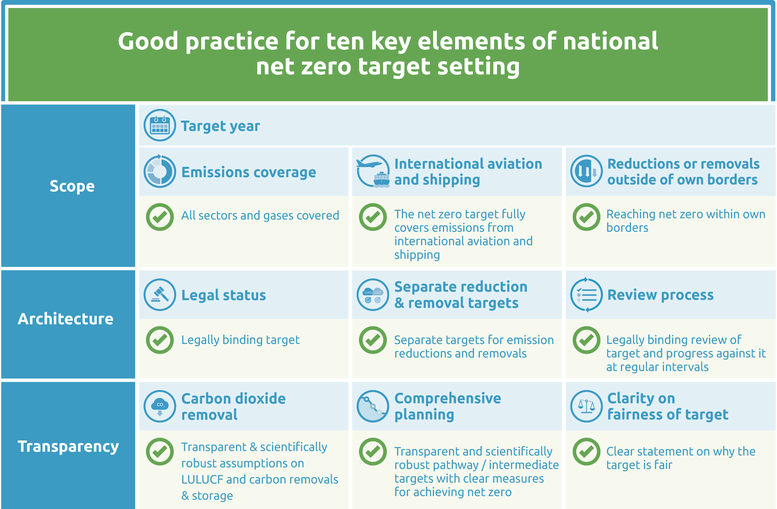
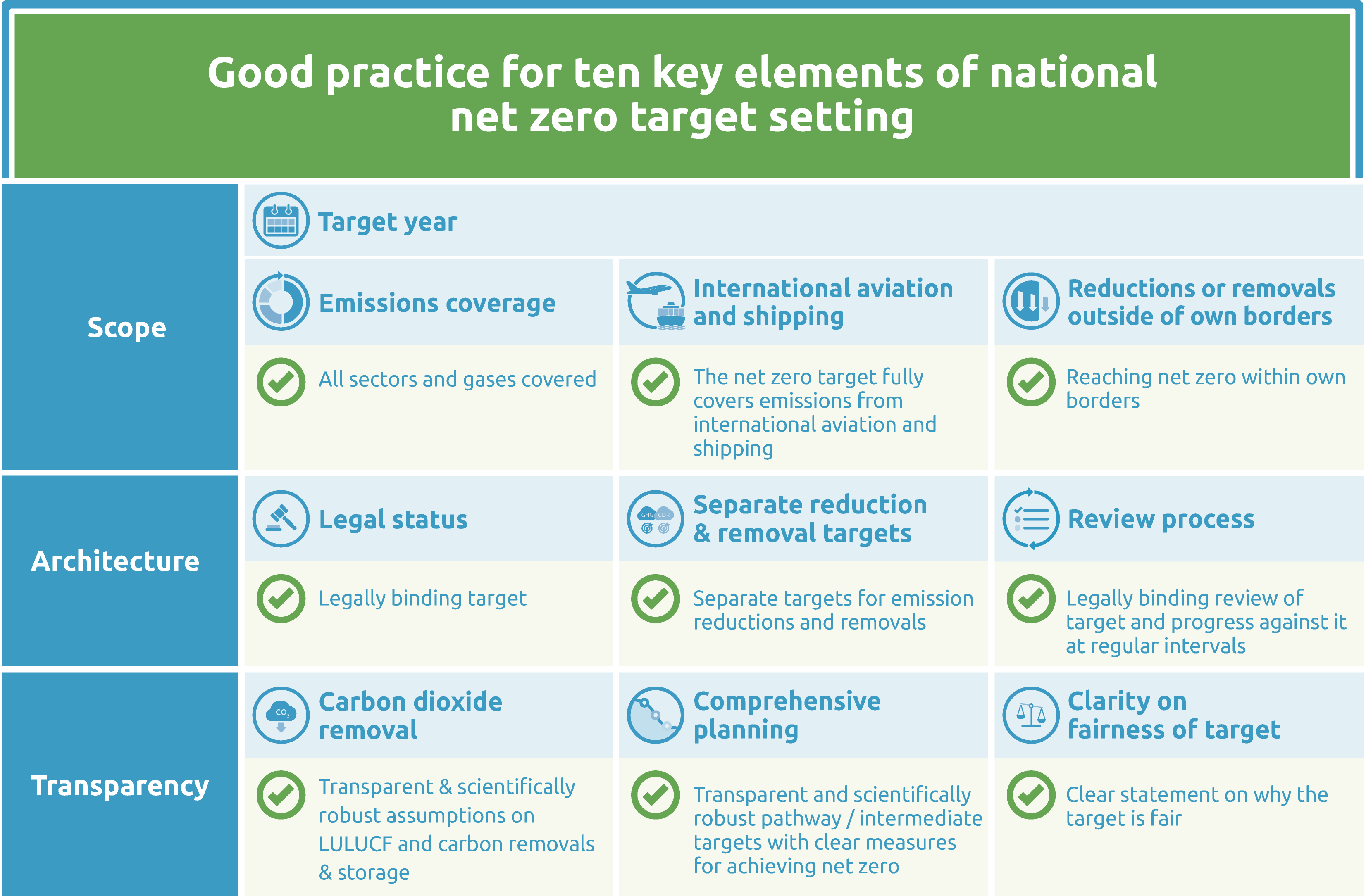
The Climate Action Tracker has defined the following good practice for all ten key elements of net zero targets. Countries can refer to this good practice to design or enhance their net zero targets.
Further analysis





Latest publications




Stay informed
Subscribe to our newsletter