
Türkiye
Policies & action
We rate Türkiye’s current policies and action as “Highly insufficient” when compared to modelled domestic pathways as this metric is more favourable than its fair share contribution. The “Highly insufficient” rating indicates that Türkiye’s policies and action in 2030 lead to rising, rather than falling, emissions and are not at all consistent with limiting warming to 1.5°C. If all countries were to follow Türkiye’s approach, warming could reach over 3°C and up to 4°C.
For a full explanation of the methodology behind our current policy pathway for Türkiye, please see the Assumptions page.
Policy overview
The CAT estimates that Türkiye’s emissions will be between 587–627 MtCO2e in 2030 (excluding LULUCF) under current policies and actions, or 10–18% above 2018 levels. This is a significant increase compared to our previous assessment from October 2025, which saw Türkiye’s emissions reach 534–611 MtCO2e in 2030, or 1–15% above 2018 levels. This shift upwards in emissions is due to updated historical emissions – which show higher emissions in 2024 than earlier projected – and the use of more up-to-date sources to construct the bounds of the current policy projections (Republic of Türkiye, 2026). For more details, please see the Assumptions section.
Even as Türkiye’s agenda for COP31 aims to reduce global emissions, its own emissions continue to rise, and state investment in fossil fuels is expanding. From 2026 through the end of 2029, the Turkish government has announced that domestic coal plants will receive a purchase guarantee at a price higher than the unit cost of electricity for all but one plant (Ember, 2026b). This is expected to allow less efficient plants to remain in operation longer and could lead to a new record in coal-fired electricity generation over the next few years. In Türkiye, about two-thirds of electricity generated from coal still relies on imported fuel, making a focus on coal power especially costly and undermining the government’s focus on energy independence (Ember, 2026b).
Türkiye is also seeking to become a regional hub for oil and gas, with the national energy company Turkish Petroleum (TPAO) recently signing a memorandum of understanding with BP to further develop oil and gas fields, fund new exploration efforts, and expand Türkiye’s oil and gas export capacity (IENE, 2026). Alparslan Bayraktar, the Minister of Energy and Natural Resources, announced that TPAO expects to produce 500,000 barrels of oil and gas per day by 2028, with this agreement part of broader efforts to raise output to one million barrels per day (IENE, 2026). Such efforts directly undermine Türkiye’s international commitments to reducing emissions in line with the Paris Agreement. They also run counter to the International Court of Justice’s (ICJ) 2025 advisory opinion on climate change which states that governments must develop NDC targets representing the highest possible ambition and end support for fossil fuels – or risk breaching international law.
In response to the energy shock caused by closure of the Strait of Hormuz, the Turkish government also introduced a fuel tax relief mechanism to prevent excessive increases in gasoline prices. However, in just two months of operation, the cost of subsidising these price increases reached nearly USD 2 bn as inflation rose to 34% in April 2026, its highest level since late 2025 (Daily Sabah, 2026a). The CAT’s recent briefing on government responses to the Iran war notes the risk of this approach – by attempting to insulate consumers from higher fuel prices, Türkiye weakens the price signals that would encourage a shift to EVs, entrenches dependence on fossil fuels, and carries an enormous fiscal cost that reduces the government’s ability to invest in decarbonisation (Climate Action Tracker, 2026a).
Even as it expands support for fossil fuels and struggles with price increases, Türkiye is also investing heavily in expanding its renewable energy capacity through new sources of clean generation and upgraded grid infrastructure.
Under the Roadmap for Renewable Energy to 2035, Türkiye intends to increase its total wind and solar capacity to 120 GW by 2035, compared to a current capacity of about 40 GW in 2025 (Republic of Türkiye Ministry of Energy and Natural Resources, 2024c; Ember, 2026). While this is commendable, it falls short of what is needed for a 1.5°C compatible Turkish power sector, which would see wind and solar capacity reach 150 GW by 2035 (Climate Action Tracker, 2026b). The Roadmap also calls for USD 108 bn of investment in grid modernisation and capacity expansion over the next decade, intended to prepare Türkiye’s power sector for the addition of new renewable capacity (Climate Policy Database, 2024).
Despite accelerating action on renewables, Türkiye has not committed to a phase-out plan for fossil fuels, which must be removed from the power sector by 2045 if Türkiye is to align with the 1.5°C limit (Climate Action Tracker, 2026b). If Türkiye is serious about meeting its 2053 net zero target, then it will need to develop a realistic plan to phase out fossil fuels instead of continuing to support and expand existing capacity of oil, gas, and coal.
Türkiye’s Climate Change Mitigation Strategy and Action Plan 2024–2030 lays out several actions to reduce emissions across every sector of the economy. These include decarbonising the power sector through increased deployment of renewable capacity and support for battery storage technologies; improving energy efficiency in the industrial and buildings sectors; driving a modal shift to maritime and railway services in the transport sector; and implementing strategies to reduce methane emissions in the waste and agriculture sectors (Ministry of Environment, Urbanization and Climate Change, 2021).
With the passage of its new Climate Law in July 2025, Türkiye has also formalised the launch of an Emissions Trading System (ETS) modelled after the EU’s ETS (Republic of Türkiye Ministry of Environment Urbanisation and Climate Change, 2024). This is a market mechanism which caps how much GHGs a company can emit, with the cap gradually declining over time.
The pilot phase of Türkiye’s ETS is expected to begin in Q3 2026, with all necessary plans and secondary legislation to be ready by 2027 (ICAP, 2025). If designed to cover major sectors and price carbon competitively, the ETS could drive emission reductions in Türkiye’s industrial sector and help to reduce costs from the EU’s Carbon Border Adjustment Mechanism (CBAM), which applies a carbon tax on certain products imported into the EU if they fail to align with European emissions standards (European Commission, 2024).
Power sector
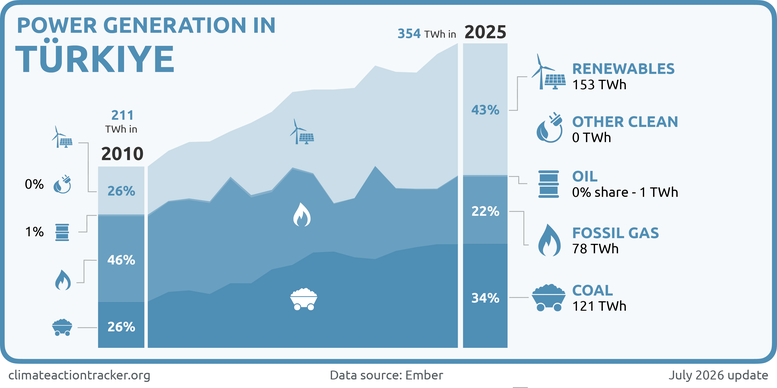
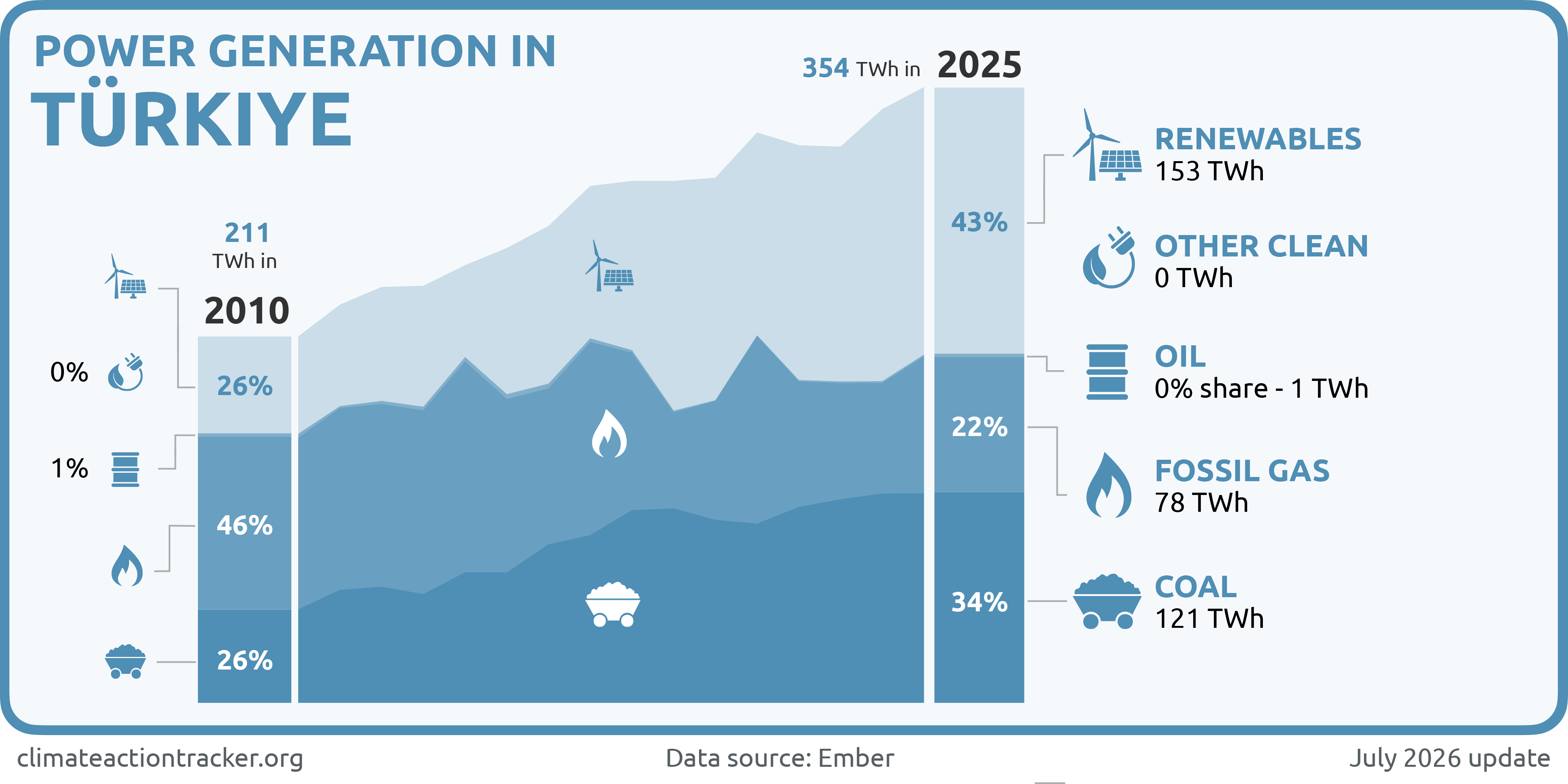
Fossil fuels met 56% of Türkiye’s electricity supply in 2025, with coal providing 34% and fossil gas contributing 22% of total power (Ember, 2026a). Reliance on fossil fuel imports has driven efforts to diversify the mix, though imported coal continues to drain Turkish finances and imperil efforts to align with 1.5°C (Ember, 2025; Türkiye Cumhuriyet Merkez Bankası (Central Bank of the Republic of Türkiye), 2023). Renewables have seen their share of total electricity grow significantly since 2010, rising to about 43% of total electricity in 2024 (Ember, 2026a).
The story of Türkiye’s power sector decarbonisation has two sides: while Türkiye has made significant progress in expanding renewable electricity, particularly solar power, fossil fuels remain firmly embedded in the power system. Notably, the country became the largest producer of coal-fired electricity in Europe in 2024, overtaking Germany (Ember, 2025).
It is possible that coal power may be close to peaking in Türkiye, although it still provides over one-third of total electricity and the government has no commitment to a phase-out plan (Ember, 2025).
Rising electricity demand has contributed to these mixed outcomes. Rapid economic growth, industrial expansion and increasing electrification have driven sustained growth in power consumption, allowing renewables and fossil fuels to expand simultaneously rather than renewables displacing fossil generation (IEA, 2026). The industrial sector has consistently had the highest share of electricity demand over this period, standing at 44% in 2023 (UNFCCC, 2026). The commercial and public services and residential sectors have also seen significant increases in electricity demand, given rapid urbanisation of the population and expansion of services, resulting in increased demand for appliances, heating and cooling systems and digital systems.
Global electrification targets, such as the 35% by 2035 that Türkiye has introduced in the COP31 Action Agenda, help highlight this lever of decarbonisation. While Türkiye's rate of electrification over the 2013–2023 period remained stable at around 21%, official projections expect to reach only about 25% by 2035 (Ministry of Energy and Natural Resources, 2022). To reach the 35% by 2035 gaol, Türkiye would need significant policy changes to accelerate electrification while ensuring the deployment of renewable power to avoid that the rising electricity demand is met by fossil fuels rather than clean energy.
A 1.5°C compatible Turkish power sector requires a targeted shift away from coal and fossil gas, building on the promising momentum in renewables. The Turkish government needs to double down on renewables by rolling out wind and solar faster – to 90 GW by 2030 and 150 GW by 2035 – while developing a fossil fuel phase out plan (Climate Action Tracker, 2026b). For more information, see the CAT’s latest briefing on decarbonising the Turkish power sector.
Considering historical trends and official targets, alongside current policies and government plans for development in the energy sector, we evaluate Türkiye’s progress in the power sector as:
- Moving in the “Wrong direction” on coal,
- Sending “Mixed signals” on fossil gas, and
- Making “Slow progress” on renewables.
Coal
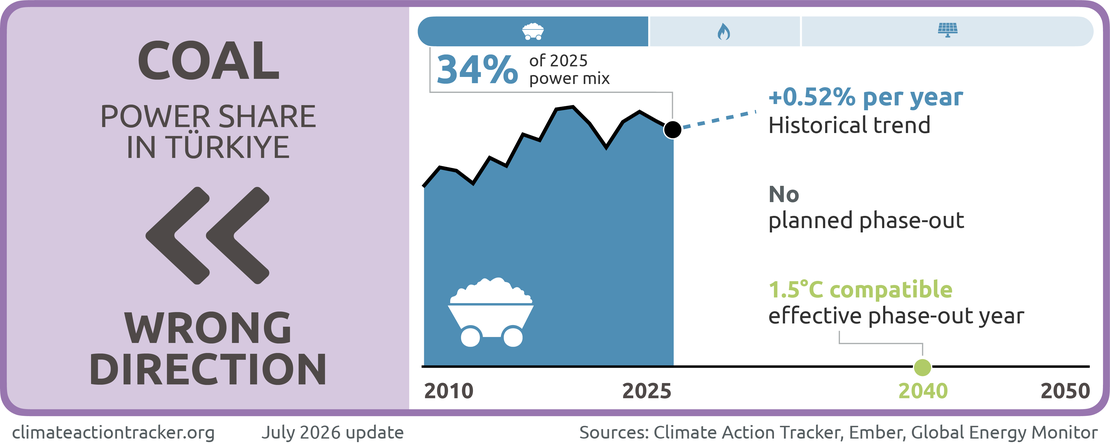
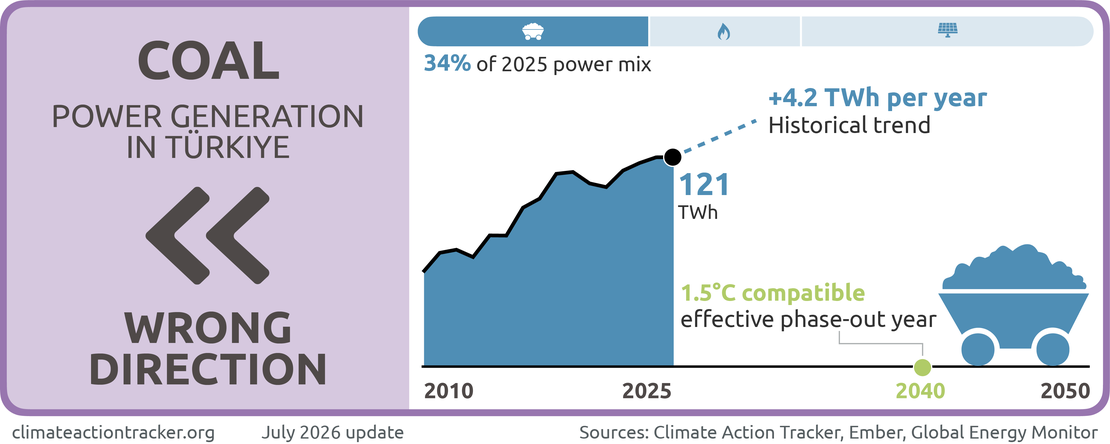
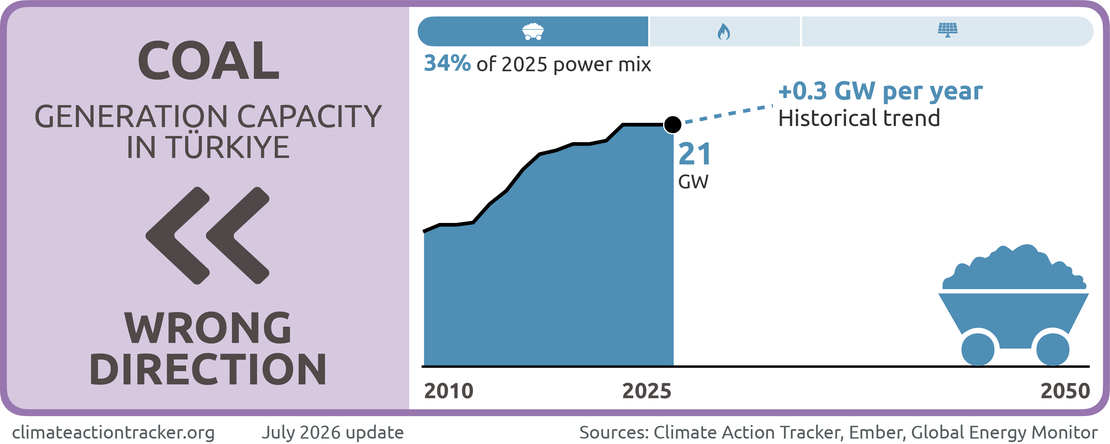
Coal maintains a significant share in the electricity generation mix, accounting for 34% in 2025 (Ember, 2026a). While the share of coal in the power mix has fluctuated, coal generation in absolute terms has significantly increased in the last decade. This stands in sharp contrast with what is needed to limit warming to 1.5°C, which would see Türkiye cut coal’s share in electricity generation to single digits by 2030 and nearly phased out by 2035 (Climate Action Tracker, 2026b).
Declining investment interest along with growing citizen opposition has led to Türkiye shelving much of its planned coal capacity extensions. However, Türkiye has no plans to phase out coal and still envisions a long-term role for it in its energy system. Existing coal-fired power plants continue to benefit from substantial government support. Türkiye also has not adopted COP26’s commitment to a coal exit.
As a result, we evaluate Türkiye as moving in the “Wrong direction” on coal in the power sector.
Türkiye’s plans for its domestic coal reserves – and the subsequent cancellation of those plans – only tell half the story. Although domestic coal reserves were intended to reduce dependency on imported fossil fuels, Türkiye remains heavily reliant on imported Russian coal. As of 2025, nearly two-thirds of Türkiye’s coal generation relies on imports, racking up significant costs and undermining the country’s energy security (Ember, 2026c).
In July 2026, an administrative court in Türkiye’s southeastern province of Kahramanmaraş revoked environmental approval for two new units at the Afşin-Elbistan A Thermal Power Plant, one of the country’s largest coal-powered sites, finding that officials failed to consider the risks to public health and the environment (Turkish Minute, 2026b). The Afşin-Elbistan plant has long drawn public attention for its poor record on air pollution – a study by Human Rights Watch from 2021–2024 found levels of PM 2.4 more than five times higher than the WHO guidelines (Turkish Minute, 2026b).
Cancelling most planned coal capacity is a positive step towards weaning the country off coal, but as the host of COP31, Türkiye could lead by example by developing a coal phase-out plan to align with 1.5°C and ensure an orderly and just transition for Turkish coal mining communities.
Fossil gas
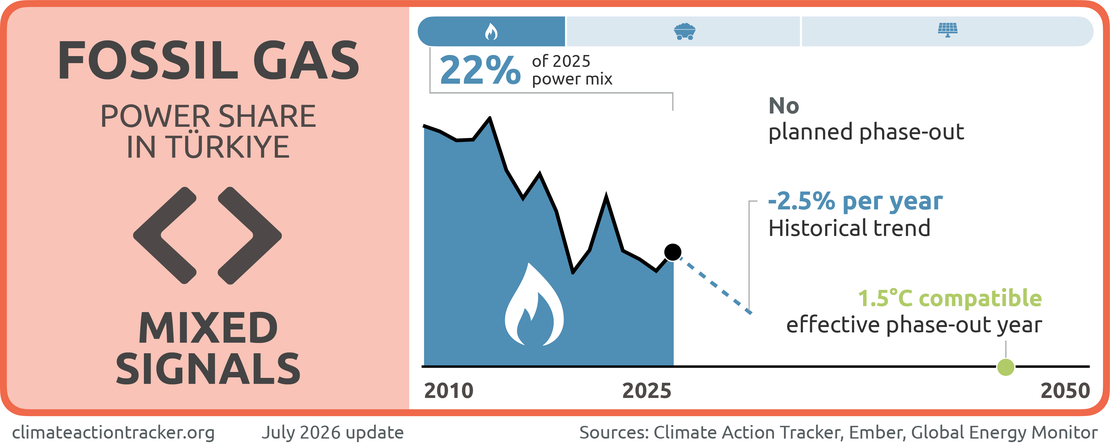
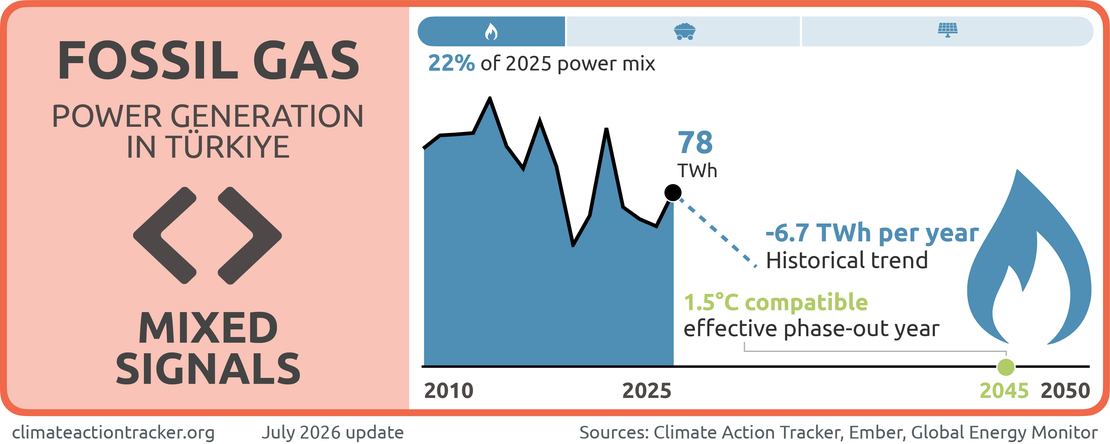
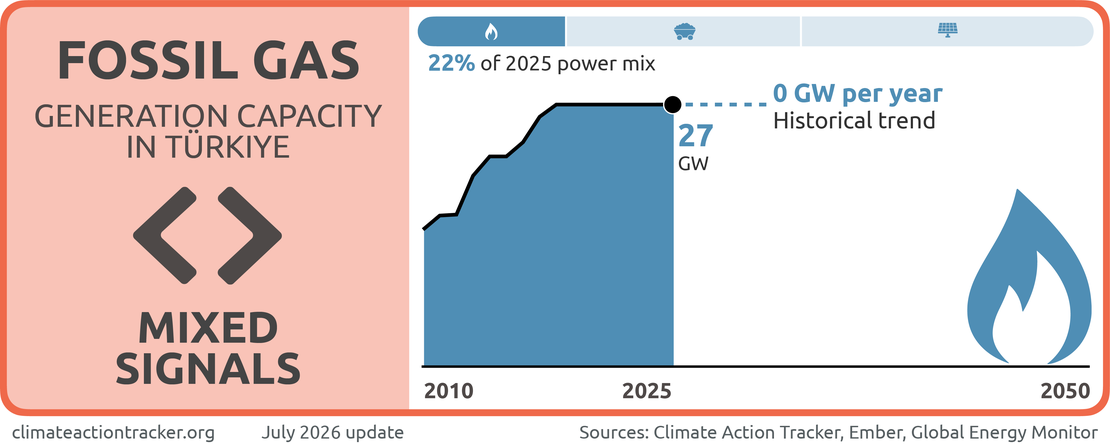
Fossil gas provided 22% of Türkiye’s electricity supply in 2025 (Ember, 2026a). Despite 1.5°C benchmarks requiring that share to fall to 4–9% by 2035 and be completely phased out by 2045 (Climate Action Tracker, 2026b), Türkiye aims to become a fossil gas trading hub (Turkish Ministry of Energy and Natural Resources, 2022).
We evaluate Türkiye as sending “Mixed signals” on fossil gas in the power sector. While the share of fossil gas in electricity generation has largely fallen since the 2010s, Türkiye is pouring money into exploration for new fossil gas fields and aims to become an internationally competitive player in the fossil gas market (Daily Sabah, 2024). The push for increased domestic capacity comes as Türkiye remains overwhelmingly dependent on imported fossil gas – 95% in 2025 (Enerdata, 2026) – leaving the country reliant on other governments’ policies and price volatility on the global market.
Both fossil gas’ share of the energy mix and its total generation have fluctuated in the past five years. While its share of total generation increased in 2025 to 22%, the previous two years marked historical lows of 18% in 2019 and 19% in 2024 (Ember, 2026a). There are a few reasons for last year’s increase. On the demand side, gas tends to substitute for decreased energy output from hydropower due to drought conditions, as occurred in 2025. This is worrying because reduced energy output from hydropower now appears to be part of a long-term historical trend.
On the supply side, the discovery of the Sakarya gas field in the Black Sea has transformed Türkiye’s fossil gas sector and reflects longer-term government policy. Production began in 2023 and supply from the field is expected to grow significantly in the coming years (Daily Sabah, 2026b), with 2025 already seeing record extraction (AA, 2025).
Türkiye has also focused on diversifying its fossil gas resources in recent years. While Russia has long been Türkiye’s main supplier of fossil gas, efforts to diversify supply have seen the share of Russian gas in total gas imports fall from over 60% two decades ago to 37% in the first half of 2025 (Kenez, 2025). Other major suppliers include Azerbaijan, Iran, and the US (Energy Market Regulatory Authority, 2024).
In 2024, Türkiye signed a fossil gas deal with Hungary, a deal that represents the first time Türkiye will export fossil gas to a European country that is not its neighbour (Gavin, 2024). While European negotiators have been open to continuing talks with Türkiye about establishing a fossil gas hub even after the collapse of talks on Türkiye’s accession to the EU, continued investments in fossil gas are out of sync with European standards as the continent seeks to transition away from fossil fuels (Siccardi, 2024). Partnerships with countries in Central and East Asia could still fuel an expansion of fossil gas, as Türkiye has signed a major deal with Turkmenistan for shipping via Iran, as well as new agreements with Iraq and Azerbaijan (Dayar, 2025; Reuters, 2026b; Sezer, 2026).
The latest energy crisis has underscored that fossil gas cannot be relied upon as a stable or secure transition fuel, instead marking a decisive turning point for the world towards accelerating the shift away from all fossil fuels. Türkiye therefore risks owning significant stranded assets if it pursues this policy.
Aside from the risk of stranded assets connected to a fossil gas hub, expanding domestic gas consumption also runs counter to Türkiye’s Paris Agreement obligations and the International Court of Justice's ruling on countries' legal responsibilities to phase out fossil fuels (International Court of Justice, 2025). If Türkiye intends to achieve net zero by 2053, it needs to focus on decreasing the share of gas in the energy mix, shelving plans to expand oil and gas production, and instead direct investments towards deploying renewables (Güllü et al., 2023).
Renewables
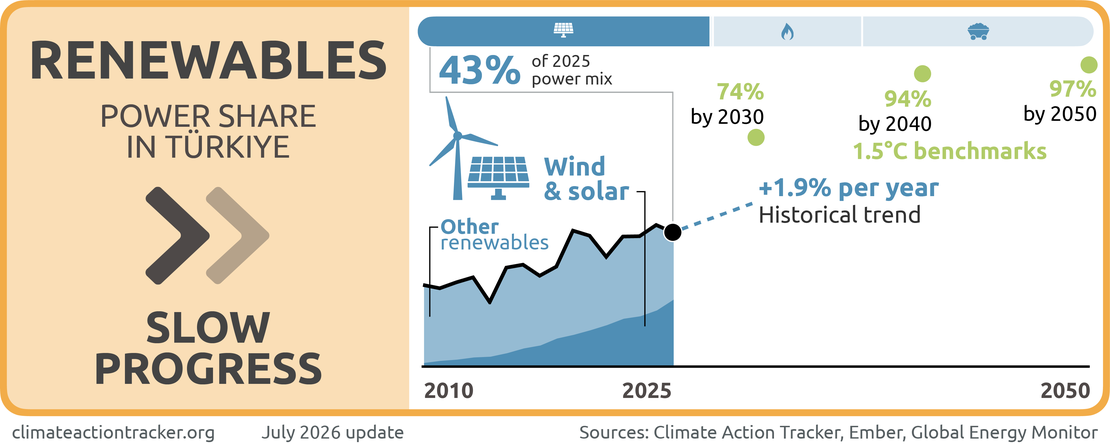
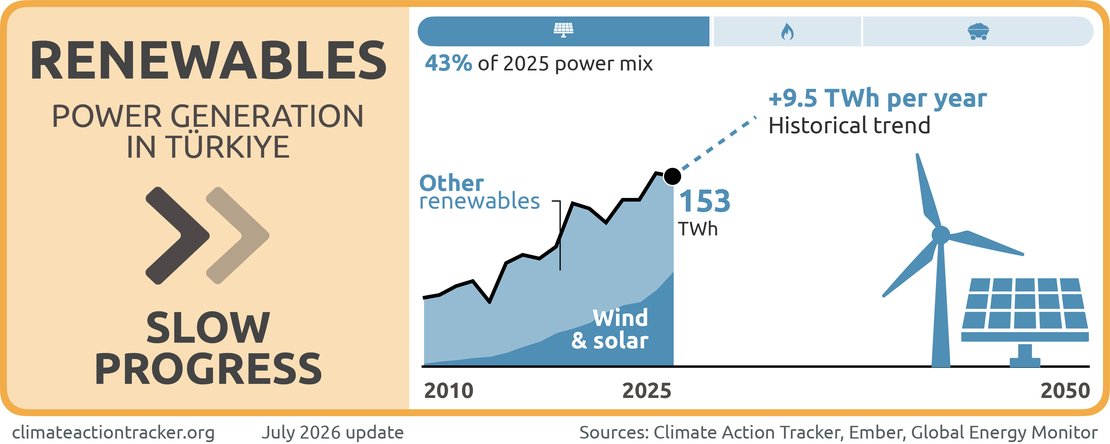
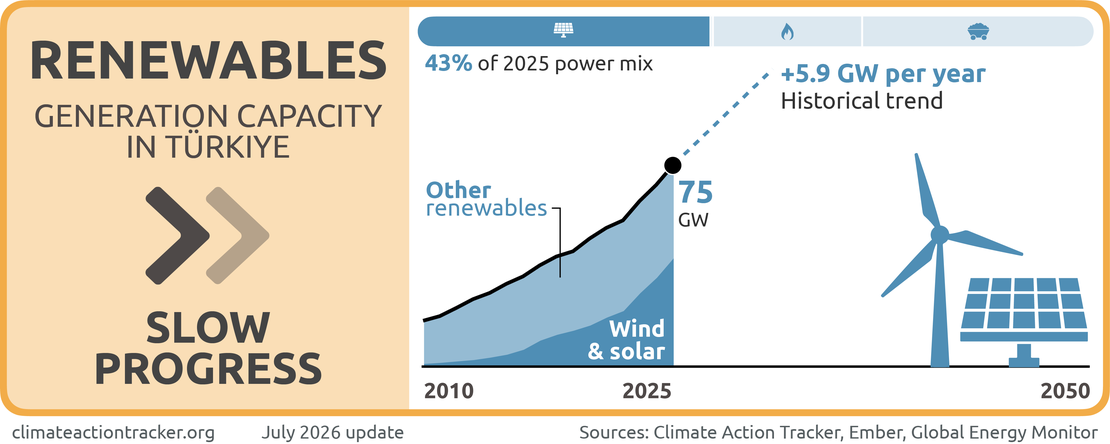
Wind and solar contributed 22% of Türkiye’s total electricity in 2025, up from 18% the year before, driven primarily by a surging expansion of solar power (Ember, 2026a). Hydropower remains Türkiye’s largest source of renewable energy, providing a further 16% of total electricity in 2025 despite drought conditions leading to a decline in output (Ember, 2026c).
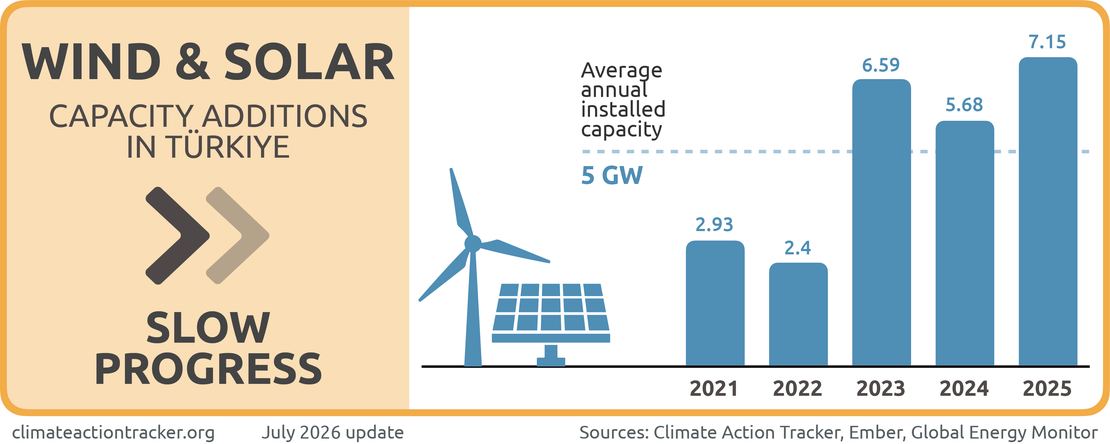
Türkiye aims to triple wind and solar capacity from 40 GW in 2025 to 120 GW in 2035, which would represent 49% of total generation (Ember, 2026a). According to the Roadmap for Renewable Energy to 2035, reaching this target will involve bringing at least 7.5–8 GW of wind and solar online every year until 2035 (Kazanci, 2024; Republic of Türkiye Ministry of Energy and Natural Resources, 2024). While this is commendable, it falls short of what is needed for 1.5ºC.
The latest CAT benchmarks show that aligning Türkiye’s power sector with a 1.5°C pathway would require renewables to supply 83-89% of electricity generation, with wind and solar alone providing 53-59% by 2030. Combined wind and solar capacity would need to reach around 150 GW by 2035, 30 GW more than its current target (Climate Action Tracker, 2026b).
As a result, we evaluate Türkiye as making “Slow progress” on renewable power generation.
Türkiye has already exceeded its solar capacity goal for 2025, with total solar capacity more than doubling over the past two and a half years. This surge has helped to avoid USD 15 bn in costs for importing foreign gas (Gümüş, 2025). To maintain this rapid pace, Türkiye could explore other forms of solar generation like rooftop, hybrid, floating, and storage-integrated designs, which have significant untapped potential.
Wind power has grown more slowly than solar over the past five years but may begin to accelerate as new capacity comes online, and past investments bear fruit (Ember, 2026a). Manufacturers in Türkiye are now able to produce key components for wind installations domestically, including towers, blades, generators, and gearboxes, with a significant portion of equipment exported to Europe (Hurriyet Daily News, 2026). These exports contribute to a positive feedback loop, driving down costs and helping to power the expansion of wind capacity in Türkiye and abroad.
Grid Expansion and Battery Storage
A key area requiring further investment is grid expansion to support the continued rollout of renewable energy. Türkiye’s Roadmap for Renewable Energy for 2035 calls for USD 108 bn of total investment over the next decade, with USD 28 bn earmarked for transmission grid modernisation and USD 80 bn for renewable capacity expansion, with both public and private partners involved (Climate Policy Database, 2024). These investments are intended to expand the transmission system, improving interconnectivity to prepare for the addition of new renewable capacity (Republic of Türkiye Ministry of Energy and Natural Resources, 2024; Spasić, 2023).
Since both wind and solar are types of Variable Renewable Energy (VRE), rather than sources like hydroelectric or geothermal power, which provide steady, continuous energy, new utility-scale battery energy storage systems (BESS) will also need to be constructed to ensure that electricity is effectively produced, stored, and distributed as needed.
In terms of planned capacity, Türkiye is racing far ahead of any EU country on grid-scale batteries, with more than 33 GW already approved and ready for construction, equivalent to over 80% of current wind and solar capacity (Niranjan, 2026). An additional 188 GW of battery storage is currently awaiting approval, putting Türkiye in a strong position to accelerate its renewable energy rollout.
This surge is the result of a 2022 mandate that gives new renewable projects paired with battery storage preferential access to the grid. Although bureaucratic hurdles remain, such as bottlenecks in permitting and a reliance on spot market prices for electricity, Türkiye has sent a clear signal to investors that batteries are a smart bet on the future of the national energy system (Niranjan, 2026).
Nuclear
Efforts to meet growing energy demand while reducing dependency on fossil fuel imports have seen Türkiye include nuclear power in its energy portfolio (Gesellschaft für Anlagen- und Reaktorsicherheit, 2023). With significant financing and training support from Russia, Türkiye’s first nuclear power plant, the Akkuyu Nuclear Power Plant, was expected to begin supplying energy in 2025, but due to delays, will not be fully operational before 2028 (Maddela, 2025). There are two additional nuclear power plants, Sinop and Thrace, which are both still in the proposal stages (Reuters, 2026a) Together, all three of these projects are central to Turkey’s long-term target of reaching 20 GW of nuclear capacity by 2050 (Avcıoğlu, 2026).
As of June 2026, Reactor 1 at the Akkuyu Plant has entered commissioning, the final stage before it can begin generating energy (World Nuclear News, 2026). When fully operational, Akkuyu is expected to provide 10% of Türkiye’s total electricity needs.
Although nuclear electricity generation does not emit CO2, the CAT does not see nuclear as the solution to the climate crisis due to its risks such as nuclear accidents and proliferation, high and increasing costs compared to alternatives such as renewables, long construction times, incompatibility with the flexible supply of electricity from wind and solar, its vulnerability to heat waves, and security issues.
While nuclear power can reduce the emissions intensity of the Turkish power system, there are also fears around the potential impact of earthquakes in the region (Hadjicostis & Mcdermott, 2023). There has been considerable opposition towards nuclear energy as a result, with safety considerations around seismic activity a concern for local communities (Temocin, 2018). The uncertainties and risks around nuclear construction make the technology unreliable in planning the necessary decarbonisation of the power sector.
Industry
Türkiye’s industry sector accounted for 13% of total emissions in 2024 (excl. LULUCF) (Republic of Türkiye, 2026). The manufacturing industry alone represents over a fifth of Turkish GDP (Republic of Türkiye Ministry of Environment Urbanisation and Climate Change, 2024). As the EU remains Türkiye's largest export market, industrial decarbonisation is becoming both a climate and competitiveness imperative.
Cement, iron, and steel production account for the majority of Türkiye’s process-related emissions (Republic of Türkiye Ministry of Environment Urbanisation and Climate Change, 2024). These industries will be impacted by the EU’s Carbon Adjustment Border Mechanism (CBAM), which officially entered into force on January 1, 2026 (Taxation and Customs Union, 2026). CBAM places a carbon price on goods imported into the EU. Given that the EU represents an important trading partner for Türkiye, decarbonising the industrial sector will be essential to maintaining industrial competitiveness.
Supported by the European Bank for Reconstruction and Development (EBRD), Türkiye has a low-carbon pathways (LCPs) initiative to decarbonise the steel, cement, aluminium, and fertiliser sectors (Sarı, 2024). These LCPs show that for Türkiye to meet its 2053 net zero goal, decarbonising these hard-to-abate sectors is critical and will require investments of over USD 70 bn. An effective transition will allow Türkiye’s industrial sectors to become more competitive abroad and attract new investment, while reducing its reliance on imported fossil fuels (Sarı, 2024).
One concern with these LCPs is a reliance on carbon capture and storage (CCS) technologies, as these are not yet mature enough to be deployed at scale. In Türkiye’s LCP for the cement sub-sector, CCS is considered a cornerstone of industrial decarbonisation and efforts to achieve the 2053 net zero target. The roadmap estimates that CCS alone may provide between 30–60% of all emissions reductions in the cement sector, supplemented by other improvements such as increased clinker efficiency and alternative fuels (Republic of Türkiye Ministry of Industry and Technology, 2024).
However, CCS technologies require geologically stable sites for captured carbon to be safely stored long-term, which may be difficult in Türkiye due to seismic activity and earthquake risks (Turkish Minute, 2026a). While it is critical to develop and refine roadmaps for reducing industrial emissions, relying on CCS technologies with over-optimistic assumptions may undermine plans to decarbonise the sector. CCS should not be a replacement for other mitigation options but rather complement them.
ETS
With the passage of its new Climate Law in July 2025, Türkiye has now formalised the launch of an Emissions Trading System (ETS) modelled after the EU’s ETS (Republic of Türkiye Ministry of Environment Urbanisation and Climate Change, 2024). This is a market mechanism which caps how much GHGs a company can emit, with the cap gradually declining over time. The pilot phase of Türkiye’s ETS is expected to begin in Q3 2026, with all necessary plans and secondary legislation to be ready by 2027 (ICAP, 2025).
The specific sectors and gases to be covered, as well as exact details on the emissions thresholds, will be defined in secondary legislation and have not yet been specified. However, the Turkish ETS is expected to have coverage similar to the EU ETS and leaves the door open for Türkiye to adopt its own CBAM for imported goods (ICAP, 2025).
Agriculture
Agricultural emissions accounted for 13% of Türkiye’s total emissions in 2024 (excl. LULUCF), with the main sources being methane emissions from enteric fermentation in livestock and nitrous oxide emissions from organic decomposition in soil (Republic of Türkiye, 2026). Agricultural emissions have been steadily climbing over the last several decades and were 42% higher in 2024 compared to 1990 levels.
60% of Türkiye’s methane emissions come from the agricultural sector (İklim Değişikliği Başkanliği [Climate Change Directorate], 2024). In its Long Term Climate Strategy, the government lays out four key priorities for reducing agricultural emissions: improved management of soil and water, adoption of climate-smart agriculture practices, improved management of agricultural residue, and increased education in the form of skills training (İklim Değişikliği Başkanliği [Climate Change Directorate], 2024).
As of spring 2026, most of the fieldwork has been completed on Türkiye’s most comprehensive general agricultural census to date, which aims to deliver detailed information on land use, livestock holdings, management, and other productive activities in the sector (Daily Sabah, 2026c). This new data will play a key role in shaping agricultural policies, with full results expected in 2027. However, while this effort may lay the groundwork for future climate policies in agriculture, the government has not yet implemented policies to meaningfully decarbonise the sector.
Transport
Transport emissions accounted for nearly 18% of Türkiye’s total emissions in 2024 (excl. LULUCF) (Republic of Türkiye, 2026). The sector is one of the fastest-growing sources of emissions in the country, with emissions rising from about 27 MtCO2e in 1990 to over 100 MtCO2e in 2024, driven primarily by road transportation (Republic of Türkiye Ministry of Transport and Infrastructure, 2024; Statista, 2026).
Electric vehicles
Türkiye adopted the COP26 declaration on zero emission vehicles (ZEVs), which aims for 100% of new car and van sales to be zero-emission by 2040. Türkiye aims to increase the market share of EVs to 35% by 2030 (Republic of Türkiye Ministry of Industry and Technology, 2022) and has made significant progress towards this goal, with EVs reaching about 19% of the passenger car market in the first half of 2026, up from 18% the year before (Yilmaz & Yildirim, 2026). However, the government has yet to translate the 2040 target of the ZEV declaration into national transport policy.
Türkiye’s EV industry gives it an advantage in decarbonising the transport sector, and sales of its first domestically-produced EV, the Togg, have already driven a substantial increase in EV uptake (Kasapovic & Knowles, 2024). In July 2024, the Turkish government passed a USD 5bn package to boost annual EV production to one million vehicles (Reuters, 2024). Combined with the special consumption tax (ÖTV), which features significantly lower rates for battery electric vehicles (EAFO, 2025), EVs have quickly become the most attractive option for consumers, while internal combustion vehicles can be subject to taxes as high as 80–220% under the ÖTV (Nio, 2025). In 2025, Togg officially surpassed Tesla and BYD as the best-selling EV brand in Türkiye, as overall sales more than doubled (Yenişafak, 2025).
Expanding charging infrastructure is critical to supporting the continued rollout of EVs, especially as car ownership is projected to increase significantly by 2030 (Wietschel, 2025). While coverage remains uneven, with chargers deployed mostly around major cities like Istanbul, Ankara, and Izmir, the Energy Market Regulatory Authority reported a nearly 400% increase in public charging points over the last two years, from 6,500 units in March 2023 to over 31,000 in June 2025 (Nio, 2025). Government targets are ambitious, aiming for 143,000 charging stations by 2030 and 273,000 by 2035 (Kabakcı, 2025). Reaching these goals will require significant investment and more concerted efforts to expand charging networks in rural areas.
Public transport
A modal shift towards rail is another important aspect of reducing transport emissions in line with 1.5°C. Türkiye aims to increase the share of freight transport by rail to 20% by 2035 and the share of passenger transport by rail to 5% by 2035, up from 2019 levels of 0.9% and 3%, respectively (Republic of Türkiye Ministry of Environment Urbanisation and Climate Change, 2023). Ongoing measures to achieve this include significant investments in modernising its rolling stock and constructing new lines between major cities (Railway Gazette International, 2024; Railway Supply, 2024).
A move towards rail is also important in reducing traffic congestion and air pollution in Turkish cities, which are considerable – in 2025 Istanbul, Antalya, and Izmir recorded air pollution levels between three and five times above the WHO’s thresholds, while Ankara exceeded limits by two to three times (Türkiye Today, 2026). While a shift to EVs can improve air quality, electrification alone will not solve congestion and growing transport demand. Expanding public transport and rail infrastructure will therefore be essential to reducing emissions, improving mobility and limiting further growth in private vehicle use.
Electricity demand and system integration
As decarbonisation of the transport sector proceeds, demand for electricity to power electric vehicles such as cars, buses, trains, and ferries is expected to grow significantly. This creates a strong linkage between transport and power-sector decarbonisation: the climate benefits of electric means of transport depend on the availability of clean electricity.
While the announcement of Türkiye’s proposed global target of 35% electrification by 2035 is a step in the right direction, decarbonisation across the economy will require enormous amounts of electricity. This makes it even more important for Türkiye to phase out of fossil fuels and aggressively shift to cheaper and cleaner renewable sources while expanding the power grid to support new generation capacity and effective distribution around the country.
Waste
Waste emissions accounted for around 3% of Türkiye’s total emissions in 2024, representing a small and relatively stable source of greenhouse gases since 1990 (Republic of Türkiye, 2026). The two main sources of waste emissions in Türkiye are solid waste disposal and the treatment and discharge of wastewater, both of which produce significant amounts of methane.
Türkiye’s main programme to reduce emissions in the waste sector is the “Zero Waste Policy,” which launched in 2017 and aimed to increase recycling rates to 35% by 2023 (EEA, 2025c). This target has since been reached, as the recycling rate for municipal waste increased from 13% in 2017 to 36% in 2024, and the government now aims to reach 60% by 2035 (EEA, 2025b).
Despite this progress, the total amount of waste generated in Türkiye has increased significantly since 2010 as a result of growth in the mining and industrial sectors (EEA, 2025b).
Türkiye has included zero waste as part of its COP31 Action Agenda, recently holding its second Zero Waste Forum in Istanbul to highlight reductions in the sector as a key tool for reducing methane emissions (Upadhyaya, 2026). Reducing methane emissions from landfill waste is expected to be a focus of Türkiye’s COP31 Presidency, although the details are not yet known. Given that Türkiye currently struggles to manage its own waste generation, any calls for global action would need to be matched by domestic ambition.
Türkiye does not currently impose pretreatment requirements nor bans on landfilling or incineration of waste (EEA, 2025c). To reduce emissions in the waste sector, Türkiye should consider enacting these and other such policies that aim to reduce the amount of methane generated during the waste cycle.
Türkiye had a small LULUCF sink of 67 MtCO2 in 2024, or about 11% of total emissions level (excl. LULUCF) (Republic of Türkiye, 2026).
Türkiye was successful in meeting its target of increasing its forest land to cover 30% by 2023 (Kübra Ağaçyetiştiren, 2024; Republic of Türkiye Ministry of Environment Urbanisation and Climate Change, 2024). The sink is increasingly under strain, however, due to the government’s increase in wood production and declining forest productivity due to climate stress, alongside severe drought and wildfires in recent years, which show no signs of stopping in a warming world (EEA, 2025a). The latest Climate Change Mitigation Strategy and Action Plan recognizes this issue and aims to prevent further degradation of Türkiye’s forests by switching to a “carbon-oriented forest management” approach that ultimately improves sink capacity (Republic of Türkiye Ministry of Environment Urbanisation and Climate Change, 2024).
Türkiye signed the forestry pledge at COP26. While its 2030 NDC does not specifically mention the declaration, the main mitigation policies in the LULUCF section do aim to halt and reverse forest loss and land degradation by 2030 (Republic of Türkiye, 2021). Its new 2035 NDC does not include any new targets or policies for the forestry sector.
Methane
Methane comprised around 12% of Türkiye’s total emissions in 2024, predominantly from the agriculture and waste sectors (Republic of Türkiye, 2026). Türkiye has not signed the Global Methane Pledge, which aims to cut global methane emissions by 30% by 2030 below 2020 levels.
Further analysis





Latest publications




Stay informed
Subscribe to our newsletter